
If you hold SOL and leave it sitting in a wallet, you are paying an invisible tax. Native staking locks capital, Solana’s inflation keeps printing, and MEV tips flow to validators you will never meet. Jito is the Solana project that turned this problem into a product. By 2026 it has grown into the ecosystem’s largest liquid staking pool, the dominant MEV auction system on the network, and the operator of a brand new restaking primitive. If you want the one word summary of what Jito does, it is this: Jito lets your SOL keep earning while it keeps working everywhere else in DeFi.
This Jito review for 2026 breaks down everything a potential depositor or JTO holder should know. We cover JitoSOL yields, the fee stack, how the block engine actually earns MEV, how Jito stacks up against Marinade and Lido, the security track record, and whether the protocol still deserves the hype it enjoyed when JTO launched in late 2023. If you want to skip ahead, there is a verdict and rating at the bottom. If you want the short answer, keep reading the next paragraph.
TL;DR: Jito at a glance
Verdict: Jito is the default Solana liquid staking token for anyone who wants real yield plus deep DeFi integration. The 4 percent protocol fee is middle of the pack. The MEV revenue layer is the real moat. Rating: 4.5 / 5.
- What it is: A Solana liquid staking protocol (JitoSOL) plus an MEV auction system (Block Engine) plus a restaking network (Jito Restaking).
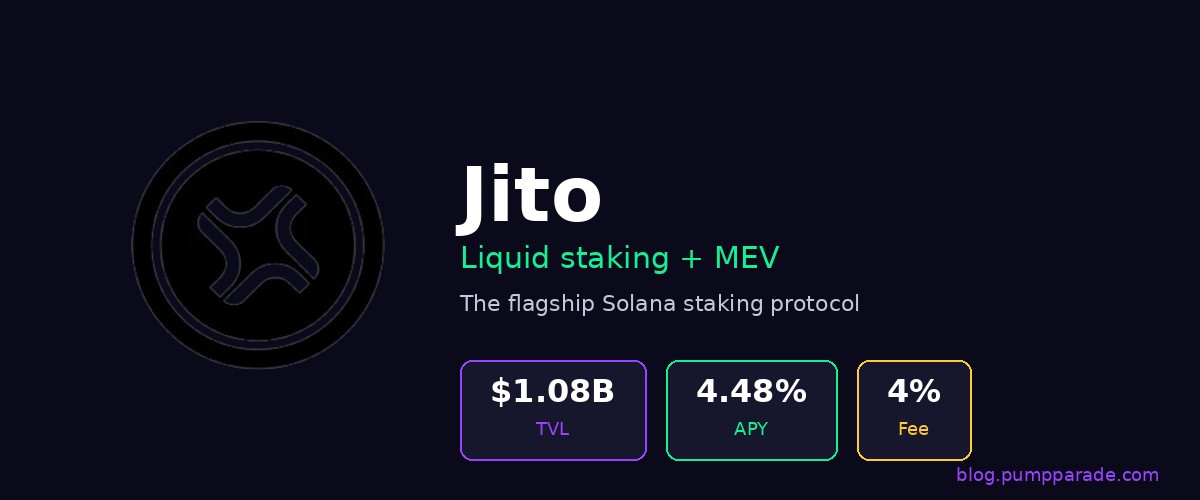
- Current TVL: About $1.08 billion in the liquid staking pool, roughly $18 million in restaking.
- JitoSOL APY: Around 4.48 percent, with MEV tips included in the yield rather than paid as a side airdrop.
- Protocol fee: 4 percent of staking rewards, which is lower than Lido’s 10 percent and Marinade’s 6 percent.
- Audits: Two independent audits are published, including a dedicated review from Neodyme.
- Token: JTO is the governance token, trading near $0.45 against a $6.01 all time high.
- Best for: SOL holders who want yield plus liquidity, DeFi users who want JitoSOL as collateral, and anyone who believes MEV revenue will keep growing on Solana.
Visit Jito to see the current rate before committing any SOL.
What is Jito?
Jito is three things stitched together into one brand. The first is the Jito Stake Pool, which mints JitoSOL whenever a user deposits SOL. The second is the Jito-Solana validator client, a fork of the stock Solana client that includes a block engine for ordering transactions and routing MEV tips. The third is Jito Restaking, launched in late 2024 and now one of the few live restaking primitives on Solana rather than Ethereum.
Across those three products Jito sits at an unusual position in the stack. The protocol does not run a trading venue, a lending market, or a wallet. It is the plumbing underneath them. When a Solana user swaps on Raydium or borrows on Kamino, there is a good chance a Jito-powered validator ordered the block, that JitoSOL is somewhere in the collateral pool, and that MEV tips captured during the swap are flowing back to Jito stakers. This bundling is why DeFiLlama classifies Jito Liquid Staking separately from Jito MEV Tips and Jito Restaking. The total footprint is larger than any single page suggests.
Features deep dive
JitoSOL: liquid staking with MEV baked in
JitoSOL is a receipt token. Deposit 1 SOL and the pool mints an amount of JitoSOL that reflects your share of the pool’s growing SOL balance. You do not have to run a validator, you do not deal with cooldown periods for day to day use (you can swap JitoSOL back to SOL instantly on any Solana DEX), and the token redeems for more SOL every epoch as rewards accrue.
What separates JitoSOL from a plain stake pool is how MEV tips are handled. Validators in the Jito network run the Jito-Solana client, which auctions block space to searchers who want transactions placed in a specific order. The tips those searchers pay are not pocketed by validators alone. A share flows back to the stake pool and ends up as higher JitoSOL redemption value. That is why the headline APY can beat the raw inflation yield on native staking without exposing holders to additional slashing risk.
Jito-Solana client and the Block Engine
The Jito-Solana client is a fork of the Solana validator software with two significant additions. The first is a block engine endpoint that accepts bundles of transactions from searchers in exchange for tips. The second is a relayer that filters incoming transactions and forwards them to validators running the client. Together they create an open MEV market on Solana that previously existed only on Ethereum under systems like MEV-Boost.
By 2026 the share of Solana stake running Jito-Solana is a majority. That matters because it keeps the auction competitive and keeps tip revenue meaningful for stakers. If adoption slips, the APY premium shrinks. If it holds, every incremental DeFi expansion on Solana flows some tips into JitoSOL.
Jito Restaking
Launched in late 2024 and still growing, Jito Restaking lets JitoSOL holders delegate their staked SOL to Node Consensus Networks, which can be oracles, bridges, or any application that wants extra economic security. In exchange, those networks pay rewards that stack on top of the base staking yield. The system is modular, with Vault programs that users deposit into and Node Operators that opt in to specific networks.
Restaking is early. The $18 million in TVL is tiny compared to the main stake pool. But the primitive is live, audited, and the only serious Solana answer to EigenLayer. For long term believers, this is where incremental upside sits.
JTO governance
JTO is the governance token. Holders vote on fee splits, treasury deployments, Jito Foundation grants, and parameters for the restaking network. Governance participation has been uneven, but the DAO treasury is sizeable and recent proposals have pushed grants toward Solana developer tooling.
Fees and pricing
Jito takes a 4 percent protocol fee on staking rewards and MEV tips. There are no deposit or withdrawal fees to mint or redeem JitoSOL at the pool rate, though swapping JitoSOL to SOL instantly on a DEX will cost a small amount of slippage. On a current APY of 4.48 percent, the pre fee yield is close to 4.67 percent and the 4 percent fee lands you at the net rate. Compare that structure to Lido on Ethereum (10 percent of rewards) or Marinade (6 percent) and the fee discount is noticeable at scale.
Where it gets more interesting is the MEV portion. Validators who run the Jito-Solana client give up a share of their tip revenue to the pool, which is then split again. The net effect for JitoSOL holders is that the headline APY already includes an MEV premium that native stakers do not get. There is no second yield to claim, no extra farming step, no bonus token to sell. It is baked into the price of JitoSOL.
Jito vs Marinade vs Lido
Liquid staking is not a monopoly. Marinade is still the second largest Solana pool, and Lido dominates Ethereum. The products are not identical, but a direct feature comparison is useful before you pick one.
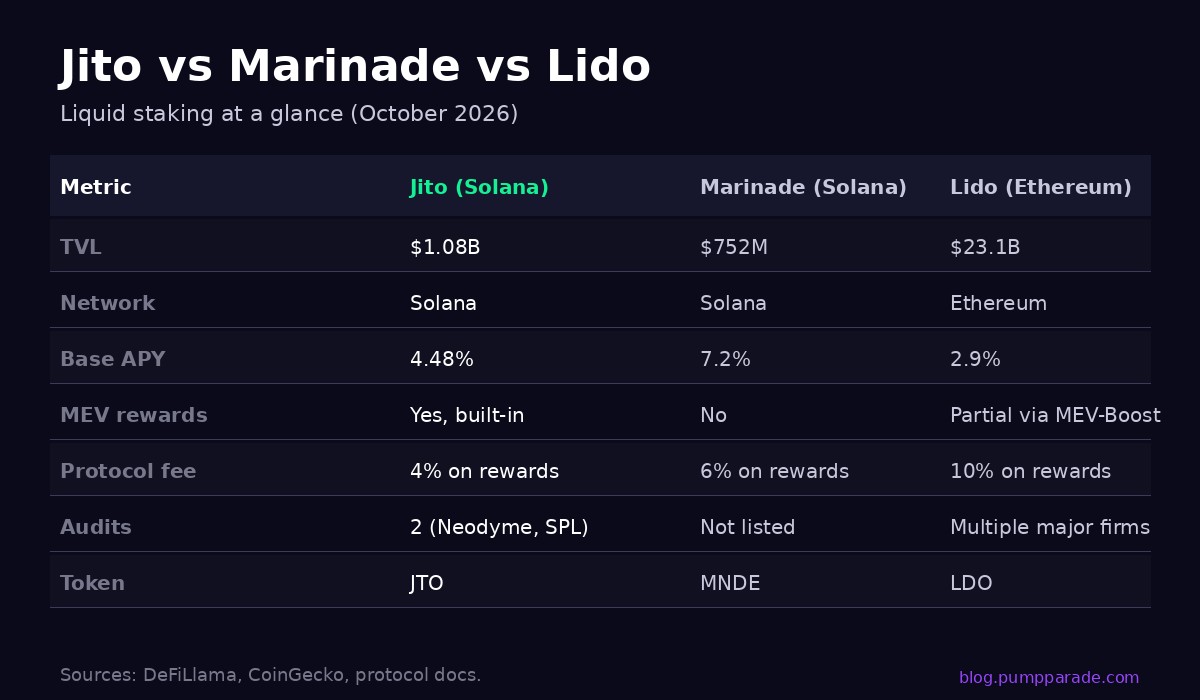
The headline takeaways are simple. Jito has the lowest protocol fee of the three. Marinade shows a higher base APY because its number includes delegation strategy incentives and MNDE rewards. Lido operates on a chain with much lower native yield but far more DeFi integrations in dollar terms. If you are a Solana native user, Jito is almost always the right pick. If you hold ETH and want the largest LST market by TVL, Lido is still the default.
For a deeper read on how liquid staking tokens compete, our Marinade vs Lido breakdown walks through the Ethereum side of the market in detail.
Pros and cons
Pros
- MEV revenue sharing is unique. JitoSOL holders receive MEV tips automatically. No other large Solana liquid staking token does this as cleanly.
- Low protocol fee. 4 percent is competitive with every major liquid staking token.
- Deep DeFi integration. JitoSOL is accepted as collateral on Kamino, marginfi, Drift, and most Solana money markets. Instant on chain exits via Jupiter are routinely under 10 basis points of slippage for retail sizes.
- Two independent audits. The Neodyme and SPL stake pool audits are both public. Not every liquid staking token can say that.
- JTO governance treasury is substantial. Meaningful grants have shipped. The DAO is not a shell.
- Restaking optionality. Users who want extra yield can route into Jito Restaking without leaving the ecosystem.
Cons
- Centralization concerns. A majority of Solana stake running the Jito-Solana client is good for yield and bad for client diversity. If a Jito-Solana bug slipped through, the blast radius would be large.
- JTO price drawdown. JTO trades around $0.45, down from a $6.01 ATH. Governance exposure has cost holders money.
- MEV revenue is cyclical. If Solana memecoin volume collapses, so does a chunk of the APY premium.
- Restaking is still small. The TVL and operator set are early. Do not expect EigenLayer scale yields yet.
- Not available for direct US retail custody in some wallets. JitoSOL is a decentralized SPL token, but a few centralized venues restrict it. Check your platform before depositing.
Security and trust
Jito has published two independent audits, both referenced on the SPL stake pool security page and in the Jito documentation. The first is the standard Solana stake pool program audit, which covers the on chain program used to mint and burn JitoSOL. The second is a dedicated audit of Jito’s additions by Neodyme, one of the more respected Solana security firms. There is also a public bug bounty program.
Operational history is clean. The protocol has not suffered a loss of user funds since the stake pool launched. The restaking program is newer and therefore carries higher model risk, but it was deployed with its own audit before accepting deposits. The Jito Foundation runs the frontends and maintains the validator client, but the token and the stake pool program are non custodial. Your JitoSOL lives in your own wallet. Only the underlying SOL is custodied by the on chain stake pool program.
User experience
Minting JitoSOL from the official frontend is a two click flow once you have your wallet connected. Pick an amount, approve the transaction, and your wallet receives JitoSOL within a few seconds. Redeeming works the same way, with the choice between an instant swap through Jupiter at a tiny slippage cost and an epoch delayed redemption straight from the pool at the exact rate.
The dashboard shows live APY, cumulative rewards, your historical growth curve, and the validator set the pool delegates to. There is a dark mode by default, mobile support that actually works, and a direct link to the DeFi integrations so you can route JitoSOL into Kamino or Drift without copying addresses. Of all the Solana liquid staking frontends we have used, Jito’s is the cleanest in 2026. If you also care about wallet UX, our Phantom wallet review covers the companion piece most JitoSOL holders use.

Who should use Jito?
Jito is the right default for three groups of users. The first is any SOL holder who wants passive yield without running a validator and without giving up DeFi access. JitoSOL does the job for less than Lido and less than Marinade, and the MEV share is a genuine edge.
The second is DeFi power users. If you borrow on Kamino, trade perps on Solana money markets, or farm on Orca, JitoSOL as the base collateral asset usually unlocks the best risk adjusted LTV in the ecosystem.
The third is JTO believers. Governance tokens with a real treasury, a working product, and an obvious growth lever (restaking) are rare. The current price is well off the top. Nothing on this page is financial advice, and Pump Parade is not a licensed advisor, but the setup is one that long term DeFi observers find structurally interesting.
Who should skip? Users who want pure delta neutral strategies, users with regulatory restrictions on MEV products in their jurisdiction, and anyone who is uncomfortable with the client diversity picture on Solana.
Verdict: 4.5 / 5
Jito earns its position as the default Solana liquid staking token for 2026. The 4 percent fee is competitive. The MEV revenue sharing is a genuine innovation that other protocols still have not matched at this scale. The audit record is clean. The DeFi integrations are deep enough that JitoSOL is now more useful inside DeFi than SOL itself for most strategies. The main structural knock is Solana client concentration, which Jito itself has little direct control over, and the restaking program is early. Neither issue is enough to keep this review below a four and a half out of five.
If you are deciding between Jito and the alternatives today, start by checking the live rate on Jito’s own dashboard. Then compare the net APY after fees to Marinade and your preferred CEX staking product. For most Solana users the answer is clear within five minutes. Open Jito here if you want to kick the tires.
FAQ
Is JitoSOL safe?
JitoSOL is backed one to one by SOL staked across a diversified validator set, and the stake pool program has two independent audits. There has been no loss of user funds since launch. The main residual risks are smart contract risk (always nonzero for any DeFi product) and Solana network risk. Only commit funds you can afford to leave in a non custodial product.
What is the current JitoSOL APY?
According to DeFiLlama’s yield tracker, the pool rate was 4.48 percent at the time of this review. It changes every epoch and typically moves with Solana inflation and MEV market activity. Always verify the live rate from the Jito dashboard before committing.
How is Jito different from Marinade?
Both are Solana liquid staking pools. Marinade pioneered the category and offers directed stake and strategies through its Native product. Jito focuses on MEV capture and typically produces a steadier net APY once fees are included. Marinade charges 6 percent against Jito’s 4 percent.
Do I earn JTO just by holding JitoSOL?
Not automatically. JTO was distributed through a 2023 airdrop and subsequent incentive campaigns. Current JitoSOL holders earn yield in the form of JitoSOL redemption appreciation, not fresh JTO tokens. Governance participation requires holding JTO itself.
Can I use JitoSOL as collateral?
Yes. JitoSOL is accepted on Kamino, marginfi, Drift, Save, and the vast majority of Solana lending and perps venues. LTV ratios vary by venue. Instant on chain conversion back to SOL is available on Jupiter at typically under 10 basis points of slippage for retail sizes.
Is JTO a good investment?
JTO is a governance token with a real underlying business, a sizeable treasury, and a product that captures Solana MEV revenue. It has also drawn down significantly from its ATH. We do not give personalized investment advice (Pump Parade is not a licensed financial advisor). Treat it like any crypto position: size for the risk, do your own research, and never bet more than you can lose.
Sources and data: DeFiLlama Jito Liquid Staking, CoinGecko JTO, and the official Jito documentation. All figures as of October 2026 and subject to change.