Search “best AI stock picker” and you’ll get a dozen listicles, most of them written by a company that sells one. They all rank tools by how impressive the marketing sounds. That’s backwards. The question that matters with any AI stock tool is simpler: can you check its work?
Here’s a way to sort these tools that doesn’t depend on whose ad budget is bigger.
There are really three kinds of “AI stock picker”
Scores. The tool gives each stock a number. Danelfin’s AI Score, from 1 to 10, is the clearest example. You get a ranking and some of the factors behind it, then you decide what to do.
Patterns and bots. Tickeron is the best-known one here: pattern recognition on charts, plus “AI Robots” that generate trade signals for active traders. More frequent, more technical, more for people who trade often.
Agents. Software that researches a stock, decides, places the (simulated or real) trade, and writes down why. The output isn’t a score, it’s a decision with reasoning attached. This is the newest category and the one most listicles lump in with the others.
Signal apps such as Prospero.ai sit somewhere between scores and bots: they condense data into a few proprietary signals per stock.
None of these categories is “better”. They answer different questions. A score helps you research. An agent does the work and asks you to judge the result.
Four things to check before trusting any of them
- Live or backtested? A backtest is a simulation run after the fact. It’s easy to make look great. Live results, recorded as they happened, are the only ones worth much.
- How long is the record? Six good months is noise. Look for at least a couple of years, including a bad stretch for the market.
- Does it explain itself? “Score: 9” tells you nothing when it’s wrong. A written reason lets you spot when the tool is reacting to something silly.
- Is the record public and complete? Including the losers. If a tool only shows you winning picks, assume the rest look different.
What the research actually says
Two recent papers are worth knowing about, because they test AI stock picking live rather than on historical data the model may already have seen.
A Peking University study (arXiv 2601.11958) had an AI model with web search rate every Russell 1000 stock daily from April 2025. Its top-20 picks beat the index over the roughly nine-month window. The catch the authors stress: the edge was concentrated in the very top picks and faded fast as the list got longer, and the model couldn’t pick losers at all. It’s also a short window.
A second paper (arXiv 2604.17327) tested MarketSenseAI, a commercial multi-agent system, over 19 months on the S&P 500. Its strong-buy picks averaged 2.18% a month against 1.15% for an equal-weight benchmark. That’s a strong result. But look at it month by month:
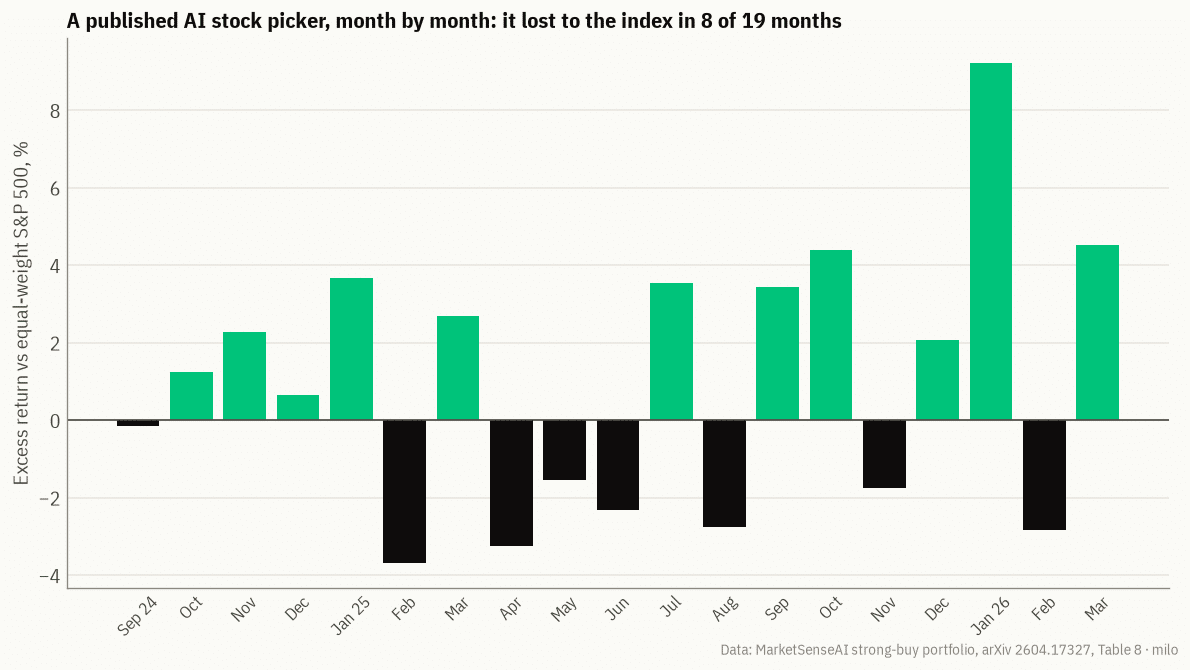
It trailed the benchmark in 8 of the 19 months, sometimes by more than 3 points. The authors themselves say the result rests on 19 observations from a mostly rising market. If you’d followed a tool like this, you’d have spent a lot of months wondering whether it had stopped working.
That’s the realistic picture: there’s real evidence that AI can add something, and it comes with long losing stretches and short track records. Anyone promising you more is selling.
The tools, side by side
| Type | What you get | Can you check it? | |
|---|---|---|---|
| Danelfin | Score | 1–10 AI Score per stock, with factors | Partly: it shows the factors behind each score |
| Tickeron | Patterns / bots | Chart patterns, AI Robot signals | Depends on the robot; check whether results are live |
| Prospero.ai | Signals | Proprietary signals per stock | Limited: the signal logic is proprietary |
| MarketSenseAI | Agent research | Written thesis plus rating per stock | Yes, a public paper reports its live results |
| milo | Agent | Agents that research, trade on paper and explain each move | Yes, every trade comes with its reasoning |
Pricing changes often, so check each site.
Where milo fits
I’ll be upfront that this is our blog. milo is an AI agent platform. On US stocks, milo agents do research and paper trading only: they read insider buys, Congress disclosures and 8-K filings, make simulated trades, and explain each one in plain English. No real money moves on stocks.
That’s deliberate. The fair way to judge any AI picker is to watch it work for a while, on paper, with its reasoning in front of you, before you trust it with anything. Try a milo stock agent in paper mode and see whether its reasoning holds up.
FAQ
Can AI pick stocks better than humans?
Some live studies show an edge, mostly in the very top picks and over short windows. The evidence is promising and nowhere near settled.
What is an AI stock picking agent?
Software that researches, decides and records trades on its own, with its reasoning attached, as opposed to a tool that gives each stock a static score.
Danelfin or Tickeron?
Danelfin suits slower research where you want a ranking. Tickeron suits active traders who want pattern alerts and bot signals.
Are AI stock picker returns real?
Ask whether they’re live or backtested, how long the record is, and whether losing picks are included. Most published numbers are backtests.
Not investment advice. Past performance, live or simulated, doesn’t predict future results.