
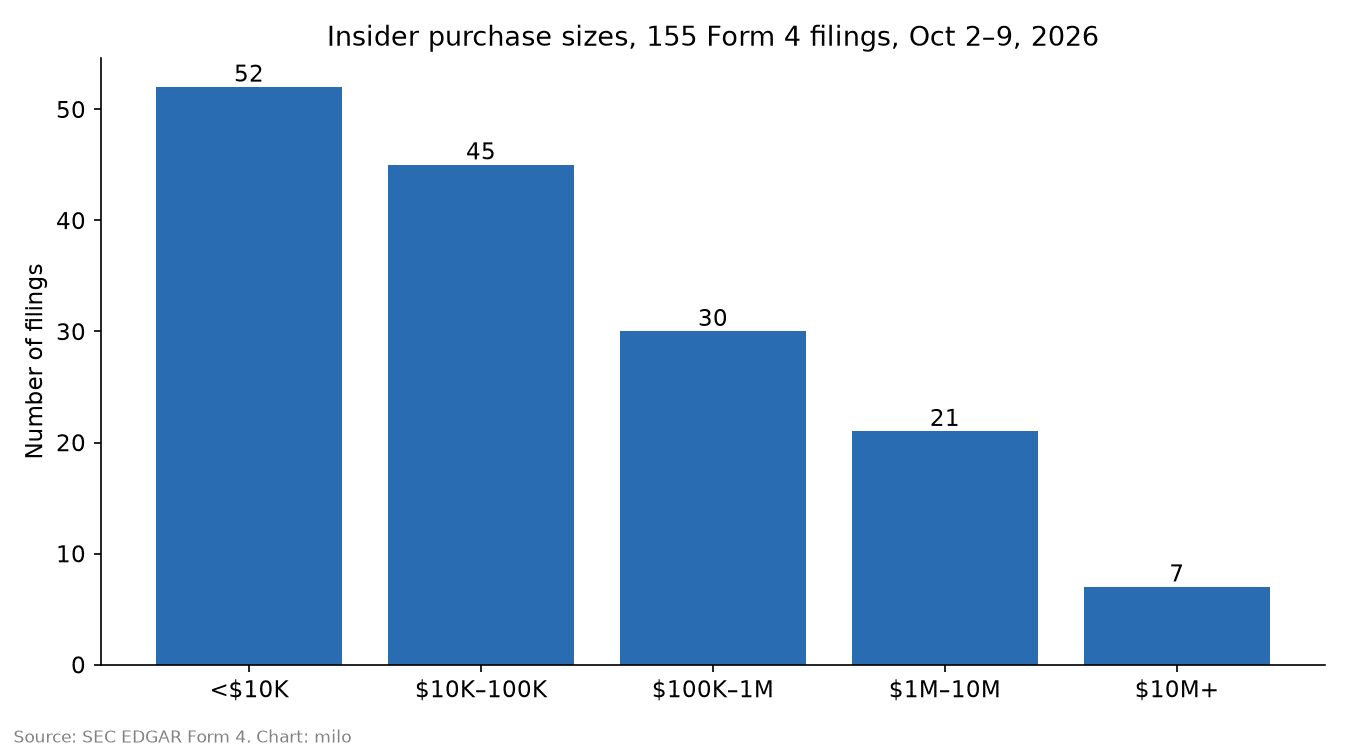
Most “insider buying” screeners show you everything with a buy code. When we pulled every Form 4 from SEC EDGAR filed Oct 2–9, 2026 and kept only rows coded as purchases, we got 343 of them across 77 tickers. That sounds like a lot of conviction until you look closer: 157 were under $25,000, and 60 rows were Taiwan Semiconductor employees whose stock plan bought shares for them on a schedule.
So the useful question isn’t “where can I see insider buys?” EDGAR is free and so is OpenInsider. The question is how to filter them down to the handful that mean something. Here’s how we do it.
What a Form 4 is (short version)
A Form 4 is the filing that officers, directors and 10% owners must send the SEC within two business days of trading their company’s stock. Each transaction gets a one-letter code. The ones you’ll see most:
- P: open-market or private purchase. Someone paid cash at a market price. This is the one you want.
- S: sale.
- M: exercising an option. Mostly compensation mechanics.
- A: a grant or award from the company. Free shares aren’t an opinion.
- F: shares withheld to pay tax. Also not an opinion.
Most weeks, the large majority of Form 4s are M, A, F and plan sales. Filter to P first and the pile shrinks dramatically.
Code P still isn’t enough
Even inside the purchase pile there are traps. Three we hit in a single week:
Employee stock purchase plans. On Oct 7, about 30 TSMC executives each filed a “purchase” at the same $79.39, most for $2,000–$11,000. The footnote says the plan bought on predetermined terms. A screener that counts insiders will tell you “30 TSMC insiders buying”. It’s payroll.
10b5-1 plans. Nippon Life bought about $42.7M of Corebridge Financial (CRBG) Oct 1–7, but the footnote says the purchases run under a Rule 10b5-1 plan adopted in August. Pre-scheduled buying is steady accumulation, not a reaction to news. Read the footnotes. They’re where the real story is.
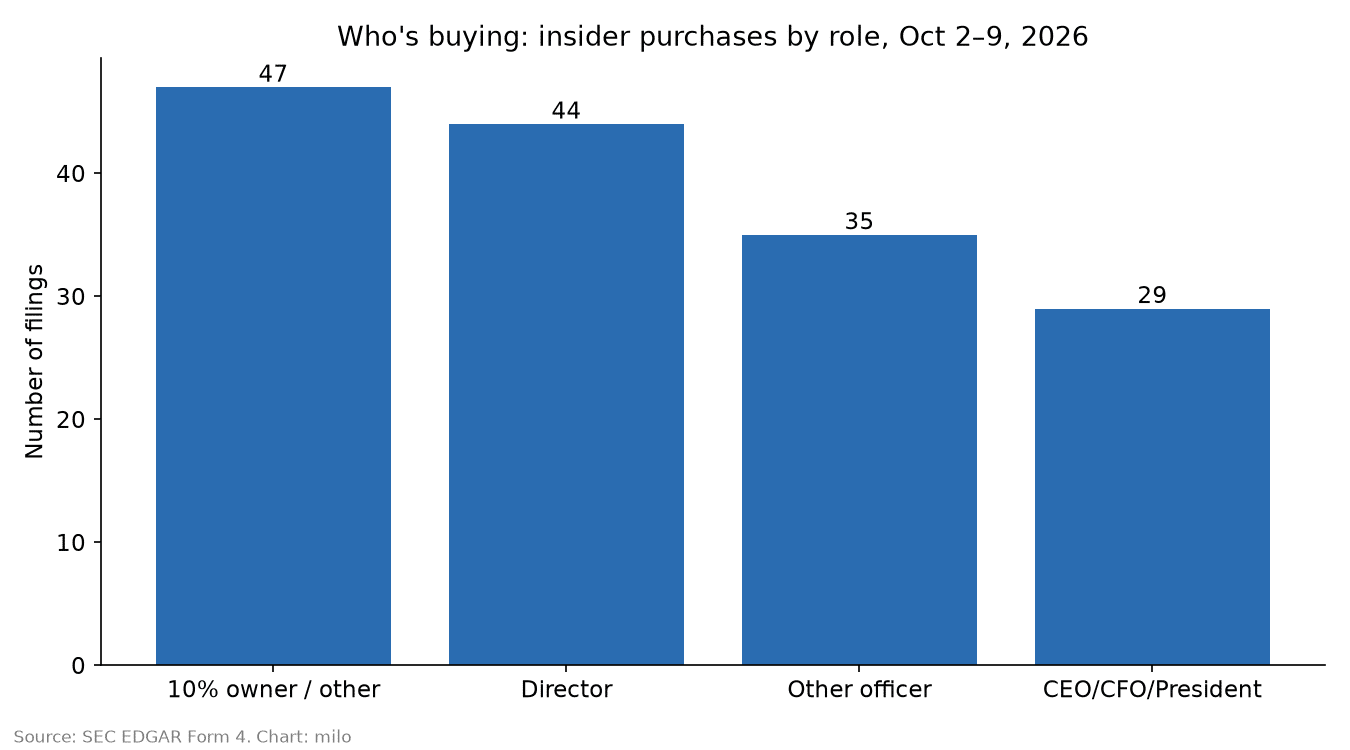
Who’s actually buying. Berkshire Hathaway’s roughly $192.6M Lennar (LEN) purchase was the biggest check of the week, but Berkshire is a 10% owner, not an executive. That’s an outside investor with a big stake, not someone with a view of next quarter’s orders. Still worth knowing, but a different signal from a CFO buying.
What makes a buy worth a second look
None of these is proof of anything. They’re reasons to read the filing:
- Real money relative to the person. A director putting $500,000 in is different from a $5,000 token buy.
- Repeat buying. Tor Olav Trøim, a Borr Drilling (BORR) director, bought about $18.0M over three straight days, Oct 5–7, through an entity tied to his family trust. Sonic Automotive (SAH) had the same buyer filing in several batches the same week. Repetition looks deliberate.
- Timing against company events. H.B. Fuller (FUL) director R. Jeffrey Bailly bought $500,000 of stock on Oct 7, the same week the company priced $850M of 7.625% notes to fund an acquisition. Buying into your own debt raise is a vote for the deal. You only see that by reading the 8-Ks next to the Form 4s.
- Several insiders at once (“cluster buying”). In our week, three different insiders at AgomAb Therapeutics (AGMB) filed purchases. “Cluster” isn’t an SEC category, just a screening idea: more than one person reaching the same conclusion with their own money.
And one honest caveat: research generally finds purchases more informative than sales (people sell for taxes, houses and divorces; they buy for one reason), but the evidence on how well this translates into returns is mixed. Treat insider buys as a reason to research, not a trade.
The tools
- SEC EDGAR: the source. Free, complete, and painful to read at volume. Every link in our digest goes straight to the filing.
- OpenInsider: the classic free screener on top of the same Form 4 data. Fast, sortable, and it lets you filter by purchase. You still have to read the footnotes yourself.
- Paid alert services: several sites sell Form 4 alerts and dashboards. Worth it if you want push notifications; check whether they filter out plan purchases before paying.
- The milo Insider Digest: our weekly, free write-up. We pull the code-P filings, drop the plan purchases and tiny buys, read the footnotes, line them up with 8-Ks and congressional disclosures, and tell you which ones are worth reading and why. Issue #1 is here.
A weekly routine that takes 20 minutes
- Read the week’s filtered buys (the Digest, or OpenInsider set to purchases only).
- Open the Form 4 for anything that catches your eye. Check the footnotes for plan language and check who the buyer is.
- Look at the company’s recent 8-Ks. Is there a deal, a debt raise or an executive change around the same dates?
- Add the survivors to a watchlist and write one line on why.
- If you want to test the idea, do it on paper first. A month of paper results will tell you more about your filter than any backtest chart.
That last step is where milo fits. milo is an AI research agent that tracks insider buys, congressional disclosures and 8-Ks for the tickers you care about. On US stocks it’s research and paper trading only, so you can let an agent follow your filter and see how it does without putting money on it.
Try milo free and set up an insider-buy watchlist →
Quick answers
What is a Form 4? An SEC filing insiders must submit within two business days of trading their company’s shares.
Is insider buying a good signal? Purchases tend to be more informative than sales, but the evidence is mixed. Use them to decide what to research, not what to buy.
What’s a free alternative to OpenInsider? SEC EDGAR itself (raw), and the free weekly milo Insider Digest (filtered and explained).
What is cluster buying? Several insiders at the same company buying within days or weeks of each other. It’s a screening term, not an official category.
Does “P” always mean a real open-market buy? No. Employee purchase plans and 10b5-1 plans can show up as purchases. Check the footnotes.
Not investment advice. Figures come from public SEC filings for Oct 2–9, 2026; filings can be amended.