Every few months a chart goes viral showing that some member of Congress “beat the market” by a mile. Then someone on r/stocks asks the obvious follow-up: can I just copy them? And someone else answers with the problem that nobody’s tracker can fix. By the time you see the trade, it’s old news.
That’s the real story of Congress trade trackers. The tools differ in polish, alerts and price. They all read the same public filings, and those filings arrive late by law.
What a Congress trade tracker actually shows you
The STOCK Act (2012) requires members of Congress, and senior staff, to file a Periodic Transaction Report for stock trades over $1,000. The deadline is 30 days after they’re notified of the trade, and never more than 45 days after the trade itself. Trades by a spouse or dependent child count too. House reports go to the House Clerk; Senate reports go to the Senate eFD system. The fine for filing late is $200, which is not much of a deterrent.
Two more details matter more than people think:
- Amounts are ranges, not numbers. A report says “$1,001–$15,000” or “$500,001–$1,000,000”. You don’t know the real size.
- The date you see first is the filing date. A tracker shows a trade when the report lands, not when the trade happened.
Every tracker on the market is a nicer front end for those two government databases.
How late is “late”? We checked a batch
We pulled seven House reports signed in September 2026, covering 130 transactions, and measured the gap between each trade date and the date the member signed the report.
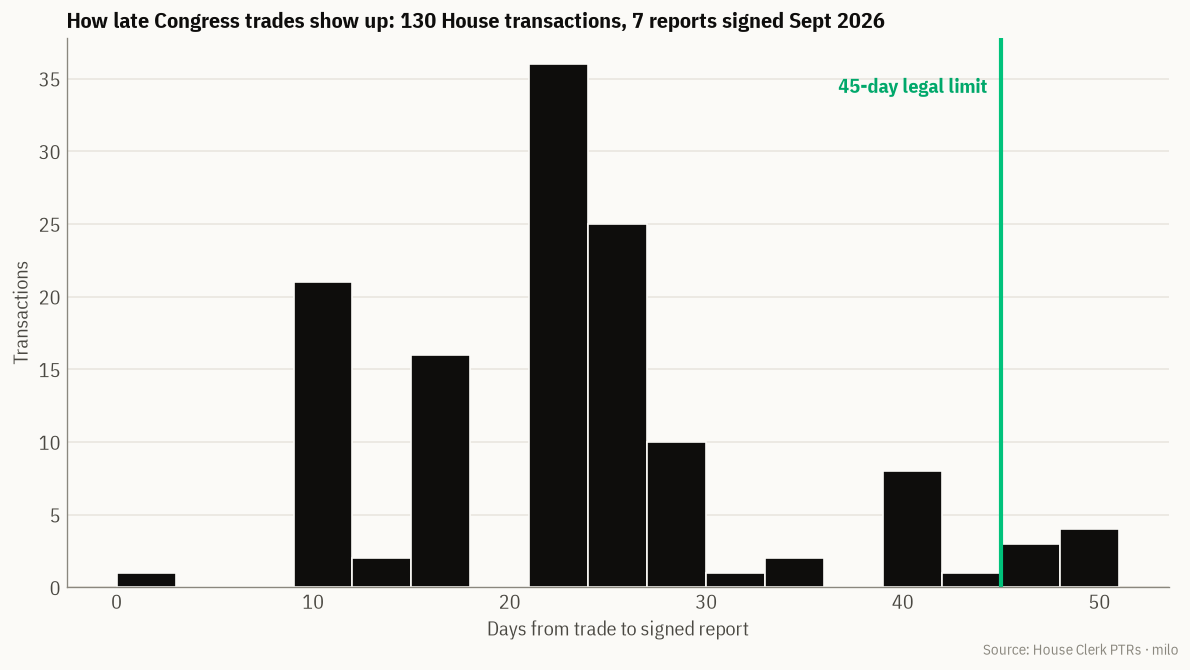
- The median gap was 23 days.
- 19 of the 130 trades were more than 30 days old when the report was signed.
- 7 were signed after the 45-day limit (up to 49 days).
- One trade was reported the same day. That’s the exception.
So even in a small, ordinary batch, a typical trade is three weeks old before any tracker can show it.
The trackers, briefly
I’m not going to pretend to rank these by traffic or accuracy, because nobody publishes data that would let you. Here’s what each is good for, based on what they offer publicly. Check current pricing on their sites, since it changes.
Capitol Trades. Free and clean. Good for browsing by politician, ticker or sector without signing up for anything. Best for “what did my representative buy?”
Quiver Quantitative. Congress trades plus a lot of other alternative data (lobbying, contracts, insider trades). It also publishes strategy backtests built on Congress trades. Free tier plus paid plans.
Unusual Whales. Known mostly for options flow, and it has a big Congress trading section and alerts. Paid subscription for the full product.
Autopilot. An app that lets you link a brokerage account and automatically mirror a politician’s portfolio. That’s a different thing from tracking. You’re copying trades with the lag baked in.
The source itself. The House Clerk and Senate eFD sites are free and always first. They’re also unpleasant to use: many House reports are PDFs, and older paper filings are scanned images.
| What it’s for | Cost | Data delay | |
|---|---|---|---|
| House Clerk / Senate eFD | The raw filings | Free | None beyond the legal lag |
| Capitol Trades | Browsing and searching | Free | Legal lag + processing |
| Quiver Quantitative | Data plus backtests | Free tier, paid plans | Legal lag + processing |
| Unusual Whales | Alerts and dashboards | Paid | Legal lag + processing |
| Autopilot | Auto-copying a portfolio | Paid | Legal lag + execution |
Notice the last column. Nothing on this list removes the lag, because the lag is in the law.
Why “copy Congress” charts look better than real life
Most of those viral performance charts quietly enter each trade on the trade date. You couldn’t have done that. You’d have entered on the disclosure date, often weeks later, at a different price. Add the dollar ranges, which make position sizes a guess, and the gap between the chart and what a follower could actually earn can be large. It can go either way, but it’s never zero.
If you want an honest answer to “does this work?”, the test has to enter on the disclosure date, size positions conservatively, and compare against just buying an index fund over the same period.
Test it on paper before you put money behind it
That’s the part I’d actually do before paying for any tracker. Pick a rule (“buy what members of the Armed Services committees disclose, one week after disclosure, hold 90 days”) and run it on paper for a few months.
This is what we use milo for. milo reads House and Senate disclosures, insider Form 4s and 8-K filings, and you can set up an agent to follow a rule like the one above and explain each trade in plain English. On US stocks milo is research and paper trading only: no real money, just a record you can judge before you trust the idea. Try a Congress-following paper agent on milo.
FAQ
How long do members of Congress have to report stock trades?
Under the STOCK Act, within 30 days of being notified of the trade and no later than 45 days after the transaction.
What’s the best free Congress stock tracker?
Capitol Trades is the easiest free one to browse. Quiver Quantitative has a useful free tier. The House Clerk and Senate eFD sites are the free primary sources.
Can I see Congress trades in real time?
No. No tracker can, because members aren’t required to report for up to 45 days.
Do the reports show exact dollar amounts?
No, only ranges such as $1,001–$15,000 or $1,000,001–$5,000,000.
Is copying Congress trades profitable?
The honest answer is that it depends on the period and on how you handle the lag. Be skeptical of any backtest that enters on the trade date. Paper-test the strategy yourself, entering on the disclosure date.
Not investment advice. Filings can be amended and trackers can contain errors; check the original report before acting on anything.