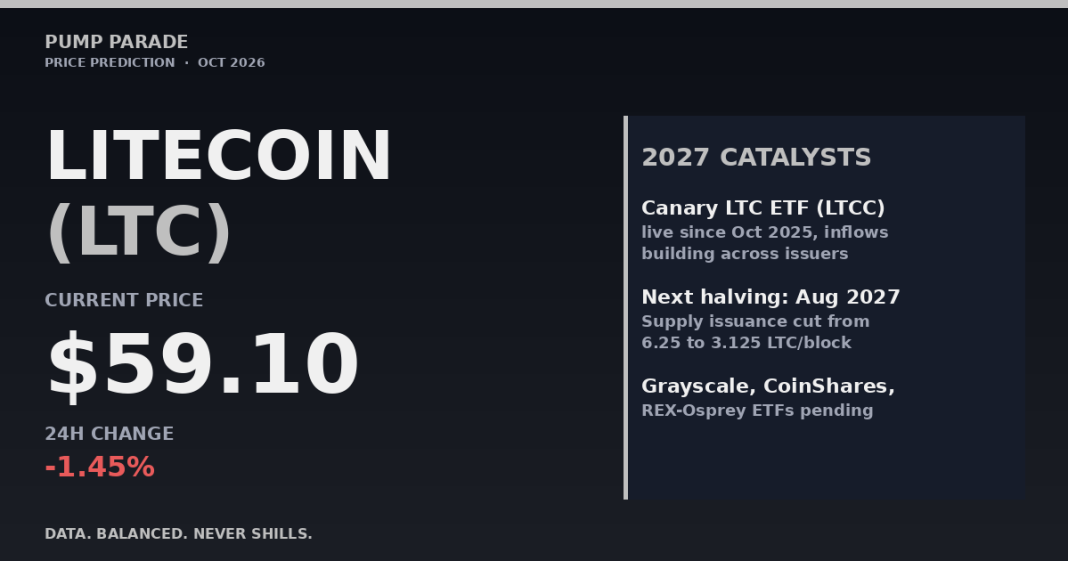
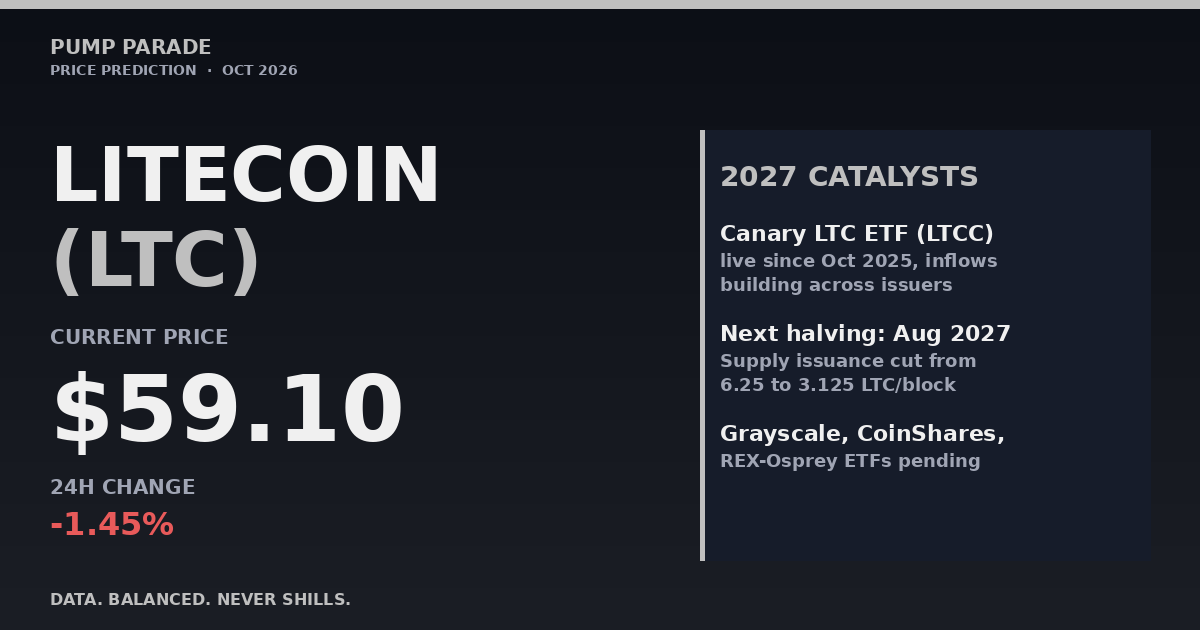
Litecoin trades at $59.10 as of October 20, 2026, down 1.45% on the day and 3.57% on the week. On the surface, that reads like a sleepy chart. Dig one level deeper and the Litecoin price prediction 2027 conversation looks very different.
The Canary Litecoin ETF (ticker: LTCC) is live. Three more spot filings from Grayscale, CoinShares, and REX-Osprey sit in the queue. The next programmed halving lands in August 2027, slicing block rewards from 6.25 to 3.125 LTC. And the chart still shows a token that trades 85.6% below its $410 all-time high from May 2021, which gives it the one thing the top-ten names no longer have: room.
Here is what we actually see in the numbers, where the bull case holds up, and where it falls apart.
Key Takeaways
- LTC trades at $59.10 with a $4.59B market cap, rank 24. The 30-day return is +3.83%, so the token is holding above its summer lows while the broader market cools.
- The Canary Litecoin spot ETF debuted October 28, 2025. Early inflows have been modest ($7M+ in cumulative net inflows as of late November 2025), well below Solana or XRP ETF debuts.
- Our base case Litecoin price prediction 2027 is $155, with a bear floor at $70 and a bull target at $260 if ETF inflows accelerate before the halving.
- The next halving is scheduled for August 2027 (per CoinGecko’s project data). In 2019 and 2023, LTC rallied into the event then sold off hard. This cycle has institutional access the earlier ones did not.
- The bear case is simple: Litecoin keeps losing mindshare to newer L1s. Payments narrative no longer moves markets on its own.
Where Litecoin Stands Today
Before any forecasting, the current snapshot matters. Here is where LTC sits right now, pulled from CoinGecko market data on October 20, 2026.
| Metric | Value |
|---|---|
| Price (USD) | $59.10 |
| 24-hour change | -1.45% |
| 7-day change | -3.57% |
| 30-day change | +3.83% |
| Market cap | $4.59B |
| 24-hour volume | $213M |
| Market cap rank | #24 |
| Circulating supply | 77,734,855 LTC |
| Max supply | 84,000,000 LTC |
| All-time high | $410.26 (May 2021) |
| Percent from ATH | -85.6% |
Translation: Litecoin is a mid-cap at this point, not a top-ten asset. Supply is 92.5% of the eventual maximum, so new issuance pressure is limited and will shrink further after the 2027 halving. The token is holding a monthly uptrend while printing a down week, which is often what accumulation looks like.
Why is Litecoin trading sideways right now?
Three things are pulling in different directions.
On the demand side, the Canary ETF opened a regulated channel for US institutional buyers, but the uptake has been slow. Yahoo Finance reported LTCC saw five straight sessions of zero daily net inflows in late November 2025, with cumulative inflows stuck near $7.26M and total trading volume under $750K. For comparison, XRP ETFs pulled roughly $586M in net inflows over a similar window, and Solana ETFs cleared $570M. Institutional appetite for LTC exists on paper. It has not shown up in the tape yet.
On the supply side, the 2027 halving is still ten months out. Historically, miners and swing traders start positioning six to nine months ahead of a halving, which puts us at the edge of that window right now, not inside it.
On the narrative side, Litecoin has a positioning problem. The “digital silver” story is now 13 years old. New L1s and L2s compete for the payments narrative that used to be LTC’s alone. Mindshare is thin, and that keeps a lid on volatility until a catalyst breaks the range.
The Bull Case for LTC
Three specific, verifiable catalysts could compound into a serious move. These are not hopes. They are either live or on the calendar.
1. The ETF stack grows beyond Canary
Grayscale, CoinShares, and REX-Osprey all have spot Litecoin ETF filings in motion. If any two clear and launch during the first half of 2027, LTC moves from a one-issuer market to a four-issuer market. More issuers compete for the same mandate, which usually means more marketing spend, more advisor placement, and more consolidated flow. The DOGE ETF path shows how fast flows can reprice an asset when the second and third issuers arrive. If LTC follows that curve, our model points to $140 to $180 by mid-2027.
2. The 2027 halving reduces miner selling
At the current hash rate, Litecoin miners sell most of what they mint to cover electricity and gear. The August 2027 halving cuts fresh issuance from roughly 2.19 million LTC per year to 1.1 million. That is a $65M annual reduction in forced miner selling at current prices. In both 2019 and 2023, LTC rallied into the halving (roughly +300% and +80% respectively) before correcting. If this cycle gets the pre-halving ramp with ETF demand layered on, the top of the move could be meaningfully higher than past cycles.
3. MWEB and the privacy option
The MimbleWimble Extension Blocks upgrade, activated in 2022, remains one of the few optional privacy layers available on a top-30 asset. As stablecoin and ETF rails attract more regulatory attention, holders who want transactional privacy have fewer places to go. Monero is one option, Zcash is another, and LTC is the only one of the three with a US spot ETF. That is a weird but real differentiator.
The Bear Case for LTC
The bull case is coherent. So is the bear case. We would be bad at our jobs if we only showed one side.
1. ETF flow stays weak
The LTCC debut was flat. If the next two issuers launch and still only pull single-digit millions, the thesis that institutions want LTC exposure collapses. In that world, LTC trades like any other mid-cap altcoin, which means it tracks Bitcoin with higher beta on the downside and lower beta on the upside. $45 to $55 becomes the range through 2027 and the halving becomes a sell-the-news event.
2. The narrative keeps aging
Litecoin was launched by Charlie Lee in 2011 as a faster, cheaper fork of Bitcoin. In 2026, “faster and cheaper than Bitcoin” is a crowded field. Solana, Sui, Base, and dozens of Bitcoin L2s all pitch some version of it. LTC does not have a developer ecosystem story to counter. If payments adoption shifts to stablecoins on cheaper rails (likely) and privacy demand migrates to purpose-built chains, LTC is left as a store of value with no yield and a shrinking narrative moat.
3. Macro risk from Bitcoin
LTC’s correlation to BTC on daily returns runs north of 0.75 most quarters. Bitcoin is 35% off its all-time high and still trying to reclaim its range. If BTC breaks support and heads toward $65K to $70K, LTC almost certainly cracks $50 and prints a new local low. The halving will not save it from a market-wide drawdown.
Litecoin Price Prediction 2027: Targets by Timeframe
Here is our scenario modeling. These are not guarantees. They are what the data points to if specific conditions hold. Every path has a trigger that would move LTC between the three cases.
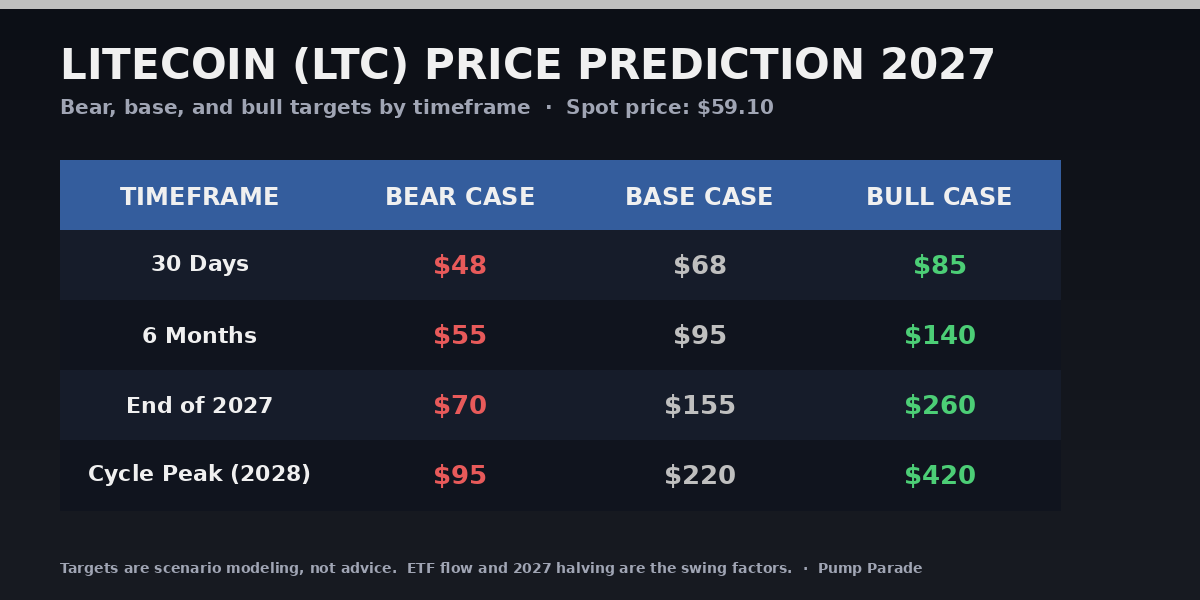
30-day outlook (through November 2026)
Bear: $48. Base: $68. Bull: $85. The near-term is a function of Bitcoin direction and whether the Grayscale filing gets an SEC acknowledgment letter. A clear ETF catalyst in November could push LTC through the $70 resistance it has defended all summer.
6-month outlook (through April 2027)
Bear: $55. Base: $95. Bull: $140. This is the pre-halving positioning window. Historical pre-halving rallies have ranged from 80% to 300%. Our base case assumes a 60% rally from current levels, consistent with a cycle that has institutional access but also faces narrative headwinds.
End of 2027 (post-halving)
Bear: $70. Base: $155. Bull: $260. The base case assumes the halving plays out like 2023 (pre-halving rally, modest post-halving correction, year-end recovery). The bull case requires at least two more spot ETFs to be live and pulling consistent flow by year-end. Analyst Bitcoinsensus has publicly called a $1,000 to $2,000 range as a “realistic possibility” for this cycle, which would require every bull condition to hit, plus a BTC run north of $150K.
Cycle peak scenario (2028)
Bear: $95. Base: $220. Bull: $420. If the halving plus ETF flow combination works and the broader crypto cycle extends into 2028, a retest of the $410 all-time high is on the table. Changelly’s model projects $126 to $200 for 2027 average, which sits inside our base case range, while more aggressive forecasters at CoinCodex and VentureBurn have called for $250 to $1,400+. Treat the ceilings as low-probability tails, not expected values.
How Litecoin Compares to Bitcoin Cash
The closest apples-to-apples comparison for LTC is Bitcoin Cash. Both are early-era BTC forks competing for the digital-cash narrative. Here is how they stack up on October 20, 2026.
| Metric | Litecoin (LTC) | Bitcoin Cash (BCH) |
|---|---|---|
| Price | $59.10 | $272.89 |
| Market cap | $4.59B | $5.5B |
| 24h volume | $213M | $127M |
| From ATH | -85.6% | -92.8% |
| Spot ETF live? | Yes (Canary LTCC) | No |
| Next halving | Aug 2027 | Apr 2028 |
| Block time | 2.5 min | 10 min |
| Privacy layer | MWEB (optional) | None (CashFusion wallet-level) |
LTC has more daily volume despite a smaller market cap, a live US spot ETF, and faster blocks. BCH has a lower circulating supply and a longer time until its next halving. Both tokens face the same core question: does the digital-cash thesis still earn a position in a diversified crypto allocation? Our read is yes for LTC (because of the ETF), and uncertain for BCH on its own merits.
What Would Change Our View
Three specific triggers would move us between cases.
Trigger 1 (bull): Grayscale, CoinShares, or REX-Osprey LTC ETFs launch in Q1 or Q2 2027 and clear $100M in cumulative net inflows within 60 days. That would validate institutional demand and move our 2027 end target from $155 to roughly $210.
Trigger 2 (bear): LTCC and any new launches collectively stay below $50M in cumulative inflows through June 2027. That would signal the institutional thesis is broken and push our end-of-2027 target toward $85 to $95.
Trigger 3 (either direction): Bitcoin either breaks $100K and holds, or cracks $70K and holds. LTC’s beta to BTC is high enough that the macro-crypto backdrop will dominate whatever is happening at the Litecoin project level.
Frequently Asked Questions
Will Litecoin reach $500 by 2027?
Not in our base case. $500 LTC would require a market cap near $39B, roughly 8.5 times today’s level. That would need a major shift in institutional allocation plus a strong BTC cycle. It is possible as a 2028 cycle-peak outcome if every bull condition hits, but it is a low-probability outcome for 2027 specifically.
Is Litecoin a good investment in 2026?
It depends on your horizon. For a 3-to-6 month trade, LTC is a sideways chart with modest ETF-flow upside and real BTC-correlated downside. For a 12-to-24 month hold aimed at the halving plus full ETF adoption, the risk-reward looks more balanced. It is not a core allocation. It is a tactical position tied to specific calendar events.
When is the next Litecoin halving?
The next halving is projected for August 2027, roughly 10 months from this writing. Block rewards will drop from 6.25 LTC to 3.125 LTC. Based on 2019 and 2023 patterns, the strongest price action typically happens in the 6 to 9 months before the event, not after.
Is Litecoin dead?
No, but the “digital silver” story has aged. Daily on-chain transaction counts remain healthy (consistently above 100,000 per day), the hash rate is near all-time highs, and the Litecoin Foundation is active. The project is not technically dead. The narrative question is whether a 2011-era payments chain still earns a spot in portfolios when newer options exist.
What is the Litecoin price prediction for 2030?
Looking that far out requires wider error bars. Coinpedia models project a $400 to $530 range for 2030. Our own long-horizon framework points to $300 to $450 as a base case, assuming LTC retains top-30 status and the ETF stack remains active. Numbers north of $1,000 require both a crypto super-cycle and a reversal of LTC’s declining mindshare.
How does the Litecoin ETF affect LTC price?
ETFs matter because they create a regulated, tax-efficient wrapper for institutions that cannot hold spot crypto directly. The Canary launch alone has not moved price much. If three or four issuers compete for the same mandate (as happened with BTC and ETH ETFs), concentrated marketing can turn modest flows into real demand. That is the mechanism to watch.
The Honest Take
Litecoin in October 2026 is a tactical position, not a conviction trade. The ETF is live but the flows are not. The halving is coming but it is still ten months out. The chart is holding above summer lows but under a clear downtrend from last winter. Everything is on the calendar. Nothing is confirmed.
If you are long LTC, our read is that holding into Q1 2027 makes sense, because that is when the second and third ETF decisions are expected and when pre-halving positioning typically starts. If you are not long, the setup you are waiting for is either a confirmed break above $70 on volume, or a sharper flush to the $45 to $50 zone that resets risk-reward.
What we would not do is chase green candles here. The structure is not pointing to vertical price discovery. It is pointing to a slow accumulation range that resolves one way or the other based on institutional flow data that will show up on SoSoValue week by week. Watch the data, not the influencers.
Analysis timestamp: October 20, 2026, 10:11 UTC. LTC spot price $59.10. Data sources: CoinGecko, Birdeye, SoSoValue (via Yahoo Finance), BYDFi halving research, Changelly forecasts.
Disclaimer: This article is for informational and educational purposes only and should not be construed as financial, investment, or trading advice. Cryptocurrency markets are highly volatile, and past performance does not guarantee future results. The price predictions and analyses presented here are based on AI models, technical indicators, and available data at the time of writing, they are not guarantees. Always conduct your own research (DYOR) and consult with a qualified financial advisor before making any investment decisions. Pump Parade and its authors do not assume liability for financial losses incurred based on information provided in this article.