AI models can generate stock picks, and some public tests posted eye-catching gains. The evidence underneath is usually short, noisy, and full of drawdowns. Below is a scorecard of the experiments you can actually verify, plus a checklist for running a fair paper test yourself.
The short answer
Yes, ChatGPT (and other AIs) can generate stock picks and run a simulated portfolio. Public tests are short and volatile. In one six-month micro-cap paper-trading study, the portfolio’s maximum drawdown reached −50.33%. Treat AI picks as research input, not advice.
The experiments, side by side
Don’t trust a single viral thread. Here are the public AI paper-trading experiments and studies we could verify from primary sources, lined up the same way.
ChatGPT runs a $100 micro-cap portfolio for ~6 months (Nathan Smith study)
Nathan Smith’s January 2025 paper, Evaluating ChatGPT as a Portfolio Decision-Maker in Micro-Cap Equities, is the cleanest retail-readable ChatGPT portfolio experiment we found in full text.
Setup, from the PDF:
- Universe: U.S.-listed micro-cap equities
- Starting capital: $100
- Duration: about six calendar months
- Design: forward-only paper trading. ChatGPT made the portfolio decisions; a human only prompted the model and entered the trades
- Benchmarks: Russell 2000 and S&P 500 were plotted for context, not as a formal relative-performance test
- Costs: the simulation did not include commissions or bid–ask spreads
What the PDF actually reports (not a newsletter paraphrase):
- The largest equity run in the series was +21.51% (a short window in mid-November 2025)
- Maximum drawdown reached −50.33% (equity fell to $67.10 on that trough day, from the $100 start)
- The portfolio was routinely 2–3 concentrated tickers; average position cost basis was about 25% of starting capital
- Of 46 realized lot exits, exactly half were profitable, but average losses exceeded average gains (profit factor 0.82)
- The model often re-entered tickers that had already lost money, and leaned on event-driven binary outcomes
That is the important pattern: a headline “up” moment can sit next to a drawdown that would have shaken most people out. The study is exploratory. It documents behavior under thin capital and elevated micro-cap risk. It is not a claim that ChatGPT beats the market.
Multi-model Reddit experiments (figures unverified)
Several r/ChatGPT and r/artificial threads describe head-to-head tests: ChatGPT vs Gemini vs Claude vs Perplexity with small starting pots; GPT, Gemini, Grok and DeepSeek on paper Alpaca accounts with a live leaderboard; and a risk-management shootout across many models.
We could not open those threads reliably enough to confirm dollar amounts, durations or whether money was real or paper. So this article does not quote their percentages. Methodologically they are useful as existence proofs: people are trying multi-model paper contests. They are too short and too lightly documented to crown a winner.
The academic side: MarketSenseAI, agentic nowcasting, StockAgent, AlphaQuanter
Four research papers from 2025–2026 are worth knowing about, because they try harder on leakage and benchmarks than a weekend Reddit run.
MarketSenseAI (Signal or Noise in Multi-Agent LLM-based Stock Recommendations?): a deployed multi-agent LLM equity system, validated at the portfolio level with live, look-ahead-free signals. On its S&P 500 cohort (19 months, Sep 2024–Mar 2026), the strong-buy equal-weight portfolio averaged +2.18% per month against a passive equal-weight benchmark of +1.15%. That is a real published edge. The same paper shows the result rests on 19 monthly observations in a mostly rising market, and the S&P 100 cohort is directionally similar but statistically underpowered. Month by month, the strong-buy book still trailed its equal-weight benchmark in a large minority of months (we covered that pattern in our best AI stock picker piece).
Agentic AI nowcasting (Autonomous Market Intelligence…): a fully agentic LLM rates every Russell 1000 stock daily from April 2025, searching the live web without curated inputs. The abstract’s headline result: longing the top 20 picks produced 18.4 bp of daily alpha (Fama–French five factors plus momentum) and an annualised Sharpe ratio of 2.43. The authors stress the edge is concentrated in the top tier and dilutes as you add more names; bottom-ranked stocks looked statistically like the market. Sample length is still short (about nine months in the draft we read).
StockAgent (ACM): an LLM trading simulation designed to control for data leakage. Useful as a methodology paper; do not treat it as a retail performance claim.
AlphaQuanter (ACL Findings 2026): an RL-trained single-agent framework with tool use, backtested on five large-cap stocks (GOOGL, MSFT, META, NVDA, TSLA). It reports strong backtest metrics versus prompt-only and multi-agent baselines. That is a different animal from a live multi-stock paper portfolio: small universe, historical simulation, research prototype.
Scorecard
| Experiment | Model(s) | Universe | Capital / size | Duration | Live / forward? | Benchmark | Headline (verified) | Max drawdown / risk note | Public logs? |
|---|---|---|---|---|---|---|---|---|---|
| Smith micro-cap | ChatGPT | U.S. micro-caps | $100 | ~6 months | Forward-only paper | R2K / S&P as context | Largest run +21.51% | Max DD −50.33% | Yes (paper + eval repo) |
| MarketSenseAI | Multi-agent LLM | S&P 500 cohort | ~35 strong-buys / month | 19 months | Live, no look-ahead | Equal-weight S&P 500 | +2.18%/mo vs +1.15% EW | Trailed EW in many months | Paper; system is commercial |
| Agentic nowcasting | Agentic LLM + web | Russell 1000 | Top-20 long | ~Apr 2025–Jan 2026 | Live nowcast | FF5 + momentum | 18.4 bp daily α; Sharpe 2.43 | Edge concentrated in top tier | Dataset / updates on GitHub |
| AlphaQuanter | RL single-agent | 5 large-caps | Single-name books | 6-month test window | Backtest | B&H / rules / other agents | SOTA vs listed baselines (paper) | MDD reported per stock in paper | Code + data on GitHub |
| Reddit multi-model threads | GPT / Gemini / Claude / Grok / … | Mixed | Small pots (claimed) | Weeks | Mixed / unclear | Often none | Not cited — unverified | Unknown | Thread posts only |
No milo paper-agent row here: we only add one when we can pull live paper-mode figures from the product. Guessing would break the point of the table.
What the experiments get wrong (the fair-test checklist)
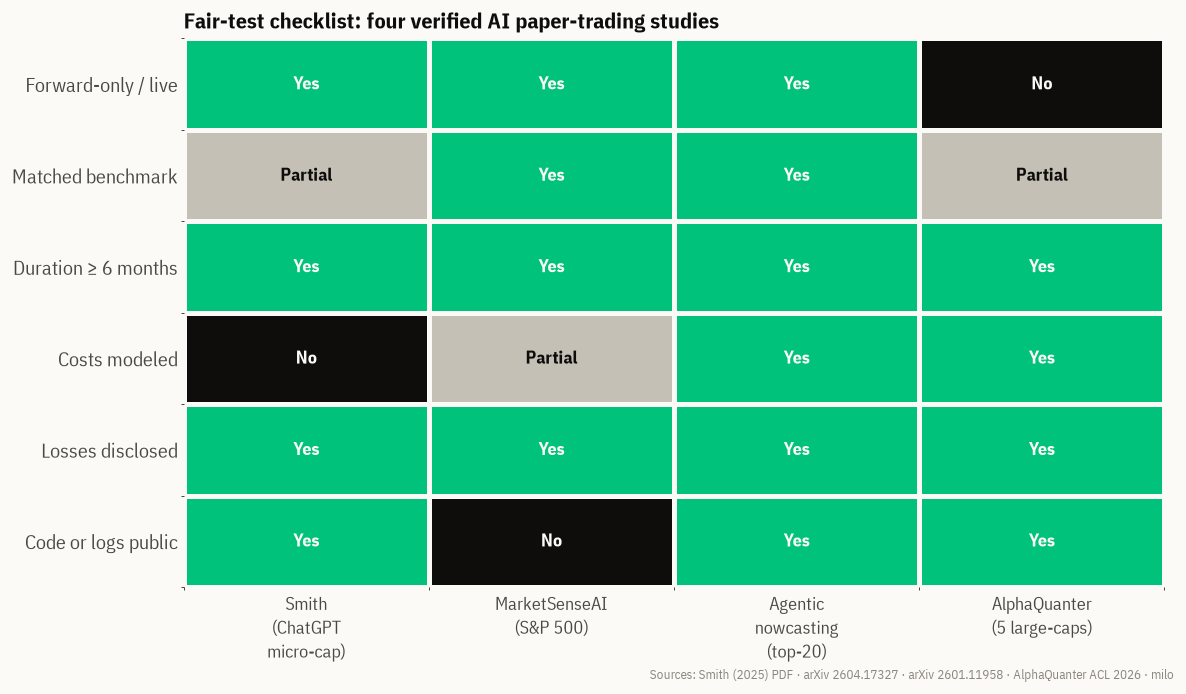
When a ChatGPT portfolio post goes viral, run it through this list before you copy the setup.
Short windows and lucky single stocks
Six months of micro-caps, or nine months of a rising Russell 1000, is not a career. Smith’s largest run was a handful of days. The nowcasting paper’s edge sat in the top 20 names. Concentrated luck looks like skill until the next regime.
No benchmark or the wrong one
Beating “cash” on a $100 account is not the same as beating a relevant index. Micro-caps should be judged against something like the Russell 2000, not the S&P 500, if you care about relative skill. Smith’s paper is careful about this: the big indexes are context, not the score. Many Reddit posts skip a benchmark entirely.
Backtests vs forward-only tests (look-ahead bias)
If the model may have seen the news, the filings or even the price path in training data, you are not testing prediction. The better papers (MarketSenseAI, the nowcasting study) insist on live or strictly timestamped generation. AlphaQuanter is explicit that it is a backtest. Both kinds of work are useful. They answer different questions.
Concentration and drawdowns
Smith’s book sat in two or three names and drew down more than 50%. The nowcasting alpha faded as the list got longer. MarketSenseAI’s edge is also a concentrated strong-buy filter, not “the whole index, but smarter.” High concentration is where the interesting numbers come from, and where the pain lives.
Fair-test checklist (reuse this):
- Forward-only or live signals (no peeking)
- A matched benchmark for the same universe
- Same investable set for the AI and the benchmark
- Costs included (spread, commission, turnover)
- Duration of at least six months, ideally through a bad stretch
- Losses and drawdowns disclosed, not only winners
- Decisions logged with reasons you can audit
What the serious research actually found
Put together, the rigorous work does not say “ChatGPT prints money.” It says something narrower:
- There is evidence of selection skill in some live or forward setups, especially in top-ranked or strong-buy buckets.
- The edges are sample-short, often concentrated, and sit next to real drawdowns or months of underperformance.
- Asymmetry shows up repeatedly: models are better at picking winners than losers (nowcasting paper), or portfolio outcomes are dominated by a few binary bets (Smith).
- There is no consensus that a general-purpose chatbot, left alone with a brokerage, is a reliable stock picker.
That is still interesting. It is not a product brochure.
How to run your own fair AI paper-trading test
If the secondary question on your mind is “how would I test an AI myself without risking money?”, here is a boring, fair protocol:
- Pick a universe (for example, a fixed list of 50 liquid U.S. stocks) and freeze it.
- Pick a benchmark that matches that universe (equal-weight of the same list, or a relevant ETF).
- Go forward-only. Prompt the model with information available that day. No “what would you have done in 2022?”
- Log every decision and the reason in plain English, including holds.
- Include costs in the paper ledger, even if they are rough (for example, a fixed bps per trade).
- Run at least six months, and keep going through an ugly stretch if you get one.
- Publish the losers with the winners. If you cannot show the drawdown, you do not have a result.
Want to see an AI agent explain every stock decision before you trust it? milo runs stock agents in paper mode, with no real money, and narrates each move in plain English. → andmilo.com/stocks
FAQ
Can ChatGPT pick stocks?
Yes, it can generate picks and run a simulated portfolio, but public tests are short and volatile. In one six-month micro-cap paper-trading study, the portfolio’s maximum drawdown reached −50.33%. Treat AI picks as research input, not advice.
Has anyone tested ChatGPT with real or paper money?
Yes. Nathan Smith’s forward-only micro-cap paper trade is the clearest documented ChatGPT portfolio study we verified end to end. Multi-model Reddit experiments exist too; most are paper or very small accounts, and we could not confirm their posted figures from primary pages.
Can AI beat the stock market?
Some 2026 research reports outperformance — MarketSenseAI versus an equal-weight S&P 500 book, and an agentic nowcasting study with alpha concentrated in the top 20 picks — but the samples are short and the edges narrow. There is no consensus.
What is AI paper trading?
An AI makes simulated trades with no real money, so you can measure its decisions and risk before trusting it with anything that matters.
How do you test an AI trading strategy fairly?
Go forward-only, use a matched benchmark, include costs, run 6+ months, and disclose losses.
Which AI is best at picking stocks: ChatGPT, Gemini, Claude or Grok?
There isn’t enough rigorous evidence to name one. The head-to-head Reddit tests are too short to generalize from. Don’t pick a “winner” off a weeks-long leaderboard.
milo’s stock agents are paper trading and research only (insider buys, Congress trades, 8-K filings). Try one at andmilo.com/stocks. Related read: milo Insider Digest #1.
Educational content, not investment advice. Paper-trading results don’t reflect real-money trading.