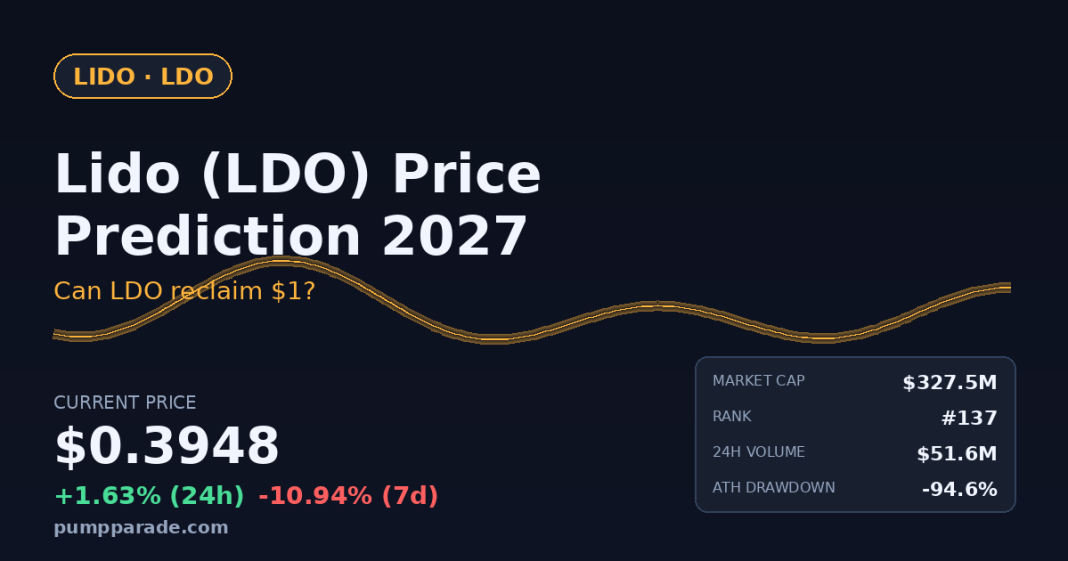
Our Lido (LDO) price prediction for 2027 starts with a strange chart. LDO trades at $0.39 as of October 19, 2026, up 1.6% on the day and down roughly 11% on the week, still sitting about 95% below its 2021 all-time high of $7.30. For a protocol that quietly runs the largest Ethereum liquid staking operation on the planet, that disconnect is the whole story.
The gap between what Lido does (secures 23% of staked ETH, roughly $35B in value) and what LDO trades for ($328M market cap) is the setup. Every month that gap stays wide, more capital asks whether the token is a claim on anything that will ever accrue value. The flipside: when the gap closes, it tends to close fast.
This piece covers where LDO stands right now, the two or three catalysts that could actually matter inside a 12-18 month window, the risks that keep institutional allocators cautious, and a scenario-based target set. If you want the short version: a $1 LDO is reachable, but only if a specific sequence of things lines up. We will show you which.
Key Takeaways
- LDO trades near $0.39 with $328M market cap, roughly 94% below its 2021 all-time high.
- The main 2027 catalyst is a potential SEC approval of the VanEck Lido Staked ETH ETF, filed October 2025, which would be the first US stETH-reference product.
- Lido’s DAO is building an automated LDO buyback that activates only when ETH is above $3,000 and protocol revenue is above $40M annually.
- Market share has slipped from 32% to about 23% as BitMine, Grayscale, Ether.fi, and Rocket Pool have taken institutional flows.
- Our base case targets $0.65 by Q4 2027. The bull case reaches $1.20 if the ETF approves and ETH holds $4,000.
Where Lido Stands Today
Lido is the largest liquid staking protocol on Ethereum. Users deposit ETH, receive stETH in return, and the token accrues staking rewards automatically. stETH is accepted as collateral across most of DeFi, which is why Lido has historically dominated the category.
The protocol secures roughly 9.3 million ETH, worth more than $35 billion at current prices. That is a 23% share of all staked ETH, down from a peak above 32% in 2024 but still the largest single operator by a wide margin. The LDO token is a governance claim on the DAO treasury and on protocol fee decisions. It is not a yield-bearing token itself, which is a point we return to in the bear case.
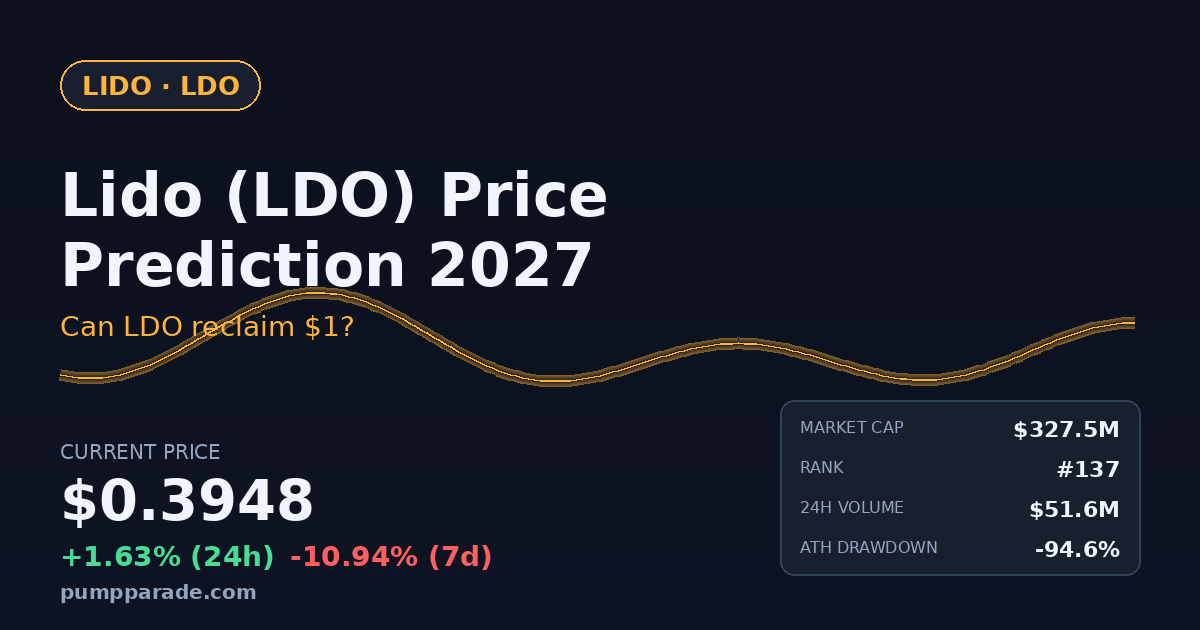
Here is the snapshot that frames the rest of the analysis.
| Metric | Value |
|---|---|
| Price (USD) | $0.3948 |
| 24h change | +1.63% |
| 7d change | -10.94% |
| Market cap | $327.5M |
| 24h volume | $51.6M |
| Market cap rank | #137 |
| All-time high | $7.30 (Aug 2021) |
| % from ATH | -94.6% |
| Circulating supply | 829.6M / 1B |
Three things stand out. First, the volume-to-market-cap ratio is 15.8%, which is heavy for a mid-cap. LDO is actually being traded, not stranded. Second, roughly 170 million tokens remain to be unlocked over the next few years, a slow dilution tail that limits how fast price can run. Third, the $327M market cap is small relative to what Lido does. The whole story in 2027 is whether that gap compresses.
Why is LDO stuck in a range right now?
The simplest answer is that LDO holders have been waiting for the DAO to do something with protocol revenue. For most of 2024 and 2025, Lido generated meaningful fees but passed none of it to LDO. That changed in principle during the February 2026 Tokenholder Update, which proposed an automated buyback mechanism. The activation thresholds, though, are strict.
Buybacks only trigger when ETH trades above $3,000 and annualized protocol revenue clears $40M. ETH is currently in the mid-$3,000s, and Lido’s annualized revenue sits in the low $30M range. The market is pricing LDO as a stock that just announced a buyback but has not yet started executing. That is a reasonable discount, not a broken thesis.
The other weight on price is competition. BitMine and Grayscale have launched staking services aimed at institutional allocators who historically would have routed into Lido. Rocket Pool, Ether.fi, and smaller validator networks have taken retail share. Lido’s response has been to launch stVaults (custom validator arrangements for large depositors) and Lido Earn (yield products built on Mellow Protocol). Both are TVL-positive, but neither has moved the needle enough to re-rate LDO.
Can Lido ride the ETH staking ETF wave?
VanEck Lido Staked ETH ETF approval
VanEck filed for the first US Lido Staked ETH ETF in October 2025. The structure would reference stETH, giving institutional investors regulated access to Ethereum staking yield for the first time. The timing is tied to the SEC’s May 2025 guidance that proof-of-stake activities are not securities and its August 2025 follow-up on liquid staking receipts. If VanEck gets a greenlight in 2026 or early 2027, Lido becomes the default pipe for billions in new ETF flows. Even a 10% capture of institutional ETH staking demand would move Lido TVL by $5B or more. LDO is the market’s most direct expression of that upside.
Automated LDO buybacks go live
The proposed buyback allocates the lesser of 50% of revenue above $40M or $10M annually. Half the allocation buys LDO directly on the market. Half pairs LDO with wstETH in a DAO-owned LP. Even at $10M per year, that is 25 million LDO absorbed at current prices, or 3% of float. For a token trading at a $328M market cap with daily volume of $52M, a persistent bid of that size compresses supply at the margin. The signaling value is bigger than the mechanical impact.
Lido V3 vaults and Earn products scale
stVaults Phase 3 (permissionless minting) went live in March 2026. Lido Earn, launched the same month and powered by Mellow Protocol, held about 61,000 ETH TVL by late February and continues to grow. These are vertical expansions, not just defensive moves. They let Lido charge for infrastructure beyond pure staking, which is what the Curated Module take rate increase from 4.96% to 6.11% codified. Higher take rate on growing TVL is how the protocol gets to the $40M buyback trigger faster.
What could sink LDO back to its lows?
Market share erosion is not reversing
Lido peaked above 32% of staked ETH and now sits near 23%. The slope is not stabilizing. BitMine and Grayscale brought institutional allocators who care about compliance and brand, not DeFi composability. Ether.fi’s restaking narrative pulled DeFi natives. If the next 12 months look like the last 12, Lido ends 2027 closer to 18% share. A smaller Lido means a smaller revenue base, which means buybacks never activate.
The ETF could get delayed or restructured
Lido’s own leadership estimated that a delayed VanEck approval would leave 25-30% of the institutional thesis exposed. “Delayed” is doing work in that sentence. The SEC has signaled openness, but it has not approved. If the first stETH ETF gets restructured away from direct stETH exposure, or if approval slips past Q2 2027, the narrative that currently supports LDO at this level fades.
LDO is still a governance token, not a cash flow claim
Until buybacks are live and compounding, LDO holders own voting rights and option value. That has been the structure for three years and the token is down 94% from ATH. Protocols with similar setups (Uniswap’s UNI is the obvious parallel) have struggled to re-rate even when the underlying business grows. Patience is a thesis, but it is a thin one if a cheaper alternative shows up.
Lido Price Prediction 2027: Targets by Timeframe
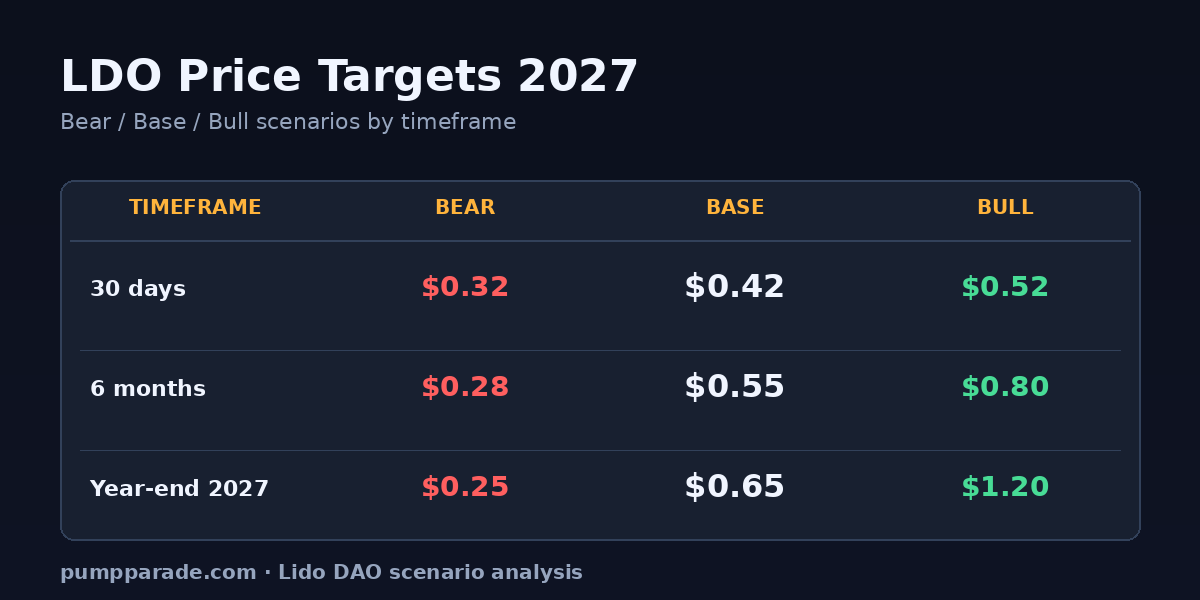
Here is how we see the next 12 to 18 months. These are scenario ranges, not point forecasts, and they assume no systemic crypto drawdown and no Lido-specific exploit.
| Timeframe | Bear | Base | Bull |
|---|---|---|---|
| 30 days (end Nov 2026) | $0.32 | $0.42 | $0.52 |
| 6 months (Apr 2027) | $0.28 | $0.55 | $0.80 |
| Year-end 2027 | $0.25 | $0.65 | $1.20 |
Bear scenario ($0.25 by late 2027): VanEck filing stalls, market share continues drifting toward 18%, ETH ranges below $3,000, and buybacks never activate. LDO retests its $0.235 all-time low. This is the “patience ran out” path.
Base scenario ($0.65 by late 2027): VanEck approval lands in H2 2027 with modest flows. ETH holds the $3,500-$4,500 range. Lido defends 22-24% share. Buybacks activate but at the lower end ($5-7M in year one). LDO re-rates to a level consistent with its revenue multiple, not its full TAM.
Bull scenario ($1.20 by late 2027): ETF approves cleanly and attracts $2B+ in year one. ETH breaks $5,000. Lido wins back share from institutional flows. Buyback hits the $10M cap, which signals a 2028 lift. LDO trades back above the $1 psychological level for the first time since mid-2024.
For reference, independent sources diverge sharply. Mudrex pegs a 2027 average of $2.57 with a $3.33 upside. MEXC’s formulaic 5% growth model produces a $0.41 target. The honest ground truth is between these: closer to our base case than to either extreme. External price sources are useful as sanity checks, not as truth. You can see live LDO data on CoinGecko and the original VanEck filing writeup from the Lido blog for primary sources.
How does Lido compare to Rocket Pool?
Rocket Pool (RPL) is the closest apples-to-apples competitor. Both tokenize staked ETH, both offer a liquid receipt token (stETH vs rETH), and both have governance tokens that have struggled to accrue value. The comparison is worth doing because allocators often debate which is the better LST exposure.
| Metric | Lido (LDO) | Rocket Pool (RPL) |
|---|---|---|
| Staked ETH | ~9.3M | ~700K |
| Market share of staked ETH | ~23% | ~1.7% |
| Liquid staking token | stETH / wstETH | rETH |
| Node operator model | Curated + permissionless modules | Permissionless with RPL bond |
| Token utility | Governance, future buybacks | Governance, node operator collateral |
| Market cap rank | #137 | Mid-200s |
| Dominant catalyst | VanEck Lido ETF | Decentralization narrative |
The read: Lido wins on scale and institutional alignment. Rocket Pool wins on decentralization narrative and smaller cap optionality. If the ETH staking ETF story plays out, Lido is the direct beneficiary. If the market rotates toward decentralization premium, Rocket Pool catches a bid. For a 2027 price prediction, Lido has the clearer catalyst stack.
What Would Change Our View
Three things would move us off this base case in a hurry:
SEC approves the VanEck filing in H1 2027. If it happens by June, we shift the base case toward $0.90 and the bull case toward $1.60. Early approval compresses the narrative timeline by 6-9 months.
Lido market share breaks below 20%. If share drops into the high teens, the “losing the category” argument becomes real. Base case falls to $0.40, bear case to $0.20.
A validator slashing or smart contract exploit. Lido has never had a major incident, which is why it commands trust. One serious slashing event or a stETH depeg below 0.98 would reset the entire thesis. We would move to the sidelines until the forensic post-mortem is public.
Frequently Asked Questions
Will LDO reach $1 in 2027?
Possible, but it requires a specific chain of events. VanEck’s Lido Staked ETH ETF must get SEC approval and attract meaningful inflows. ETH must hold above $3,500. Lido must stabilize market share near 22% or higher. If all three line up, $1 is reachable in late 2027. Our base case targets $0.65 by year-end 2027, with $1.20 as the bull case.
Is Lido DAO a good investment in 2027?
LDO is a bet on institutional ETH staking demand and on the DAO’s buyback mechanism going live. The upside is 2 to 3x in a bull case, downside is 30-40% in the bear case. That is an asymmetric setup for investors who already have ETH exposure and want a leveraged proxy for the liquid staking narrative. It is not a core holding for conservative allocators.
What is stETH and how does it work?
stETH is the receipt token you get for depositing ETH into Lido. The balance updates daily to reflect staking rewards. One stETH stays loosely pegged to one ETH, and the token can be used as collateral across DeFi protocols like Aave, Morpho, and Curve. wstETH is the wrapped version that keeps a fixed balance and lets the price appreciate against ETH instead.
How is Lido different from Rocket Pool?
Lido is larger (23% share versus 1.7%) and uses a curated set of professional node operators alongside its newer permissionless modules. Rocket Pool is fully permissionless and requires node operators to post RPL as collateral. Lido optimizes for scale and composability. Rocket Pool optimizes for decentralization. Both produce staked ETH, with different trust and governance tradeoffs.
Does holding LDO earn yield?
Not directly. LDO is a governance token with no built-in yield distribution today. The DAO is building an automated buyback that would absorb LDO from the open market using protocol revenue, but it has activation thresholds and is not live yet. For yield exposure to Lido, hold stETH or wstETH, not LDO.
Is Lido DAO safe to use?
Lido has operated for over four years without a major slashing or smart contract exploit, which is why it secures the largest ETH stake of any single protocol. Risks remain: smart contract bugs, validator slashing, and a stETH depeg under extreme market stress. For a longer walk-through of liquid staking tradeoffs, see our earlier Marinade vs Lido breakdown.
The Honest Take
LDO is a token where the thesis is clear and the timing is not. The protocol works, the user base is sticky, and the narrative catalysts are real. The question is whether the market gives Lido credit for them in 2027, or whether it waits until buybacks are actually compounding in 2028. We lean toward 2027 being the re-rating year because the ETF filing is the first regulatory domino. If it falls, everything downstream (buybacks, market share stabilization, revenue growth) gets easier.
For a reader deciding whether to add LDO to a basket, the honest answer is this: it belongs if you want direct exposure to the institutional ETH staking narrative and you can tolerate a 30-40% drawdown while the ETF decision plays out. If you want yield, hold stETH. If you want the equity-like upside, hold LDO in size you can lose. If you want adjacent DeFi exposure with a different risk profile, our Aave 2027 outlook covers that lane, and our Ethena 2026 analysis covers synthetic dollar yield. If none of those fit, LDO is a watchlist name, not a position.
Disclaimer: This article is for informational and educational purposes only and should not be construed as financial, investment, or trading advice. Cryptocurrency markets are highly volatile, and past performance does not guarantee future results. The price predictions and analyses presented here are based on AI models, technical indicators, and available data at the time of writing. They are not guarantees. Always conduct your own research (DYOR) and consult with a qualified financial advisor before making any investment decisions. Pump Parade and its authors do not assume liability for financial losses incurred based on information provided in this article.