Raydium quietly powers a huge slice of Solana’s on-chain economy, yet it rarely gets the same hype as newer DEXs or aggregators. If you have traded a Solana memecoin, farmed yield on a stablecoin pair, or launched a token through an AMM pool, chances are Raydium’s liquidity was in the mix somewhere. But is it still the best place to swap, provide liquidity, or launch a pool in 2026? This review digs into the fees, the features, the trade-offs, and the verdict.
TL;DR: Our Quick Verdict on Raydium
Rating: 4.3 / 5
Raydium remains one of the most important liquidity venues on Solana. It combines a classic AMM, a hybrid order-book integration, and a growing suite of LP tools that still make it a top choice for traders who want deep pools, concentrated liquidity ranges, and a clean path to listing new tokens. The user interface is polished, fees are competitive, and TVL has stayed above $1.2 billion through 2026. The main knocks are the lack of a native cross-chain layer, a RAY token that has underperformed the broader Solana rally, and a crowded field where Jupiter still routes most retail swaps. If you live on Solana, Raydium belongs in your toolbox. If you need multi-chain support out of the box, you will still need an aggregator alongside it.
What Is Raydium?
Raydium is an automated market maker (AMM) and liquidity provider built on Solana. It launched in early 2021 and was one of the first protocols to pair an AMM with an on-chain central limit order book, back when it integrated with Serum. Today Raydium runs on its own hybrid model: standard constant-product pools, concentrated liquidity pools similar to Uniswap V3, and a dedicated launch infrastructure called AcceleRaytor and the newer LaunchLab product line.
The protocol is governed in part by the RAY token, which captures a small share of trading fees through buybacks. Raydium is non-custodial, which means users keep control of their own keys through a Solana wallet like Backpack or Solflare, and interact with the protocol directly from the browser or mobile.
Raydium By The Numbers (October 2026)
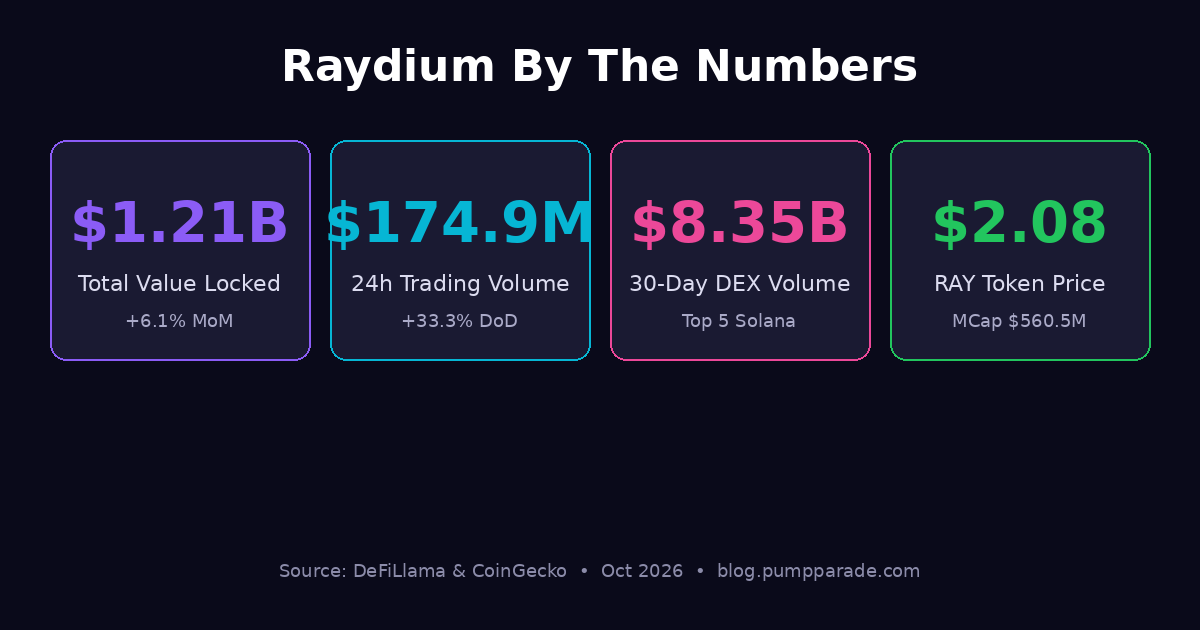
Here are the key stats as of this review, pulled from DeFiLlama, CoinGecko, and Birdeye:
- Total Value Locked: $1.21 billion, up roughly 6.1 percent over the past 30 days.
- 24-hour trading volume: $174.9 million, up 33.3 percent day over day thanks to a memecoin rotation.
- 7-day volume: $1.24 billion.
- 30-day volume: $8.35 billion, which places Raydium inside the top five Solana DEXs by throughput.
- RAY price: $2.08.
- RAY market cap: $560.5 million, with a circulating supply around 269 million tokens.
- Supported chain: Solana only (with wrapped and bridged assets available).
The TVL has stayed remarkably sticky through a choppy summer. Even when Solana memecoin volumes faded in Q3, Raydium’s pools kept most of their deposits, a sign that LPs trust the protocol with real capital rather than just hot-money speculation.
Features Deep Dive
Standard AMM Pools
The classic Raydium experience is the constant-product AMM. Any user can swap through these pools, and anyone can deposit two tokens to become a liquidity provider. Fees for most standard pools sit at 0.25 percent per trade, with 0.22 percent going to LPs and 0.03 percent routed to the RAY buyback pool.
Concentrated Liquidity (CLMM)
Raydium’s concentrated liquidity pools, often called CLMMs, work similarly to Uniswap V3. LPs can set a specific price range where their capital earns fees. This produces higher capital efficiency and larger fee yields for active providers, but it also means LPs need to rebalance when the market drifts out of their range. Fee tiers in CLMM pools typically range from 0.01 percent for stablecoin pairs to 1 percent for volatile pairs, so the economics change substantially depending on which pool you join.
Hybrid Order Book Integration
Historically Raydium shared liquidity with the Serum order book, so swap routes could pull from both the AMM and a limit order book at the same time. After the Serum shutdown in late 2022, Raydium rebuilt this integration with OpenBook, Solana’s community-driven order book. In 2026, most retail swaps route through the AMM, but larger traders can still tap deeper liquidity on paired OpenBook markets for tighter execution.
LaunchLab and Memecoin Launches
Raydium has leaned into Solana’s memecoin boom with LaunchLab, a project launch and bonding-curve platform aimed at new tokens. It is one of the main destinations for projects that graduate from pump.fun style bonding curves and want permanent liquidity on an AMM. For creators, this means fast listing, immediate price discovery, and native integration with Raydium’s existing pool infrastructure.
Yield Farming
Raydium’s “Farms” section lets LP token holders stake their positions to earn additional rewards, often in RAY plus a partner token. Yields vary widely, from mid-single digits on stablecoin pairs to 50 percent or higher APR on new memecoin pools. These are high-risk, high-reward opportunities where impermanent loss can easily eat the posted APR, so position sizing matters.
Portfolio and LP Dashboard
The Raydium portfolio tab gives LPs a clean view of their positions, pending rewards, impermanent loss exposure, and historical fees earned. It is not as deep as a third-party tracker, but it is enough to manage positions without jumping to another tool. For broader portfolio tracking across protocols, pairing Raydium with a dedicated analytics tool is still the better workflow.
Fees and Pricing
Fees are the first thing anyone looking at a DEX should check, and Raydium’s structure is competitive without being the cheapest option on Solana.
- Standard AMM swap fee: 0.25 percent per trade (0.22 percent to LPs, 0.03 percent to RAY buyback).
- CLMM fee tiers: 0.01 percent, 0.05 percent, 0.25 percent, and 1 percent, chosen by pool creators.
- LaunchLab fees: Varies by launch, typically a small protocol cut on the bonding curve and a listing fee at graduation.
- Network fee: Standard Solana network fees apply, typically fractions of a cent per transaction.
- Deposit or withdrawal fees: None. LPs can enter and exit positions at any time, paying only Solana gas.
Compared to peers, Raydium sits in the middle. Orca generally undercuts on stablecoin pairs with its 0.01 percent tier, and Jupiter can save traders money by routing across multiple DEXs. But for direct pool trades, Raydium’s fees are reasonable, especially given the depth of its memecoin and token2022 liquidity.
Pros and Cons
Pros
- Deep liquidity across memecoin, blue-chip, and stablecoin pairs on Solana.
- Both standard AMM and concentrated liquidity pools in one interface.
- LaunchLab provides a strong on-ramp for new projects without needing bespoke listings.
- Clean, responsive UI that works well on both desktop and mobile.
- Native integration with major Solana wallets and widely supported by aggregators.
- Low Solana network fees keep active LP management cheap.
- Transparent fee breakdown with clear routing of buybacks to RAY.
Cons
- Solana only. No native support for Ethereum, Base, or other chains.
- Standard AMM fee of 0.25 percent is higher than Orca’s cheapest stablecoin tier.
- RAY token has underperformed SOL and most Solana DeFi tokens over the past year.
- Impermanent loss on CLMM pools can be brutal in high-volatility memecoin pairs.
- No native fiat on-ramp, so new users still need a CEX or wallet integration to buy SOL first.
- Documentation around some newer features like LaunchLab tier mechanics could be clearer for first-time creators.
Security and Trust
Raydium has been live for close to five years, which in DeFi terms is a serious track record. The protocol has survived multiple Solana outages, the collapse of FTX and Serum, and a 2022 exploit of a pool authority that saw the team cover affected users with its own treasury and a RAY buyback adjustment. That response, while not perfect, signaled a willingness to make depositors whole and reset the system rather than socialize losses to LPs.
Smart contract audits have been performed by firms including Kudelski Security and OtterSec, with the latest reviews published on Raydium’s documentation site. The protocol is open source, with its program code viewable on GitHub, and governance updates are announced through the official @RaydiumProtocol channels. As with any DeFi protocol, residual smart contract risk is real. LPs should size positions accordingly and prefer audited pools over fresh deployments.
User Experience
The Raydium interface is one of the better DeFi UIs on Solana. Swaps load in under a second once the wallet is connected. Pool views show APR, TVL, and 24-hour volume at a glance. Adding or removing liquidity takes a handful of clicks, and transaction simulation surfaces estimated slippage before the trade signs.
Mobile support is strong. Raydium’s responsive web app works well through Phantom’s in-app browser and other Solana wallet browsers. Dedicated apps are not required, which keeps the user flow simple. The main friction point is the sheer density of information in the LP dashboard, which can feel overwhelming the first time a user manages a concentrated liquidity position.
Who Should Use Raydium?
Raydium is a great fit for several user profiles in 2026:
- Active Solana traders who want direct access to AMM pools without routing through an aggregator every time.
- Liquidity providers who are comfortable managing concentrated ranges and want higher capital efficiency.
- Memecoin degens looking for the first permanent AMM listings for tokens graduating from bonding curves.
- Project teams that want a plug-and-play launch infrastructure through LaunchLab.
- Yield farmers who are willing to accept volatility in exchange for high posted APRs.
Who should probably skip Raydium? Multi-chain traders who do not want to maintain a Solana workflow, retail users who prefer the simplicity of a swap aggregator, and risk-averse holders who are not comfortable with impermanent loss math.
Final Verdict
Raydium has aged well. In a market where new DEXs ship every quarter and old ones get forgotten by the next memecoin cycle, Raydium has kept its liquidity sticky, its interface sharp, and its product roadmap focused on real on-chain needs. It is not the cheapest DEX on Solana for every pair, and the RAY token’s price action continues to lag the broader ecosystem. But as a core piece of Solana’s DeFi stack, it remains close to indispensable.
If you spend any serious time on Solana, Raydium is worth having in your rotation. For a quick swap of a well-known pair, an aggregator may still find a better route. For deeper LP strategies, direct AMM access, and participation in new launches, Raydium is where the work happens.
Our rating: 4.3 / 5. Visit Raydium and connect a Solana wallet to try it yourself. For a broader view of where Solana is headed from here, see our Solana price prediction for 2027.
FAQ
Is Raydium safe to use in 2026?
Raydium has been live since 2021, has been audited by firms including OtterSec and Kudelski Security, and has a track record of covering users after one past exploit. No DeFi protocol is risk-free, but Raydium ranks among the better-tested AMMs on Solana. Users should still verify pool addresses, start with small test transactions, and avoid fresh unaudited pools when possible.
What is the difference between Raydium and Jupiter?
Jupiter is a swap aggregator that routes trades across many Solana DEXs, including Raydium, to find the best price. Raydium is one of those underlying DEXs. For a one-off swap, Jupiter often gives better execution. For LPing, launching tokens, or managing concentrated liquidity, you interact directly with Raydium.
What are Raydium’s fees?
Standard AMM pools charge a 0.25 percent swap fee, split between LPs (0.22 percent) and RAY buybacks (0.03 percent). Concentrated liquidity pools use tiered fees of 0.01, 0.05, 0.25, and 1 percent depending on pair volatility. Solana network fees are a fraction of a cent per transaction.
Can I earn yield by providing liquidity on Raydium?
Yes. LPs earn swap fees from the pool and can stake LP tokens in Raydium’s Farms section for additional RAY and partner-token rewards. Yields vary from mid-single digits for stablecoin pairs to 50 percent plus APR on new memecoin pools. Factor in impermanent loss before committing capital.
Does Raydium work on mobile?
Yes. The Raydium web app is responsive and works smoothly inside Solana wallet browsers like Phantom, Backpack, and Solflare. There is no dedicated iOS or Android app, which keeps the experience simple and reduces attack surface.