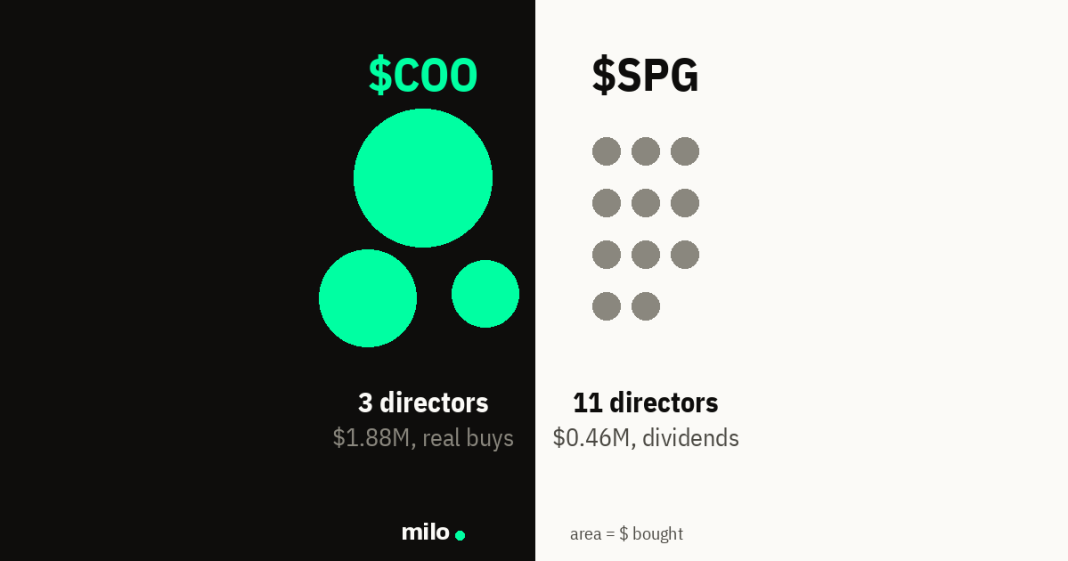
A cluster buy is when several insiders at one company buy its stock around the same time. Sometimes that means something. Sometimes it’s paperwork that happens to look exciting on a screener.
Below are two “clusters” from September 2026, both pulled from milo’s insider feed and both checked against the original SEC filings. One is three directors putting real money in. The other is eleven directors who didn’t really decide to buy anything at all. They look the same at a glance, and the difference only shows up when you open the filing.
What cluster insider buying means
Cluster insider buying means several different insiders (officers, directors or 10% owners) buying shares of their own company in the open market within a short window, usually a few days to a few weeks.
Two things worth knowing up front. First, “cluster” is a screener word, not an SEC category. The SEC never sees a cluster. It sees individual Form 4 filings, one per insider per trade report, and every tracker decides for itself what counts as close enough together. Second, there’s no official number of insiders that makes a cluster. Most tools use two or three distinct buyers, and they all pick their own time window.
On a Form 4, the line you care about is transaction code P, which the SEC’s Form 4 instructions define as an “open market or private purchase”. That’s different from code A (a grant or award), M (an option exercise) or F (shares withheld to pay tax or an exercise price). Only P means someone paid for stock.
Why people pay attention to it
One insider buying can have a dozen boring reasons. Maybe they just got a bonus, maybe the board expects directors to own shares, maybe they like the dividend. Several people at the same company buying with their own money in the same couple of weeks is harder to explain away, and that’s the whole appeal.
It’s also fast information. A Form 4 has to be filed before the end of the second business day after the trade, so you usually see an insider purchase within days, not months.
What it isn’t is a promise. The research on clusters is mixed (more on that below), and a lot of what screeners label as a cluster turns out to be mechanical. Which brings us to the two examples.
A real cluster: Cooper Companies, September 2026
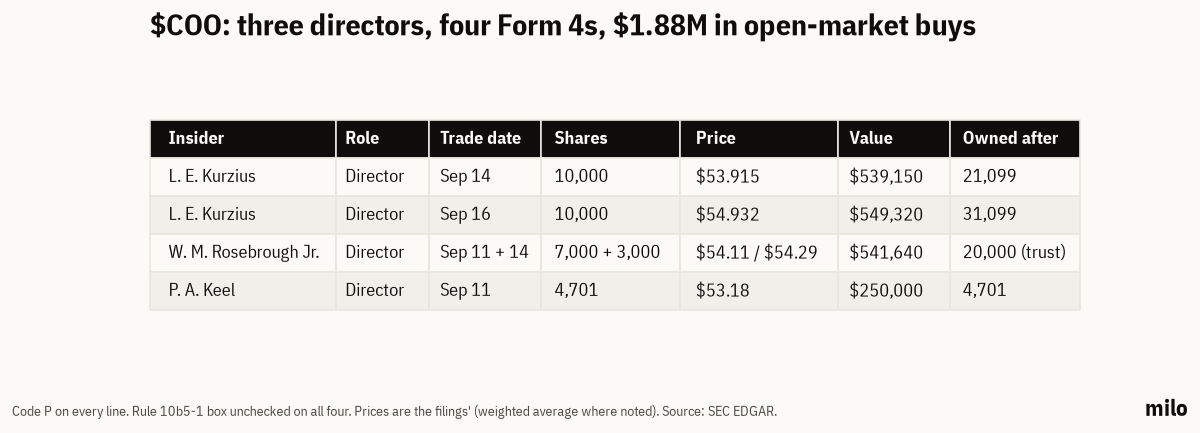
Between September 11 and September 16, three directors of Cooper Companies ($COO) bought stock in the open market. Four Form 4 filings, $1,880,109.98 combined.
Who bought, and how much
- Lawrence Erik Kurzius bought 10,000 shares on September 14 at $53.915 and another 10,000 on September 16 at $54.932. That’s two filings (first, second) and about $1.09M. His direct holding went from 11,099 shares before the first buy to 31,099 after the second, so he roughly tripled it in three days.
- Walter M. Rosebrough Jr. bought 7,000 shares on September 11 and 3,000 on September 14 at weighted average prices of $54.11 and $54.29, through a revocable trust where he’s the sole trustee (filing). $541,640 in total, taking the trust from 10,000 shares to 20,000.
- Paul A. Keel bought 4,701.015 shares on September 11 at a weighted average of $53.18 (filing). That comes to $249,999.98, which looks a lot like someone deciding “I’ll put in $250k” and letting the broker work out the share count. The filing lists 4,701.015 shares owned after the trade, the same as the purchase.
What the filings tell you
Every line is code P. Every filing has the Rule 10b5-1 box unchecked, so none of these were trades scheduled in advance under a trading plan. None of them carry a footnote about dividend reinvestment, awards or any other mechanism. The footnotes that are there just explain weighted average prices across several fills (and, for Rosebrough, the trust), which is what you’d expect from someone buying in the market.
And the sizes matter. These are hundreds of thousands of dollars per person, and in two of the three cases the purchase doubled or tripled what the director already held. That’s what a cluster is supposed to look like.
None of this tells you where $COO goes next. It tells you three people close to the company chose to put their own money in during the same week, and that you’re looking at a real signal worth researching, not a filing artifact.
A fake cluster: Simon Property Group, September 30, 2026
Why it looks like a big signal
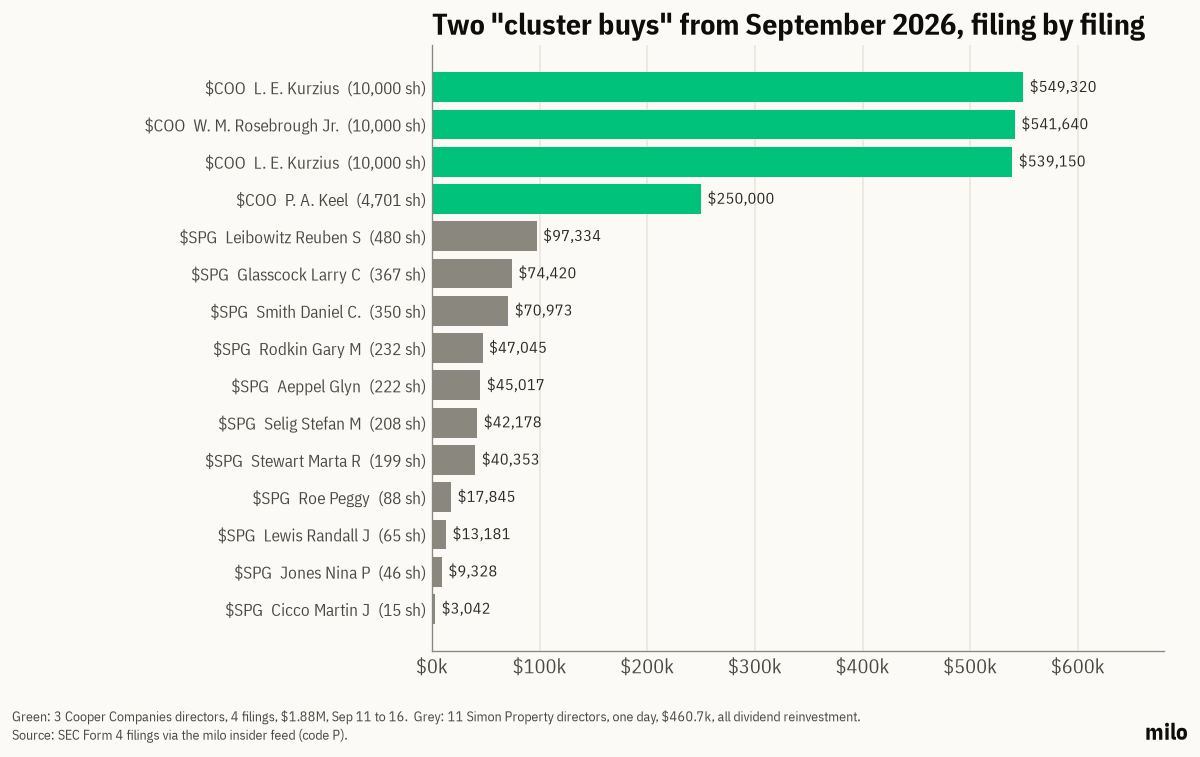
On September 30, eleven directors of Simon Property Group ($SPG) each reported a code P purchase. All eleven at the same price, $202.78. On most screeners, eleven insiders buying on one day would be the loudest cluster of the month. In milo’s feed, it was the largest group of distinct buyers at any company.
Then you look at the sizes. The eleven purchases add up to 2,272 shares and $460,716.16. The biggest was 480 shares. The smallest was 15 shares, about $3,042.
The footnote that changes everything
Open any of the eleven filings (here’s Reuben S. Leibowitz’s) and footnote F1 says the shares were:
“acquired through the reinvestment of dividends received on restricted stock awarded to the Reporting Person as non-cash compensation under the Simon Property Group, L.P. 2019 Stock Incentive Plan.”
We opened all eleven. Every one has that same footnote. So this was a dividend being paid on directors’ restricted stock and automatically turned back into shares. Nobody picked up the phone and decided to buy $SPG that day.
Here’s the part that should bother anyone who trusts filters: the 10b5-1 box is unchecked on all eleven of these too. Dividend reinvestment isn’t a 10b5-1 trading plan, so the box doesn’t catch it. Only the footnote does.
A 5-step check before you call it a cluster
- Count distinct insiders, not filings. Kurzius filed twice, so $COO is four filings but three people. It gets more extreme: in the same feed, a single 10% owner of Texas Pacific Land ($TPL), Horizon Kinetics Asset Management, filed 31 separate Form 4s between August 17 and September 29 for 34 shares in total. That’s a lot of filings and one buyer.
- Confirm code P. A, M and F are grants, option exercises and tax withholding. They show up as “acquisitions” but nobody paid market price out of pocket.
- Read the footnotes. Dividend reinvestment, plan purchases and similar mechanics live there. This is the step that exposes $SPG.
- Check the 10b5-1 box. A checked box means the trade ran on a plan set up earlier, so it says less about what the insider thinks today. An unchecked box is necessary but, as $SPG shows, not enough.
- Compare the buy to what they already own. The “amount owned following” column is right there on the form. Going from 11,099 to 31,099 shares is a decision. Adding 15 shares to 1,387 is a rounding error.
A quick red-flag rule from the two examples: same price, same day, lots of insiders, tiny share counts. When you see all four together, open the filing before you get excited.
What the research says
Honestly, it’s mixed. OQRO’s explainer summarizes a 2019 Journal of Financial Research study by Alldredge and Blank whose abstract reports that clustered insider purchases were followed by abnormal returns above 2% in the next month. The same page reports OQRO’s own 2026 test, where stocks with two or more insiders buying within 30 days beat the S&P 500 more often than single buys (43% vs 34% of the time over 90 days), but the typical result still trailed the index.
Our own numbers point the same careful way. In a small milo paper test of 72 insider purchases of $100k or more at large US companies, only 25 beat $SPY over the next 20 trading days. That test wasn’t about clusters specifically, but it’s a good reminder that “insiders bought” is not the same as “the stock went up”.
So the fair takeaway: a real cluster is a good reason to start researching a company. It’s not a buy signal by itself, and a fake one like $SPG isn’t even that.
How to track clusters without the busywork
Doing the five checks by hand on every filing gets old fast. That’s most of what milo’s insider feed is for: it watches SEC Form 4 open-market buys (code P) across the roughly 500 US companies it tracks, links every filing, and lets you follow an idea in a paper portfolio so you can see how it plays out with no real money involved.
Watch insider buys and paper-test the ones that pass your checks. Try milo free. If you just want the filings, milo’s insider and SEC filings page lists them for the most-followed US stocks.
For a weekly short list of the open-market buys that held up after we read the filings, there’s the milo Insider Digest. And if you’re still choosing a tracker, our free OpenInsider alternative guide compares the options.
FAQ
What is cluster insider buying?
Several different insiders at the same company buying its shares on the open market within a short period, usually days to weeks. It’s a screener term, not an official SEC label.
Is cluster insider buying a bullish signal?
Sometimes. Several people risking their own money at once is notable, but research results are mixed and many “clusters” are mechanical. Treat it as a reason to look closer.
How many insiders make a cluster?
There’s no official number. Most screeners use two or three or more distinct insiders, each with its own time window.
How do I spot a fake cluster?
Look for the same price on the same day across many insiders, small share counts, and footnotes that mention dividend reinvestment or a plan. The eleven $SPG director filings on September 30, 2026 had all of those.
Where do I find insider purchases?
SEC EDGAR has every Form 4 for free. Trackers like OpenInsider and the milo Insider Digest collect them so you don’t have to search company by company.
Does a 10b5-1 plan matter?
Yes. A trade under a pre-set 10b5-1 plan was scheduled in advance, so it says less about the insider’s current view. Form 4 has a checkbox for it. It won’t flag dividend reinvestment, though, so read the footnotes too.
For education only. Not investment advice. milo stock features are paper trading and research only. Data: milo insider feed (SEC Form 4, code P, 100 filings dated August 18 to October 7, 2026), checked against the original filings on SEC EDGAR on October 19, 2026. Share counts and prices are as reported in the filings.