Aave (AAVE) trades at $150.61 at the time of writing, down 5.7% in the last 24 hours and down 12.8% on the week. Any serious Aave price prediction 2027 starts with the one-month picture: AAVE is still up 18% over the past 30 days, and the protocol itself crossed $51 billion in total value locked earlier this year with a 17.9% share of all DeFi deposits.
That is not a struggling franchise. That is the dominant lender in on-chain credit, trading at a 77% discount to its 2021 all-time high. The real Aave price prediction 2027 debate hinges on three questions. Does Aave V4 ship cleanly and keep institutional borrowers? Does GHO scale from a few hundred million into the multi-billion stablecoin tier? And does the automated buyback flywheel, now running under Aavenomics 3.0, outrun DeFi token dilution across the sector?
This article walks through the data behind each of those questions, lays out specific bear, base, and bull targets by timeframe, and gives you a set of invalidation levels so you can tell when the thesis is working and when it is not.
Key Takeaways
- AAVE trades at $150.61, down 12.8% on the week but up 18% on the month, with a $2.32B market cap and rank 46.
- Protocol fundamentals are strong: $51B TVL, 17.9% DeFi market share, and $402M in annualized revenue reported mid-2026.
- Aavenomics 3.0 went live in late June 2026, routing protocol revenue into automated AAVE buybacks and cutting DAO operating spend.
- Aave V4 is already live on Ethereum and Avalanche with over $800M in deposits across both deployments, and Horizon RWA is targeting $1B in net deposits in 2026.
- Our base case AAVE price prediction for 2027 sits in the $280 to $330 band, with a bull target of $450 and a bear floor near $85.
- The thesis invalidates on a weekly close below $85, a GHO depeg event, or Morpho taking majority DeFi lending share.
Where AAVE Stands Today
Before we talk about targets, here is the snapshot that frames everything else. All prices are as of October 15, 2026.
| Metric | Value |
|---|---|
| Price | $150.61 |
| 24-hour change | -5.69% |
| 7-day change | -12.78% |
| 30-day change | +18.08% |
| Market capitalization | $2.32 billion |
| 24-hour volume | $260 million |
| Market cap rank | 46 |
| All-time high | $661.69 (May 2021) |
| % from ATH | -77.24% |
| Circulating supply | 15.44 million of 16 million |
The number worth sitting with is the 96% circulating ratio. Only about 560,000 AAVE remain to be released, which puts the token in roughly the same supply-shock category as late-cycle Bitcoin. Combine that with active buybacks and you get the structural setup bulls keep pointing at.
Why Is AAVE Range-Bound Right Now?
AAVE has spent most of 2026 in a $110 to $220 range, and the current pullback to $150 is a textbook mid-range flush. Three forces are keeping the token honest.
First, macro. Risk assets are rotating out of mid-caps as traders brace for a slower pace of Fed cuts. That is hitting the entire DeFi basket, not just AAVE. The 24-hour decline across the top 50 lending and perps tokens averaged -4% to -8% today.
Second, token unlocks and sector rotation into Hyperliquid and Aster perps have pulled capital away from DeFi 1.0 names. Our own recent coverage of Hyperliquid’s $150 target shows that story in motion.
Third, and this is the one that matters, the market is still pricing in execution risk on Aave V4. The code is live. The deposits are growing. But the market wants to see migration finish and Risk Stewards activated on both Ethereum and Avalanche before it re-rates the token.
Is AAVE a Buy at $150?
At $150, AAVE trades roughly five times forward earnings against reported protocol revenue, which is cheap for a franchise with scale. Three catalysts, each with hard numbers behind them, support the upside thesis and could re-rate the token.
Aave V4 Scales Past $5B in Deposits
V4 uses a Hub and Spoke design: a single cross-chain Liquidity Hub holds deposits, while customizable Spokes host asset-class or venue-specific markets. As of the August 2026 development update from Aave Labs, V4 deposits across Ethereum and Avalanche crossed $800 million, with active loans at a record high. If migration from V3 continues through Q1 2027 at the current pace, V4 alone could carry $5B to $10B in deposits by late 2027. That is the kind of unit economics that justifies a materially higher AAVE price.
Aavenomics 3.0 and Automated Buybacks
Aavenomics 3.0 went live on June 27, 2026, and routes protocol revenue into automated AAVE token buybacks. The protocol was running at a reported $402M in annualized revenue at the time, with TVL of $12.45B on the V4 deployment alone. Mechanical buybacks against a near-fully-diluted float of 15.44M tokens matter. If 20% of protocol revenue flows into buybacks for a full year, that is roughly $80M chasing a thin float of unlocked AAVE: around 2.5% of the circulating market cap per year, bought automatically. That is a slow but relentless bid.
Horizon RWA Hits $1 Billion
Horizon, Aave’s institutional RWA market, launched in August 2025 and had $550M in net deposits by December 2025, per founder Stani Kulechov. The 2026 target he set publicly is $1B and beyond, working with Circle, Ripple, Franklin Templeton, and VanEck. Horizon lets qualified institutions borrow USDC, RLUSD, or GHO against tokenized money-market funds. If Horizon hits $1B this year, it validates AAVE as the credit layer institutions actually use, not just a DeFi curiosity. Related reading: our Chainlink price prediction covers the oracle rails those RWAs depend on.
What Could Push AAVE Below $100?
Balanced analysis means naming the risks. Here are the three that could keep AAVE pinned below $200 or send it lower.
Morpho and Compound Steal Share
Morpho’s optimizer and vault architecture has been winning lender market share through 2026. If Morpho’s TVL continues to grow at double the pace of Aave’s, the 17.9% DeFi market share Aave reported mid-year starts to shrink. Lending is a scale business. Losing share compresses revenue, which compresses buyback flow, which compresses the token thesis.
GHO Depeg or Stall
GHO’s supply has crawled, not sprinted. Staked GHO sits at a reported $14.4M as of the August 2026 governance update, which is tiny relative to the opportunity. The bear case is that GHO never breaks out of its niche, meaning Aave’s stablecoin bet is a cost center rather than a growth engine. A GHO depeg event, however brief, would also damage the trust the protocol has spent years building.
Regulatory Chill on DeFi Lending
The U.S. SEC closed its four-year investigation of Aave in August 2025, which was a huge tailwind. But stablecoin regulation under the GENIUS Act and ongoing debate on DeFi lending licenses mean the regulatory ceiling is not fully priced. A single enforcement action against an on-chain lender, even one that is not Aave, could cool institutional borrower demand on Horizon overnight.
Can AAVE Hit $300 by End of 2027?
Here is where the above translates into numbers. Every target is a scenario, not a promise, and every scenario has invalidation levels so you can hold the thesis accountable.
30-Day Outlook (through mid-November 2026)
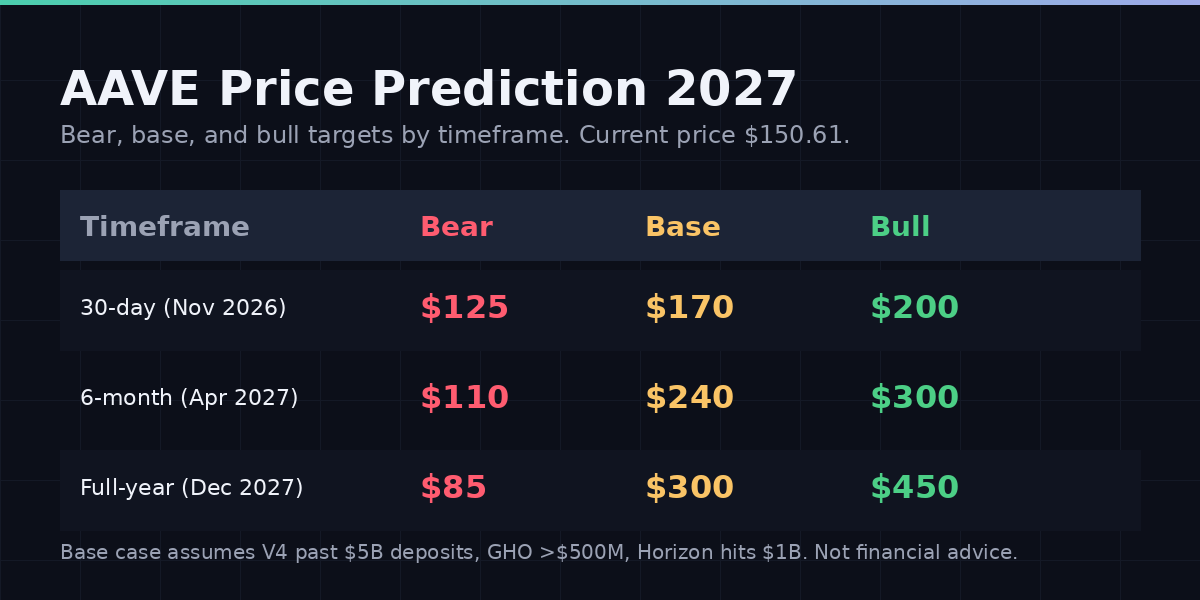
AAVE is mid-range after a 12.8% weekly flush. The 50-day moving average sits near $162 and should act as resistance on the first reclaim attempt. Our hybrid model gives a 55% probability of a bounce into the $165 to $185 zone within 30 days if BTC holds above $78,000. The downside risk is a flush to the $125 to $130 band, which lines up with the June 2026 breakout retest. Bear: $125. Base: $170. Bull: $200.
6-Month Outlook (through April 2027)
This window captures the next V4 Risk Steward activation, likely Q1 2027 Umbrella updates, and the first full six months of Aavenomics 3.0 buyback data. If V4 crosses $2B in deposits and GHO breaks $500M in supply, AAVE should trade in the $220 to $280 range. Bear: $110. Base: $240. Bull: $300.
Full-Year 2027 Target (through December 2027)
This is where the question “can AAVE hit $300?” gets answered. Our base-case AAVE price prediction for 2027 is $280 to $330, which assumes V4 scales to $5B+ in deposits, Horizon hits its $1B target and expands, and buybacks compound for a full year against a nearly fully circulating supply. The bull case clears $450 if ETH rallies past $5,000 and DeFi TVL across the sector doubles. The bear case is a $85 floor if lending share erodes and buybacks fail to offset dilution from other DeFi tokens draining the sector.
For comparison: Changelly publishes an average 2027 AAVE target of $424 with a $493 maximum, while Coinbase’s 5% growth model implies $135 in 2027. Our base case sits roughly in the middle of those two anchors, which is where we expect the market to settle given actual protocol fundamentals.
How Does AAVE Compare to Morpho?
Lending protocols should be judged head-to-head on the same metrics. Here is the comparison that matters.
| Metric | Aave | Morpho |
|---|---|---|
| Total value locked | $51 billion | ~$7 billion |
| DeFi lending market share | 17.9% | ~5% |
| Annualized revenue | $402M (mid-2026) | ~$60M est. |
| Buyback mechanism | Automated via Aavenomics 3.0 | None active |
| Native stablecoin | GHO | None |
| RWA market | Horizon ($550M+ deposits) | Limited |
| Circulating supply ratio | 96.4% | ~32% |
The scoreboard favors Aave on every structural metric: more TVL, more revenue, active buybacks, a native stablecoin, and a near-fully circulating supply. Morpho’s edge is architecture: isolated vaults, cleaner risk, and a growing lender preference for curated markets. Our take is that AAVE wins on scale and MORPHO wins on growth rate. For 2027, we think the market still rewards scale.
What Would Change Our View on AAVE
Here are the three scenario triggers that would force us to redo this analysis.
One: a GHO depeg event or a credible exploit on V4 that locks user funds. Either event would reset the trust premium and the base case drops by at least 30%. Two: Morpho crossing 15% DeFi lending market share. That signals that curated markets, not pooled markets, are the future, and Aave’s revenue model needs a rebuild. Three: U.S. regulatory action naming on-chain lending as a licensed activity in a way that disfavors permissionless protocols. The institutional borrower pipeline into Horizon would thin out fast.
On the upside, a single trigger would push us toward the bull target: ETH reclaiming $5,000 with Aave V4 above $5B in deposits before Q2 2027. That is the combo that unlocks the $450 scenario.
Frequently Asked Questions
Can AAVE reach $300 in 2027?
Our base case AAVE price prediction for 2027 is $280 to $330, so yes, $300 is well within reach if Aave V4 scales past $5B in deposits and automated buybacks under Aavenomics 3.0 continue compounding. The scenario needs ETH to hold above $3,500 and DeFi TVL to grow sector-wide. It is not guaranteed, but it is the central scenario.
Is AAVE a good investment in 2027?
AAVE has the strongest fundamentals in DeFi lending: $51B TVL, 17.9% market share, $402M in annualized revenue, and automated buybacks against a near-fully-circulating supply. Those are the kind of metrics equity analysts would call investable. That said, crypto risk-reward is bimodal, so size positions accordingly and never allocate more than you can afford to lose on a single DeFi name.
Why is AAVE price falling?
AAVE is down 12.8% this week on a mix of macro de-risking, token unlocks across the DeFi sector, and capital rotation into perps DEX tokens like Hyperliquid and Aster. The protocol fundamentals have not changed: TVL and revenue continue to grow. Short-term price and long-term fundamentals are often disconnected, and this is one of those windows.
What is Aavenomics 3.0?
Aavenomics 3.0 is the governance upgrade that went live on June 27, 2026. It routes a portion of protocol revenue into automated AAVE token buybacks and cuts DAO operational spending. The practical effect is a permanent, mechanical buy pressure on AAVE tokens funded by the lending protocol’s actual revenue, independent of market sentiment.
What is the AAVE price prediction for 2030?
Longer-term predictions carry more uncertainty, but our model points to a $600 to $900 range by 2030 if Aave becomes the dominant on-chain credit layer and GHO reaches $5B in supply. Changelly’s published 2030 average sits at $1,407, which is more aggressive. Coinbase’s 5% growth model gives $156. Reality will almost certainly land between those two anchors.
How does Aave make money?
Aave earns revenue from the spread between borrowing rates and lending rates on every market, plus flash loan fees, GHO interest, and liquidation penalties. At $402M in annualized revenue, Aave operates like a bank with a 15.44M-token share class, and under Aavenomics 3.0 part of that revenue flows back into buying AAVE on the open market.
The Honest Take
AAVE is one of the cleanest “fundamentals vs price” setups in crypto right now. The protocol does $402M in annual revenue, holds $51B in deposits, buys back its own token mechanically, and has a 2.32% supply overhang. The token trades 77% below its 2021 high. If any of this were a public equity, analysts would be writing accumulate notes.
But it is not a public equity. It is a DeFi governance token in a sector that gets rotated out of every time the macro turns. The $300 target by end of 2027 is not a prediction we would bet the house on, it is the probability-weighted base case given the information we have today. Watch V4 deposit growth, GHO supply, Horizon deposits, and the pace of buyback execution. Those four numbers will tell you more about where AAVE is going than any chart pattern.
The setup looks constructive. The execution risk is real. Position size accordingly, and for broader DeFi context, our Aave Review 2026 digs into the fees, features, and user experience side of the protocol.
Disclaimer: This article is for informational and educational purposes only and should not be construed as financial, investment, or trading advice. Cryptocurrency markets are highly volatile, and past performance does not guarantee future results. The price predictions and analyses presented here are based on AI models, technical indicators, and available data at the time of writing: they are not guarantees. Always conduct your own research (DYOR) and consult with a qualified financial advisor before making any investment decisions. Pump Parade and its authors do not assume liability for financial losses incurred based on information provided in this article.