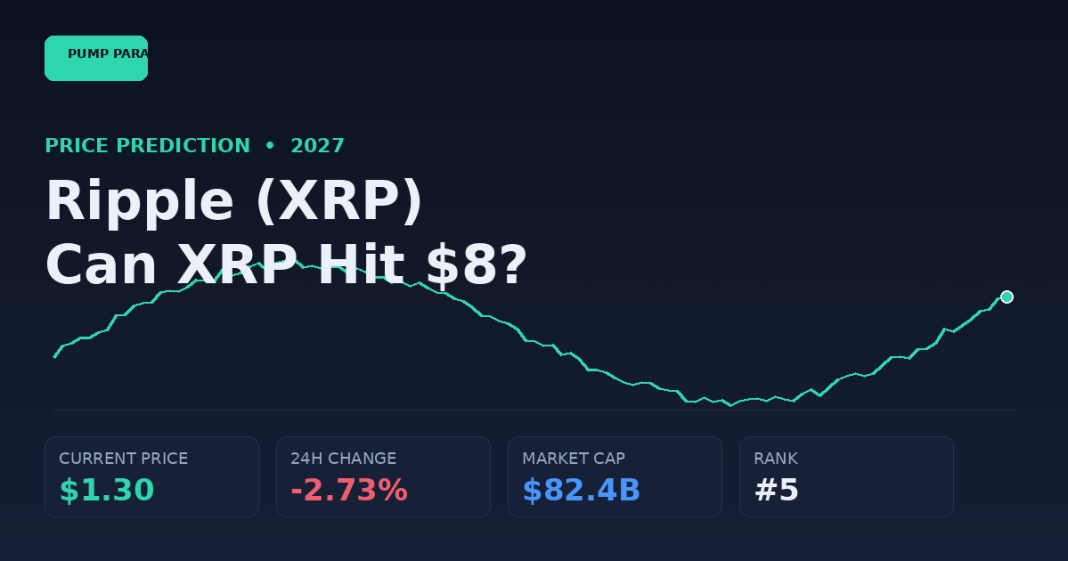
The XRP price prediction 2027 question has moved from fringe forum chatter into mainstream analyst spreadsheets. Standard Chartered, Bitwise, and Grayscale all now carry formal XRP targets in their 2027 and 2028 models. The numbers are far apart, and the chart doesn’t look like a token with institutional conviction.
XRP trades at $1.30 at time of writing, down 2.73% on the day and roughly 66% below its all-time high. That price sits almost 54% below where the first spot XRP ETF launched in November 2025, even though those ETFs have pulled in about $1.4 billion in cumulative inflows since.
Here’s what the data suggests, where analyst models disagree, and the specific levels and events that would push XRP toward the $8 Standard Chartered target by end-2027, or confirm the bear case instead.
Key Takeaways
- XRP trades at $1.30, with a $82.4B market cap and roughly 66% below its 2018 USD all-time high of $3.84.
- Six spot XRP ETFs have attracted about $1.4 billion in net inflows since November 2025, but price fell 54% over the same period.
- Standard Chartered targets $8 by end-2026 and $10.40 by end-2027. Bitwise’s max case hits $9.60 by end-2027.
- Our base case for 2027 lands at $4.80, with a bear case near $1.90 and a bull case near $9.
- The $1.20 to $1.35 support zone and the $2.00 resistance ceiling are the two levels that matter most over the next 90 days.
Where Does XRP Stand Today?
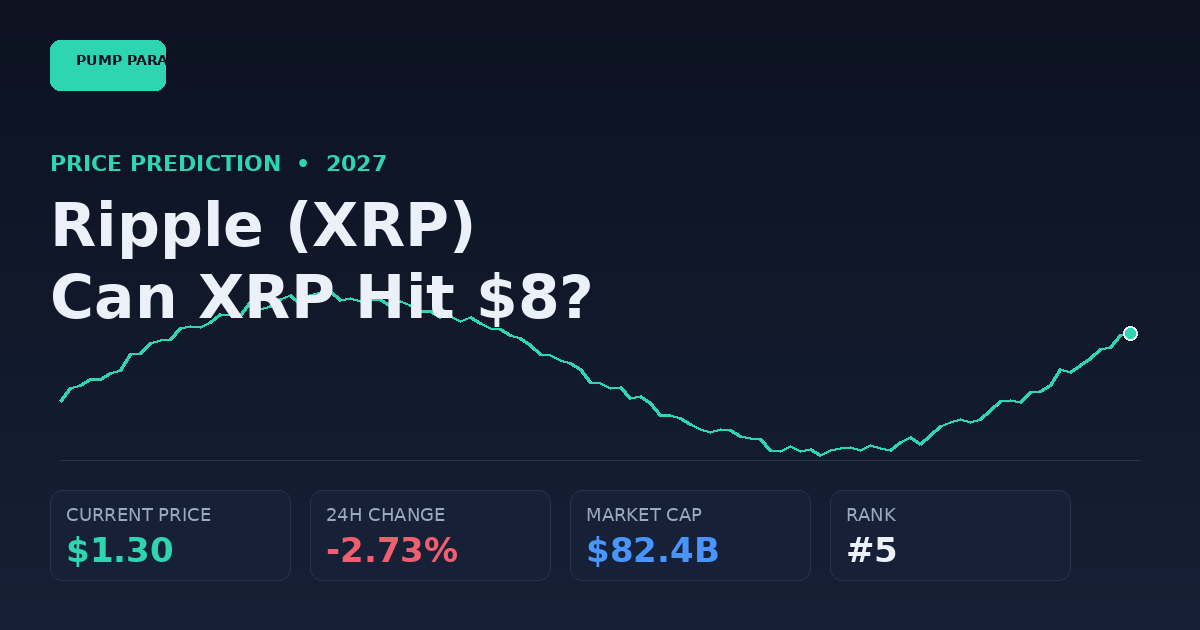
Before any 2027 forecast earns credibility, the setup needs context. Here’s the snapshot pulled from current market data:
| Metric | Value |
|---|---|
| Price | $1.3047 |
| 24h change | -2.73% |
| 7d change | -7.18% |
| Market cap | $82.37B |
| 24h volume | $0.97B |
| Market cap rank | #5 |
| All-time high (USD) | $3.84 (Jan 2018) |
| % from ATH | -66.0% |
Volume is the first flag. Just under $1B in 24-hour turnover is light for a top-five asset with ETF products listed on US exchanges. For comparison, that’s less than one-third of what XRP routinely traded during its December 2024 rally. Thin volume on a losing tape typically means positioning, not panic, but it also means breakouts have to overcome liquidity dead zones.
The 66% drawdown from ATH is misleading if you only read the headline. XRP set that peak during the January 2018 cycle, before the SEC lawsuit, before Ripple’s 2023 legal win, and before any ETF existed. The more useful benchmark is the November 2025 high above $3.00, which coincided with the ETF launch window. Current price is tracked live on CoinMarketCap.
Why Is XRP Range-Bound Right Now?
Three overlapping forces explain the current chop between $1.20 and $1.60.
First, the ETF narrative front-ran itself. XRP ran from under $0.60 in October 2024 to above $3.00 in January 2025 on anticipation of ETF approval. When the approvals landed in November 2025, there was no fresh fuel. Classic buy-the-rumor, sell-the-news behavior, and ETF inflow data has not been strong enough to overcome the selling pressure from early longs taking profit.
Second, Ripple’s monthly escrow releases keep adding supply. One billion XRP unlocks each month, with most returned to escrow but typically 300 to 500 million circulating. That’s roughly $400 million to $650 million in potential sell pressure at current prices, which the market has to absorb before any sustained rally.
Third, macro and crypto beta. Bitcoin is down about 1.4% on the week, Ethereum is off 2.4%, and the broader altcoin complex is in a 5% to 15% weekly drawdown. XRP’s 7-day performance of -7.18% is actually in line with the sector, not an outlier. The token is not breaking down on token-specific news. It’s drifting with the tape.
The Bull Case for XRP
Three concrete catalysts underpin the thesis for XRP reaching $8 or higher by 2027.
Bull Case 1: ETF Inflows Compound
Spot XRP ETFs hold about $1.37 billion in AUM across six products, roughly 1.6% of XRP’s market cap. The pace matters more than the absolute figure. Weekly net inflows of $43.16 million are modest, but Franklin’s XRPZ and Bitwise’s XRP are consistently leading flows, with cumulative inflows of $252 million and $265 million respectively. If retail-driven ETF demand holds at even $200 million per month through 2026, that’s $2.4 billion in annual spot buying. Bloomberg Intelligence analyst James Seyffart has noted XRP ETF demand skews more retail than Bitcoin ETFs, which creates a different flow dynamic worth tracking.
Bull Case 2: RLUSD and the Payments Narrative
Ripple’s RLUSD stablecoin crossed $2.49 billion in market cap in 2026, growing 86% since the start of the year according to KuCoin’s tracking. That matters for XRP because every RLUSD transaction on the XRP Ledger consumes XRP for fees, and the growth narrative strengthens the case that institutions are picking XRPL as their settlement rail. If RLUSD continues scaling and major banks move cross-border flows onto XRPL, the base demand for XRP as a bridge asset gets real for the first time since 2017.
Bull Case 3: The Tokenization Thesis
Bitwise CIO Matt Hougan’s April 2025 investment case for XRP models the token capturing 1% to 2% of a projected $10.9 trillion global tokenization market. That math produces a max-case target of $9.60 by end-2027 and $29.32 by 2030. The thesis rests on XRPL’s low fees, deterministic finality, and growing roster of institutional partners. Hougan’s 2025 target of $4.48 missed badly as XRP closed near $2, so the model’s track record is weak, but the directional logic on tokenization is widely shared across institutional research desks.
The Bear Case for XRP
Three risks keep us from putting more than modest conviction behind the bull targets.
Bear Case 1: ETF Demand and Price Have Decoupled
This is the single biggest problem. XRP ETFs have attracted $1.4 billion in net inflows while the spot price fell 54%. Either institutional allocators are absorbing supply from retail sellers who are taking profit after a multi-year wait, or the ETF structure is routing demand that would otherwise show up on exchanges without providing the price pressure markets priced in before approval. Either way, the clean “ETF inflows equal price appreciation” story that worked for Bitcoin isn’t working for XRP so far.
Bear Case 2: Escrow Supply and Insider Flows
Ripple holds roughly 36 billion XRP in escrow, releasing one billion per month. Historically about 70% returns to escrow, but the 300 million or so that stays in circulation represents meaningful fresh float. On top of that, Ripple itself sells XRP to fund operations, and insider wallet movements get tracked and front-run by on-chain analytics firms. The result is a persistent supply overhang that caps rallies more aggressively than it does for assets with fixed-schedule emissions.
Bear Case 3: Payments Competition is Fierce
XRP’s original pitch was replacing or complementing SWIFT for cross-border settlement. That lane now has serious competitors: Stellar’s partnership with MoneyGram and Franklin Templeton, Hedera’s enterprise consortium with Google and IBM, and stablecoins routed on Solana, Ethereum, and Base that increasingly handle corporate payments. Chainlink’s CCIP is building the interoperability layer banks actually want. For a deeper comparison, our Stellar price prediction covers how XLM is positioning in the same lane.
XRP Price Prediction 2027: Targets by Timeframe
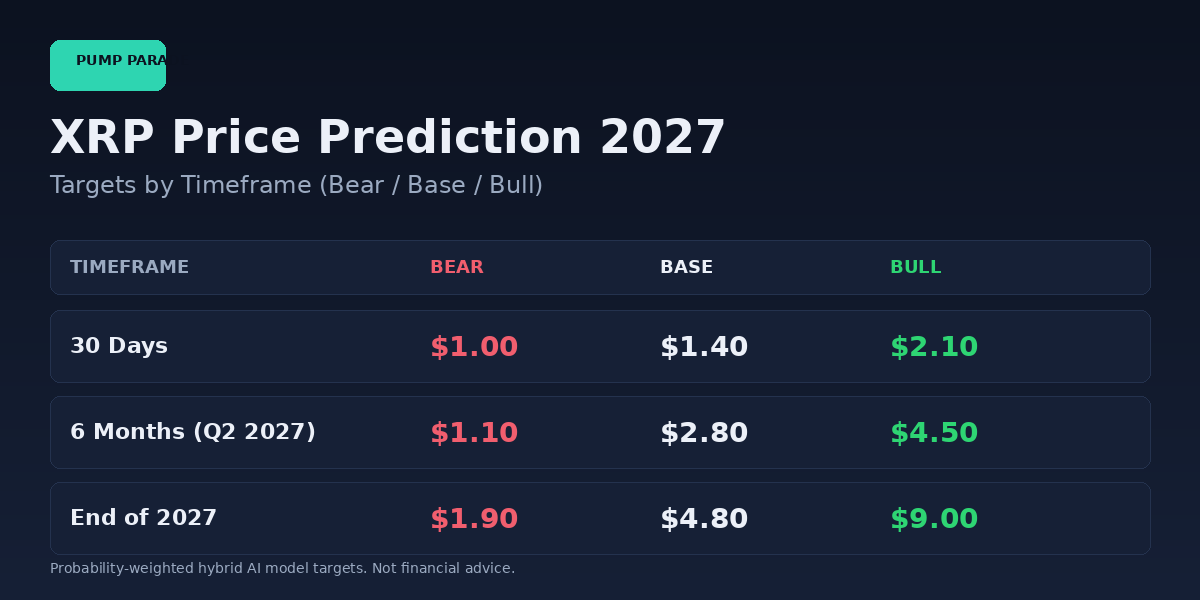
Our hybrid AI model combines technical structure, on-chain flows, ETF demand data, and comparable asset cycles. Here’s how the probability-weighted targets break down.
30-Day Outlook
The near-term setup is a classic range trade. Support sits at $1.20 to $1.25, which has held three times since September. Resistance stacks at $1.60 (local pivot) and then $2.00 (psychological, previous consolidation). The pattern suggests a 60% probability of continued chop in the $1.20 to $1.65 zone, 25% probability of a breakdown toward $1.00 if BTC loses $78K, and 15% probability of a breakout above $2.00 on positive ETF flow data or a Ripple partnership announcement.
- Bear case: $1.00
- Base case: $1.40
- Bull case: $2.10
6-Month Outlook (Through Q2 2027)
The six-month frame is where the ETF narrative gets tested. If cumulative inflows cross $3 billion by Q2 2027 and RLUSD market cap passes $5 billion, the probability of a sustained move above $2.50 jumps materially. A base case here assumes modest ETF accumulation, continued RLUSD growth, and no major regulatory setback.
- Bear case: $1.10
- Base case: $2.80
- Bull case: $4.50
Long-Term 2027 to 2028 Outlook
The 2027 price prediction is where analyst models diverge most. Standard Chartered’s $10.40 target implies an 8x move from current price. Bitwise’s $9.60 max case assumes 1% to 2% capture of global tokenization volume. CoinCodex-style flat-growth bear models suggest $2.70 or lower. Our probability-weighted base case lands at $4.80.
- Bear case: $1.90
- Base case: $4.80
- Bull case: $9.00
How Does XRP Compare to Stellar (XLM)?
Stellar is the closest functional competitor to XRP. Both target cross-border payments. Both have real institutional partnerships. Here’s how they stack up:
| Metric | XRP | Stellar (XLM) |
|---|---|---|
| Price | $1.30 | $0.18 |
| Market cap | $82.4B | $6.3B |
| Market cap rank | #5 | #23 |
| Native stablecoin | RLUSD ($2.49B) | USDC (via partnership) |
| Spot ETF | Yes (6 products) | No (pending) |
| Transaction finality | 3-5 seconds | 3-5 seconds |
| Average fee | ~$0.0002 | ~$0.00001 |
| Major enterprise partner | Bank of America, SBI | MoneyGram, Franklin Templeton |
XRP wins on market cap, ETF presence, and native stablecoin momentum. Stellar wins on fees and has stronger retail remittance adoption through MoneyGram. For investors sizing the broader cross-border thesis, holding both is a defensible way to express the view without picking the single winner.
What Would Change Our 2027 XRP View?
Three specific triggers would move our 2027 base case up or down.
Upgrade trigger: Spot XRP ETF cumulative inflows cross $5 billion by end-Q2 2027, and RLUSD market cap passes $7 billion. Together those signal real institutional adoption rather than retail speculation, and the base case shifts toward $7.00 by end-2027.
Downgrade trigger: A sustained weekly close below $1.00 on rising volume, combined with net ETF outflows for four consecutive weeks. That setup would confirm that current price action is not consolidation but distribution, and the base case drops toward $1.50.
Regime-change trigger: Major US bank announces XRPL integration for cross-border settlement in production, not pilot. That’s the catalyst that unlocks the Bitwise max case and pulls our bull target toward $12. No such announcement is on the public calendar as of this writing.
Frequently Asked Questions
Will XRP reach $5 in 2027?
Reaching $5 by end-2027 implies a 4x move from current price. That’s within reach in a bull-case scenario where ETF inflows accelerate past $3 billion cumulative and RLUSD scales toward $10 billion. Our probability-weighted base case lands at $4.80, so $5 is essentially the upper edge of the base case rather than a bull-only outcome.
Is XRP a good investment in 2027?
XRP sits at a difficult spot: it has real catalysts (ETFs, RLUSD, tokenization), but the clean “ETF approval drives price” thesis has not played out. The risk-reward is reasonable at current levels for investors with a 2-year horizon who can tolerate 40% drawdowns. It’s not a conviction trade in the short term.
What is Standard Chartered’s XRP price prediction?
Standard Chartered’s digital assets research team, led by Geoffrey Kendrick, has published targets of $8 by end-2026, $10.40 by end-2027, and $12.50 by end-2028. The firm’s models rely on continued ETF adoption and growing cross-border payments market share for XRP.
How much are spot XRP ETFs holding?
Six spot XRP ETFs together hold about $1.37 billion in assets as of early 2026. Franklin Templeton’s XRPZ and Bitwise’s XRP ticker lead weekly inflows, while Canary Capital’s XRPC has the largest AUM at approximately $349 million.
Why has XRP’s price fallen since ETF approval?
Three overlapping reasons. ETF approval was priced in during the 2024 run from $0.60 to above $3.00. Monthly escrow unlocks of 300 to 500 million circulating XRP create persistent supply pressure. Broader altcoin weakness through 2026 has dragged on the whole sector. ETF inflows have been steady but not large enough to offset those headwinds.
The Honest Take
XRP is a token the data community has strong priors on in both directions. The bull case is specific: ETFs, RLUSD, tokenization, a growing institutional roster. The bear case is also specific: supply overhang, decoupled ETF demand, and competition from faster-moving ecosystems. The uncomfortable reality is that both can be true at the same time.
Our model’s probability-weighted 2027 target is $4.80, with meaningful tails on both sides. If you own XRP as a long-term bet on cross-border payments, the thesis is intact but requires patience that most retail traders don’t have. If you’re trying to time a short-term swing, the $1.20 to $2.00 range is the realistic playing field until one of the triggers above fires. For a comparison with another payments-adjacent token, our Hedera (HBAR) price prediction covers a smaller-cap bet on the same enterprise narrative. For how our last XRP read is tracking, see our prior XRP price prediction for 2026.
The real question for the next 90 days isn’t whether XRP hits $8. It’s whether weekly ETF inflows reaccelerate above $100 million and RLUSD keeps compounding. Those two metrics will tell you more about the 2027 target than any chart pattern.
Disclaimer: This article is for informational and educational purposes only and should not be construed as financial, investment, or trading advice. Cryptocurrency markets are highly volatile, and past performance does not guarantee future results. The price predictions and analyses presented here are based on AI models, technical indicators, and available data at the time of writing. They are not guarantees. Always conduct your own research (DYOR) and consult with a qualified financial advisor before making any investment decisions. Pump Parade and its authors do not assume liability for financial losses incurred based on information provided in this article.