
A Form 4 is how a company insider tells the public they bought or sold their own company’s stock. Click one on EDGAR and you get a wall of boxes, tiny numbered columns and legal footnotes. You only need about six of those boxes, and they take a minute once you know where to look.
So let’s read a real one. On September 10, 2026, Uber CEO Dara Khosrowshahi bought 141,000 shares of $UBER. We’ll go through his filing box by box. Then we’ll look at a $PEP filing that says “purchase” on every line and still isn’t a purchase in the way most people mean it.
What a Form 4 is and when it’s filed
Form 4 is filed with the SEC by a company’s officers, directors and anyone who owns more than 10% of a class of its stock. Every time one of them changes their holdings, they file one.
The SEC’s Form 4 instructions say it “must be filed before the end of the second business day following the day on which a transaction resulting in a change in beneficial ownership has been executed.” That speed is why people watch them.
Khosrowshahi traded on September 10, 2026, and EDGAR shows his filing accepted the same day.
Where to find one
Every Form 4 is free on SEC EDGAR. Search for the company and filter its filings by form type 4. Each filing has a readable HTML version and the raw XML that trackers read.
Trackers like OpenInsider and the milo Insider Digest save you the searching. A good one links back to the original filing, because you’ll want to check the source before you trust a number. If you’re still choosing a tool, our free OpenInsider alternative guide compares the options.
Walking through Uber’s September 10, 2026 filing
Here’s the real filing, as EDGAR renders it, with our notes on top. You can open the original on EDGAR (accession 0001184237-26-000008) and follow along.
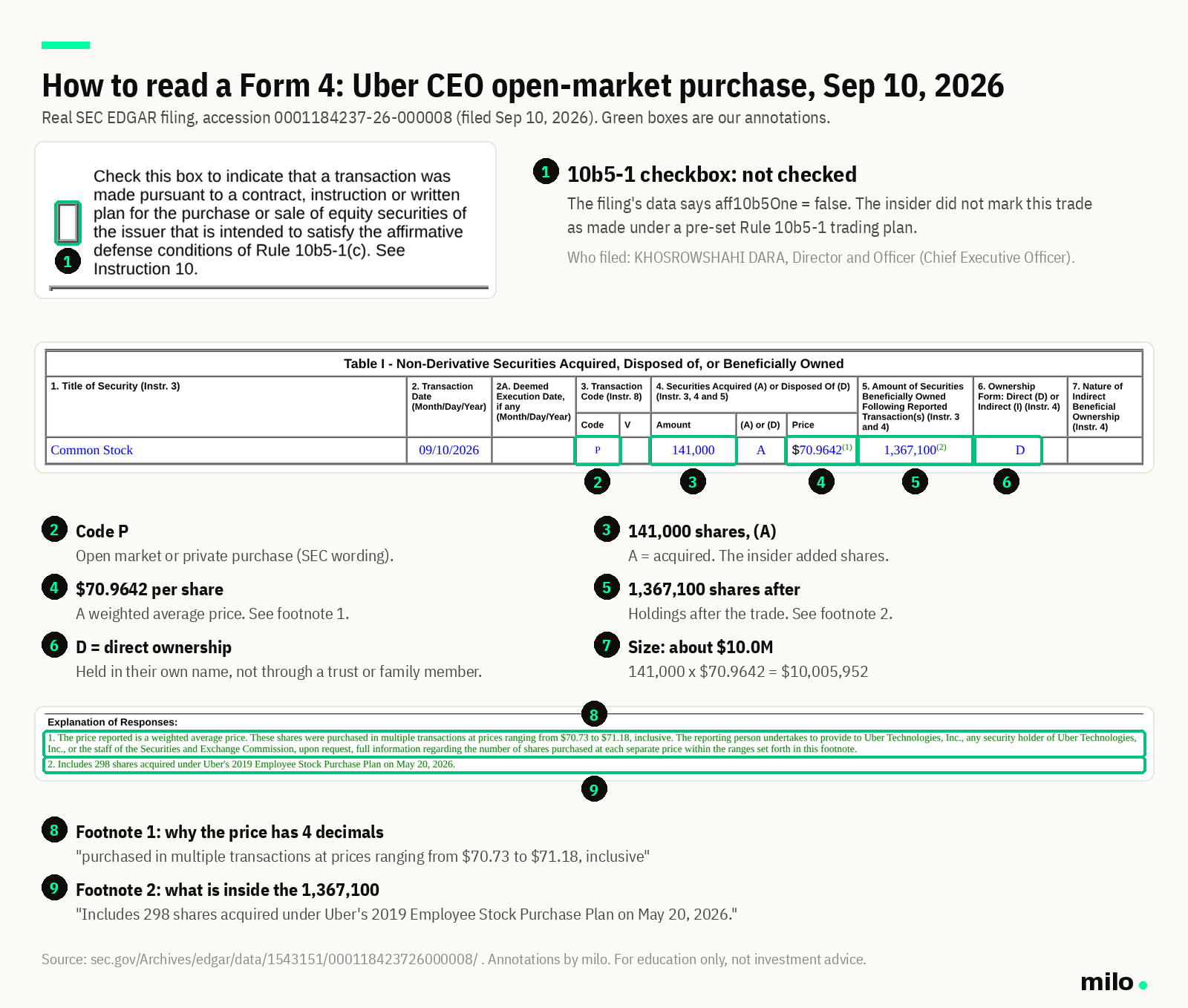
Boxes 1 and 5: who filed and how they’re related to the company
Box 1 is the filer’s name, here KHOSROWSHAHI DARA, last name first. Box 2 is the company, Uber Technologies, Inc, $UBER.
Box 5 is the relationship. Khosrowshahi ticked both Director and Officer, and the officer title is Chief Executive Officer. A CEO buying with their own money means more than a 10% owner fund rebalancing, and Box 5 is where you tell them apart.
Table I: the actual trade
Table I is the part that matters most. It lists trades in plain stock, called non-derivative securities. Uber’s filing has one line:
- Column 1, title of security: Common Stock.
- Column 2, transaction date: 09/10/2026.
- Column 3, transaction code: P, the one people look for. More on codes below.
- Column 4, amount: 141,000 shares, marked (A) for acquired. A sale would show (D) for disposed.
- Column 4, price: $70.9642. Four decimals hints at an average.
- Column 5, amount owned after the trade: 1,367,100 shares.
- Column 6, ownership form: D, for direct.
Two bits of math help. Size: 141,000 shares times $70.9642 is about $10,005,952. That matches milo’s insider feed. Size against what he already had: 1,367,100 minus 141,000 leaves 1,226,100 shares before the trade, so this one buy grew his reported holding by about 11.5%.
People skip that second number. A $10 million buy sounds huge, but how much it adds to what they already owned is what shows how hard they leaned in.
D or I: direct or indirect
D means the insider holds the shares in their own name. I means indirect: a spouse, a trust, a family partnership or a fund they control, named in column 7. Khosrowshahi’s line is D, so column 7 is empty. Remember this column for the $PEP example below.
Footnotes: the price range and the ESPP shares
The small numbers next to the price and the holding point to the Explanation of Responses at the bottom. Uber’s filing has two.
Footnote 1 explains the odd price. It says the price “is a weighted average price” and that the shares “were purchased in multiple transactions at prices ranging from $70.73 to $71.18, inclusive.” Big orders fill in pieces, so the filer reports the average and the range.
Footnote 2 explains part of the holding. The 1,367,100 shares “includes 298 shares acquired under Uber’s 2019 Employee Stock Purchase Plan on May 20, 2026.” Small, but it’s a good habit to check what’s inside the “owned after” number.
The 10b5-1 checkbox
Near the top there’s a checkbox. Under instruction 10, the filer ticks it if the trade “was made pursuant to a contract, instruction or written plan” meant to meet the conditions of Rule 10b5-1(c). In plain words: the trade was scheduled in advance under a trading plan.
A planned trade can be set up months earlier, so it says less about what the insider thinks today. In Uber’s filing the box isn’t checked, and the raw XML agrees: the field aff10b5One is false.
Table II: options and other derivatives
Table II covers derivatives: stock options, restricted stock units, warrants, convertible notes. Option grants and exercises show up here.
In Khosrowshahi’s September 10 filing, Table II is empty. That’s common for a plain stock purchase, and it’s why beginners can read Table I and the footnotes first and come back to Table II later.
Transaction codes that matter, and the ones that are mostly noise
Column 3 of Table I holds a one-letter code. General Instruction 8 of the SEC’s instructions lists 20, but you’ll see six over and over.
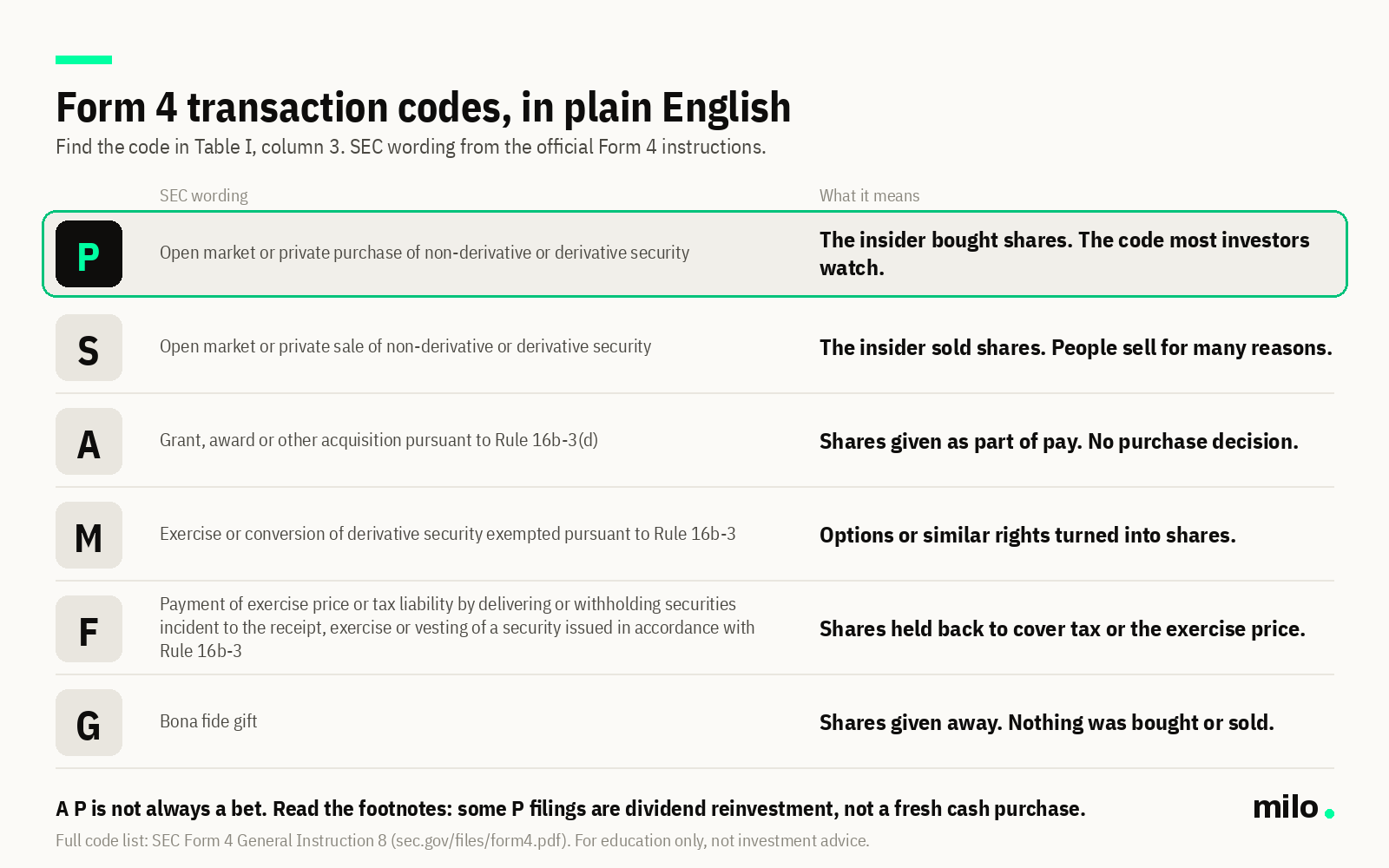
| Code | SEC wording | What it usually means |
|---|---|---|
| P | Open market or private purchase of non-derivative or derivative security | The insider bought shares |
| S | Open market or private sale of non-derivative or derivative security | The insider sold shares |
| A | Grant, award or other acquisition pursuant to Rule 16b-3(d) | Shares given as part of pay |
| M | Exercise or conversion of derivative security exempted pursuant to Rule 16b-3 | Options or similar rights turned into shares |
| F | Payment of exercise price or tax liability by delivering or withholding securities incident to the receipt, exercise or vesting of a security issued in accordance with Rule 16b-3 | Shares held back to cover tax or the exercise price |
| G | Bona fide gift | Shares given away |
Why P is the code most investors care about
Most Form 4s aren’t trading decisions. A is pay, M is an option turning into stock, F is shares kept back for tax, G is a gift. S is a sale, and people sell for lots of reasons: taxes, a house, diversifying.
P is different. It usually means the insider took their own cash and bought stock at a price anyone could pay. That’s why screeners build around it, and why milo’s insider feed only pulls code P.
The catch is the word “usually.”
When a P isn’t what it looks like: the PepsiCo trust swap
On October 14, 2026, PepsiCo director Robert C. Pohlad reported four lines in Table I, all coded P, all at $128.28 a share:
- 84,507 shares
- 45,075 shares
- 45,075 shares
- 9,989 shares
That’s 184,646 shares in total. Multiply by $128.28 and you get $23,686,388.88, and that’s exactly the value milo’s insider feed gave it. A screener that only reads the code sees a $23.7 million director buy at $PEP. The filing is on EDGAR (accession 0001061272-26-000004), and the 10b5-1 box is not checked.
Now read the rest of the line. Column 6 on all four says I, indirect, and column 7 says “Held By Revocable Trust.” Each line points to footnote 1, which says the shares were “acquired from irrevocable trusts established by the reporting person through the exercise of the reporting person’s power to substitute assets of equivalent value for property held by such trusts.” In exchange, a revocable trust where Pohlad is sole trustee and beneficiary gave those irrevocable trusts cash of equal value, priced at “the average of the high and low prices of PepsiCo Common Stock on October 14, 2026.”
Put simply, Pohlad moved $PEP shares from trusts he set up into a trust he controls, paying cash priced at the average of that day’s high and low. Nothing was bought in the market. It’s a swap between his own trusts, coded P because one technically bought from the other. Count it as a $23.7 million bet and you’ve read the code but skipped the footnote.
Footnote 2 adds that the trust’s total includes 168,632 shares Pohlad had earlier reported as owned directly and then moved into the trust. More shuffling.
We’ve seen the same pattern before. In our cluster insider buying breakdown, eleven $SPG directors all showed code P purchases on the same day at the same price, and the footnote said it was dividend reinvestment. Read the footnote before you trust the code.
A 60-second checklist for any Form 4
Next time you open a filing, go in this order:
- Who filed? Box 1 and Box 5. A CEO or CFO buying means more than a 10% owner fund moving shares around.
- What’s the code? Column 3 of Table I. If it isn’t P or S, it’s probably pay, an option exercise, tax withholding or a gift.
- How big is it next to what they own? Shares bought against the column 5 total. Uber’s buy added about 11.5% to Khosrowshahi’s holding.
- Direct or indirect? Column 6, and column 7 if it says I. Trusts and family entities deserve a closer look.
- What do the footnotes say? Price ranges are normal. Trust swaps, dividend reinvestment and transfers are not new buys.
- Is the 10b5-1 box checked? If yes, the trade was planned in advance and says less about today.
Six things, about a minute. That catches most filings that look exciting on a screener and turn out to be paperwork.
Skip the manual EDGAR checks
One filing is easy. Every insider buy across hundreds of companies is a job. milo pulls open market insider buys from SEC filings and links each one back to EDGAR, so you can open the source in one click. Follow anything interesting in a paper portfolio, with no real money, and a milo agent explains every move.
Try milo and paper-test an insider idea before you put money near it.
If you just want to browse, milo’s insider trading and SEC filings page lists recent Form 4 buys and sales for 50 of the most-followed US stocks, read straight from EDGAR. For a weekly short list of buys that held up after we read the filings, there’s the milo Insider Digest.
FAQ
What is SEC Form 4?
A filing that company officers, directors and 10% owners submit to the SEC when their holdings change. It’s due before the end of the second business day after the trade.
What does code P mean on Form 4?
An “open market or private purchase.” It usually means the insider paid cash, but check the footnotes. The $PEP trust swap was coded P too.
What is the 10b5-1 checkbox on Form 4?
It shows whether the trade was made under a pre-set plan meant to meet Rule 10b5-1(c). A checked box means the trade was scheduled ahead of time.
What does D or I mean on Form 4?
D is direct, in the insider’s own name. I is indirect, through a spouse, trust or family entity named in column 7.
Why does Form 4 show a price range in the footnotes?
Large orders fill at several prices. The form reports a weighted average and the footnote gives the range. Uber’s CEO bought at an average of $70.9642, with fills from $70.73 to $71.18.
For education only. Not investment advice. milo stock features are paper trading and research only. Sources: Uber Form 4 for Dara Khosrowshahi (filed September 10, 2026) and PepsiCo Form 4 for Robert C. Pohlad (filed October 16, 2026), read on SEC EDGAR with footnotes; SEC Form 4 instructions; milo insider feed, read October 21, 2026.