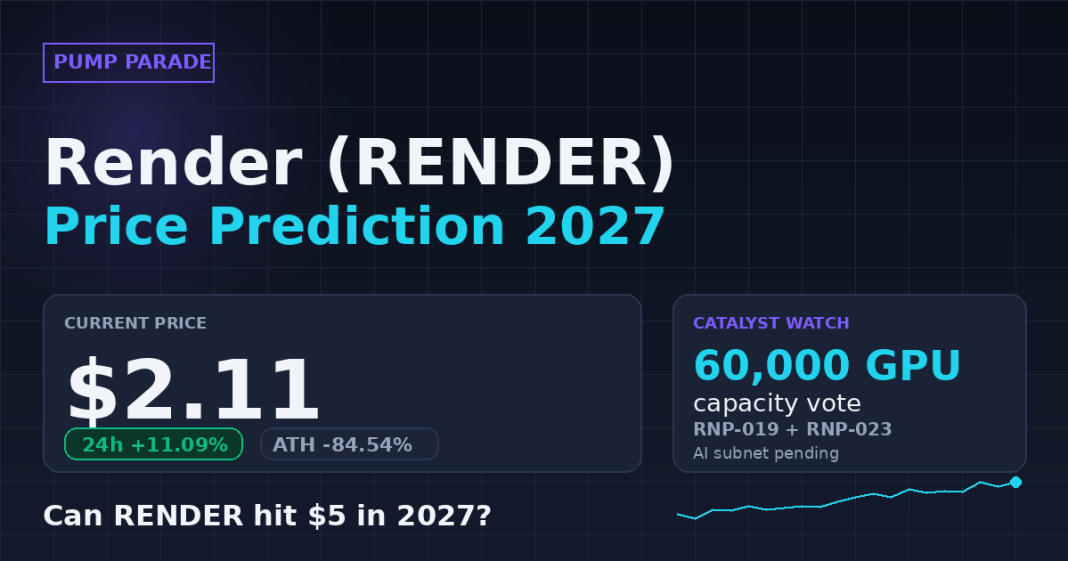
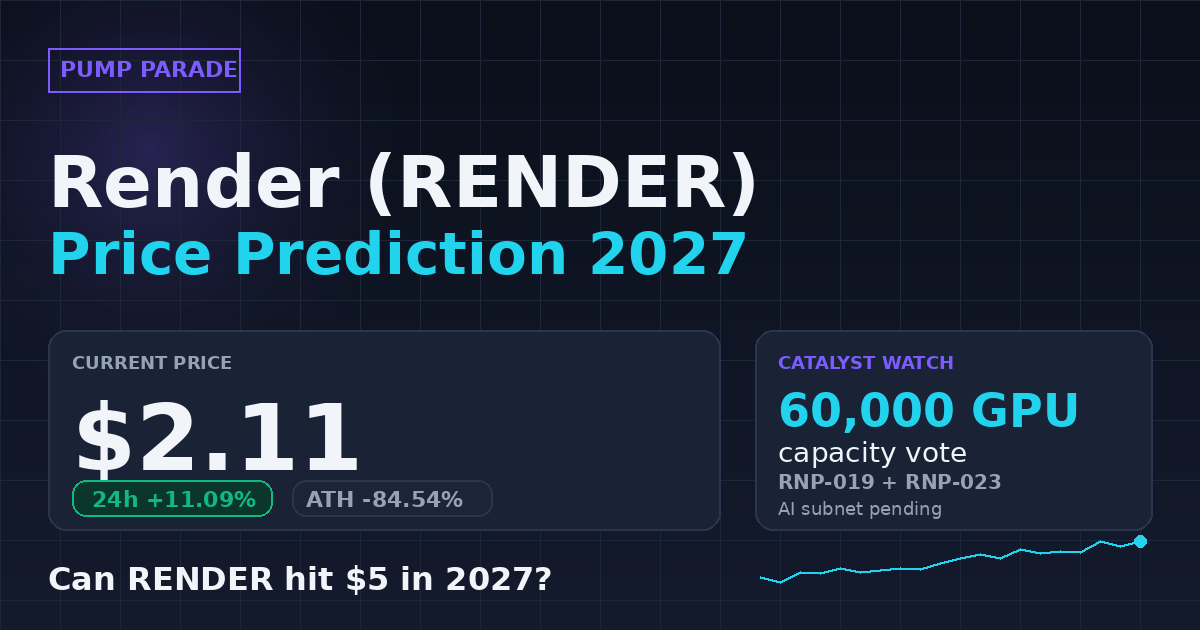
Render (RENDER) trades at $2.11 after a 11% daily rip, and the token now sits roughly 85% below its 2024 all-time high of $13.63. The GPU rental network has quietly become the clearest crypto bet on AI compute demand, with on-chain data from Render Network Foundation showing AI workloads at 35 to 40% of total network volume. The question driving every Render price prediction 2027 search right now is simple: can RENDER actually hit $5 before Christmas next year, or is this just another AI token head-fake?
The setup is interesting. RENDER was down 85% from its ATH into early October, then ripped 11% in a single session on reported governance progress for two capacity-expansion proposals. The AI narrative is back on the table. Nvidia’s Blackwell B200 rollout is spilling GPU demand into every corner of the market, and decentralized compute networks are catching bids as pure-play plays on that trend.
Below, we break down where RENDER stands today, the real catalysts and risks over the next 15 months, and three price targets you can actually defend with data. We also run a head-to-head against io.net, the closest competitor, and answer the questions buyers are asking Google right now.
Key Takeaways
- Current state: RENDER at $2.11, market cap $1.09B, rank 83, down 84.54% from its March 2024 ATH of $13.63.
- Main catalyst: Pending governance proposals RNP-019 and RNP-023 could add roughly 60,000 consumer GPUs and expand AI-focused capacity.
- Tokenomics: Burn-Mint Equilibrium model, with token burns reportedly up 278.9% year-over-year through late 2025.
- Bull target: $5.00 by end of 2027 if AI compute demand holds and the two capacity RNPs ship on schedule.
- Bear risk: $0.90 if hyperscaler GPU supply floods the market and the “DePIN discount” widens.
- The honest take: This is a high-beta AI proxy, not a stablecoin. The setup is credible but needs network growth to show up in token burns before $5 becomes a base case.
Where RENDER Stands Today
Here’s the current state of the Render token, pulled live from on-chain and market data at the time of writing.
| Metric | Value |
|---|---|
| Price | $2.11 |
| 24h change | +11.09% |
| 7-day change | +5.67% |
| Market cap | $1.09B |
| 24h volume | $29.0M |
| Market cap rank | #83 |
| All-time high | $13.63 (March 2024) |
| % from ATH | -84.54% |
| Circulating supply | ~532M RENDER |
| Max supply | ~644M RENDER |
Two numbers matter here. First, $1.09 billion is not a huge market cap for a project that sells into one of the largest spend categories in tech. Second, 85% below ATH tells you the market has already priced in a lot of disappointment. The question is whether that disappointment is still rational in the age of Blackwell.
Why Is RENDER Rallying Right Now?
Three forces are moving the token into the back half of 2026. One, AI compute demand continues to run ahead of supply. Hyperscalers are reporting multi-quarter waitlists for H200 and B200 GPUs, and the overflow is reaching smaller studios, independent researchers, and Web3 teams that cannot access traditional cloud capacity at any price. That is Render’s native market.
Two, governance momentum. The Render Foundation is advancing RNP-019 and RNP-023, two proposals that together would add approximately 60,000 consumer GPUs and expand AI subnet capacity. If both pass, Render roughly doubles the compute it can meter and burn against.
Three, the Solana migration is maturing. Render completed its move from Ethereum to the Solana Virtual Machine in 2024, and the token is now settling the vast majority of its volume on Solana rails. Lower fees mean more frequent compute jobs make economic sense, which widens the addressable market for small AI inference workloads. If you want context on the chain itself, our Solana price prediction for 2027 covers the SOL side of that story.
The Bull Case
GPU demand keeps outrunning hyperscaler supply
Enterprise AI spend has not slowed. Nvidia’s data center segment is still absorbing every chip it can ship, and the gap between demand and allocated supply has widened, not narrowed, through 2026. Render monetizes that gap. Every rendering job, whether a Hollywood VFX frame or a batched AI inference task, triggers token flow under the Burn-Mint Equivalence model. More jobs, more burn, less float.
RNP-019 and RNP-023 ship on schedule
If both capacity proposals clear governance and the GPUs come online in the first half of 2027, Render’s throughput roughly doubles. The practical read-through: a credible path to meaningful fee revenue and sustained burns that the market can actually model. Analysts tracking the rising AI compute demand on Render are already citing year-over-year burn growth of 278.9% through late 2025 as evidence the mechanism works at scale.
DePIN sector gets its ETF moment
Spot ETFs have widened the on-ramp for BTC, ETH, SOL, and now a handful of mid-caps. If the SEC extends that treatment to a basket DePIN product in 2027, Render is one of the three or four names any issuer builds around. That is a structural bid, not a narrative trade.
The Bear Case
Hyperscalers catch up and the DePIN discount widens
The simple risk: Nvidia, TSMC, and the hyperscalers close the GPU supply gap faster than expected. If AWS, Azure, and Google Cloud can price match a decentralized network, enterprise buyers will stay on the incumbents for compliance reasons alone. Render’s thesis gets harder to sell.
Token burns do not translate to price
Burn mechanics are only bullish if demand for the token outpaces supply issuance. Render still issues RENDER to GPU operators as emissions. If the network grows but burns do not meaningfully exceed emissions, the float stops shrinking. Multiple other DePIN tokens have hit this ceiling.
AI narrative fatigue
Markets rotate. If the AI trade peaks and capital rotates into the next theme, RENDER likely gets sold alongside Bittensor and other AI tokens, regardless of fundamentals. Beta is a two-way street.
Will RENDER Reach $5 by 2027? Price Targets by Timeframe
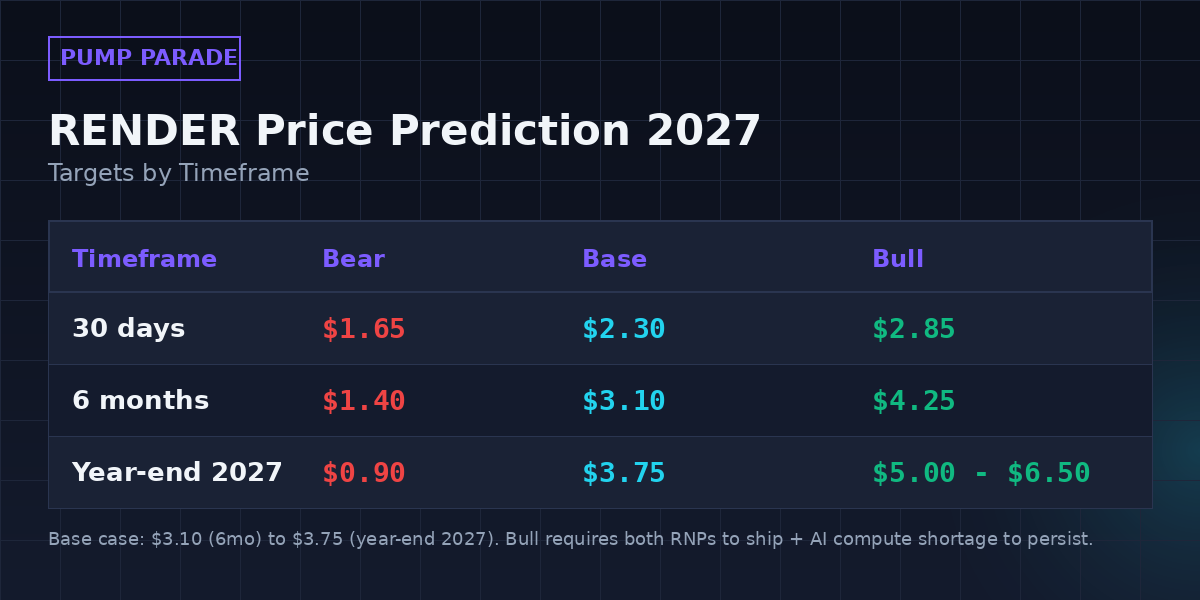
Here is how the three horizons shake out, with explicit bear, base, and bull cases for each.
30-day outlook (through mid-November 2026)
- Bear: $1.65 if the broader market rolls over and the current rally fades without governance news.
- Base: $2.30, modest continuation if volume holds above $25M per day.
- Bull: $2.85 if RNP-023 gets a scheduled vote date and AI compute demand headlines keep coming.
6-month outlook (through April 2027)
- Bear: $1.40 if AI narrative cools and RENDER retests the summer 2026 lows.
- Base: $3.10, assuming at least one capacity RNP passes and burns continue trending higher.
- Bull: $4.25 if both RNPs clear governance and a credible DePIN ETF filing lands.
Long-term (year-end 2027)
- Bear: $0.90 if hyperscalers out-compete on price and token burns stall.
- Base: $3.75, a reclaim of 2024 territory on steady AI growth and completed capacity upgrades.
- Bull: $5.00 to $6.50, which would require AI compute to remain capacity-constrained plus a DePIN product on a major exchange or ETF rail.
For comparison, Benzinga’s analyst aggregation puts the 2026 Render average target at $4.25, while BYDFi’s bull scenario stretches to $8 for 2027 and 2028. Our base case sits conservatively between those two.
Is RENDER a Better Bet Than io.net?
io.net is the closest competitor. Both run GPU marketplaces, both are built on Solana, and both are pitched as the picks and shovels of the AI build-out. Here is how they stack up on the metrics that matter.
| Metric | RENDER | io.net (IO) |
|---|---|---|
| Market cap | $1.09B | ~$180M |
| Core use case | GPU rendering + AI inference | AI training clusters |
| Settlement chain | Solana | Solana |
| Tokenomics | Burn-Mint Equilibrium | Fixed supply + emissions |
| Flagship partners | OTOY, Stability AI, Endeavor | Various AI startups |
| Governance | RNP system, active | Foundation-led |
| Peak-to-trough | -85% from ATH | -95%+ from ATH |
| Positioning | Hollywood + AI | Pure AI compute |
Translation: Render is the more mature project, with a real customer base in 3D rendering before AI was even a crypto narrative. io.net is the higher-beta, higher-risk bet with more upside if AI training workloads centralize on crypto rails. Most portfolios that hold both weight RENDER at roughly 3 to 5 times IO exposure.
What Would Change Our View
Three triggers would move us from base to bull, or from base to bear.
- Burn growth stalls below 100% YoY. The 278.9% figure through late 2025 is the single most important data point in the thesis. If quarterly burn growth drops materially below triple digits while emissions hold, the deflationary case weakens and we revise toward the bear range.
- Both RNP-019 and RNP-023 clear and ship. If 60,000 additional GPUs come online and the AI subnet goes live by mid-2027, the base case shifts up by 20 to 30% and $5 becomes the central tendency, not the bull extreme.
- Nvidia launches a direct cloud rental competitor. If Nvidia DGX Cloud or an equivalent slashes retail GPU rental pricing by 40%+, that is a direct arrow at Render’s revenue model. Bear case moves from $0.90 to the mid-$0.60s.
Frequently Asked Questions
What is the Render (RENDER) price prediction for 2027?
Our base case puts RENDER between $3.10 and $3.75 by the end of 2027, with a bull target of $5.00 to $6.50 and a bear case of $0.90. The range reflects uncertainty on AI compute demand and governance execution over the next 15 months.
Can RENDER reach $5 in 2027?
$5 is plausible but requires two things to hit together: AI compute demand must remain capacity constrained through 2027, and RNP-019 and RNP-023 need to clear governance and ship. If either leg fails, $3 to $4 is the more realistic ceiling. If both land, $5 becomes the base case rather than the bull scenario.
Is RENDER a good long-term investment?
RENDER is a leveraged bet on decentralized GPU compute. The project has real customers, working tokenomics, and credible governance. It is also down 85% from its ATH, which cuts both ways. For a long-term hold thesis, size it as a high-beta AI proxy rather than a core position, and expect 50% drawdowns along the way.
Why is RENDER linked to AI growth?
Render operates a decentralized GPU marketplace. The same chips that train and run AI models render 3D graphics, so demand for AI compute directly bids up Render’s rental market. AI workloads already account for 35 to 40% of network volume, up from a small single-digit share in 2023.
How does RENDER compare to Bittensor (TAO)?
Bittensor is a decentralized machine learning network. Render is a decentralized GPU rental network. Both are AI plays, but they monetize different layers of the stack. TAO captures value when models get trained on-chain, RENDER captures value when any GPU workload runs. Our Bittensor price prediction covers the TAO side in detail.
Where can I trade RENDER?
RENDER trades on all major centralized exchanges and across Solana DEX aggregators, including Jupiter. If you prefer a self-custody route, our Jupiter overview walks through how the Solana DEX layer handles tokens like RENDER.
The Honest Take
Render is one of the cleaner stories in crypto AI, and most of the noise around it is justified. Real customers. Real burns. Real governance. A tokenomics model that has survived two cycles and keeps compounding on-chain volume. The 85% drawdown from ATH is doing more work than most charts admit: it is pricing in a scenario where crypto AI never recovers its 2024 enthusiasm.
That said, $5 is not a given. The base case puts fair value closer to $3.50 by late 2027. $5 requires the AI compute shortage to persist, both pending RNPs to ship, and sentiment to stay constructive on the DePIN sector. Any of those failing drops the central target by 20 to 30%. Any two of them failing puts the bear case back on the table.
For traders, the setup worth monitoring is a close above $2.60 on sustained volume, which would confirm the current rally is more than a dead cat. For long-term holders, the question is simpler: do you believe decentralized GPU networks capture a meaningful share of the AI compute boom? If yes, RENDER is one of the two or three best vehicles to express that view. If you want context on the AI token basket more broadly, our coverage on Bittensor’s 2026 trajectory is a good companion read.
The honest answer to “Can RENDER hit $5?” is: yes, but not by accident. The token needs the fundamentals to show up on-chain over the next 12 months. If they do, $5 clears. If they do not, the market has already told you where it thinks fair value lives, and that number starts with a 1.
Disclaimer: This article is for informational and educational purposes only and should not be construed as financial, investment, or trading advice. Cryptocurrency markets are highly volatile, and past performance does not guarantee future results. The price predictions and analyses presented here are based on AI models, technical indicators, and available data at the time of writing. They are not guarantees. Always conduct your own research (DYOR) and consult with a qualified financial advisor before making any investment decisions. Pump Parade and its authors do not assume liability for financial losses incurred based on information provided in this article.