

Backpack vs Solflare: Which Solana Wallet Wins in 2026?
Phantom gets most of the headlines, but if you actually live on Solana, the more interesting fight is happening one tier down. On one side, Backpack has grown from a niche xNFT experiment into a full trading stack, complete with its own exchange, US equity perpetuals, and multi chain support. On the other, Solflare has kept its head down and built one of the most polished pure Solana experiences on the market, complete with its own hardware wallet, debit card, and native staking flows.
They target overlapping users, so most Solana traders will pick one and stick with it. This 2026 breakdown covers fees, features, security, and use cases so you can choose the right one on the first try instead of the third.
TL;DR: Quick Verdict
- Pick Backpack if you actively trade, want a wallet that plugs directly into a licensed exchange, care about perpetuals (crypto and now US stocks), or juggle assets across Solana, Ethereum, Base, Arbitrum, and Bitcoin.
- Pick Solflare if you mostly stake SOL, collect NFTs, want the lowest possible in-wallet swap fees, or value a first party hardware wallet (Shield) and a working debit card today.
- If you are still on the fence: run both. They are free, non custodial, and you can import the same seed phrase into either.
Backpack at a Glance
Backpack started life as the wallet from the Coral team behind Anchor, the framework a big chunk of Solana was built on. In 2026 it is a self custody wallet across ten plus networks (Solana, Ethereum, Base, Arbitrum, Monad, Bitcoin, and more) that is tightly bound to Backpack Exchange, a licensed venue that recently crossed $1 billion in 24 hour perpetuals volume and now offers perps on real US stocks like AAPL, TSLA, NVDA, MU, SNDK, plus SPY and QQQ.
The pitch is simple: one identity, one collateral pool, and one app for spot, perps, stocks, lending, and self custody.
Backpack Wallet Features
- Multi chain support: Solana, Ethereum, Base, Arbitrum, Monad, Bitcoin, and other EVM networks.
- Backpack Exchange integration: spot, perps, US equity perps, lending, all sharing one margin pool.
- xNFTs: executable NFTs that run mini apps inside the wallet.
- Browser extension and mobile apps for iOS and Android, with cross device sync.
- Hardware wallet support via Ledger.
- BP token: the native exchange token with fee discounts and points program history.
- Licensing: the exchange side is regulated under MiCA (EU), MiFID II via CySEC, VARA in Dubai, and FinCEN in the US.
Solflare at a Glance
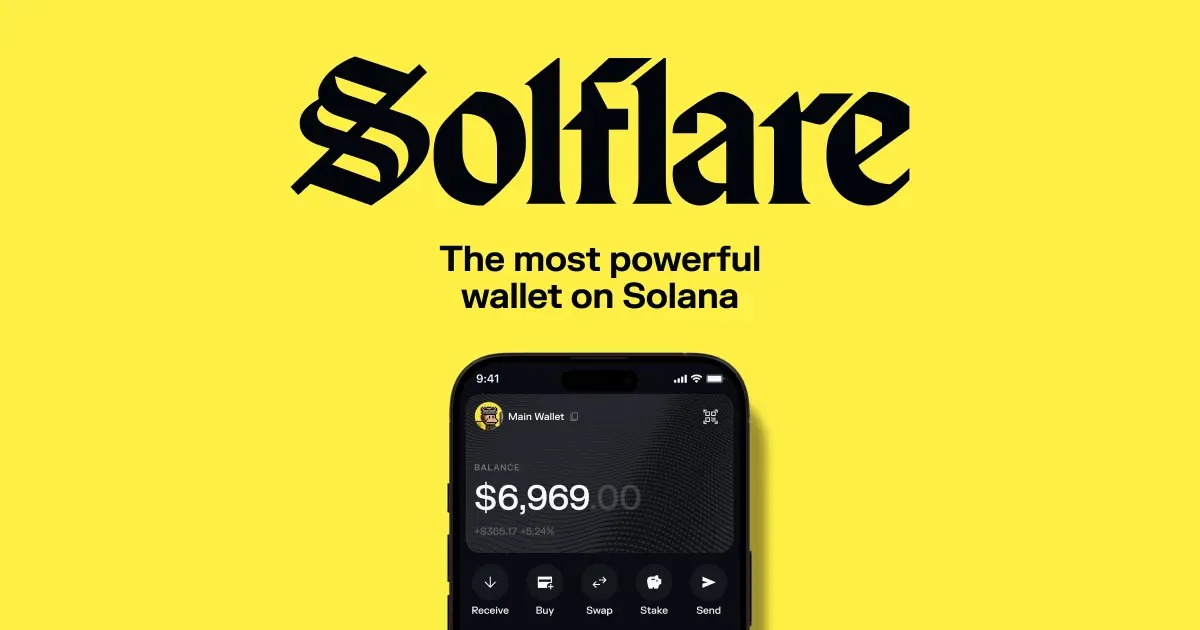
Solflare has been around since 2021 and, unlike Backpack, has stayed almost entirely focused on Solana. If a feature ships on Solana, Solflare tends to support it early. The team has spent 2025 and 2026 leaning harder into everyday utility: a physical Solflare Card that spends USDC directly, a Ledger style hardware wallet called Shield, an AI assistant called Magic, and 24/7 human customer support.
It reads less like a trading app and more like a Solana super wallet for people who want to hold, stake, swap, and spend without ever leaving the wallet.
Solflare Wallet Features
- Solana native: deep integration with SOL, SPL tokens, LSTs, and Solana NFT standards.
- In wallet swap aggregating Jupiter and other routers, tuned for tight spreads.
- Native SOL staking with validator picker and one click delegate.
- Perpetuals trading on Solana assets from inside the wallet.
- NFT gallery with rich collection views and rarity data.
- Solflare Shield hardware wallet starting at $49, tap to sign supported.
- Solflare Card for spending USDC in the real world.
- Magic AI assistant and live human support.
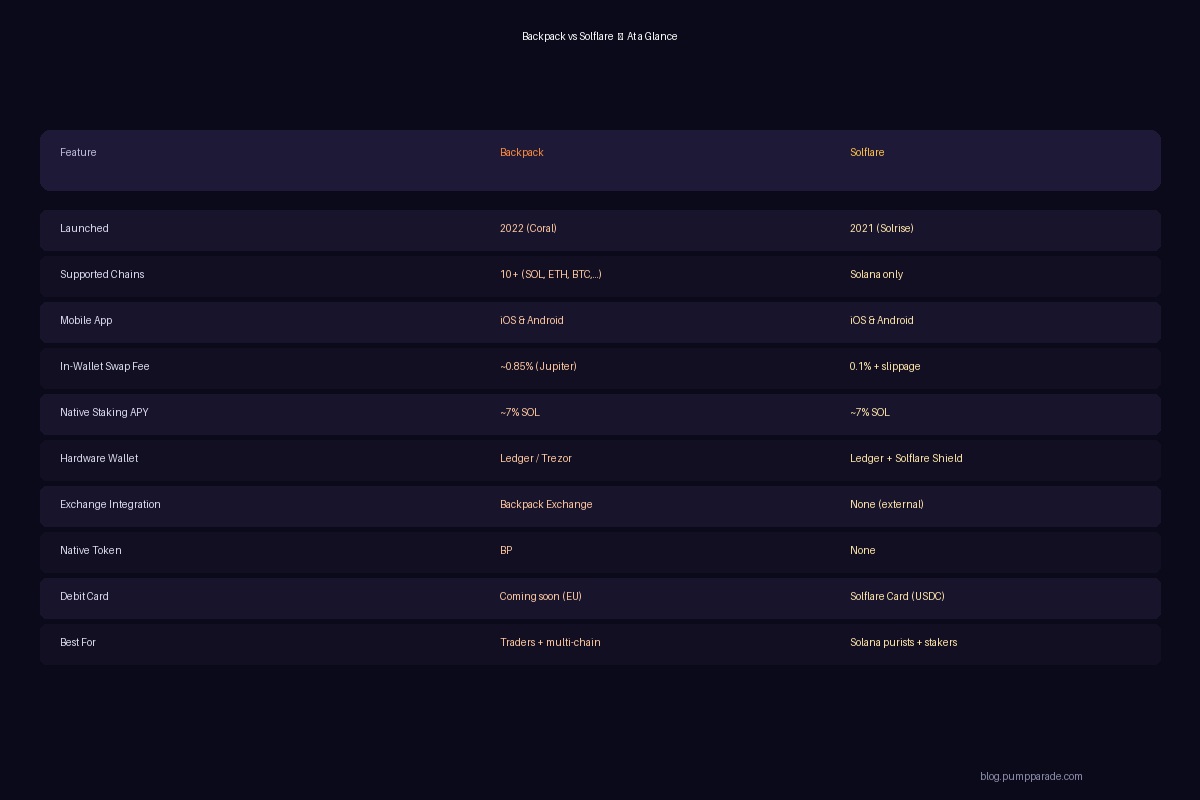
Head-to-Head Comparison Table
Fees: Where Your Money Actually Goes
In-Wallet Swaps
Both wallets route through Jupiter for Solana swaps, but they charge different service fees on top of the underlying DEX cost. In our 2026 testing:
- Backpack charges roughly 0.85% as a platform fee on swaps executed inside the wallet, in addition to slippage. This is higher than most competitors, which is one of the trade offs for the polish and the exchange integration.
- Solflare charges around 0.1% plus slippage on in wallet swaps, sometimes lower on high liquidity pairs. That is closer to a typical Jupiter aggregator quote and one of the tighter fees in the Solana wallet category.
For a $10,000 swap of SOL to USDC, that is roughly $85 with Backpack versus $10 with Solflare. If you swap frequently, that difference adds up fast.
Exchange and Perp Trading (Backpack Only)
On the exchange side, Backpack uses a tiered maker taker model in line with major CEXs, with visible discounts for BP token holders and market makers. US equity perps settle in USD, fund hourly instead of the standard 8 hour cycle, and allow up to 10x leverage. This is a genuine advantage: if you want to short SPY or long NVDA without leaving Solana, no other Solana native wallet offers that today.
Staking and Card Fees
Both wallets offer roughly 7% APY on native SOL staking, since that is set by the network rather than the wallet. On the spending side, Solflare Card charges standard interchange plus a small conversion spread when you swipe USDC. Backpack does not yet offer a live consumer card, though a card is on the public roadmap and expected in the EU first.
Security and Trust
Both wallets are non custodial: the seed phrase belongs to you, not to Backpack or Solflare. That said, the security stories diverge.
- Backpack combines a mature open source wallet with a licensed centralized exchange. That is a plus (regulated on ramps, KYC when needed, insurance on some jurisdictions) and a minus (you now have a KYC footprint if you use exchange features). The exchange side has been through multiple regulatory audits and holds four regulatory licenses.
- Solflare has a longer clean track record on the pure wallet side, with no significant exploits since launch. The Shield hardware wallet is a strong addition for anyone holding meaningful size, and Ledger support remains for users already invested in that ecosystem.
If you plan to hold six figures or more of Solana assets, pair either wallet with a hardware device. That is more important than which wallet you pick.
User Experience
Solflare feels lighter. The UI is cleaner, staking flows are opinionated in a good way, and the NFT gallery is arguably the best on Solana. It is a wallet that a first time SOL buyer can navigate without a tutorial.
Backpack feels heavier because it is doing more. The wallet is closely coupled to the exchange UI, and while that is powerful, it can be intimidating if all you want is to send SOL to a friend. Where Backpack shines is on the desktop, where the collateral pool, positions view, and cross chain balances all sit next to each other.
Mobile is close to a wash. Both apps are stable, both have biometric unlock, and both handle QR code deep links correctly. Solflare has a slight edge for pure staking flows, Backpack has a slight edge for live trading.
Pros and Cons
Backpack
Pros:
- True multi chain (10+ networks) in one wallet.
- Deep integration with a licensed exchange offering crypto and US stock perps.
- Unified margin pool means idle balances still earn yield.
- Strong pedigree from the Anchor / Coral team.
Cons:
- Higher in wallet swap fees (~0.85%).
- No first party hardware wallet yet.
- Consumer card not yet live.
- More surface area = steeper learning curve for beginners.
Solflare
Pros:
- Lower in wallet swap fees (~0.1%).
- First party hardware wallet (Shield) at an accessible $49 price.
- Live debit card for spending USDC.
- Cleanest staking and NFT flows on Solana.
- 24/7 human support.
Cons:
- Solana only. No EVM, no Bitcoin.
- No native exchange or perp venue owned by the same team.
- No native token or points program.
- Fewer power user features on desktop.
Who Should Use Which?
Pick Backpack if you are:
- An active trader who wants perps, spot, and self custody in one login.
- Interested in trading US equity perps on chain.
- Managing assets across Solana, Ethereum, Base, Arbitrum, or Bitcoin.
- Comfortable with a slightly higher swap fee in exchange for exchange integration.
Pick Solflare if you are:
- A long term Solana holder who stakes SOL and collects NFTs.
- Fee sensitive on in wallet swaps.
- Looking for a first party hardware wallet without paying Ledger prices.
- Wanting a debit card for real world USDC spending today.
- New to Solana and want the smoother onboarding.
Final Verdict
Backpack and Solflare are not really competing for the same wallet slot, they are competing for the same user’s time. Backpack is trying to be a full trading operating system with a wallet attached. Solflare is trying to be the best Solana experience for people who mostly want to hold, stake, spend, and swap. Both are excellent at what they do.
If forced to pick one wallet for a Solana native in 2026, we lean Solflare for the average user because of the lower fees, the Shield hardware option, and the live card. For anyone who trades actively, especially perps or US equity perps, Backpack is the more powerful choice and the exchange integration is genuinely a category advantage.
Fortunately, you do not have to commit. Both wallets are free and non custodial. Install both, keep your primary bag in the one you trust most, and use the other for the flow it does best.
FAQ
Is Backpack safer than Solflare?
Neither has had a major wallet level exploit. Solflare has a longer track record as a pure wallet. Backpack’s exchange side is regulated in multiple jurisdictions, which is a different kind of safety. Both are safer when paired with a hardware wallet.
Which wallet has lower swap fees?
Solflare, by a wide margin on typical Solana pairs. In 2026 testing, Solflare charges roughly 0.1% on in wallet swaps versus roughly 0.85% for Backpack.
Can I use the same seed phrase in Backpack and Solflare?
Yes. Any standard BIP39 seed phrase will import into both wallets. Just remember that anyone with your seed has full access, so only import it into apps you trust and never share it.
Does Solflare support Ethereum or Bitcoin?
No. Solflare is Solana only in 2026. If you need multi chain, Backpack or another cross chain wallet is a better fit.
Which wallet is best for staking SOL?
Both offer similar APY around 7%. Solflare’s staking UI is a bit friendlier, especially for choosing validators. If staking is your main use case, Solflare has the edge.
Related Reading
If you liked this breakdown, check out our other 2026 wallet and Solana coverage on PumpParade:
- MetaMask vs Trust Wallet: Best Crypto Wallet 2026
- Pump.fun Review 2026: Fees, Features and Verdict
- Zapper vs DeBank: Best Crypto Portfolio Tracker 2026
Fees, features, and volume figures cited in this article are based on public data and product documentation as of September 2026. Data sourced from DeFiLlama, Backpack, and official product documentation.