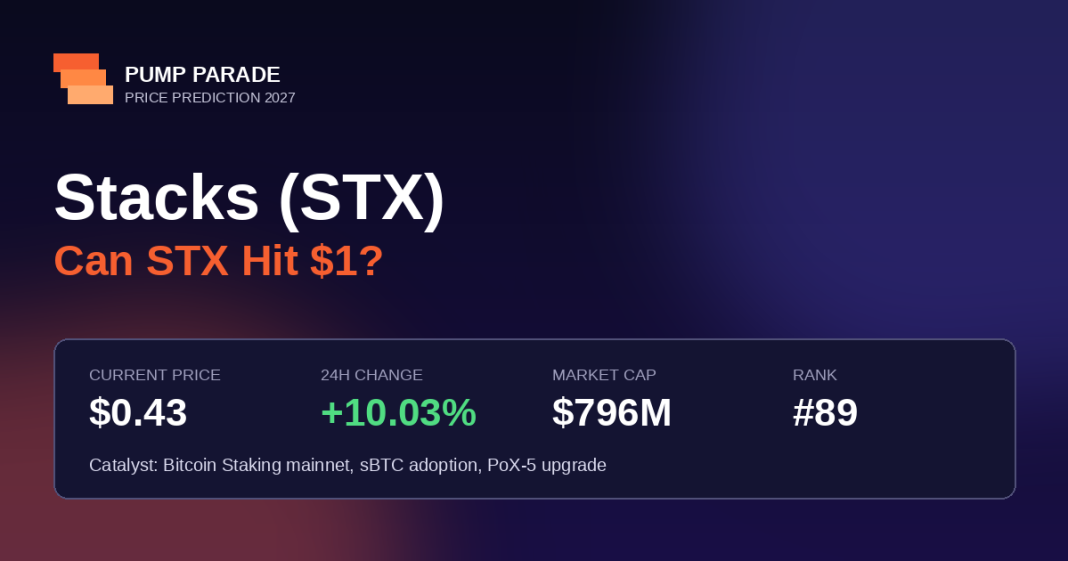
Stacks (STX) trades at $0.43 at the time of writing, up roughly 10% in the last 24 hours and climbing out of a sideways range that trapped the token for most of 2026. The focus of this Stacks price prediction 2027 piece is simple, because the next 12 months are shaping up to be the most consequential in the project’s history.
Three things changed this year. The Nakamoto upgrade cut Stacks block times to seconds. The sBTC bridge crossed 2,949 BTC in supply by the end of Q2, bringing real Bitcoin into Stacks smart contracts without a centralized custodian. And the Stacks Q2 2026 ecosystem report showed cumulative wallets passing 1.6 million while daily active users jumped 55% quarter over quarter.
So the question we are answering: can STX reclaim $1 by late 2027, and what has to happen for the bull case to play out? We will walk through the current setup, the bull and bear cases, three price targets by timeframe, how Stacks compares to CORE DAO, and the scenarios that would flip our view either way.
Key Takeaways
- STX trades at $0.43 with a market cap near $796M, ranking around #89 by capitalization.
- The sBTC bridge, Fireblocks custody integration, and PoX-5 upgrade are the three catalysts within the next 90 days.
- Our base case targets $0.70 within six months. The bull case is a $1.00 reclaim by late 2027 if sBTC supply doubles.
- Downside risk sits at $0.30 if Bitcoin DeFi narratives cool or token unlocks weigh on the chart.
- STX is still roughly 89% below its all-time high of $3.86, which gives any sustained rally a long runway.
Where Stacks Stands Today
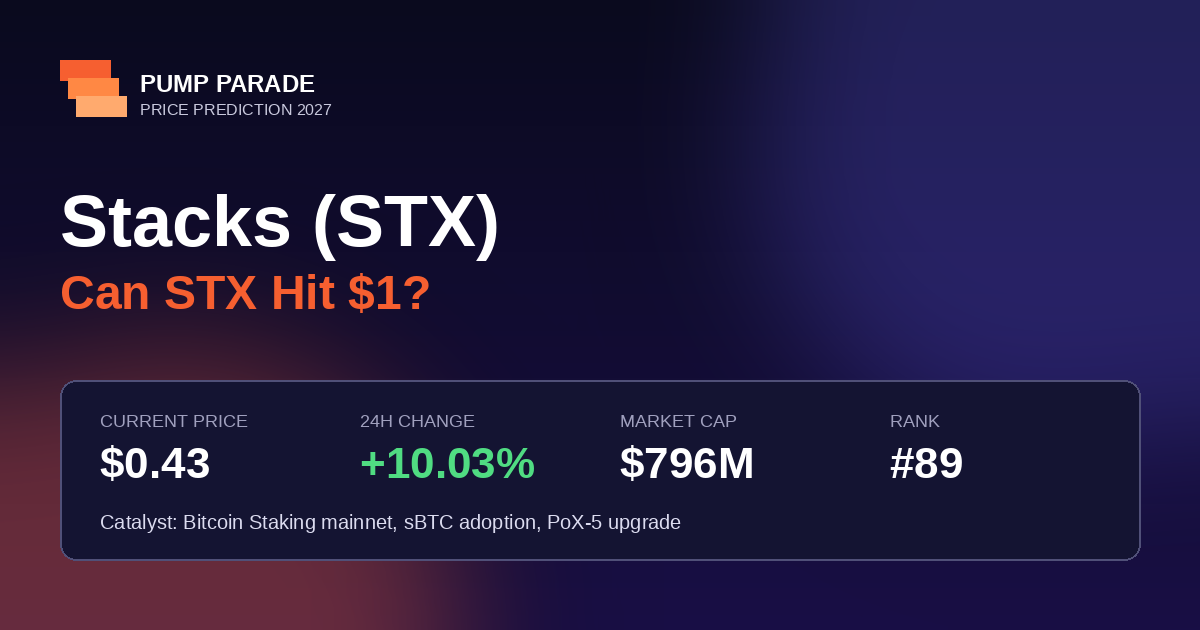
Before the forecast, the current snapshot. STX is doing what mid-cap Bitcoin ecosystem tokens tend to do at the start of a new narrative cycle: outperforming on the way up, consolidating on the way down, and attracting steady on-chain volume.
| Metric | Value |
|---|---|
| Price | $0.43 |
| 24h Change | +10.03% |
| Market Cap | $796.5M |
| 24h Volume | $107.3M |
| Rank | #89 |
| Circulating Supply | 1.9B STX |
| All-Time High | $3.86 |
| % From ATH | roughly 89% below |
The 24h volume to market cap ratio sits near 13%, which is healthy. Compare that to the Solana ecosystem leaders we covered in our recent SOL price prediction, where volume to market cap often runs closer to 5%. Higher turnover usually means a token is being actively traded rather than passively held, and that is often a precondition for a trend to form.
Why Is Stacks Rising Right Now?
Three forces are driving STX. First, Bitcoin DeFi is finally a real narrative with real numbers behind it. The sBTC bridge has unlocked native-feeling Bitcoin yield for the first time, with BitFlow’s sBTC pairs averaging a 17.9% BTC APY over 30 days during Q2. Hermetica’s hBTC and Stacking DAO’s stSTX both posted all-time-high TVLs.
Second, institutional plumbing is in place. The Fireblocks custody integration, finalized earlier in 2026, lets institutional desks hold and move STX and sBTC through MPC wallets. That matters because the first bull run for Stacks in 2024 ended partly because custodians could not comfortably hold the asset.
Third, UTXO Management, a subsidiary of Nakamoto Inc. (NASDAQ: NAKA), signed on as the inaugural Bitcoin Staking participant and committed part of its treasury BTC. Bitcoin Magazine reported a target of around 3% BTC-denominated yield. Public-company treasuries buying into a Bitcoin L2 yield mechanism is a credibility unlock, not a trade.
The Bull Case for STX
sBTC Supply Doubles by Mid-2027
If sBTC supply roughly doubles from 2,949 BTC to 6,000 BTC over the next 12 to 15 months, STX captures more of the Bitcoin DeFi mindshare. Historical patterns from Ethereum’s early DeFi summer suggest native-asset bridges tend to compound, not decay. More sBTC means more liquidity in Zest for lending, more volume on BitFlow, and a larger pool of fees funnelling back to STX stackers.
PoX-5 Mainnet and Bitcoin Staking Go Live
PoX-5 is the next consensus upgrade. It introduces a new staking model with waterfall bond structuring and a 15% reserve fund. It also opens the Bitcoin Staking primitive to a broader set of participants beyond the UTXO Management pilot. If this ships cleanly in Q4 2026 or Q1 2027, STX stackers see a real yield pickup, and that is a textbook rerating catalyst.
Public-Company Treasuries Buy In
The thesis is simple: the top 100 Bitcoin treasury companies hold more than 1.2 million BTC, roughly 5% of supply. Even a 1% to 2% allocation to Bitcoin Staking through Stacks would be a nine-figure capital inflow. That is a slow drip, not a rocket, but the kind of flow that reprices mid-cap tokens on a six-month horizon.
The Bear Case for STX
sBTC Growth Stalls
If sBTC supply stays flat or grows below 10% per quarter, the Bitcoin DeFi narrative loses momentum. Capital does not stay patient. Rival Bitcoin L2s like CORE DAO, Rootstock, and BOB would start to look more attractive on a growth-rate basis, and STX would compress back to the lower end of its range.
Token Unlocks and Stacking Dilution
Stacks has a predictable emission schedule, and roughly half of circulating STX is already deployed in stacking contracts. If STX price falls and holders de-stack to realize gains, the float increases and spot pressure builds. Dilution risk is limited since circulating supply already equals total supply, but liquid float swings matter at this market cap.
Bitcoin Beta Risk
STX is a high-beta Bitcoin asset. In practical terms, when BTC falls 10%, STX has historically fallen 15% to 20%. If Bitcoin breaks down below $90,000 and stays there, STX follows. No amount of ecosystem progress overrides BTC price action in the short term, and traders should size positions accordingly.
Stacks Price Prediction 2027: Targets by Timeframe
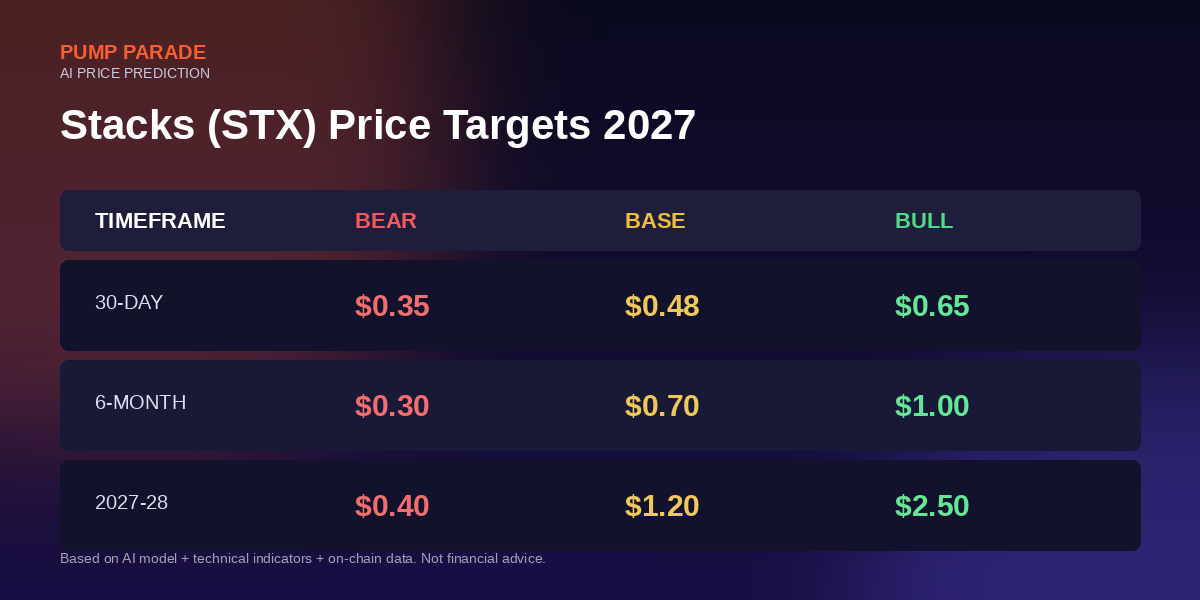
These are the levels our model and the on-chain context point to. They are not promises. Price predictions are hypotheses with timeframes, and every target comes with a condition.
30-Day Outlook
Short-term, STX looks like a continuation setup. Base case is a drift to $0.48 as the recent breakout consolidates. Bull case is $0.65 if BTC breaks to a new all-time high and the Bitcoin DeFi trade reaccelerates. Bear case is $0.35 if BTC pulls back toward $90K and risk assets compress.
6-Month Outlook
By April 2027, PoX-5 should be live and sBTC supply numbers for Q4 2026 will be public. Base case is $0.70. Bull case is $1.00, which lines up with the 2024 high and the main round-number magnet above the current range. Bear case is $0.30, roughly a retest of the 2026 lows if the narrative cools entirely.
Long-Term (2027 to 2028)
The long-term range is wider. Base case targets $1.20, which assumes steady but unspectacular sBTC growth and no new unlocks. Bull case is $2.50, which requires Bitcoin DeFi TVL to grow 3x to 5x from current levels and sustained public-company treasury participation. Bear case is $0.40, which assumes Bitcoin L2 competition fractures the market.
For context, CryptoRank’s 2026 to 2030 outlook puts STX in a $5 to $8 range in a bullish 2027 scenario. We think that is aggressive. Our base is more conservative because mid-cap altcoins historically underperform their peak-cycle targets by 30% to 50%.
How Does Stacks Compare to CORE DAO?
The closest competitor to Stacks is CORE DAO, another Bitcoin smart contract chain with its own staking mechanism. Here is the side-by-side on the metrics that matter.
| Metric | Stacks (STX) | CORE DAO (CORE) |
|---|---|---|
| Market Cap | $796M | ~$450M |
| BTC Bridge Supply | 2,949 BTC (sBTC) | ~1,400 BTC (lstBTC) |
| Smart Contract Language | Clarity | Solidity (EVM) |
| Consensus | Proof of Transfer (PoX) | Satoshi Plus (DPoW) |
| Block Time | ~5 seconds | ~3 seconds |
| Institutional Custody | Fireblocks integrated | BitGo, Copper |
| Native Yield | Bitcoin Staking (3% BTC APY target) | BTC Staking (variable) |
Stacks has the larger market cap and the deeper BTC bridge. CORE DAO has an EVM-compatibility advantage for developer onboarding. If you think the next wave of Bitcoin DeFi gets built by Ethereum-native devs, CORE wins. If you think it becomes its own thing with its own language, STX is the better bet. Both can win. The market is not winner-take-all.
What Would Flip Our View on STX?
Three concrete triggers would move us off the base case.
Flip bullish: sBTC supply crosses 5,000 BTC before Q2 2027, OR a top-five public-company Bitcoin treasury allocates to Bitcoin Staking in size, OR Zest and BitFlow combined TVL crosses $500M.
Flip bearish: sBTC supply drops below 2,500 BTC in any quarter, OR PoX-5 ships with a critical security flaw, OR Bitcoin breaks $85K support and stays there for more than 30 days.
Flat and hold: sBTC grows 10% to 20% per quarter, PoX-5 ships without drama, BTC stays in a $95K to $130K range. In that scenario, STX grinds between $0.40 and $0.70 for most of 2027.
Frequently Asked Questions
Is Stacks a good investment in 2027?
Stacks offers direct exposure to the Bitcoin DeFi thesis, one of the few credible narratives tying mid-caps to the Bitcoin treasury flywheel. The risk-reward favors patient holders if sBTC growth continues. It is not a sure bet, and position sizing matters because STX has roughly 1.5x to 2x the volatility of BTC itself.
Will STX reach $1 by 2027?
Our base case has STX trading between $0.70 and $1.20 by late 2027. A clean break above $1 requires sBTC supply to roughly double and institutional Bitcoin Staking participation to scale. The bull case gets STX to $2.50 if both of those happen and BTC runs to new all-time highs. The bear case keeps STX below $0.50.
What is sBTC and how does it work?
sBTC is a two-way peg that moves Bitcoin between the base layer and Stacks without a centralized custodian. Users deposit BTC and mint sBTC on Stacks, which can then flow through DeFi protocols. When they want BTC back, they burn sBTC and the bridge releases the underlying Bitcoin.
How does Stacks compare to Rootstock and other Bitcoin L2s?
Stacks is purpose-built as a Bitcoin smart contract layer with its own language (Clarity) and settles state back to Bitcoin. Rootstock uses a merge-mined sidechain with EVM compatibility. CORE DAO uses hybrid consensus. Stacks leads in native BTC bridge supply. CORE leads in developer accessibility.
What is the Nakamoto upgrade?
Nakamoto was the biggest hard fork in Stacks history, activated in October 2024. It cut block times from the roughly ten-minute Bitcoin cadence down to seconds, and it introduced the groundwork for sBTC. It is the moment Stacks stopped being a slow Bitcoin sidechain and became a usable DeFi platform.
The Honest Take
Stacks is not a hype trade right now. It is a slow-building thesis trade with real numbers behind it. The sBTC supply curve is the single most important chart we are watching. If it compounds through 2027, STX reclaims $1 and probably more. If it stalls, the whole Bitcoin L2 narrative decelerates and STX stays rangebound.
The upside case is credible but not guaranteed. The downside case is uncomfortable but limited by how far STX has already fallen from its ATH. For traders, this is a setup worth monitoring. For long-term holders who believe Bitcoin DeFi will matter, STX is one of two or three pure plays worth researching alongside Bitcoin forks like BCH and the broader L1 landscape.
Disclaimer: This article is for informational and educational purposes only and should not be construed as financial, investment, or trading advice. Cryptocurrency markets are highly volatile, and past performance does not guarantee future results. The price predictions and analyses presented here are based on AI models, technical indicators, and available data at the time of writing, they are not guarantees. Always conduct your own research (DYOR) and consult with a qualified financial advisor before making any investment decisions. Pump Parade and its authors do not assume liability for financial losses incurred based on information provided in this article.