Avalanche (AVAX) is trading at $8.77 as of October 29, 2026, down 24% in the last 30 days and sitting roughly 94% below its $144.96 all-time high. For a Layer 1 that attracted BlackRock, Franklin Templeton, and VanEck to its network over the past year, that disconnect is the whole story. The avalanche AVAX price prediction 2027 question is really a bet on whether institutional rails translate into token demand, or whether AVAX stays decoupled from the thing it actually powers.
The setup is strange. Avalanche RWA TVL hit $1.3 billion earlier this year, up 949% year over year according to AMBCrypto. VanEck’s spot AVAX ETF has been live since January 2026. Yet the token keeps bleeding. Something has to give in the next 12 months, in one direction or the other.
Below, we break down where AVAX stands today, the catalysts that could trigger a rebound, the risks that could grind it lower, and specific 2027 targets by timeframe. This is analysis, not advice.
Key Takeaways
- AVAX trades at $8.77, down 94% from its 2021 ATH and down 24% in the past 30 days.
- Avalanche RWA TVL reached $1.3 billion, with BlackRock, Franklin Templeton, FIS, and S&P Dow Jones building on the network.
- The Avalanche9000 upgrade cut subnet (L1) deployment costs by 99.9%, which should accelerate institutional subnet launches.
- Base case 2027 target: $14 to $18. Bull case: $25 to $30 if ETF inflows match the SOL ETF trajectory.
- Bear case: a close below $7.50 opens $5.80 and keeps AVAX trapped under $12 for the cycle.
- Watch Avalanche TVL, subnet count, AVAX ETF net flows, and C-Chain fee burn as the four signals that matter most.
Where Avalanche (AVAX) Stands Today
The current price picture is bleak at a glance and interesting on a second look. AVAX closed yesterday at $8.77 with $216 million in daily volume. That is a mid-cycle liquidity level, not a dead chain. The problem is relative performance: SOL is down 16% in 30 days, AVAX is down 24%, and the gap has widened every week since mid-September.
| Metric | Value |
|---|---|
| Price (29 Oct 2026) | $8.77 |
| 24h change | -2.22% |
| 7-day change | -4.93% |
| 30-day change | -24.14% |
| Market cap | $3.89 billion |
| 24h volume | $216 million |
| Market cap rank | #28 |
| All-time high | $144.96 (Nov 21, 2021) |
| % from ATH | -93.95% |
| Circulating supply | 443.97 million |
| Max supply | 720 million |
Price data pulled from CoinGecko at the time of writing. The circulating supply is now 62% of max, so AVAX is well past the heaviest unlock pressure. That matters when you compare it to tokens like APT or SUI that are still digesting large emissions.
Technically, the chart is in a textbook descending triangle. Horizontal support near $8.00 has been tested four times since August. Resistance is a cleanly declining trendline from the January high. The pattern usually breaks in the direction of the prevailing trend, which here is down. But descending triangles that break the other way often run hard, because trapped short sellers add fuel.
Why Is Avalanche Trading at Multi-Year Lows Right Now?
Three forces have been pressing on AVAX simultaneously, and separating them is the first step to any useful forecast.
The first is the rotation out of alt-L1s into Bitcoin and the ETF basket. BTC trades at $80K this morning. Capital that used to spray across the top-50 is instead concentrating in whatever has institutional bid. For most of 2026 that has meant BTC, ETH, and SOL, in that order. AVAX sits on the wrong side of the attention curve.
The second is the memecoin and launchpad gravity on Solana. Pump.fun, Jupiter, and the broader Solana DEX stack have absorbed most of the speculative activity that used to touch Avalanche’s C-Chain. DEX volume on Avalanche has dropped meaningfully as traders chase the hotter venue. For context on what Solana is pulling in, see our Pump.fun Review 2026.
The third is the AVAX tokenomics disconnect. Institutional adoption of Avalanche happens largely on subnets (now called L1s), and until recently those L1s did not have to use AVAX as gas. The Avalanche9000 upgrade changes that math, but the market is still pricing the old model, where enterprise usage barely touched the native token.
The Bull Case for AVAX by 2027
There are three catalysts the market is undervaluing right now. If any two show up, the base case tilts well above $15.
Catalyst 1: Avalanche9000 compounding effect on L1 launches
The Avalanche9000 upgrade went live in December 2024 and reduced the cost of deploying an L1 by roughly 99.9%, per The Block. Validators also no longer have to validate the primary network to validate a specific L1. The old staking requirement was about 2,000 AVAX, roughly $100,000 at the time.
Here is why that matters for the token, not just the ecosystem. New L1s pay a continuous base fee back to the primary network, denominated in AVAX. Fifty enterprise L1s running large settlement volumes becomes a structural buyer.
Catalyst 2: Real-world asset tokenization momentum
Avalanche RWA TVL hit $1.3 billion in Q4 2025, up 949% year on year and 68.6% in a single quarter. BlackRock extended its BUIDL tokenized treasury fund to Avalanche in Q4 2025. FIS, which clears for roughly 2,000 US banks, tokenized $6 billion in loans. S&P Dow Jones launched a tokenized index on the network. This is not vaporware, it is live settlement.
The RWA theme has become the clearest institutional narrative of the cycle, and Avalanche sits in the top three chains for it alongside Ethereum and Stellar. If that lead translates into even modest fee capture at the token layer, the current $3.9 billion market cap looks like a mispricing.
Catalyst 3: AVAX ETF inflow acceleration
VanEck’s spot AVAX ETF launched January 26, 2026. Grayscale and Bitwise have similar filings in motion. The initial inflow was modest, but ETF demand compounds. The Solana ETF basket needed about 18 weeks to pull in 2% of SOL market cap after launch. If AVAX ETFs follow the same curve starting late 2026, that is roughly $80 million in net demand against a $3.9 billion float, which is historically enough to move price 30 to 50% on its own.
The Bear Case for AVAX by 2027
The bulls have a thesis. So do the bears, and theirs is backed by a chart that has not been wrong yet.
Risk 1: L1 fee capture never shows up at the token level
The entire bull case depends on institutional L1s actually paying meaningful fees to the primary network. If large enterprise subnets negotiate special terms, run on private forks, or route around native AVAX settlement, the token stays decoupled from usage. This is a real risk, and it is the single reason analysts like Viktoras Karapetjanc have warned AVAX “stays trapped below $15” without on-chain demand.
Risk 2: Solana continues to monopolize alt-L1 attention
Solana’s native TVL recently hit new highs, Firedancer is live, and the Alpenglow upgrade shipped. Each of those pulls developers and liquidity toward Solana and away from Avalanche. In a flat alt-L1 market, there is only so much mindshare to go around. If AVAX cannot defend a differentiated story, the capital rotation stays one-way.
Risk 3: Macro tightening or a regulatory shock to RWAs
Tokenized treasuries are only attractive when yields are decent and legal clarity holds. A sudden drop in short-term rates or a US regulatory rewrite that reclassifies tokenized funds could stall the entire RWA engine. Avalanche is the chain most exposed to this narrative, which is a strength on the way up and a vulnerability on the way down.
What Is the Avalanche Price Prediction for 2027?
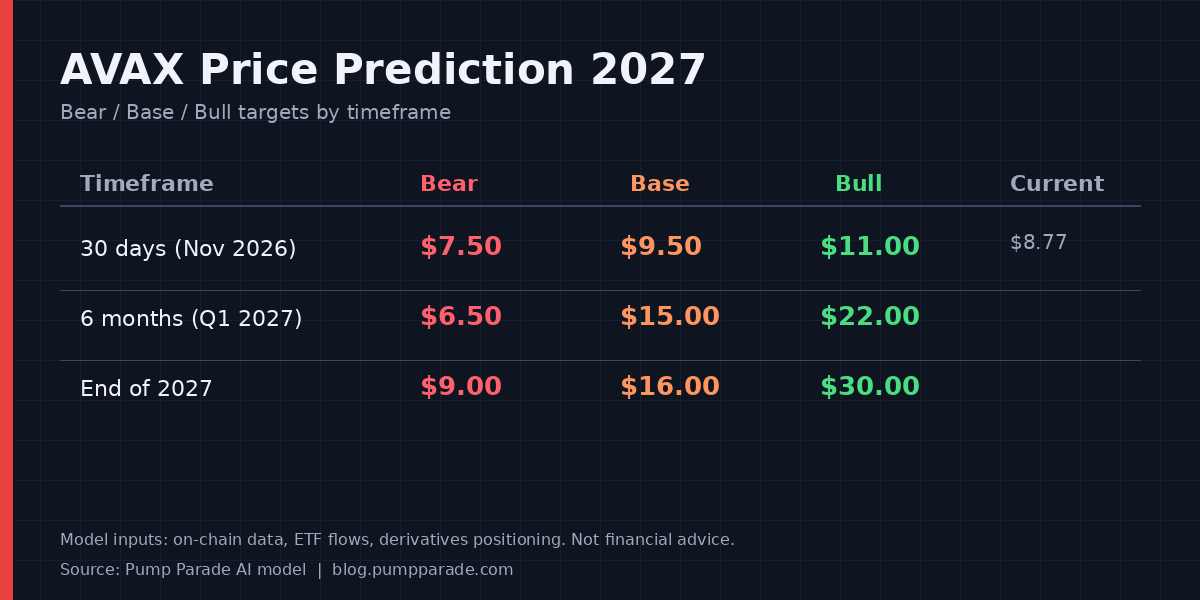
These targets reflect our hybrid AI model output combined with on-chain data from DefiLlama, ETF flow trends, and derivatives positioning. They assume no black swan macro event. All targets are conditional, not promises.
30-day outlook (through late November 2026)
The $8.00 support zone is the first line to defend. A clean daily close below $7.50 would open $5.80, which was the April 2024 low. On the upside, AVAX needs to reclaim $10.50 to invalidate the descending triangle, with a secondary target of $12.80. Base case for the next month: a range of $7.50 to $11.00. Short-term probability favors a retest of support before any sustainable move higher.
6-month outlook (through April 2027)
By late Q1 2027, we expect clarity on three fronts: the AVAX ETF flow trajectory, the number of enterprise L1s actually launched on Avalanche9000, and whether BTC breaks above or stays below $100K. Our base case range is $12 to $18, with a bull extension to $22 if ETF flows accelerate as expected. Bear case drops back to $6.50 to $9.00 if TVL stalls.
Long-term outlook (end of 2027)
Full-year 2027 targets. Bear: $7 to $10, roughly flat from today, with institutional adoption failing to translate to token demand. Base: $14 to $18, reflecting modest ETF inflows and 50 to 100 new L1s. Bull: $25 to $30, requiring sustained ETF inflows above $500 million cumulative, a Firedancer-tier catalyst at the protocol level, and a broader risk-on crypto environment.
For comparison, Traders Union analyst Viktoras Karapetjanc placed a 2027 bull target of $80 to $120 earlier this year. KoinX models cluster around $100 for 2027. We view those as cycle-top aspirational, not base cases, given the current structure. Our range is deliberately tighter and more probability-weighted.
How Does Avalanche Compare to Solana in 2026?
This is the fairest head-to-head because both are high-throughput smart contract platforms, both have spot ETFs trading in the US, and both are chasing the same institutional dollar.
| Metric | Avalanche (AVAX) | Solana (SOL) |
|---|---|---|
| Price (29 Oct 2026) | $8.77 | $100.41 |
| Market cap | $3.89B | $59.27B |
| Market cap rank | #28 | #7 |
| % from ATH | -93.95% | -65.75% |
| 30-day change | -24.14% | -15.87% |
| DeFi TVL | ~$1.2B | ~$5.9B |
| RWA TVL | $1.3B | ~$600M |
| Spot ETF status | VanEck live, others filed | Multiple live, $1.5B+ inflows |
| Flagship upgrade | Avalanche9000 (live) | Alpenglow (live) |
The reading is split. Solana wins on raw TVL, developer activity, and ETF momentum. Avalanche wins on real-world asset share and institutional partnerships. In a pure beta trade, SOL offers more upside. In a thematic bet on tokenization specifically, AVAX offers more leverage because its market cap is 15x smaller. For a wallet comparison relevant to both ecosystems, see our Backpack vs Solflare review.
What Would Change Our View on AVAX
Three specific triggers would shift our base case:
Scenario trigger 1 (bullish): Cumulative AVAX ETF net inflows cross $300 million before end of Q1 2027. That signals institutional conviction and would move our base to the $20 to $25 range.
Scenario trigger 2 (bearish): A daily close below $7.00 with weekly volume above $300 million. That breaks the multi-month structure and opens $5.00 as the next real support. Our base would drop to $6 to $9 through 2027.
Scenario trigger 3 (structural): The Avalanche Foundation discloses that fewer than 20 new L1s launched in the 12 months after Avalanche9000. That would confirm the bear thesis that the upgrade did not produce usage, and would recalibrate 2027 targets lower across the board.
Frequently Asked Questions
Can AVAX reach $100 in 2027?
Reaching $100 in 2027 would require an 11x move from the current $8.77 level, which is possible only in an aggressive bull scenario with sustained ETF inflows above $1 billion and a top-three position in RWA tokenization. We view $100 as a cycle-top aspirational number, not a base-case 2027 target.
Is Avalanche a good investment in 2026?
Avalanche offers asymmetric exposure to the real-world asset tokenization narrative at a market cap under $4 billion. The risk is that institutional usage does not translate to token demand. For investors sizing a position, treat AVAX as a thematic bet on tokenization, not a broad L1 play. Position sizing matters more than entry price.
What is the Avalanche9000 upgrade?
Avalanche9000 went live in December 2024 and cut the cost of deploying a subnet (now called an L1) by 99.9%. It also removed the requirement that validators stake AVAX on the primary network to validate a specific L1. The upgrade is designed to accelerate institutional subnet launches and route more fee flow back to the AVAX token.
Will Avalanche recover from its all-time high?
Returning to the $144.96 all-time high from November 2021 would require a 16x move. Historically, large-cap altcoins that fall more than 90% from an ATH rarely reclaim it in the following cycle, though some do. Our 2027 bull case tops out at $30, which is a 3.4x from current levels. A full ATH reclaim is a 2028 to 2030 question, not a 2027 one.
How does Avalanche compare to Solana?
Both are high-throughput Layer 1 chains with spot ETFs trading in the US. Solana leads on DeFi TVL, developer activity, and memecoin volume. Avalanche leads on tokenized real-world assets, with $1.3 billion RWA TVL and partnerships with BlackRock, Franklin Templeton, and FIS. Choice depends on which narrative you want exposure to. For a related mid-cap play on the DeFi stack, see our Jupiter (JUP) price prediction.
Is Avalanche dead?
No. Avalanche is in a drawdown phase, not a terminal decline. The network processes billions in tokenized assets, has active institutional partnerships, and recently shipped a major upgrade. The token price has disconnected from fundamentals, which is a different problem than the chain losing relevance. Price can stay disconnected for a long time, so patience is required.
The Honest Take
Here is the thing. Avalanche is the most interesting mispricing in the top 30. The chain has done the work: real institutional adoption, a landmark upgrade that fixes the biggest friction point in the stack, and a $1.3 billion RWA tail that no one else has outside of Ethereum. The token has not caught up because the market cannot yet see how L1 fees translate into AVAX demand at scale.
If that translation happens through late 2026 and 2027, AVAX in the $20 to $30 range is a reasonable 15-month target. If it does not, AVAX stays range-bound between $7 and $12 and the thesis has to wait another cycle.
The risk-reward is better than most alt-L1s at this market cap. But better risk-reward does not mean the trade works. Size positions accordingly, define your invalidation level (a close below $7 is ours), and watch TVL and ETF flow data more than price action in the next six months. The data moves first. Price follows.
Disclaimer: This article is for informational and educational purposes only and should not be construed as financial, investment, or trading advice. Cryptocurrency markets are highly volatile, and past performance does not guarantee future results. The price predictions and analyses presented here are based on AI models, technical indicators, and available data at the time of writing, they are not guarantees. Always conduct your own research (DYOR) and consult with a qualified financial advisor before making any investment decisions. Pump Parade and its authors do not assume liability for financial losses incurred based on information provided in this article.