TRON price prediction 2027 is the question every stablecoin trader is asking, and for good reason. TRX trades at $0.3305 at the time of writing, up a modest 0.47% over 24 hours and holding above the $0.33 support that bulls have defended all month. The chop looks sleepy on the surface. The on-chain picture is anything but.
Nansen and CoinDesk’s State of TRON Q3 2026 report, published October 21, pegged quarterly stablecoin settlement at $2.21 trillion, with TRON capturing roughly 73% of all stablecoin transfer volume globally. USDT on TRON hit an all-time high above $92.7 billion in Q3, and the Canary Staked TRX ETF (ticker TRXS) went live on Cboe on September 9, 2026. That is the backdrop. The question is whether $0.33 holds and whether TRX can reclaim its $0.4313 December 2024 all-time high, then push into price discovery toward $0.75 in 2027.
Let’s break down what the data actually says, where the bull case lives, and what would turn this setup bearish fast.
- TRX trades at $0.3305, 23.4% below its December 2024 all-time high of $0.4313, with 24-hour volume near $306 million.
- Q3 2026 numbers are a flex: $2.21T stablecoin settlement, 73% market share of transfer volume, 11.68 million daily transactions, 18 million monthly active addresses.
- Canary Staked TRX ETF (TRXS) launched September 9, 2026, becoming the first U.S. spot staked TRX ETF. T-Rex Group has filed for a 2x leveraged version.
- The GENIUS Act stablecoin rule from the OCC becomes effective January 2027, formalizing the regulatory status of USDT and benefiting the chain that settles most of it.
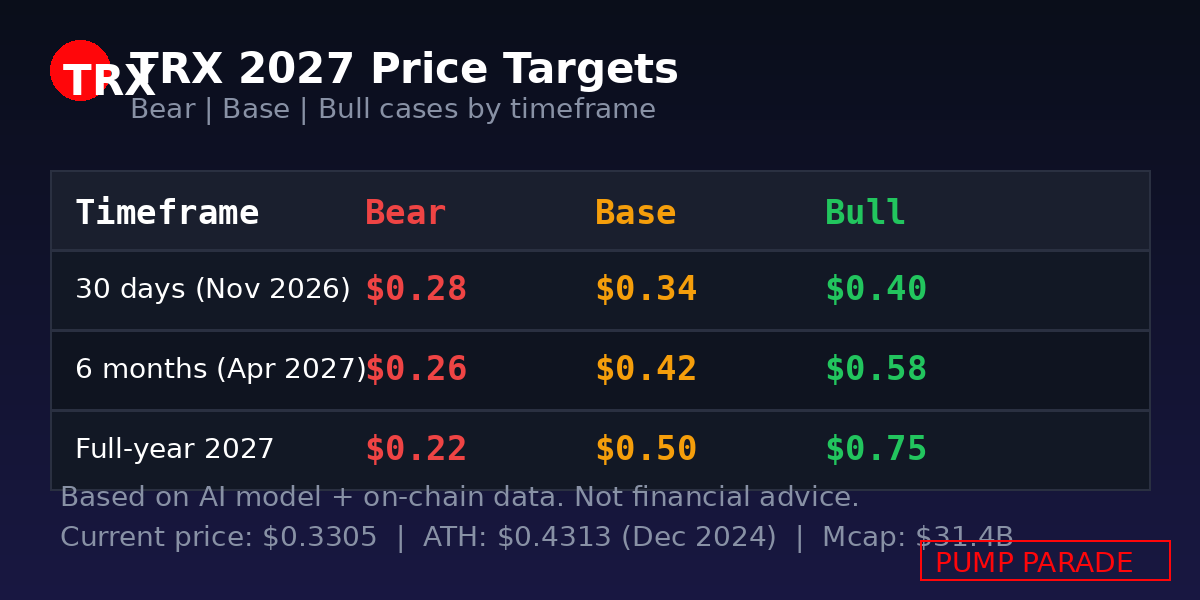
- Our 2027 range: bear $0.22, base $0.50, bull $0.75. Reclaiming the ATH is the base-case trigger that unlocks higher targets.
- The honest take: TRON prints receipts other L1s only talk about. The flaw is a dominant founder and persistent lawsuits that make institutions cautious.
Where Does TRON (TRX) Stand Today?
Before we talk targets, here is the current snapshot. All figures are at time of writing and sourced from CoinGecko and Birdeye.
| Metric | Value |
|---|---|
| Price (USD) | $0.3305 |
| 24-hour change | +0.47% |
| 7-day change | -0.16% |
| 30-day change | -1.90% |
| Market cap | $31.4 billion |
| 24-hour volume | $306.6 million |
| Market cap rank | #8 |
| Circulating supply | 95.0 billion TRX |
| All-time high | $0.4313 (Dec 3, 2024) |
| % below ATH | -23.37% |
The 30-day return is slightly negative, which is unusual given the fundamental data pouring out of the network. Translation: price is lagging activity, which is historically what sets up repricing moves when a catalyst finally lands.
Why Is TRX Range-Bound Right Now?
Three things are keeping TRX stuck between $0.32 and $0.34.
First, broader crypto conditions. Bitcoin is holding $80K but not making new highs. Ethereum is parked at $2,320. The ETH/BTC pair is weak. Beta-adjusted alt-L1s have been trading sideways in sympathy. TRX is not a BTC beta token, but it is not insulated either.
Second, supply pressure. TRON Inc., the Nasdaq-listed treasury vehicle that holds TRX on its balance sheet, bought 150,783 TRX on October 24 at an average of $0.3316, bringing holdings above 720.2 million TRX. The buys are supportive, but they are small relative to daily volume of $306 million. Treasury accumulation does not drive price alone, and the market knows it.
Third, the Sun-WLFI dispute. The ongoing lawsuits between Justin Sun and World Liberty Financial create a steady drip of headline risk. Institutions reading news flow stay on the sidelines until that resolves.
The result is a market that is quietly accumulating while waiting for a reason to break out. That reason is likely to come from one of three catalysts below.
The Bull Case for TRX
1. Stablecoin Settlement Dominance Is Now a Moat
TRON settled $2.21 trillion in stablecoins in Q3 2026, with average daily settlement up 3.9% quarter-over-quarter to $24.05 billion. The network captured about 73% of all stablecoin transfer volume at quarter-end, according to CoinDesk, and USDT on TRON hit $92.7 billion in Q3, a 2026 high of 50.6% of total USDT market share. That is not a niche. That is the primary rail for the world’s most-used digital dollar.
The flywheel compounds. More USDT on TRON means more fee burn, more validator revenue, more retail adoption in emerging markets where USDT is a dollar substitute. JustLend active loans grew from $127 million to $199 million in Q3, and total value locked rose 26.6% to $5.7 billion. The network is becoming a credit market on top of a payment rail. (For related infrastructure plays, see our Chainlink price prediction for 2027.)
2. The Canary TRX ETF and Potential Inflows
Canary Capital’s Staked TRX ETF (TRXS) debuted on Cboe on September 9, 2026, as the first U.S. spot staked TRX ETF. TRON DAO rang the Cboe closing bell September 29 to mark the launch. T-Rex Group has separately filed for a 2x leveraged TRX ETF, which, if approved, would add leveraged trading demand on top of base ETF flows.
For comparison, the first spot Bitcoin ETFs captured $40 billion in net inflows in their first nine months. Even if TRXS captures a fraction of that trajectory, say $300 million to $500 million in year-one net inflows, that is meaningful demand against a 95 billion token float where only a portion is liquid.
3. GENIUS Act Clarity for Stablecoins
The Office of the Comptroller of the Currency finalized the GENIUS Act stablecoin rule in October 2026, with full effectiveness in January 2027. The rule gives federally chartered banks a path to issue payment stablecoins and formalizes the compliance framework for existing issuers. Tether, which issues most USDT on TRON, is positioned to operate within this framework.
Regulatory clarity is not usually priced as a short-term catalyst. It compounds over quarters. A chain settling 73% of stablecoin volume with a legal green light for its biggest asset is a different investment story than one operating under regulatory ambiguity.
The Bear Case for TRX
1. Founder Concentration and Legal Overhang
Justin Sun is the primary architect of TRON, and that is both the bull case and the bear case. His holdings are large, his personal brand drives narrative, and the Sun-WLFI lawsuits remain unresolved. Any adverse ruling, SEC action, or further headline from the dispute could create concentrated selling pressure. Institutions building long-term positions typically underweight chains with concentrated founder risk.
2. Tether Dependency Is a Double-Edged Sword
73% stablecoin market share sounds great until you remember that most of it is a single asset issued by a single company. Tether’s $344 million USDT freeze on TRON in April 2026 showed what centralized stablecoin issuance can do. If regulators decide USDT needs to migrate off TRON for compliance reasons, or if Tether moves issuance to its own L1, TRX loses its primary demand driver overnight.
3. Competitive Pressure From Base, Solana, and Ethena
Base is onboarding Coinbase stablecoin flows. Solana is pulling USDC volume with its sub-cent fees. Ethena’s synthetic dollar (USDe) is growing fast as a yield-bearing alternative. TRON’s dominance is historical, not permanent. If stablecoin volume starts migrating meaningfully to competing rails in 2027, the thesis breaks.
What Is the TRON Price Prediction for 2027?
Our hybrid AI model combines on-chain settlement data, ETF flow projections, technical levels, and sentiment indicators. Here is what it suggests across three timeframes. These are scenarios, not promises.
Short-Term (30 days, through late November 2026)
Base case $0.34. The $0.328 support has held cleanly. A clean break above $0.3360 resistance, which lines up with the inverse head and shoulders neckline analysts flagged this week, would open $0.38 to $0.40 as the next test. Bull case $0.40 requires BTC holding $80K and a positive TRXS inflow print. Bear case $0.28 if BTC loses $75K.
Medium-Term (6 months, through April 2027)
Base case $0.42. This is a reclaim of the $0.40 ascending trendline from the 2025 lows and a retest of the $0.4313 ATH zone. Bull case $0.58 if TRXS crosses $500 million in net inflows and GENIUS Act implementation goes smoothly in January. Bear case $0.26 if a WLFI court ruling goes against Sun or Tether announces USDT migration plans.
Full-Year 2027
Base case $0.50. This is price discovery above ATH, driven by continued stablecoin growth and ETF inflow accumulation. The bull case $0.75 requires three things to go right: TRXS inflows exceed $1 billion, no adverse legal rulings, and stablecoin market cap grows past $500 billion with TRON holding share. Bear case $0.22 if founder-related headlines force a de-rating or stablecoin volume meaningfully migrates off TRON.
For comparison, analyst aggregator Changelly’s 2027 range sits at $0.37 to $0.56, which overlaps our base case. TokenTax’s model places the 2027 average at $0.40 with a max of $0.75, which lines up almost exactly with our bull case.
How Does TRON Compare to Ethereum for Stablecoins?
The honest competitive comparison for TRX is not against Solana or Cardano. It is Ethereum, because that is where stablecoin market share is actually fought.
| Metric | TRON | Ethereum |
|---|---|---|
| USDT held | $94B+ (Oct 2026) | $80B+ (Oct 2026) |
| Stablecoin transfer share | ~73% | ~15% |
| Avg USDT fee (user) | ~$0.30 | $1.50 to $4.00 |
| Daily transactions | 11.68M | 1.2M |
| Monthly active addresses | 18M | ~5M |
| Market cap | $31.4B | $283.9B |
| TVL (DeFi) | $5.7B | $58B+ |
| Spot ETF status | Live (Canary TRXS) | Live (multiple) |
TRON wins on throughput and user fees for stablecoin transfers. Ethereum wins on DeFi depth, developer ecosystem, and institutional recognition. The two are not interchangeable. TRX is a stablecoin settlement bet. ETH is a programmable money bet. (A broader cross-border payments comparison lives in our Ripple XRP price prediction for 2027.)
What Would Change Our View
Three scenario triggers would force a revision of these targets.
Upgrade to our bull case ($0.90 to $1.00 in 2027) if TRXS captures $1.5 billion or more in net inflows by Q2 2027, a second major issuer launches a competing TRX ETF, and Tether publicly commits to maintaining USDT issuance on TRON through 2028.
Downgrade to our bear case ($0.15 to $0.20 in 2027) if the SEC takes enforcement action against Justin Sun personally, Tether announces migration of USDT to its own chain, or stablecoin transfer volume on TRON falls below 50% share for two consecutive quarters.
Range extension ($0.28 to $0.45 drift) if nothing conclusive happens on legal, ETF, or stablecoin fronts, and TRX continues to track crypto market beta with slight outperformance from on-chain revenue. This is the “nothing changes” base case.
Frequently Asked Questions
Will TRX reach $1 by 2027?
Our model’s bull case for 2027 tops out at $0.75, which is still 30% below the $1 threshold. Reaching $1 would require TRX market cap near $95 billion, roughly triple current levels. That is plausible on a 3 to 5 year horizon if stablecoin growth accelerates, but it is not our 2027 base case.
Is TRON a good investment in 2027?
TRON is one of the few L1s with real revenue and dominant market share in a growing category (stablecoin settlement). The investment case rests on whether that moat holds through 2027. If you believe stablecoins keep growing and TRON keeps its share, the risk-reward favors accumulation at current levels. If you expect regulatory or competitive pressure to erode share, there are safer bets.
What is the TRON price prediction for 2027?
Our hybrid AI model projects a 2027 range of $0.22 (bear) to $0.75 (bull), with a base case near $0.50. The base case assumes TRX reclaims its $0.4313 ATH in H1 2027 and establishes a new range above it driven by continued ETF inflows and stablecoin growth.
Can TRON hit $2 by 2030?
At $2, TRX would need a market cap of about $190 billion, assuming flat supply. That is roughly where Ethereum traded at its 2021 peak. It is not impossible on a 5-year horizon if TRON becomes the primary global stablecoin settlement layer, but $2 is a long-horizon stretch target, not a 2027 or 2028 base case.
What is driving TRX price in 2026?
Four factors: stablecoin settlement growth, the launch of the Canary Staked TRX ETF, the GENIUS Act regulatory framework, and TRON Inc.’s treasury accumulation. The negative drags are the Sun-WLFI legal dispute and competitive pressure from Base, Solana, and emerging stablecoin issuers.
How does TRON differ from Ethereum for stablecoin transfers?
TRON offers roughly 10 to 50 times cheaper USDT transfer fees than Ethereum mainnet and ten times the daily transaction throughput. Ethereum offers deeper DeFi integration, more composable stablecoin applications, and stronger institutional validation. For sending USDT, TRON wins. For building financial applications on top of stablecoins, Ethereum still leads.
The Honest Take
TRON is one of the strangest bull cases in crypto. The chain prints real revenue, has clear product-market fit, dominates its category, and trades at 8x revenue, which is cheap compared to most alt-L1s. The on-chain data is unambiguous.
The reasons it does not get the respect its fundamentals deserve are governance concentration, founder legal risk, and a dependency on a single stablecoin issuer that could, in theory, leave. Those risks are real. They are also the reason TRX is at $0.33 instead of $0.60.
The risk-reward favors watching for a clean breakout above $0.3360 and the $0.40 psychological level. Below $0.30 the setup is broken and the base case shifts to the bear range. Above $0.43, TRX is in price discovery for the first time ever, and the upper band of our 2027 bull case comes into play fast.
Smart money is probably accumulating here while retail is bored. That is usually how the best setups look right before they are not boring anymore.
Disclaimer: This article is for informational and educational purposes only and should not be construed as financial, investment, or trading advice. Cryptocurrency markets are highly volatile, and past performance does not guarantee future results. The price predictions and analyses presented here are based on AI models, technical indicators, and available data at the time of writing, they are not guarantees. Always conduct your own research (DYOR) and consult with a qualified financial advisor before making any investment decisions. Pump Parade and its authors do not assume liability for financial losses incurred based on information provided in this article.