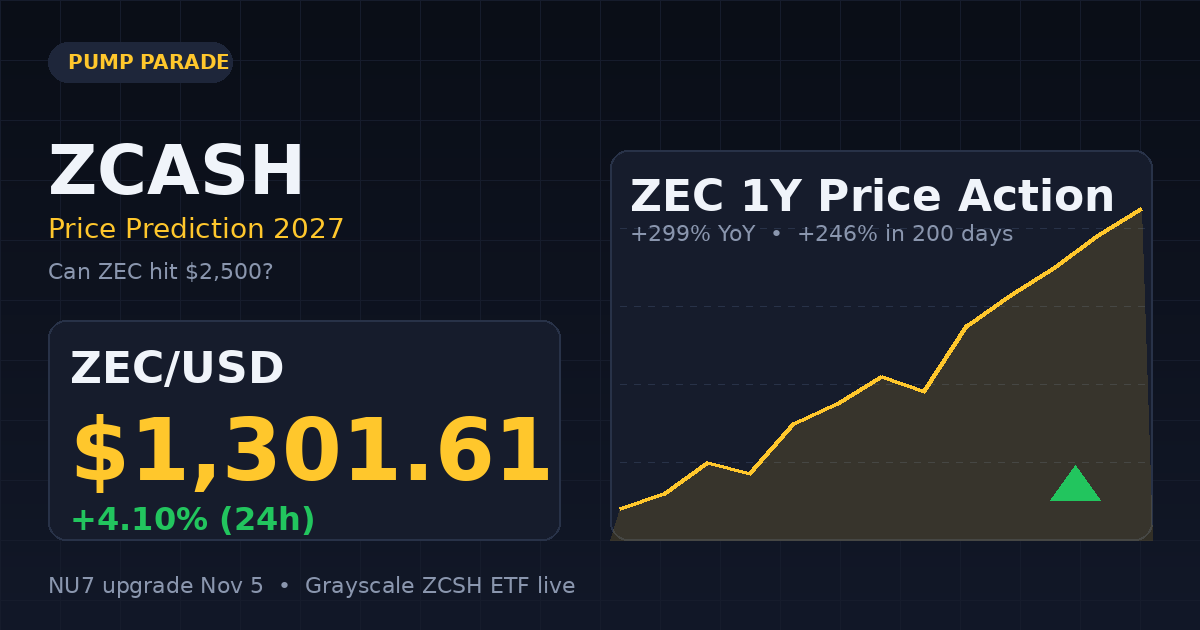
Zcash (ZEC) is trading at $1,301 at time of writing, up 299% over the past year and holding a top-10 market cap for the first time since 2017. The Zcash price prediction 2027 question suddenly matters a lot more than it did six months ago. ZEC crossed the $1,000 mark in September, two weeks after Grayscale's spot ZEC ETF (ticker ZCSH) listed on NYSE Arca, and the fund has already pulled in over $460 million in net assets.
The next catalyst is eight days away. On November 5, 2026, the NU7 mainnet upgrade activates at block 3,543,405, cutting Zcash's target block time from 75 seconds to 25 seconds. If the privacy narrative holds and institutions keep buying through the ETF wrapper, the setup for a run at $2,500 or beyond is real. Here's the full breakdown: bull case, bear case, specific targets, and the levels we are watching.
Key Takeaways
- ZEC trades at $1,301, up 299% year over year and 246% in 200 days.
- Grayscale's spot ZEC ETF (ZCSH) launched August 25, 2026 and holds roughly $463M in net assets.
- The NU7 upgrade activates November 5, 2026, cutting block time from 75s to 25s.
- Shielded supply holds at 23% of total ZEC, up from 8% in early 2025.
- Base case 2027 target: $1,800 to $2,500. Bull case: $3,500 to $5,000.
- Bear case: $600 to $800 if privacy-coin regulation tightens or ETF demand stalls.
Where Zcash (ZEC) Stands Today
Zcash's rally over the past year has been one of the sharpest in crypto. The data from CoinGecko tells the story.
| Metric | Value |
|---|---|
| Current price | $1,301.61 |
| 24h change | +4.1% |
| Market cap | $22.1 billion |
| Market cap rank | #10 |
| 24h volume | $800 million |
| All-time high | $3,191.93 (Oct 2016) |
| Percent from ATH | -59.2% |
| Circulating supply | 17.0M ZEC |
| Max supply | 21.0M ZEC |
Two numbers deserve a closer look. First, ZEC is up 299% over the past year but down 16% over the past 30 days. That reads as a healthy consolidation after a parabolic run, not a top. Second, the 10-year all-time high of $3,191.93 was set on October 28, 2016, exactly ten years ago today. If ZEC reclaims that level, it will be the longest ATH recovery of any top-10 coin.
Why is Zcash rising right now?
Three forces are stacking on top of each other, and the market is pricing them in.
The first is institutional. Grayscale listed the Zcash spot ETF on NYSE Arca on August 25, 2026, with Coinbase as custodian. The fund opened with 387,000 ZEC worth $260 million and crossed $463 million in net assets within two weeks. For privacy coins, which have historically been exchange-delisted or quietly sidelined by compliance teams, that is a reversal, not a minor headline.
The second is technical. The NU7 upgrade proposal cleared voting with 99.9% approval and activates at block 3,543,405 on or around November 5. The upgrade cuts Zcash's target block time from 75 seconds to 25 seconds, a 67% reduction in confirmation latency. For a chain that wants to be used, not just held, that matters.
The third is narrative. Per Glassnode, privacy-focused cryptocurrencies are trading 213% above their October 2025 Bitcoin-peak levels. The on-chain transparency problem became obvious once stablecoin volumes outgrew bank transfers, and the market is paying for solutions that fix it. Zcash's shielded pool, where transactions are fully private via zk-SNARKs, holds 23% of total supply, up from 8% at the start of 2025. That is sticky demand, not speculation.
Why could ZEC hit $2,500 by 2027?
Three catalysts could push ZEC to $2,500 or beyond by 2027.
The NU7 upgrade activates November 5
The headline change is the block time reduction, but the technical weight sits in what NU7 unlocks. Faster blocks mean faster shielded transaction confirmations, which makes Zcash viable as a payment layer rather than only a store of value. Developer Sean Bowe confirmed the activation height in a GitHub proposal, and the Zcash Foundation's readiness tracker shows most of the preparation work complete. If the mainnet transition is clean, expect a sell-the-news dip followed by a reclaim.
Grayscale's ZCSH ETF has institutional flow
The ETF took in roughly $200 million in incremental assets during its first three weeks. If Bitwise, Franklin Templeton, or another issuer files a competing spot privacy coin fund, Zcash gets the Litecoin treatment: more vehicles, more compliance clearance, more marginal buyers. The data from the first wave of ETF products shows AUM growth tends to compound, not spike and fade. The rally into NU7 is partly flow-driven, which gives the move more durability than a pure retail pump would.
The privacy narrative has institutional cover now
Private transactions used to be a regulatory third rail. The Grayscale filing legitimized the category at the compliance level. Combined with the shielded supply climb to 23%, the thesis is not “privacy coins might come back.” It is “privacy coins are back, and Zcash is the on-ramp.” If Monero's 2027 trajectory is any template, ZEC has room to run on institutional accumulation alone.
What could send ZEC back to $800?
Three risk factors keep us from putting the bull case on autopilot.
Regulatory overhang has not disappeared
The Grayscale ETF cleared registration, but the SEC can still move on individual chain features. The EU's Markets in Crypto-Assets regulation (MiCA) explicitly limits anonymous transactions in certain contexts, and major exchanges in Europe have delisted ZEC and XMR under those rules. If US regulators pivot after the current political window closes, the ETF wrapper does not save the underlying asset. Base rate: privacy coins have been delisted at least a dozen times across major venues in the past five years.
Technicals are stretched
Daily RSI hit 71 at the recent high, briefly entering overbought territory. The 50-day EMA sits at $869 and the 200-day at $571, which means a mean-reversion scenario could see ZEC trade back toward the $800 to $1,000 zone before the next leg up. Open interest in ZEC futures jumped to 2.3 million ZEC from 1.76 million in late October, and the funding rate flipped negative, meaning shorts are now paying premiums. That setup resolves one of two ways: a short squeeze toward $1,800, or a long liquidation back to $1,000.
Shielded supply is still a minority
23% of total ZEC supply sits in the shielded pool. That is up from 8%, but it also means 77% of circulating ZEC still transacts transparently, functionally identical to Bitcoin. If users do not move further into shielded transactions, Zcash's privacy premium erodes and the narrative weakens. The counter: shielded growth has slowed from an acceleration into stabilization, which can be read either as consolidation or as a plateau.
Zcash Price Prediction 2027: Targets by Timeframe
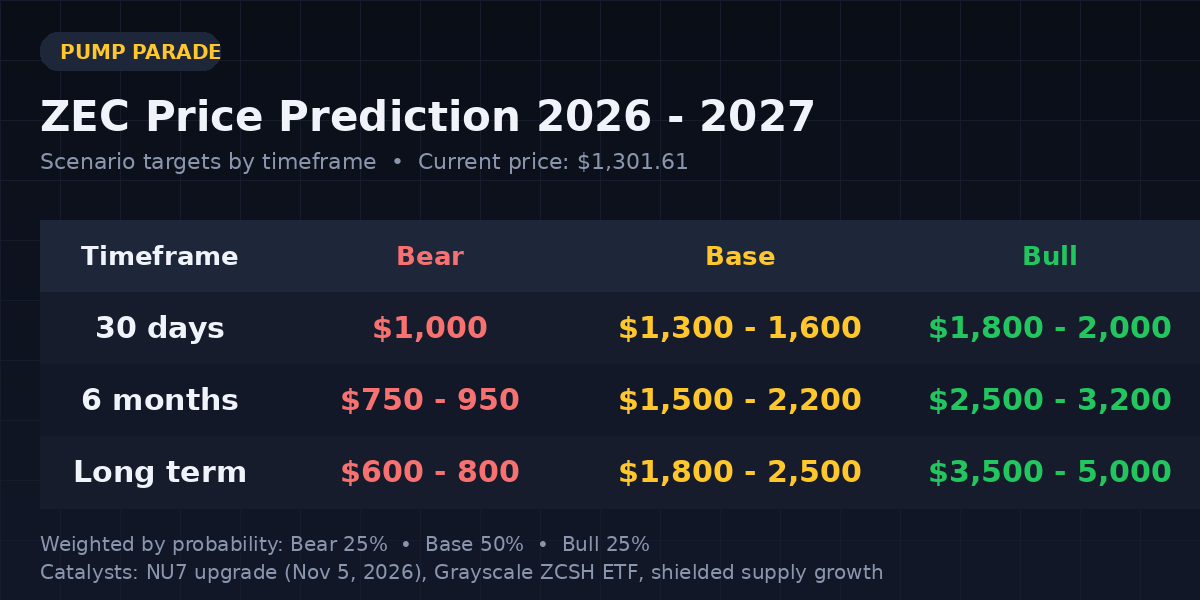
Our price targets are built from three inputs: on-chain metrics (shielded supply growth, ETF inflows), technical structure (support, resistance, moving averages), and relative-value comparisons to Monero and Bitcoin. We use three scenarios: bear (probability-weighted 25%), base (50%), and bull (25%).
30-day outlook (through late November 2026)
The NU7 activation on November 5 is the near-term catalyst. Bear: $1,000 to $1,150 if the upgrade hits a technical snag or triggers a sell-the-news event. Base: $1,300 to $1,600, with ZEC consolidating in a tight range and holding above the $1,200 support. Bull: $1,800 to $2,000 if the upgrade activates cleanly and ETF inflows pick up into year-end.
6-month outlook (through April 2027)
The medium-term picture depends on whether ZCSH's ETF momentum continues. Bear: $750 to $950 if privacy-coin regulation tightens or ETF demand plateaus. Base: $1,500 to $2,200, with Zcash consolidating in a new institutional range above the pre-ETF pricing. Bull: $2,500 to $3,200 if a second major issuer files a competing privacy coin ETF.
Long-term outlook (2027 to 2028)
By end of 2027, our hybrid model places the base case at $1,800 to $2,500. Bear case: $600 to $800 under a sustained privacy-coin regulatory crackdown. Bull case: $3,500 to $5,000 if NU7 drives on-chain usage and the shielded pool crosses 40% of supply. Hitting the all-time high of $3,191 by 2027 requires sustained institutional buying plus a meaningful ZEC/BTC relative-value rotation. It is possible, but it is not the base case.
How Does Zcash Compare to Monero?
Monero (XMR) and Zcash (ZEC) are the two serious privacy coins in the market. The differences matter.
| Metric | Zcash (ZEC) | Monero (XMR) |
|---|---|---|
| Current price | $1,301 | $611 |
| Market cap | $22.1B | $11.3B |
| Market cap rank | #10 | #13 |
| Privacy by default | No (optional) | Yes |
| Privacy tech | zk-SNARKs | Ring signatures, stealth addresses |
| Max supply | 21M | Uncapped (tail emission) |
| Spot ETF | Yes (Grayscale ZCSH) | No |
| Major CEX listings | Coinbase, Kraken, Gemini | Delisted on most major CEXs |
Zcash's edge is institutional access and optional privacy, which keeps regulators calmer. Monero's edge is privacy-by-default and a more cypherpunk community. If you are betting on the institutional thesis, ZEC is the trade. If you are betting on the regulatory-pushback thesis, XMR is the trade. For most portfolios, the two are complementary, not substitutes.
What Would Change Our View
Three scenario triggers would move us meaningfully off the base case.
Trigger 1: A second spot privacy coin ETF files or launches. A Bitwise, Franklin Templeton, or Fidelity filing for a competing privacy coin fund would raise our 2027 target to $3,500 to $4,500 as the base case. Watch for 19b-4 filings on NYSE Arca and CBOE BZX through Q1 2027.
Trigger 2: NU7 activation fails or delays past Q1 2027. If the November 5 upgrade stalls or produces consensus bugs, our 2027 base case drops to $800 to $1,200. Monitor the Zcash Foundation's NU7 readiness tracker and Zebra node sync status.
Trigger 3: A US or EU privacy-coin ban proposal advances. If MiCA Phase 2 or a US stablecoin bill contains explicit anonymous-transaction restrictions, our bear case moves to the probability-weighted center at $600 to $900.
Frequently Asked Questions
What will Zcash be worth in 2027?
Our base case for Zcash by end of 2027 is $1,800 to $2,500, built on the NU7 upgrade activating cleanly and sustained ETF inflows into ZCSH. The bear case is $600 to $800 under a regulatory crackdown. The bull case runs to $3,500 to $5,000 if a second spot privacy ETF launches and shielded supply crosses 40% of total ZEC.
Is Zcash a good investment in 2026?
Zcash has delivered 299% over the past year and holds a top-10 market cap, with institutional access through Grayscale's ZCSH spot ETF. The upside case is real, but privacy-coin regulation remains the open risk. Position sizing matters more than entry timing: ZEC fits as a satellite privacy exposure, not a core holding.
What is the Zcash NU7 upgrade?
NU7 is Zcash's seventh network upgrade, activating at block 3,543,405 around November 5, 2026. It cuts the target block time from 75 seconds to 25 seconds, speeding up transaction confirmations by roughly 67%. The upgrade passed voting with 99.9% approval and retains Zcash's current halving schedule.
Will Zcash reach $2,500 by 2027?
Reaching $2,500 is our base case for 2027, with roughly a 50% probability based on current ETF flows, NU7 execution, and shielded supply trends. It requires continued institutional buying through ZCSH, no major regulatory setbacks, and a successful NU7 activation. $2,500 is a 92% move from the current $1,301 price.
Is Zcash better than Monero?
Zcash and Monero solve privacy differently. Zcash uses zk-SNARKs with optional shielding and has institutional access through Grayscale's ETF. Monero uses ring signatures with privacy by default and is delisted from most major exchanges. Zcash wins on institutional access; Monero wins on default privacy strength.
Why is Zcash price rising?
Three catalysts: Grayscale's spot ZEC ETF (ZCSH) launched August 25, 2026 and pulled in $463M in two weeks; the NU7 upgrade activates November 5, 2026, cutting block time to 25s; and privacy coins as a sector are trading 213% above October 2025 BTC-peak levels per Glassnode.
The Honest Take
Zcash is in a legitimately strong setup. The ETF is live, institutional flow is tracking, and NU7 is eight days away. The 299% YoY return is impressive, but it also means ZEC is pricing in a lot of good news.
Our base case puts ZEC at $1,800 to $2,500 by 2027, with real optionality to $3,500+ if a second ETF files. The honest risk: privacy coins have been through this cycle before. In 2017, ZEC briefly traded above $3,000 and then spent the next six years in a drawdown. The 2026 story has institutional access that 2017 did not. That is the thesis. Position accordingly, and know what you are underwriting.
For readers tracking privacy-coin exposure across a portfolio, our Monero 2027 outlook, Bitcoin Cash analysis, and Litecoin 2027 outlook cover complementary theses worth weighing against ZEC.
Disclaimer: This article is for informational and educational purposes only and should not be construed as financial, investment, or trading advice. Cryptocurrency markets are highly volatile, and past performance does not guarantee future results. The price predictions and analyses presented here are based on AI models, technical indicators, and available data at the time of writing, and are not guarantees. Always conduct your own research (DYOR) and consult with a qualified financial advisor before making any investment decisions. Pump Parade and its authors do not assume liability for financial losses incurred based on information provided in this article.