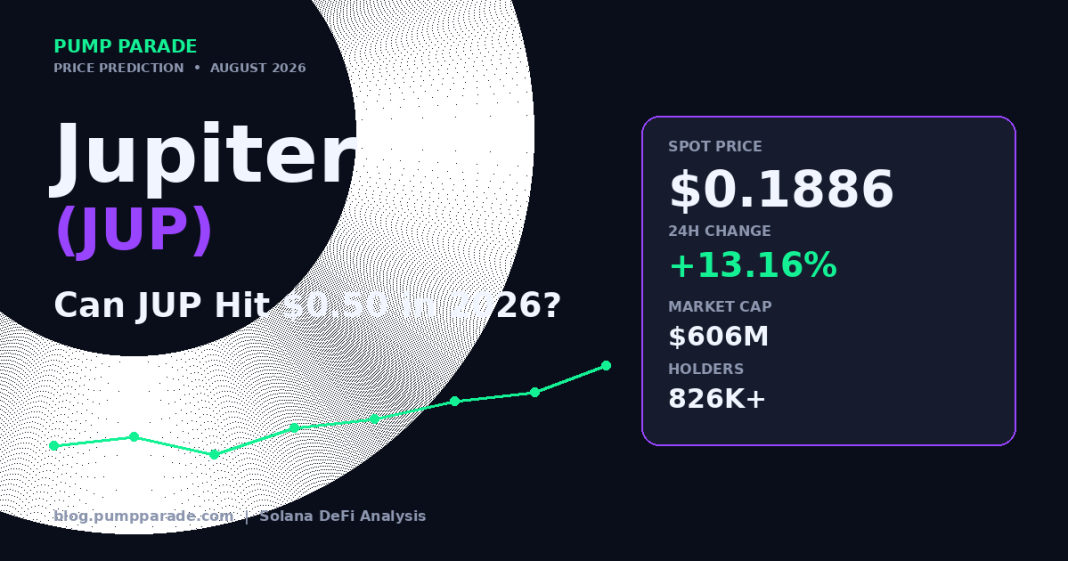
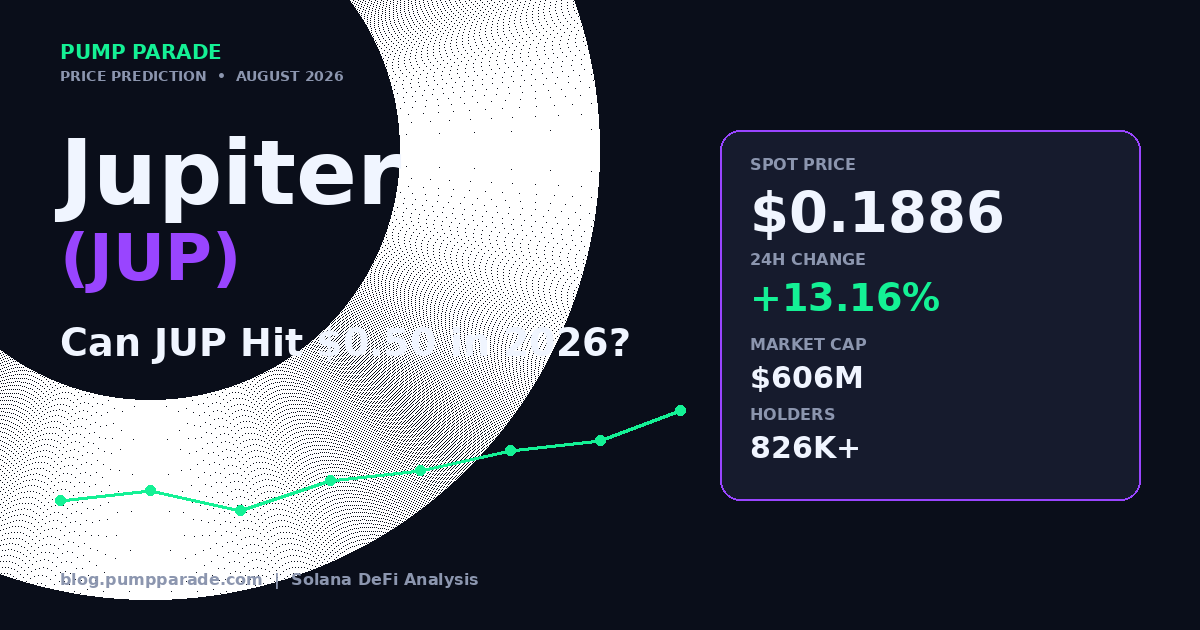
Jupiter (JUP) trades at $0.1886 this morning, up 13.16% in the last 24 hours as Solana DeFi volume rotates back into ecosystem tokens. The jupiter price prediction 2026 question has stakes now that the token sits 88% below its early-2024 highs, yet the underlying business is stronger than it has ever been.
Jupiter Lend, the protocol’s lending arm launched in 2025, is closing in on $800 million in total value locked. The team’s Net-Zero Emissions proposal passed earlier this year, meaning no more scheduled unlocks from team, investors, or Mercurial vesting. Half of protocol fees now go straight into open-market JUP buybacks. The setup is bullish on paper. The market has not agreed yet.
This piece walks through where JUP stands today, the case for a run at $0.50, the case against it, timeframe targets, how Jupiter compares to Raydium, and the questions traders actually ask on Google.
Key Takeaways
- JUP trades at $0.1886 (Aug 20, 2026), up 13.16% in 24 hours and roughly 88% below its 2024 peak.
- Jupiter Lend TVL is approaching $800 million, and 24-hour unique wallets on Solana DEX venues jumped 24% as capital rotates back.
- The Net-Zero Emissions vote ended new team and investor unlocks, tightening the free float.
- Protocol fees fund an ongoing 50% buyback; a governance proposal would raise the share and add a burn.
- Base case 2026 targets cluster around $0.22 to $0.35. Bull cases stretch to $0.55 to $1.20 if Jupiter Lend crosses $2 billion TVL and Solana volume holds.
Where Jupiter (JUP) Stands Today
Jupiter is the largest decentralized exchange aggregator on Solana and, by some measures, the largest DeFi application on the network by daily active users. The JUP token launched in January 2024 and peaked near $2 that same year before spending most of 2025 grinding lower under a combination of unlock pressure, a soft Solana market, and skepticism about whether the protocol’s buybacks could offset selling.
Here is the current snapshot.
| Metric | Value |
|---|---|
| Price | $0.1886 |
| 24h change | +13.16% |
| Market cap | $606M |
| Fully diluted valuation | $1.29B |
| Circulating supply | 3.21B JUP |
| Max supply | 6.86B JUP |
| Holders | 826,000+ |
| All-time high | $2.00 (Jan 2024) |
| % from ATH | -90.6% |
The gap between market cap and FDV is smaller than it was six months ago, which reflects the point of the Net-Zero Emissions decision. Roughly 47% of max supply is already in circulation, and future dilution is now capped by governance rather than by the original vesting calendar.
Why is Jupiter (JUP) Rising Right Now?
Three things are lining up at the same time.
First, Solana DeFi is seeing renewed volume after a summer lull. Solana clocked over $6.9 billion in 24-hour wrapped SOL volume across Birdeye-tracked venues, and Jupiter is where a large share of that flow gets routed. When aggregator volume rises, the buyback machine works harder.
Second, the community narrative around Jupiter Lend crossing $800 million in TVL has traders comparing it to Aave’s early growth curve, when protocol usage translated into token repricing. For readers tracking DeFi lending broadly, our Aave (AAVE) price prediction lays out how a similar rerating played out on Ethereum.
Third, sentiment on Solana itself has stabilized after weeks of chop. Our take on where the base layer heads next lives in the Solana (SOL) price prediction, and JUP tends to trade with a beta of roughly 1.5 to SOL when the ecosystem is in a bid.
The Bull Case for JUP
Jupiter Lend keeps compounding
The lending product is the single biggest reason to be constructive on JUP right now. TVL near $800 million puts it in the same conversation as mid-size Ethereum lending protocols despite being roughly a year old. Every dollar of lending activity generates protocol revenue, and half of that revenue currently flows into JUP buybacks. A move from $800 million to $2 billion in TVL, which is plausible if Solana perps volume holds, would meaningfully shift the buyback per token math.
Net-Zero Emissions removes the biggest overhang
The Jupiter Goes Green DAO vote in early 2026 concluded team, Mercurial stakeholder, and Jupuary allocation emissions early. Circulating supply is not growing on a scheduled basis anymore. In a market where most L1 tokens still deal with structural sell pressure, that alone is a differentiator. Analysts at tokenomist.ai flagged that roughly 30% of circulating JUP is now staked, further tightening float.
Buyback expansion and burn on the ballot
A live governance proposal would raise the fee share dedicated to buybacks above 50% and pair it with a permanent burn. If it passes and volume holds, JUP moves from a soft-capped supply story to an actively deflationary one. That is the setup that has historically preceded aggressive rerating in DeFi tokens.
The Bear Case for JUP
The 2025 buyback did not save the price
Jupiter spent roughly $70 million buying back JUP through 2025 and the token still lost value. Anatoly Yakovenko, Solana’s co-founder, publicly questioned the strategy after the 89% drawdown, arguing that the capital may have been better deployed elsewhere. Buybacks are not a magic backstop when broader market conditions are hostile.
Competition inside Solana is heating up
Meteora, Orca, and Raydium all want the same volume Jupiter aggregates. Our Orca vs Meteora comparison lays out how differentiated each is on the pool side, and both have their own token flywheels. Jupiter’s edge is routing, not liquidity, and if native DEX UX improves it could erode the aggregator premium.
Macro reversal could stall the rotation
The rotation into Solana DeFi that is helping JUP today depends on a benign risk-on tape. A hawkish Fed pivot, a sudden BTC drawdown, or a spike in equity volatility would drain flow out of long-tail DeFi tokens first. JUP historically shows a beta above 2.0 to broader crypto risk in stress conditions.
Jupiter Price Prediction 2026: Targets by Timeframe
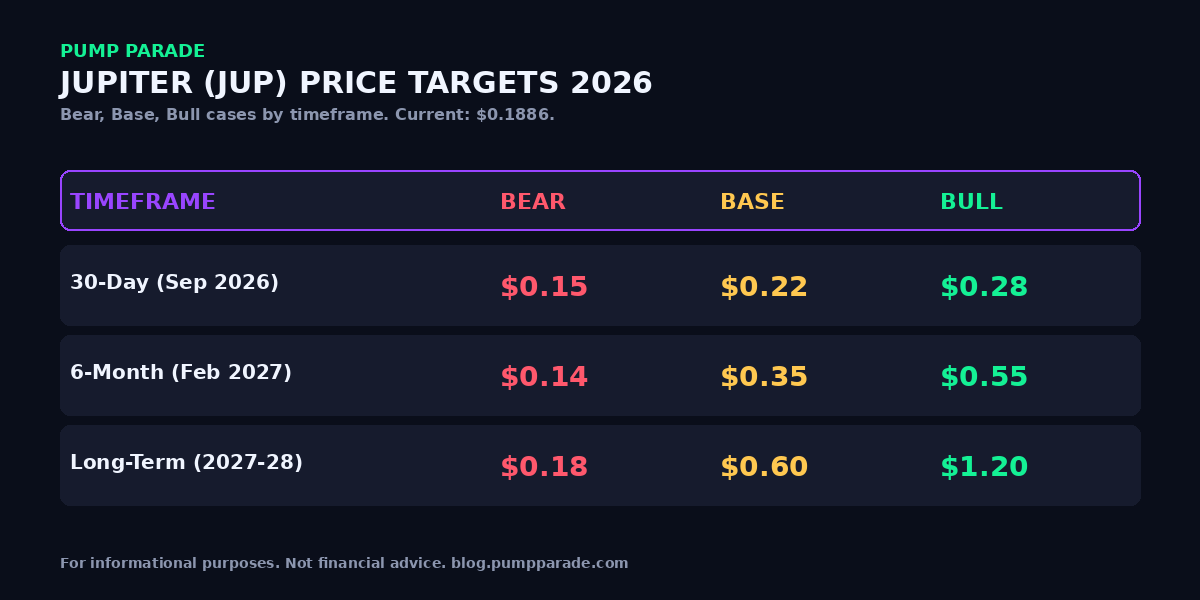
Here is how we frame the setup by timeframe. These are conditional ranges, not guarantees.
| Timeframe | Bear | Base | Bull |
|---|---|---|---|
| 30 days (through Sep 2026) | $0.15 | $0.22 | $0.28 |
| 6 months (through Feb 2027) | $0.14 | $0.35 | $0.55 |
| Long-term (2027 to 2028) | $0.18 | $0.60 | $1.20 |
30-day outlook
The 13% single-day pop happened on rising unique wallet counts and outsized DEX volume. Follow-through into the $0.22 to $0.28 zone is realistic if Solana keeps a bid. Failure to hold $0.17 would open $0.15 quickly given how thin liquidity is beyond the top book.
6-month outlook
The Feb 2027 window is where the Jupiter Lend TVL trajectory and the buyback expansion vote start showing up in the tape. Our base case of $0.35 assumes lending TVL grows to $1.2 to $1.5 billion and BTC holds current ranges. Bull to $0.55 needs the buyback vote to pass and Solana DeFi to keep leading the rotation. Analysts at Changelly model roughly $0.60 to $4.00 for full-year 2026, so our range sits within the middle of external forecasts.
Long-term outlook (2027 to 2028)
The long-term picture depends on whether Jupiter successfully expands beyond aggregation into a full DeFi superapp. A base case of $0.60 puts JUP at roughly 3x current, which is unremarkable given the sector’s history. The $1.20 bull case requires Jupiter Lend to become a top-five DeFi lender by TVL and requires the burn proposal to pass. Coinpedia’s 2027 range of $1.70 to $5.00 sits above ours because they assume a broader alt cycle we are not underwriting.
How Does Jupiter Compare to Raydium?
The two are the most-mentioned Solana DEX tokens in trader chat and they serve different roles. Jupiter aggregates. Raydium provides native liquidity, especially for launches. Here is the side-by-side.
| Metric | Jupiter (JUP) | Raydium (RAY) |
|---|---|---|
| Primary role | DEX aggregator + Lend + Perps | AMM + launchpad liquidity |
| Market cap | ~$606M | ~$450M |
| Buyback mechanism | 50% of fees | Fee capture varies by pool |
| Unlock overhang | None (Net-Zero passed) | Fully unlocked |
| Product expansion | Lend, Perps, Trigger orders | LaunchLab, CLMM pools |
| User traction | 826k+ holders | Meme-cycle dependent |
For Solana bulls, both belong in a basket. JUP has the better token structure right now. RAY has cleaner exposure to memecoin launch cycles when they return.
What Would Change Our View?
Three concrete triggers would move us off the base case.
Bullish trigger: Jupiter Lend TVL crosses $2 billion and the buyback expansion proposal passes with a burn attached. That combination pulls our 6-month base toward the current bull, roughly $0.55.
Bearish trigger: Solana 24-hour DEX volume falls below $3 billion for two consecutive weeks. That signals the rotation is over and would pull our 30-day range toward $0.14.
Structural trigger: A credible aggregator competitor gains meaningful market share, or Solana’s native DEXes internalize routing. Either scenario compresses the aggregator premium and forces us to rebuild the model from lower base assumptions.
Frequently Asked Questions
Will Jupiter (JUP) reach $1 in 2026?
Not in our base case. Getting JUP back to $1 from $0.19 requires roughly a 5x move, which needs both Solana leading the market and Jupiter Lend crossing $2 billion in TVL. Our long-term (2027 to 2028) bull case reaches $1.20, but a 2026 print at $1 would require exceptional conditions.
Is Jupiter (JUP) a good investment in 2026?
The fundamentals are the strongest they have been. Zero unlocks, growing buybacks, and a lending product with real traction argue for a rerating over 12 to 18 months. The setup fits a patient buyer who can size for volatility. It does not fit a trader looking for a quick move without a clear catalyst window.
What is the Jupiter price prediction for 2027?
Our base case for 2027 sits at roughly $0.60, driven by continued Jupiter Lend growth and the buyback compounding. The bull case runs to $1.20 if the burn proposal passes and Solana DeFi holds share against competing L1s. Other analysts, notably Coinpedia, model $1.70 to $5.00 for 2027, but that assumes a full alt cycle.
Why is Jupiter (JUP) price rising today?
The 13.16% move is a combination of Solana DeFi rotation, rising Jupiter Lend TVL headlines, and a 24% jump in unique wallet activity on Solana DEXes over 24 hours. When aggregator volume rises, fee-based buybacks intensify, which reflexively supports the token.
How does the JUP buyback program work?
Roughly 50% of Jupiter’s protocol fees are routed to open-market JUP purchases. The bought tokens are held or reallocated per DAO vote. The mechanism converts platform usage into direct spot demand, but its impact is a function of volume: quiet weeks generate less buyback pressure and rarely offset broader market weakness.
What are the biggest risks to holding JUP?
The largest risks are a macro reversal that drains Solana DeFi, aggregator competition eating into routing volume, and the buyback program continuing to disappoint if fee revenue slows. A regulatory action targeting Solana DeFi at large would also hit JUP disproportionately given its concentration in the ecosystem.
The Honest Take
Jupiter looks like a token whose story finally matches its price setup. Zero unlocks, an ongoing buyback, a live governance push to add a burn, and a lending product growing quickly are all bullish structural inputs. What is missing is a market that rewards fundamentals in real time. Right now that market is Solana DeFi, but only when SOL itself is in a bid.
A base case run at $0.22 to $0.35 into early 2027 is defensible on current data. The $0.50 print in our headline is not a promise. It is the level where the base and bull cases converge if the buyback vote passes and Jupiter Lend keeps compounding. Traders should size accordingly and watch the two triggers above: Jupiter Lend TVL and Solana DEX volume. Both are visible on-chain in near real time.
For readers who prefer a broader Solana DEX view before making a call, our Orca vs Meteora comparison walks through the native venues Jupiter aggregates. External data points worth bookmarking include the Tokenomist buyback tracker for real-time buy pressure and CoinMarketCap for volume across CEX venues.
Disclaimer: This article is for informational and educational purposes only and should not be construed as financial, investment, or trading advice. Cryptocurrency markets are highly volatile, and past performance does not guarantee future results. The price predictions and analyses presented here are based on AI models, technical indicators, and available data at the time of writing, they are not guarantees. Always conduct your own research (DYOR) and consult with a qualified financial advisor before making any investment decisions. Pump Parade and its authors do not assume liability for financial losses incurred based on information provided in this article.