
An 8-K is how a public company tells everyone something big just happened. A CEO quit, a deal closed, the auditor walked, hackers got in. The trouble is that most 8-Ks are none of those things. They’re earnings releases, exhibit lists and routine paperwork.
So we counted. We pulled every 8-K that 500 large US companies filed from July 1 to September 30, 2026, and tallied the item codes. Below is what showed up, when it showed up, a cheat sheet for which items to read first, and one real case where an alert built on item codes alone would have been two weeks late.
What an 8-K is
Form 8-K is a “current report.” Public companies file it with the SEC when certain events happen between their quarterly and annual reports. The SEC’s Form 8-K instructions say that, unless an item says otherwise, a report “is to be filed or furnished within four business days after occurrence of the event.”
A 10-Q or 10-K arrives on a schedule and covers a whole quarter or year. An 8-K arrives when something happens. That’s why people set alerts on them.
Every 8-K lists one or more item numbers, like 2.02 or 5.02. Each number is a type of event. The item number is the first thing to look at, and the thing most alert tools filter on.
We counted every 8-K from 500 big US companies in Q3 2026
How we counted
We took the 503 tickers milo tracks in its US stock universe and pulled each company’s filing history from SEC EDGAR’s submissions data. We kept every 8-K and 8-K/A filed from July 1 to September 30, 2026, and removed duplicates where two tickers share one filer (like NWS and NWSA). That left 1,450 unique filings from 500 companies, including 20 amendments. Then we counted how many filings included each item. One filing can list several items, so the counts add up to more than 1,450.
How often each item showed up
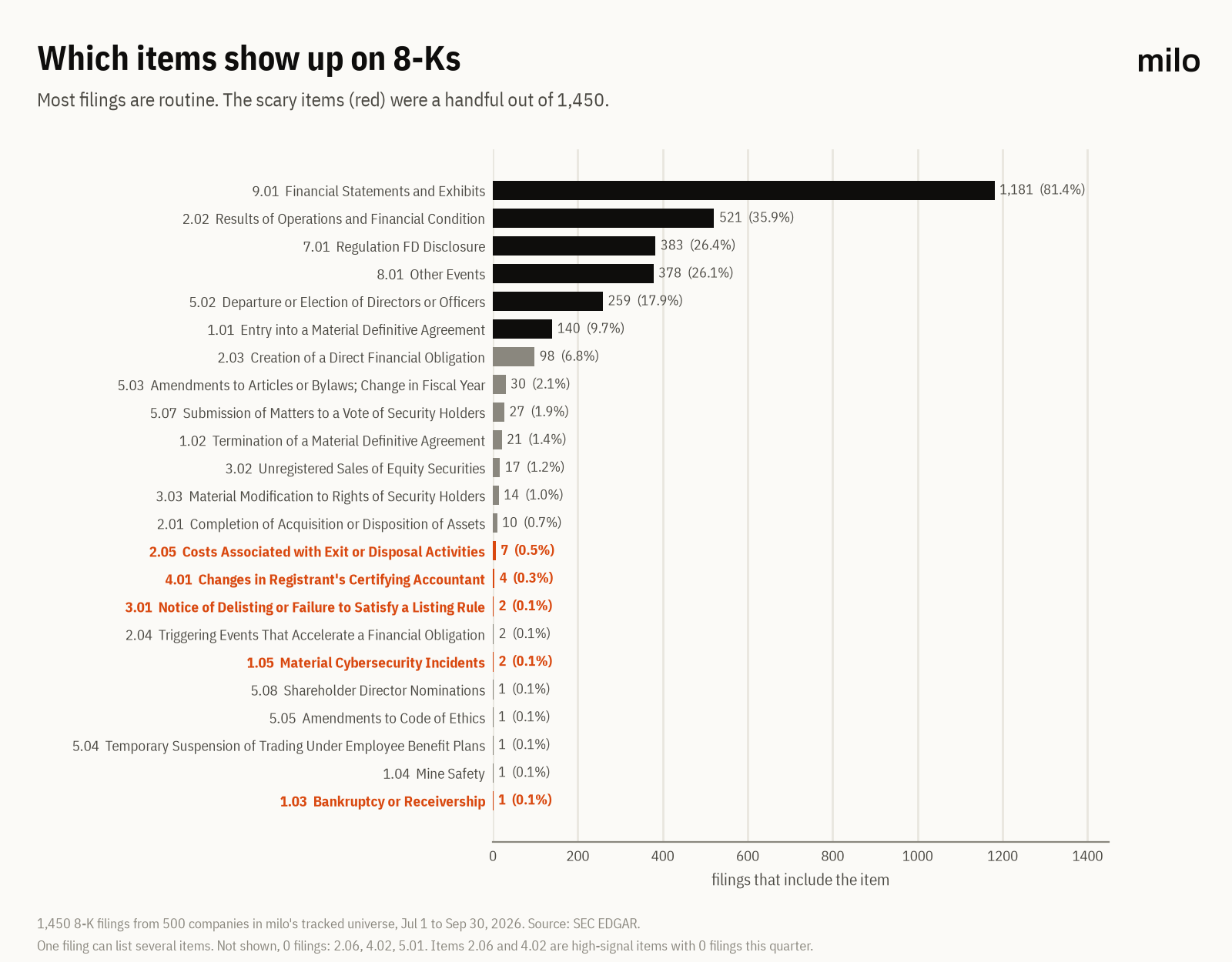
Most of it is routine. Item 9.01, financial statements and exhibits, appears on 1,181 filings, or 81.4%. That’s every filing that includes 9.01, not filings with 9.01 alone. It’s mostly a list of attached documents.
After that come earnings (2.02, on 521 filings or 35.9%), Regulation FD disclosures (7.01, 383 or 26.4%) and “other events” (8.01, 378 or 26.1%). People changes are common too: Item 5.02, directors or officers leaving or joining, was on 259 filings (17.9%). Material agreements (1.01) were on 140 (9.7%).
The items most people mean by “big news” are rare:
- 1.05, material cybersecurity incident: 2 filings
- 1.03, bankruptcy or receivership: 1 filing
- 3.01, delisting notice or failed listing rule: 2 filings
- 4.01, change of auditor: 4 filings
- 2.05, exit or disposal costs: 7 filings
- 2.06, material impairment, and 4.02, non-reliance on past financials: 0 filings
Together they were on 16 of the 1,450 filings. If your alerts fire on every 8-K, roughly 99 in 100 of them aren’t one of these.
When filings land
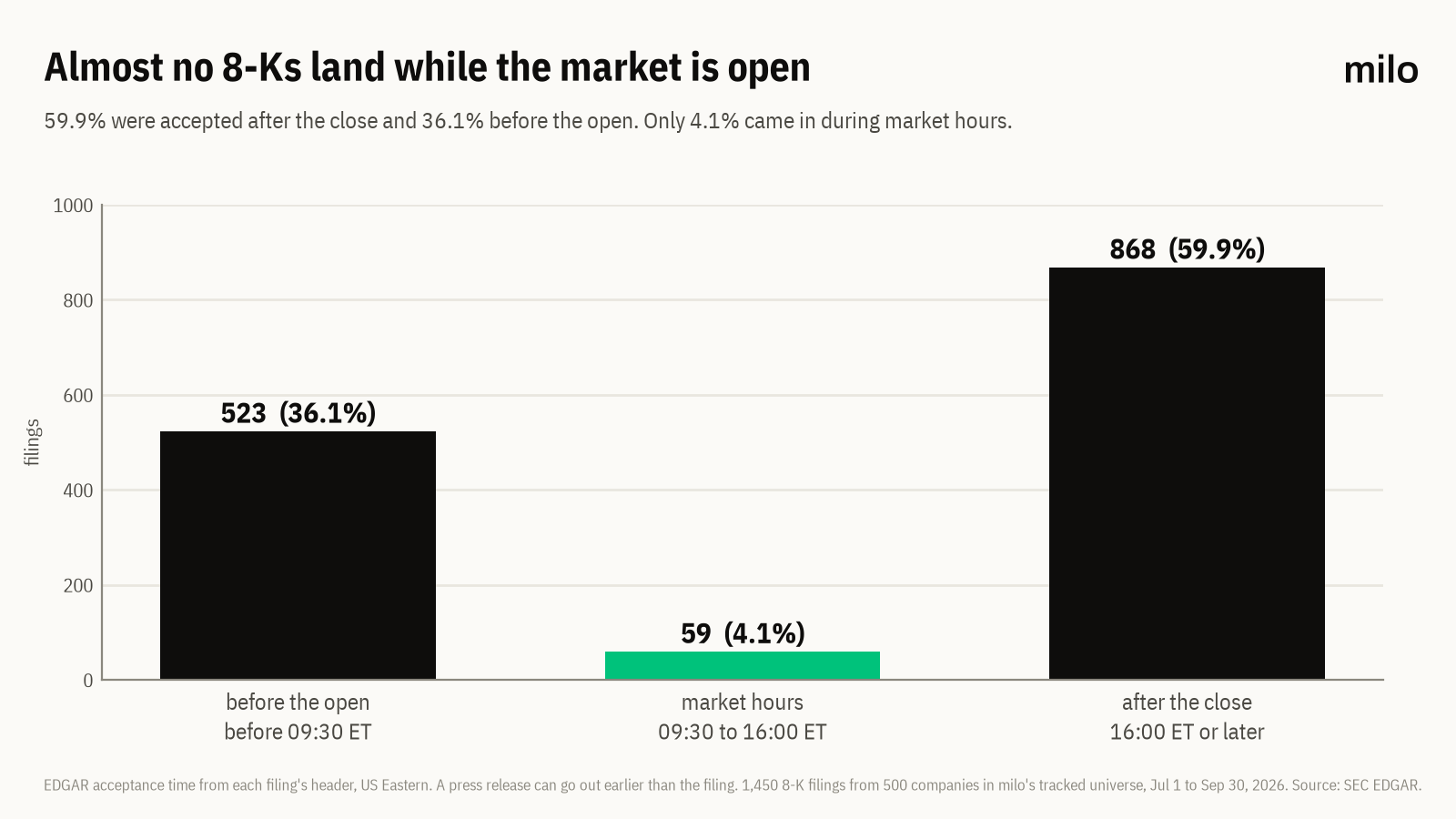
Most 8-Ks don’t arrive while you can trade on them. Using the acceptance time in each filing’s EDGAR header (US Eastern), 868 filings (59.9%) came in at or after 16:00 ET and 523 (36.1%) came in before 09:30 ET. Only 59, or 4.1%, landed during market hours. The single busiest hour was 16:00 to 16:59 ET, with 671 filings.
That shapes how you use alerts. A filing at 06:00 ET gives you a few hours before the open. One at 16:05 ET gives you the night. Acceptance time is when EDGAR took the filing, and a press release can go out a little earlier.
One data note if you pull this yourself. On 936 of the 1,450 filings, the acceptance time in EDGAR’s submissions API, converted from UTC, was four hours off the time in the filing’s own header. American Express’s July 24 earnings 8-K shows 07:00:28 ET on its EDGAR index page, while the API value converts to 11:00:28 ET. We used the header times.
The 8-K item cheat sheet
Here’s how we’d sort the items, using the SEC’s item titles and our Q3 counts.
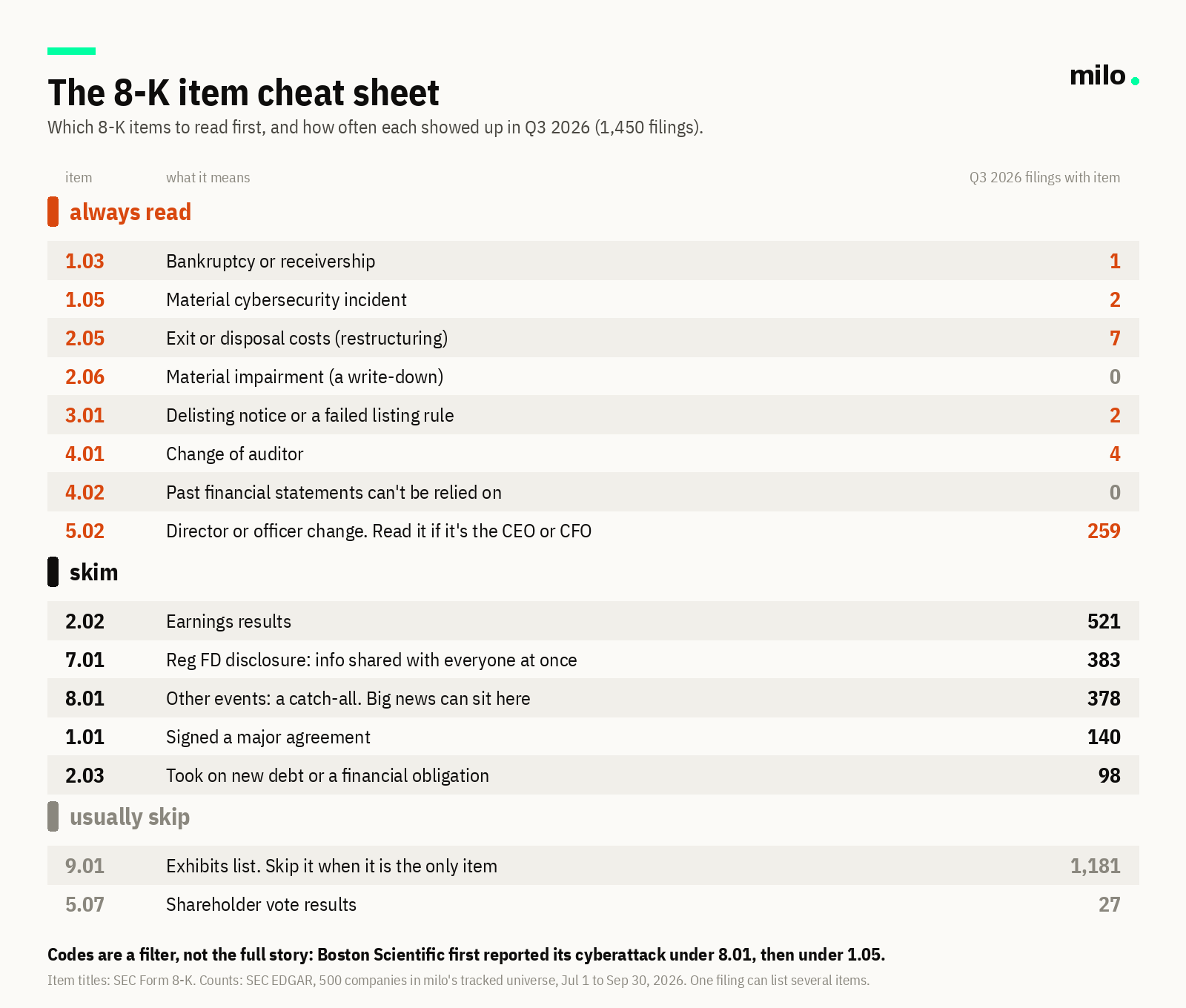
Usually skip
9.01 on its own. It’s the exhibit list. When it shows up with another item, read the other item.
5.07, shareholder vote results. 27 filings in Q3. Useful if you follow a proxy fight, otherwise it’s the tally after the annual meeting.
Skim
2.02, earnings. The press release is usually attached as an exhibit. You’ll see the numbers in the news anyway, but the filing has the full release and tables.
7.01, Regulation FD. Information shared with everyone at once, often an investor presentation. Usually routine, sometimes not.
8.01, other events. The catch-all. Most are dull, but big news can sit here. Keep reading for why this one matters.
1.01, material agreement, and 2.03, new debt. Deals and borrowing. Skim the first paragraph for size and terms.
Always read
1.03, 1.05, 2.05, 2.06, 3.01, 4.01 and 4.02. Bankruptcy, a cyber incident judged material, restructuring costs, write-downs, delisting notices, auditor changes and restatements. They’re rare, so reading every one costs you minutes a quarter.
5.02, if it’s the CEO or CFO. With 259 filings in Q3, you can’t read every board seat change. Filter for the top two jobs and a departure with no successor named.
The one real example of 1.03 in our sample was EchoStar. Its 8-K, filed August 3, 2026, says its subsidiary Hughes Satellite Systems Corporation and related entities filed Chapter 11 petitions on August 2, 2026. The same filing also listed items 2.04, 5.02, 7.01, 8.01 and 9.01. So don’t expect the scary item to show up by itself. Read the whole filing.
Why item codes alone aren’t enough: the Boston Scientific case
Here’s where a code-only alert breaks. Boston Scientific ($BSX) had a cyberattack in late August 2026. Look at which items it used.
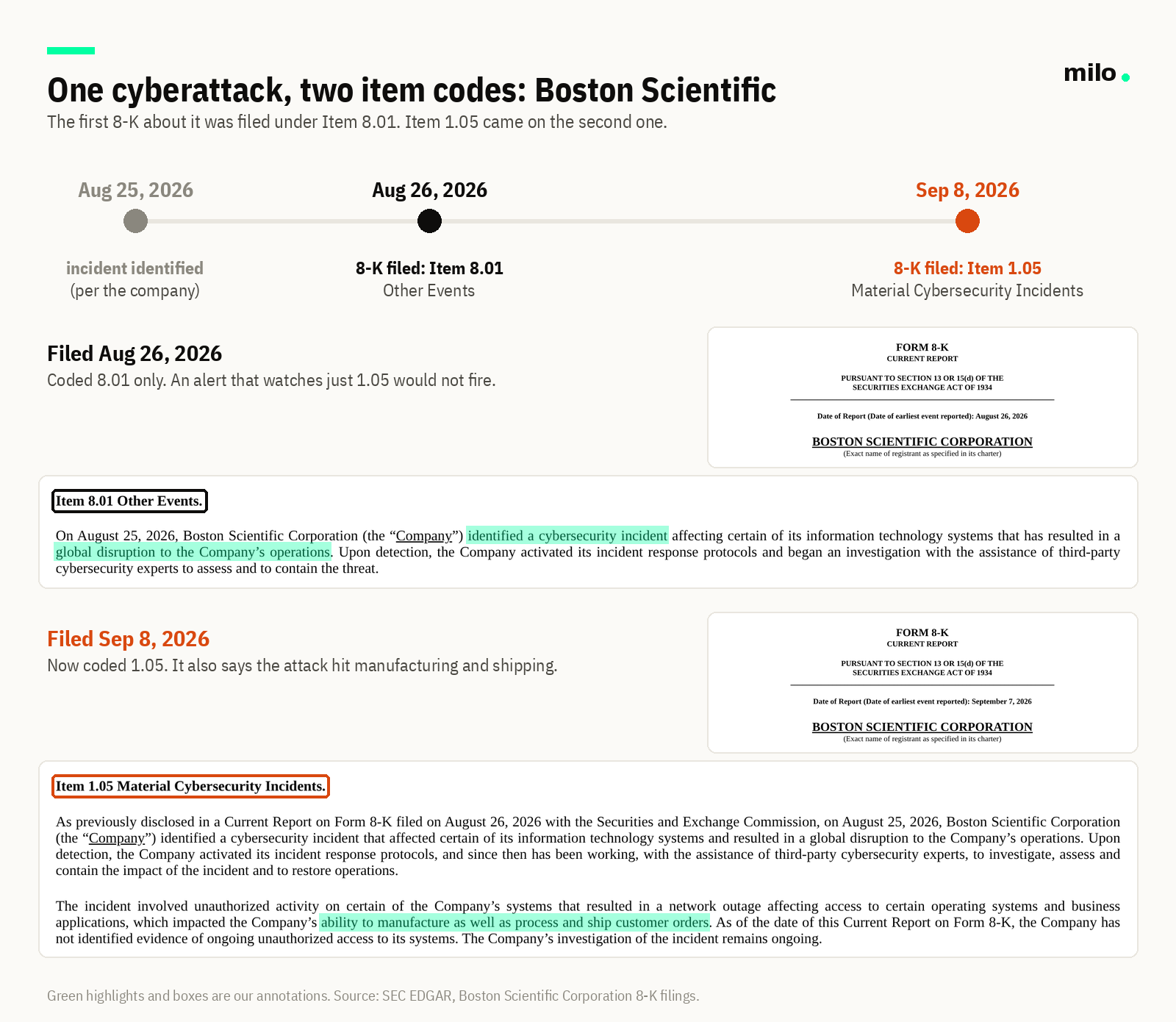
August 26: Item 8.01
The first 8-K, filed August 26 (accession 0000885725-26-000056), was coded 8.01, other events. It says the company “identified a cybersecurity incident” on August 25 that “has resulted in a global disruption to the Company’s operations,” including “the ability to process and ship customer orders.” It also says the company had “not yet determined whether the incident is reasonably likely to have a material impact.” EDGAR accepted it at 06:06:57 ET, before the open.
September 8: Item 1.05
The second 8-K (accession 0000885725-26-000059) has a date of report of September 7 and was filed September 8. This one is coded 1.05. It says the attack “impacted the Company’s ability to manufacture as well as process and ship customer orders,” that it is “likely to have a material impact” on third quarter and full year results, and that the company is “unlikely to meet” the net sales growth and adjusted EPS guidance it gave on July 29. EDGAR accepted it at 06:15:57 ET.
What a code-only alert would have missed
If your alert only watched for 1.05, it stayed quiet on August 26. The news that operations were disrupted worldwide was already public, under 8.01. The 1.05 came 13 days later.
This isn’t a loophole. Item 1.05 is due within four business days after a company decides an incident is material, and on August 26 Boston Scientific said it hadn’t decided yet. So it used 8.01. Companies do this all the time with news that doesn’t fit a box yet.
Amgen ($AMGN) shows the other path. Its Item 1.05 filing (accession 0000318154-26-000119) says it found unauthorized activity in third-party cloud environments in July 2026, and that “on July 29, 2026” it “determined that this incident is material.” The 8-K was accepted July 31 at 16:03:44 ET, two days later and after the close.
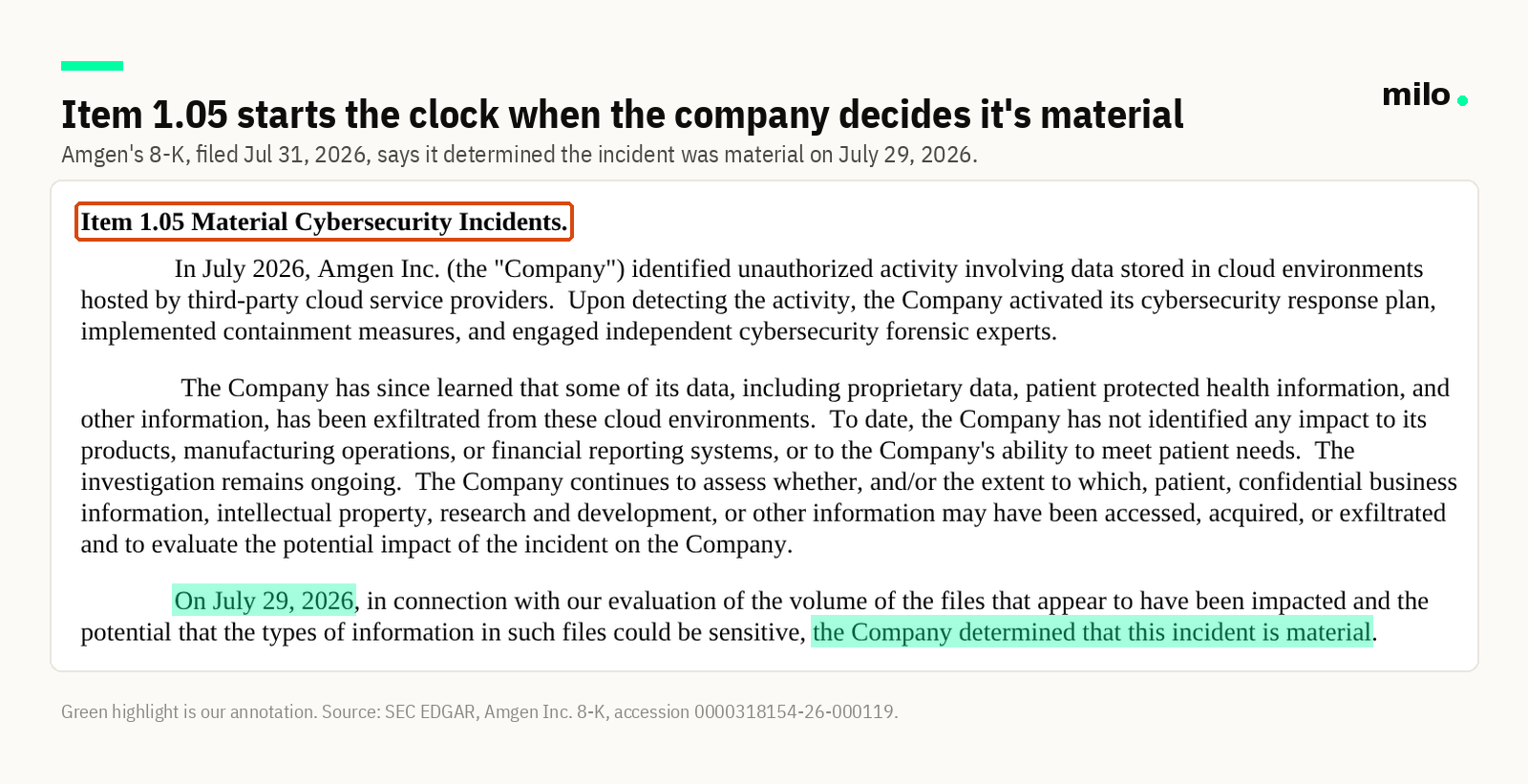
The lesson: filter on codes, but don’t let the filter be the whole system. Read 8.01 and 7.01 headlines from companies you own, because news that hasn’t been labeled yet often lands there first.
How to set up 8-K alerts that don’t drown you
You can do this for free, straight from the SEC.
- Get the company feed. Every company on EDGAR has an Atom feed of its filings. Filter it to 8-Ks with this pattern:
https://www.sec.gov/cgi-bin/browse-edgar?action=getcompany&CIK=0000885725&type=8-K&output=atom. Swap in the company’s CIK (that one is Boston Scientific). Each entry lists the item numbers, like “item 1.05”. The SEC lists its other feeds on its RSS feeds page. - Put the feeds in a reader that can filter. Any RSS reader with keyword rules works. Highlight 1.03, 1.05, 2.05, 2.06, 3.01, 4.01 and 4.02.
- Treat 5.02 separately. Flag it, then check if the CEO or CFO is named.
- Glance at 8.01 and 7.01 for what you own. One line each. This is the step that catches a Boston Scientific.
- Check the time. EDGAR shows the acceptance time on each filing’s index page, so you know if the market has had a chance to react yet.
That’s fine for five companies. It gets tedious at fifty.
milo watches 8-K filings with their item codes alongside insider buys and Congress trades, and links each one back to EDGAR. Track companies in a paper portfolio, with no real money involved, and ask milo’s research AI what a filing means for the stock.
Try milo and put an 8-K idea in a paper portfolio before you put money near it.
If you only want to browse, milo’s insider trading and SEC filings page shows the latest 8-K for 50 of the most-followed US stocks in plain English, next to their Form 4 buys and sales. And when an 8-K about a CEO lands next to insider buying, our guide on how to read SEC Form 4 shows how to check if the buy is real, and cluster insider buying explained covers what it means when several insiders buy at once.
FAQ
What is an 8-K filing?
A current report public companies file with the SEC to disclose major events, like earnings, executive changes, deals or bankruptcy. Most items are due within four business days of the event.
Which 8-K items are most important?
The rare ones: 1.03 bankruptcy, 1.05 cybersecurity, 2.05 restructuring costs, 2.06 impairments, 3.01 delisting, 4.01 auditor change and 4.02 non-reliance, plus 5.02 when it’s the CEO or CFO. In our Q3 2026 sample, the first seven appeared on 16 of 1,450 filings.
What does 8-K Item 2.02 mean?
Results of operations and financial condition. It’s usually the earnings release. It was on 35.9% of the filings we counted.
What is 8-K Item 1.05?
Material cybersecurity incidents. It’s due within four business days after the company determines an incident is material. Amgen decided on July 29, 2026 and filed on July 31.
What is 8-K Item 8.01?
“Other events,” a catch-all for news the company chooses to report. Boston Scientific first disclosed its 2026 cyberattack under 8.01, 13 days before its Item 1.05 filing.
When are 8-Ks usually filed?
Mostly outside market hours. In our Q3 2026 sample, 59.9% were accepted by EDGAR at or after 16:00 ET, 36.1% before 09:30 ET, and only 4.1% during the trading day.
How do I get 8-K alerts for free?
Use EDGAR’s per-company Atom feed filtered to type 8-K, and put it in an RSS reader with keyword rules for the item numbers you care about.
For education only. Not investment advice. milo stock features are paper trading and research only. Sources: SEC EDGAR submissions data and filing headers for 1,450 8-K and 8-K/A filings from 500 companies in milo’s tracked US universe, filed July 1 to September 30, 2026 (pulled October 20 and 23, 2026); Boston Scientific 8-Ks filed August 26 and September 8, 2026; Amgen 8-K filed July 31, 2026; EchoStar 8-K filed August 3, 2026; SEC Form 8-K instructions.