
Search “Pelosi stock tracker” and you get dashboards: a ticker, the word Purchase, a dollar band. Open the House Clerk PDF behind one of those rows and you also get who owned the trade, whether it was shares or call options, the share count, the strike and expiry, and sometimes an asset that has no ticker at all.
I opened three of the 2026 filings under Rep. Nancy Pelosi’s name on Oct 28, 2026, and compared them with what trackers show, milo’s own Congress feed included. This is a guide to reading the filing yourself. It is not a “what Pelosi bought” tip sheet.
The short answer
A Pelosi stock tracker is a front end for the Periodic Transaction Reports (PTRs) filed under Rep. Nancy Pelosi’s name with the House Clerk. On her 2026 filings every row is marked owner SP, which means spouse. Amounts are ranges, the filing can arrive weeks after the trade, and some “buys” are call options or private assets. Always open the PTR PDF.
Where the data actually comes from
Members of Congress report trades on Periodic Transaction Reports under the STOCK Act. House members file with the Clerk at disclosures-clerk.house.gov. Senators file through the Senate’s eFD system. The deadline is in 5 U.S.C. § 13105(l): a report is due “not later than 30 days after receiving notification of any transaction,” and “in no case later than 45 days after such transaction.”
Three things follow from that. You see the trade weeks later. The amount is a band like $1,000,001 to $5,000,000, not a number. And the PDF is the complete record, while every tracker, milo included, is a summary of it. I compared the main trackers and their lag in an earlier post: Congress stock trade trackers compared.
Walkthrough: filing 20035143 (Bloom Energy, Intel and a hotel LLC)
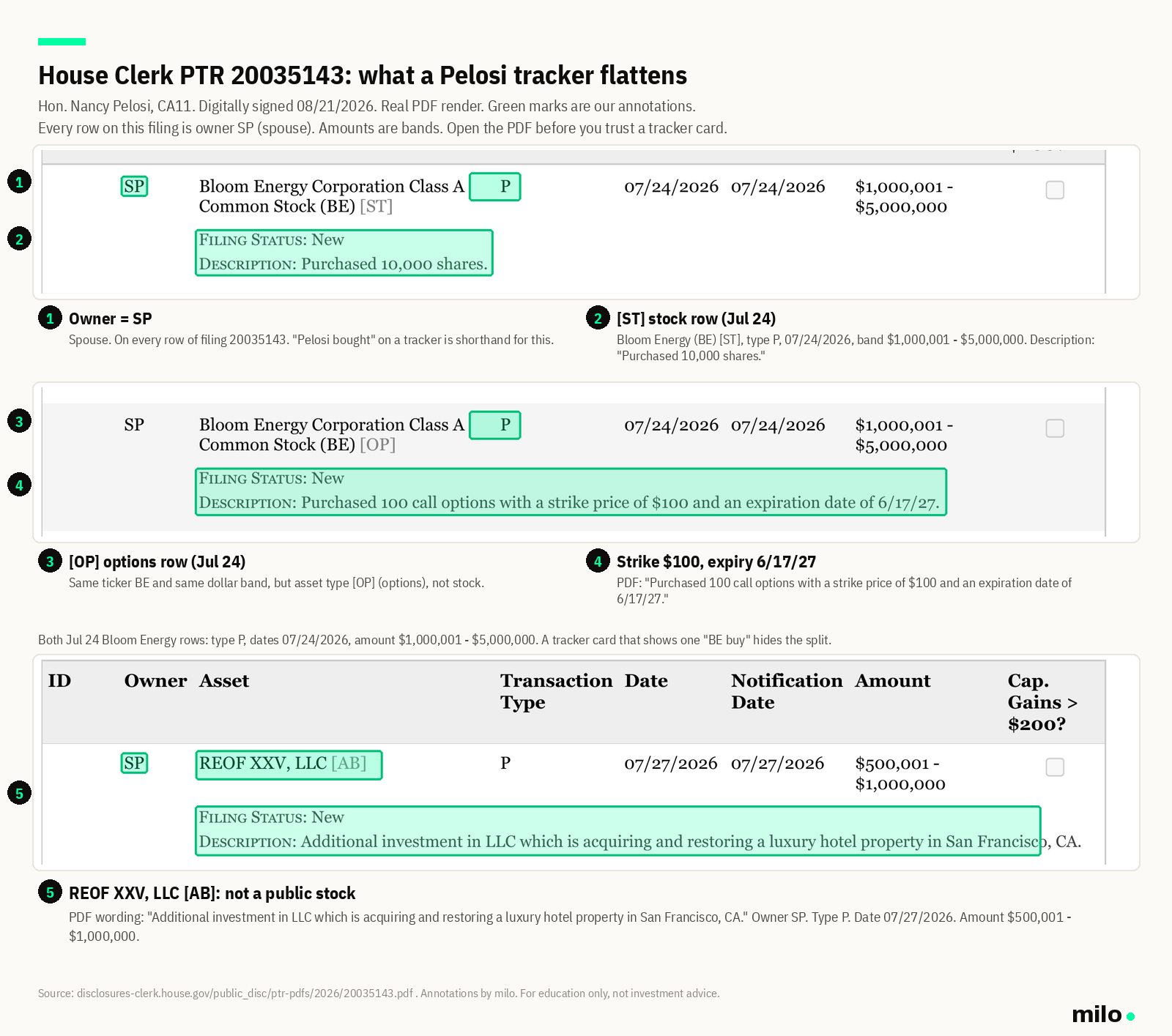
PTR 20035143 is the one most “Pelosi bought Bloom Energy” posts point to. It is digitally signed by Hon. Nancy Pelosi on 08/21/2026 and has seven rows:
| Asset (type code) | Date | Amount band | Description line in the PDF |
|---|---|---|---|
| Bloom Energy $BE [ST] | 07/24/2026 | $1,000,001 to $5,000,000 | Purchased 10,000 shares. |
| Bloom Energy $BE [OP] | 07/24/2026 | $1,000,001 to $5,000,000 | Purchased 100 call options with a strike price of $100 and an expiration date of 6/17/27. |
| Bloom Energy $BE [ST] | 07/28/2026 | $500,001 to $1,000,000 | Purchased 5,000 shares. |
| Bloom Energy $BE [OP] | 07/28/2026 | $500,001 to $1,000,000 | Purchased 100 call options with a strike price of $100 and an expiration date of 6/17/27. |
| Intel $INTC [OP] | 07/24/2026 | $250,001 to $500,000 | Purchased 50 call options with a strike price of $50 and an expiration date of 6/17/27. |
| Intel $INTC [ST] | 07/24/2026 | $500,001 to $1,000,000 | Purchased 10,000 shares. |
| REOF XXV, LLC [AB] | 07/27/2026 | $500,001 to $1,000,000 | Additional investment in LLC which is acquiring and restoring a luxury hotel property in San Francisco, CA. |
Owner is SP on every row
The Owner column says SP, spouse, on all seven rows. “Pelosi bought” in a headline is shorthand for a spouse transaction reported on a filing under her name. That is how the law works for spouses, so it is not a loophole, but a tracker card that drops the Owner column changes how the trade reads.
Bloom Energy: half the rows are calls, not shares
There are four $BE rows. Two are [ST], stock: 10,000 shares on Jul 24 and 5,000 shares on Jul 28. Two are [OP], options: 100 calls each day, strike $100, expiring 6/17/27. The House asset type code list defines ST as “Stocks (including ADRs)” and OP as “Options.”
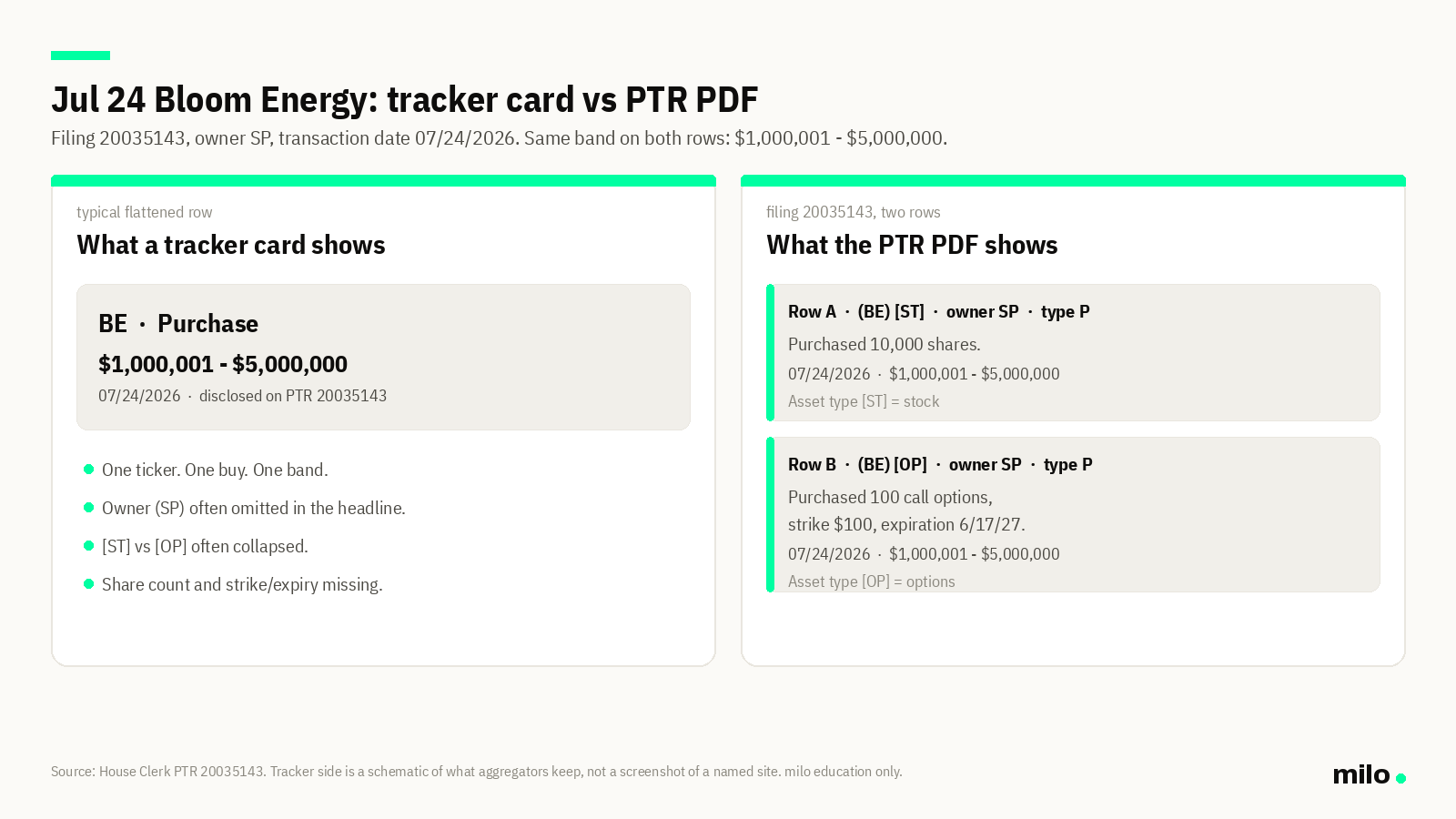
A page that shows “4 BE buys” or “2 BE buys” without saying which ones are calls is giving you the ticker and the band, and that’s it. A call with a strike and an expiry is a different bet from owning the stock.
Intel: 10,000 shares plus 50 calls
Same pattern on $INTC, same day: 10,000 shares in the $500,001 to $1,000,000 band and 50 calls, strike $50, expiring 6/17/27, in the $250,001 to $500,000 band.
REOF XXV, LLC: a “Pelosi trade” with no ticker
The last row is coded [AB], which the House list defines as “Asset-Backed Securities.” The description says it’s an “additional investment in LLC which is acquiring and restoring a luxury hotel property in San Francisco, CA.” Whatever the code, you can’t buy it on a stock app. A stock-only tracker will skip it or show it with no ticker, and that’s fine, as long as you know the filing has more in it than the dashboard.
The lag on this one filing
Last trade date on the form is 07/28/2026. Signature date is 08/21/2026. That’s 24 days, or 28 days from the first trade on 07/24. Comfortably inside the 45 days. milo’s feed lists the disclosure date for this PTR as 2026-08-24, so from milo’s side the gap is 27 to 31 days depending on the row.
The options trap: when “UBER buy” means calls
PTR 20034836, signed 06/23/2026, has just two rows, both SP, both dated 05/29/2026, and both [OP]:
- $INTC: “Purchased 200 call options with a strike price of $50 and an expiration date of 3/19/27.” Band $1,000,001 to $5,000,000.
- $UBER: “Purchased 200 call options with a strike price of $50 and an expiration date of 3/19/27.” Band $500,001 to $1,000,000.
No shares at all on this filing. If a post tells you Pelosi “bought Uber,” the filing says calls. One more thing about the bands: on an options row the band is the reported value of the options, not of the shares they would cover if exercised.
When “purchase” or “sale” isn’t what it sounds like
The January filing, PTR 20033725 (signed 01/23/2026), is the best one for learning to read the Description line:
- A $GOOGL row typed P on 01/16/2026 reads “Exercised 50 call options purchased 1/14/25 (5,000 shares) at a strike price of $150.” It’s a purchase on paper, but it’s the end of an options position opened a year earlier, not a fresh decision that week.
- A $GOOGL row typed “S (partial)” on 12/30/2025, band $1,000,001 to $5,000,000, reads “Contribution of 7,704 shares held personally to Donor-Advised Fund.” A tracker can show that as a big sale. It’s a donation.
- Same for $AAPL on 12/30/2025: “Contribution of 28,200 shares to Donor-Advised Fund,” typed S (partial), band $5,000,001 to $25,000,000.
- A Versant Media Group row typed E (exchange) reads “776 shares and cash in lieu received as a result of spinoff from Comcast Corporation.” Nobody chose to buy it.
The P or S column tells you the direction. Only the Description tells you what actually happened.
Is a 45-day lag normal? What milo’s feed shows this month
I pulled the latest 100 congressional disclosure rows from milo’s feed on Oct 28, 2026 (all members, disclosed Oct 13 to Oct 23). The median gap from trade date to disclosure date was 28 days. 45 rows were over 30 days and 31 were over 45 days.
That 31 looks bad until you check where it comes from. 29 of the 31 rows are from one filing by Rep. Michael McCaul, PTR 9116378. It’s a scanned paper form stamped “HAND DELIVERED,” with a Clerk receipt stamp dated Oct 14, 2026, covering trades from August. Rows like Intuitive Surgical ($ISRG), ASML ($ASML) and Tower Semiconductor are dated 08/07/2026 with a notification date of 9/5/2026. Take McCaul out and the other 71 rows have a median lag of 23 days, with 2 over 45.
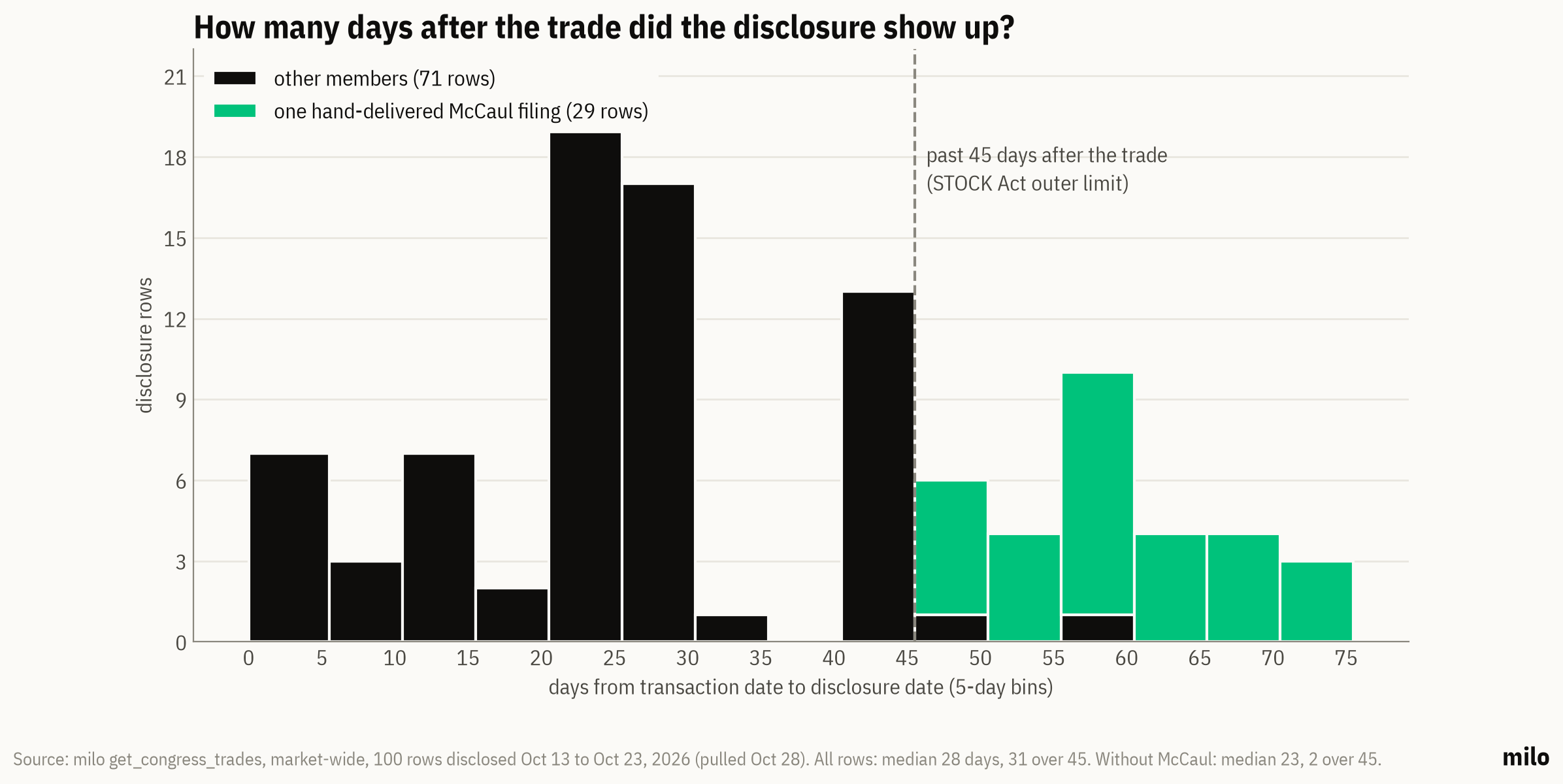
So the Pelosi filings above, at 24 to 28 days to signature, are ordinary. And a single late paper filing can move “average lag” stats a lot, which is worth remembering the next time a tracker quotes one.
How the main Pelosi trackers differ
House Clerk PDFs. First and complete. Ugly, no alerts, one PDF per filing. Everything above came from here.
Quiver Quantitative. Its Pelosi page did better than I expected when I checked on Oct 28. The data behind the page keeps all four $BE rows from 20035143 separate, tags two as “Options” and two as “Stock,” and keeps the start of the description (“PURCHASED 100 CALL OPTIONS WIT…”). The May $UBER and $INTC rows are tagged Options too. REOF XXV shows up as “Asset-Backed Securities.” Quiver also sells paid plans.
Capitol Trades. Free, browsable by politician, with a Pelosi page. It blocked my scripted check on Oct 28, so I’m not going to describe how it labels these rows. Open it and look for whether each row says stock or option.
NANC. Not a Pelosi clone. Yahoo Finance’s fund summary says it invests in companies “that sitting Democratic members of the U.S. Congress and/or their family members also have reported to have invested in.” That’s a basket of many members, not one.
Copy-trading products. Some apps sell a “Pelosi” strategy that mirrors disclosed trades in your brokerage account. That’s a different job from a tracker. If one quotes a return figure, read it as that company’s claim, and remember it can only start after a disclosure that may be weeks old.
milo. To be straight about our own feed: for $BE over the last 365 days, milo returns two Pelosi rows for PTR 20035143 (one per trade date and band), both typed “Purchase,” both linking the PDF. It doesn’t split the [ST] and [OP] lines, and it doesn’t carry the description. It’s useful for seeing Congress disclosures next to Form 4 insider filings and 8-Ks for the same stock, with the filing one click away. It isn’t a substitute for opening the PDF, and on this filing Quiver kept more detail than we did.
A 60-second checklist for any “Pelosi bought X” post
- Open the PTR PDF, not just the tracker card. Every tracker row should link to one.
- Check Owner: SP (spouse), JT (joint), DC (dependent child), or blank for the member.
- Check the asset code in brackets: [ST] stock, [OP] options, and anything else that isn’t a listed stock.
- Read the Description line. Shares, calls, an exercise, a donation, a spinoff all live there.
- Compare the transaction date with the signature or disclosure date. That gap is how stale the news is.
- Remember the amount is a band, and for options it’s the value of the options.
- If you want to test the idea, paper trade it first. We ran that test on 23 disclosed buys here: does copying Congress trades work?
Track the next disclosure without ten tabs open
milo pulls Congress trade disclosures and Form 4 insider filings into one place, each with a link to the original filing. You can follow a ticker in a paper portfolio and see what happens after the disclosure, with no real money involved. Try milo here. If you just want to browse, the milo stocks page lists recent Form 4 insider filings and 8-Ks by stock.
Reading Form 4s is the other half of this. Here’s our line-by-line Form 4 walkthrough.
FAQ
What is a Pelosi stock tracker?
A website or app that lists the stock and option transactions disclosed on Periodic Transaction Reports filed under Rep. Nancy Pelosi’s name. The primary source is the House Clerk PTR PDF.
Did Nancy Pelosi buy Bloom Energy in 2026?
PTR 20035143, signed Aug 21, 2026, reports spouse (SP) purchases of Bloom Energy: 10,000 shares and 100 calls on Jul 24, and 5,000 shares and 100 calls on Jul 28, 2026. The calls have a $100 strike and expire 6/17/27.
Are Pelosi tracker “buys” always stock?
No. Many rows are call options ([OP]). Some are exercises of old options, and some assets, like REOF XXV, LLC, have no ticker. Read the asset code and the description.
How late are Pelosi trade disclosures?
The law allows up to 45 days after the trade. Filing 20035143 was signed 24 days after its last trade date, and 20034836 was signed 25 days after its trades.
Who actually makes the trades on Pelosi’s disclosures?
Every row on her 2026 filings reviewed here is marked SP, her spouse.
Is NANC the Pelosi ETF?
No. Its fund summary says it follows reported investments by sitting Democratic members of Congress and their families, not Pelosi alone.
Can I copy Pelosi trades in real time?
No. You only see the trade after the PTR posts, usually weeks later, and the amount is a range. Treat it as research, and paper test anything you want to try.
If you’d rather watch the next filing land than refresh the Clerk’s site, milo will put it next to the insider filings for the same stock, paper trading only.
For education only. Not investment advice. milo stock features are paper trading and research only. Disclosures describe reported transactions; they are not tips. Sources, all checked Oct 28, 2026: House Clerk PTRs 20035143, 20034836, 20033725 (Nancy Pelosi) and 9116378 (Michael McCaul); House asset type codes (fd.house.gov); 5 U.S.C. § 13105 (Cornell LII); milo get_congress_trades (ticker BE, and market-wide 100 rows); Quiver Quantitative Pelosi page; Yahoo Finance NANC profile.