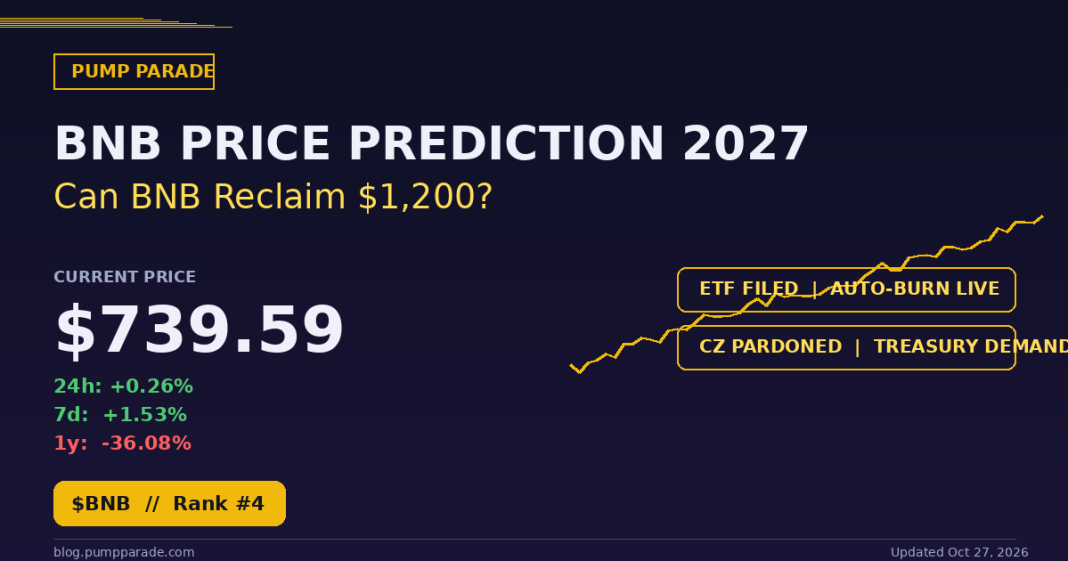
BNB is trading around $740, up 1.5% over the past week but still 46% below the record $1,370 it printed in October 2025. For a top-5 token with a $97 billion market cap, that gap is not a bug. It is the setup. The BNB price prediction 2027 question has become one of the most-searched queries in large-cap crypto, and the reason is simple: the chain is burning supply faster than most of its competitors are shipping product.
Here is the context in one line. BNB is the fee asset for the third-largest blockchain by TVL, backed by a 100-million-token destruction program now 34 quarters in. The question is not whether BNB has a case. The question is which case, and at what price. Below, we walk through where BNB stands today, the bull and bear theses, specific targets by timeframe, and the three triggers that would change our view.
Key Takeaways
- BNB trades at $739.59 as of October 27, 2026, 46% below its all-time high of $1,369.99 set in October 2025.
- Quarterly Auto-Burn has destroyed roughly 1.37 million BNB in the latest round, pushing circulating supply toward the 100 million long-term target.
- The BNB Smart Chain holds $8.66 billion in TVL and processes over 20 million daily transactions, placing it third globally among L1s.
- Our 2027 base case targets $1,000, with a bull scenario at $1,500 contingent on a VanEck ETF approval and sustained CZ-pardon aftermath flows.
- The bear case sits at $700 if memecoin activity cools and corporate treasury demand stalls below current levels.
- Three triggers would flip our view: an ETF rejection, a 50% drop in BNB Chain daily users, or a cross-chain exploit affecting over $100 million in bridged assets.
Where BNB Stands Today
Pull up the chart and the first thing you notice is the floor. BNB has traded in a $650 to $820 range for most of October 2026, with buyers consistently stepping in near the $700 psychological level. Volume is thinner than the summer, but it is not dead. Daily turnover sits around $875 million, which is light for a top-5 asset but healthy enough to absorb mid-sized institutional flows without large slippage.
| Metric | Value |
|---|---|
| Price (USD) | $739.59 |
| 24h change | +0.26% |
| 7-day change | +1.53% |
| 30-day change | -5.00% |
| 1-year change | -36.08% |
| Market cap | $97.23B |
| 24h volume | $875.39M |
| Rank | #4 |
| All-time high | $1,369.99 (Oct 13, 2025) |
| Distance from ATH | -46.02% |
| Circulating supply | 131.51M BNB |
| Max supply | 200M BNB |
The data points worth isolating: BNB is down 36% year-over-year but only 5% over the past 30 days. Translation: the heavy drawdown already happened. What we are watching now is base-building, not fresh capitulation.
Why is BNB range-bound right now?
Three forces are keeping BNB pinned between $650 and $820.
First, the broader market. Bitcoin is below $80,000, Ethereum trades under $2,400, and BNB’s 30-day correlation with BTC remains tight at 0.78. When BTC chops, large-cap alts chop with it.
Second, profit-taking from the 2025 run. BNB rallied from the mid-$300s to $1,370 in less than nine months. Even without a specific catalyst, that invites a 40 to 50% retracement. BNB’s historic average post-ATH drawdown is 48% before a sustained recovery.
Third, the ETF narrative is in a holding pattern. VanEck filed for a BNB ETF in May 2025, but regulatory action has slowed since the summer. The product is still live, but the “when” is unclear, and markets dislike that kind of ambiguity.
The counter-argument: ranges resolve. When they do, the direction tends to match the dominant on-chain trend. For BNB, that trend is supply reduction.
The Bull Case
The Auto-Burn mechanism keeps compounding
BNB’s Auto-Burn program is one of the most aggressive supply reduction mechanisms in crypto. The 34th quarterly burn, completed in January 2026, destroyed about 1.37 million BNB worth roughly $1.27 billion at the time, according to reporting from Tangem. Each quarterly round removes about 1% of circulating BNB, and the long-term goal is to cut total supply from 200 million to 100 million tokens.
Do the math at current burn pace and BNB’s circulating float drops below 110 million by mid-2027. That is a meaningful supply shock if demand stays constant. If demand grows, which the ETF filing and treasury accumulation suggest, the price impact compounds. For a counterpoint on how fee-switch mechanics affect token economics, see our Uniswap price prediction, which walks through a similar supply-demand setup.
Corporate treasuries are quietly accumulating
CEA Industries (Nasdaq: BNC) now holds 480,000 BNB, which it claims is the largest corporate BNB position. Windtree Therapeutics raised $520 million specifically to buy BNB. Nano Labs expanded to roughly 128,000 BNB. Together, these three entities hold almost 0.5% of circulating supply, locked for the long term. This is the pattern that preceded Bitcoin’s $100,000 run in late 2024.
The VanEck ETF has not been denied, only delayed
VanEck filed its BNB ETF application in May 2025. The SEC has pushed back the decision window twice but has not rejected it. If a spot BNB ETF launches in 2027, the comparable playbook is Bitcoin and Ethereum: a 30 to 50% price lift in the first 90 days, driven by passive flows. A $150 million initial AUM would translate to roughly 200,000 BNB bought on open market, matching one quarter of Auto-Burn in supply impact.
The Bear Case
Centralization risk never goes away
BNB’s biggest structural risk is also its biggest strength. The token is tied to a single exchange that controls listings, fee revenue, and burn mechanics. Changpeng Zhao’s November 2024 pardon by President Trump reduced regulatory overhang in the US, but it did not eliminate it. If a renewed CFTC investigation targets Binance, BNB’s price trades off the headlines, not the fundamentals.
Memecoin activity could fade fast
A lot of recent BNB Chain activity (over 100,000 new memecoin traders per Bubblemaps) is memecoin-driven. These flows are notoriously unstable. If the memecoin cycle cools, daily transactions could drop from 20 million to under 10 million within weeks, hurting gas-fee burns and the “BNB Chain is the activity hub” narrative in one shot.
Competition from alternative L1s is accelerating
Solana, Hyperliquid, and emerging chains like Monad and Sei are grabbing a growing share of DEX volume. Solana handles more daily transactions than BNB Chain by some metrics. For a look at how one Solana-native competitor is positioning, see our Hyperliquid price prediction for 2027. If BNB Chain loses relative TVL share, the fee-burn flywheel decelerates.
BNB Price Prediction 2027: Targets by Timeframe
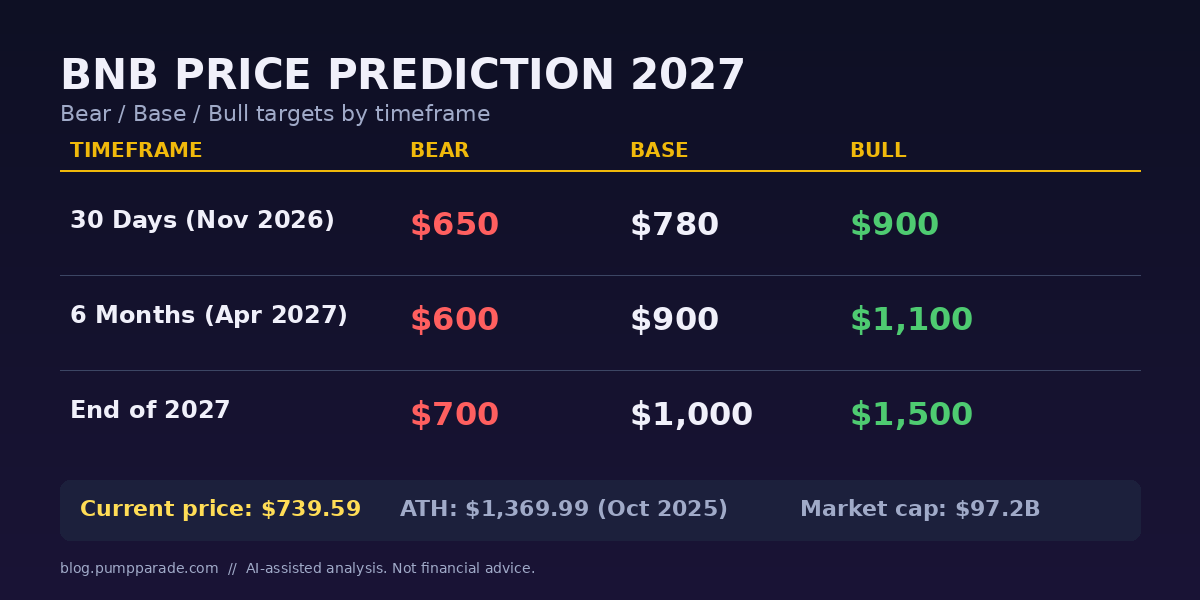
Here is how our AI model maps out BNB price scenarios across three timeframes. These are not guarantees. They are conditional scenarios tied to specific catalysts and risks.
| Timeframe | Bear Case | Base Case | Bull Case |
|---|---|---|---|
| 30 days (end Nov 2026) | $650 | $780 | $900 |
| 6 months (Apr 2027) | $600 | $900 | $1,100 |
| End of 2027 | $700 | $1,000 | $1,500 |
30-day outlook
Over the next month, our model expects BNB to consolidate between $650 and $900. Base case of $780 reflects a modest grind higher as the Q4 Auto-Burn approaches. The bull scenario needs an ETF decision date scheduled or BTC breaking above $85,000. The bear case plays out if BTC dumps below $75,000.
6-month outlook
By April 2027, we expect clearer resolution. If the market has entered a confirmed uptrend, $1,000 to $1,100 is reachable. If Bitcoin remains range-bound, BNB probably oscillates around $900. The bear case assumes a recession scenario or renewed regulatory pressure on Binance.
Year-end 2027
Our base case for end-2027 is $1,000. This assumes continued burns, no ETF but no outright rejection, and roughly flat market cap share within the top 5. The bull case of $1,500 requires ETF approval, continued treasury buying, and a broad crypto bull cycle. For comparison, Benzinga’s compiled analyst consensus places 2027 average BNB around $2,175, driven largely by Changelly. We think that is optimistic given current market cap compression, but it shows our $1,500 bull case sits well within mainstream forecasts.
How BNB Compares to Ethereum
The cleanest head-to-head comparison for BNB is Ethereum. Both are foundational L1 tokens with large ecosystems and institutional interest. Here is how they stack up on key metrics.
| Metric | BNB | Ethereum (ETH) |
|---|---|---|
| Current price | $739.59 | $2,316.63 |
| Market cap | $97.23B | $283.00B |
| Rank | #4 | #2 |
| 24h volume | $875M | $12.4B |
| Chain TVL | $8.66B | $42.1B |
| Burn mechanism | Quarterly Auto-Burn + fee burn | EIP-1559 fee burn |
| Max supply | 200M (burning to 100M) | Uncapped (net deflationary) |
| Spot ETF status | Filed (VanEck, pending) | Approved and trading |
The core trade is this: ETH has the ETF already, the deeper DeFi stack, and the institutional comfort. BNB has the harder supply cap, the aggressive burn, the lower market cap for higher asymmetric upside, and a specific catalyst (ETF approval) that is still ahead of it rather than behind. If you believe in catch-up trades, BNB is one of the few top-10 names where the headline catalyst has not yet printed.
Will BNB hit $2,000 by 2027?
Probably not. $2,000 would require BNB’s market cap to reach roughly $263 billion at today’s circulating supply, or about $220 billion if burns continue at current pace. For context, that would make BNB larger than today’s Ethereum. Not impossible, but it requires both an ETF approval and a broader bull cycle running longer than current cycle math suggests. Most mainstream forecasts, including Koinx’s model, cluster the 2027 average closer to $1,500 to $1,700. Our bull case of $1,500 reflects this consensus. $2,000 is a stretch target, worth watching but not what we would plan around.
What Would Change Our View
Three specific triggers would move our base case meaningfully in either direction.
Bullish trigger: A VanEck BNB ETF receives SEC approval. We would raise our 2027 base case from $1,000 to $1,350 and the bull case to $1,800. The playbook from BTC and ETH ETFs suggests a 30 to 50% price lift inside 90 days of launch.
Neutral-to-bearish trigger: A sustained 50% drop in BNB Chain daily active users. This would signal that memecoin activity is draining to competing chains and that the fee-burn flywheel is slowing. We would lower the base case to $800 and the bull case to $1,200.
Hard bearish trigger: A cross-chain bridge exploit affecting over $100 million in BNB Chain-bridged assets, or renewed SEC enforcement action against Binance. Either would reset the token’s risk premium. We would move the base case down to $650 and treat anything above $900 as a sell zone until the issue is resolved.
Frequently Asked Questions
Could BNB realistically reach $1,000 by end of 2027?
Yes. $1,000 is our base case for year-end 2027. It implies a market cap of roughly $125 to $130 billion once Auto-Burn continues reducing circulating supply. BNB has already traded above $1,300 in late 2025, so the price level has clearance. The scenario assumes continued burns, modest ecosystem growth, and no major regulatory event. It does not require an ETF approval.
What’s a realistic long-term price range for BNB?
Our modeling suggests a $700 to $1,500 range through year-end 2027, with the base case clustering around $1,000. Longer-term, by 2030, mainstream forecasts spread from $1,800 (Koinx) to $3,500 (bullish Changelly scenarios). We treat anything above $2,500 as speculative at current supply trajectory.
What are the biggest catalysts for BNB?
The top four catalysts are: continued Auto-Burn reducing supply by roughly 1% quarterly, VanEck ETF decision pending at the SEC, corporate treasury accumulation (CEA Industries, Windtree, Nano Labs), and BNB Chain’s growing share of memecoin and DEX activity. The ETF is the single biggest binary event.
What are the main risks of BNB?
Three risks matter most: centralization tied to Binance and ongoing regulatory scrutiny, competition from Solana and Hyperliquid for DeFi activity, and the possibility that memecoin flows reverse and drain BNB Chain’s transaction volume. Each has a defined price impact in our scenario modeling above.
Is BNB a good investment in 2027?
BNB offers one of the clearest asymmetric setups in large-cap crypto right now: a hard supply cap, an aggressive burn, a pending ETF, and corporate treasury adoption. The downside is contained around $650 based on current support levels, and the upside case runs to $1,500 or higher. Whether that fits your portfolio depends on your risk tolerance and existing crypto exposure. For a broader look at the exchange and token dynamics driving BNB, see our Binance vs Bybit comparison.
Will BNB reach $1,200 before end of 2027?
In our bull case, yes. $1,200 sits between our base ($1,000) and bull ($1,500) targets for end-2027. The clearest path involves an ETF approval announcement in early-to-mid 2027, which would likely drive a 40 to 60% rally from current levels. Without the ETF, hitting $1,200 requires either sustained corporate treasury buying or a broader crypto cycle extending into late 2027.
The Honest Take
BNB is a top-5 token trading 46% below its ATH, with the strongest supply reduction mechanism among major L1 tokens, a pending ETF filing, and a growing corporate treasury base. That is a setup that favors patience, not panic.
The bull case to $1,500 is credible. It requires specific catalysts, mostly ETF-related, but it is not fringe. The base case to $1,000 is where most of the probability mass sits in our model: it only needs continued burns and no major negative shocks. The floor around $650 to $700 has held consistently through this year.
Over the next 90 days we are watching: the Q4 Auto-Burn (likely January 2027), any VanEck ETF update from the SEC, and whether BNB Chain can sustain over 15 million daily transactions. Any one breaking positive would raise our conviction on the base case meaningfully. BNB is not a lottery ticket. It is a cash-flow-adjacent token with real buyback mechanics tied to a real exchange. Price it that way.
Disclaimer: This article is for informational and educational purposes only and should not be construed as financial, investment, or trading advice. Cryptocurrency markets are highly volatile, and past performance does not guarantee future results. The price predictions and analyses presented here are based on AI models, technical indicators, and available data at the time of writing. They are not guarantees. Always conduct your own research (DYOR) and consult with a qualified financial advisor before making any investment decisions. Pump Parade and its authors do not assume liability for financial losses incurred based on information provided in this article.