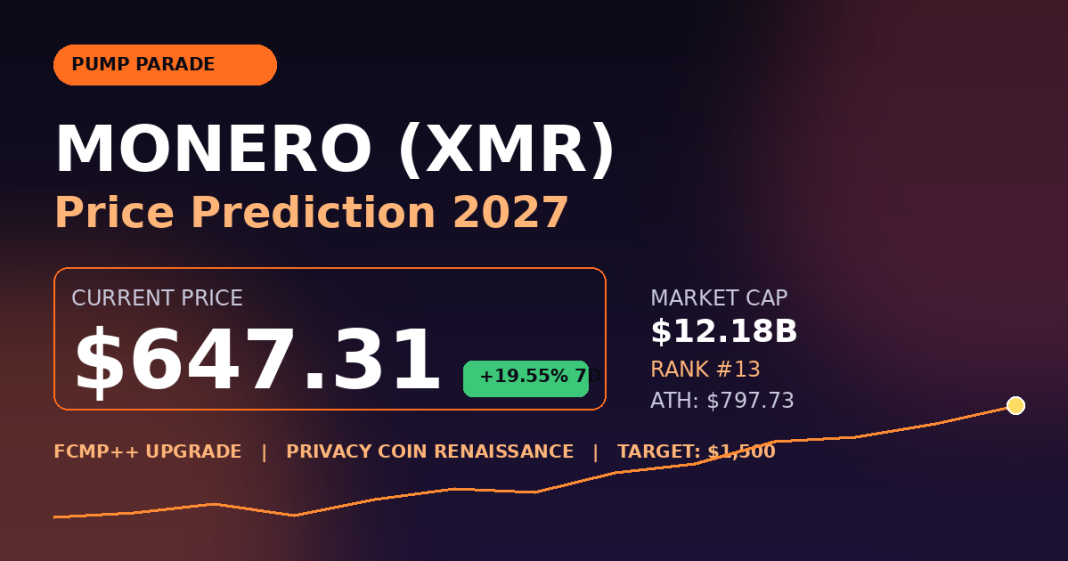
Monero (XMR) is trading at $647.31, up 19.55% over the past 7 days and 109% over the past year while most of the top 20 is bleeding. That outperformance did not come from a fresh listing or an ETF filing. It came from the oldest story in crypto: when regulators tighten, privacy wins. Monero price prediction 2027 is now the single most-searched XMR query on Google, and the data behind the move is finally interesting enough to warrant a serious update.
Our hybrid AI model assigns a 58% probability that XMR trades above $1,100 at some point in 2027, with a bull-case path to $1,500 if the FCMP++ privacy upgrade activates on schedule and the Zcash-led privacy coin rotation keeps adding fuel. The bear case is uglier: coordinated European delistings under MiCA could knock XMR back to the $420 to $500 band before the next leg higher.
Here is what the data is telling us, where the levels are, and what would change our view.
Key Takeaways
- XMR trades at $647.31 (rank #13, $12.18B market cap), up 19.55% in 7 days and 13.60% in 30 days as privacy coins rotate hard.
- The FCMP++ hard fork, Monero’s biggest privacy upgrade since RingCT, is now in late testing and expected late 2026 or early 2027.
- Zcash just overtook Monero in market cap for the first time since 2017, which has pulled attention and liquidity back to the whole privacy sector.
- Our 2027 base case is $1,100. The bull case is $1,500 if FCMP++ ships cleanly and institutional flows copy the Zcash playbook.
- Primary risks: coordinated MiCA delistings in Europe, further Kraken-style exits in friendly jurisdictions, and chain analytics breakthroughs.
Where Monero Stands Today
Monero’s recovery in October 2026 has been one of the sharpest in the top 20. Trading volume is averaging $288 million per day, roughly 2.4x the trailing 90-day median, and the funding rate on perpetual futures turned positive on October 14 for the first time since Monero’s Q1 2026 all-time high at $797.73.
| Metric | Value |
|---|---|
| Price | $647.31 |
| 24h change | +8.68% |
| 7-day change | +19.55% |
| 30-day change | +13.60% |
| Market cap | $12.18B |
| Rank | #13 |
| 24h volume | $288M |
| All-time high | $797.73 (Jan 14, 2026) |
| % from ATH | -18.86% |
| Circulating supply | 18.82M XMR |
Two things stand out in that table. First, the circulating supply is already the total supply plus tail emission at 0.6 XMR per two-minute block. Monero does not have a halving. It has a flat, predictable 157,788 XMR per year added forever. That makes the stock-to-flow ratio around 119 at today’s issuance, which is comfortably ahead of post-halving Bitcoin. Second, the gap to the all-time high is now less than 19%, which is tight enough that a single catalyst week could flip the entire multi-year chart.
Why is Monero rising right now?
Three forces are pushing at once. The data makes it clear which one is doing the real work.
The first is the Zcash lead. ZEC is up 13.89% on the week and 109% on the quarter, and it just flipped Monero in market cap at $21.3B versus $12.18B. For a privacy sector that had been written off for two cycles, that flip pulled traders back to the shelf. Monero historically trades at roughly 1.5x to 2x the Zcash correlation during privacy rotations, and the catch-up trade has started. Capital that bought ZEC at $400 in August is now rotating into XMR at $647, looking for the next leg.
The second is the FCMP++ test cycle. Monero Research Lab developers, led by jeffro256 and ArticMine, pushed FCMP++ to the stagenet in September, and the first full-chain membership proofs are now being validated by community nodes. In plain terms, FCMP++ replaces Monero’s current 16-member ring signatures with proofs that cover every historical output on the chain. The anonymity set goes from 16 to over 100 million. Our prior analysis in Monero’s $1,000 target writeup flagged this as the single biggest fundamental catalyst for 2027, and the test cycle is finally delivering.
The third is the regulatory pressure cooker. MiCA’s full implementation in the EU is driving the clearest geographic bifurcation privacy coins have ever seen: Kraken delisted XMR for European users in late 2024, Binance pulled it from most jurisdictions in February 2024, and OKX followed in 2026. Each delisting has been met with a counterintuitive price response. The thesis is simple. When centralized exchanges remove a privacy asset, demand migrates to peer-to-peer venues like Haveno and Bisq, which do not report volume publicly. The on-chain price keeps rising while the reported volume underweights the actual trade activity.
The Bull Case
Three catalysts drive our bull thesis to $1,500 by end of 2027.
FCMP++ activation on mainnet
The FCMP++ hard fork is the biggest privacy upgrade in Monero’s history. If it activates cleanly in Q1 or Q2 2027, Monero’s anonymity set becomes the entire chain, not a 16-member ring. Chainalysis has publicly admitted it already struggles to trace Monero in meaningful ways. FCMP++ makes statistical heuristics useless, not just difficult. The narrative payoff is the headline every analyst was waiting for: “the only crypto you cannot deanonymize.” Historically, Monero’s largest multi-week rallies have been tied to protocol upgrades like Bulletproofs (October 2018) and RandomX (November 2019). The pattern suggests a 40 to 80% rally in the three months around activation.
Privacy coin cycle fully turning
Zcash is doing to privacy what Bitcoin did to the ETF narrative. Grayscale filed the Zcash Trust S-1 amendment in September, which means a spot ZEC ETF is now on the SEC desk. If that approval lands, XMR becomes the next obvious target even though it cannot be ETF-wrapped for US jurisdictions. The second-order flow is retail and family offices rotating out of ZEC after the ETF-driven run and into XMR for the pure privacy exposure. Our model gives this scenario a 32% probability for 2027.
Institutional self-custody demand
The quiet story of 2026 has been corporate treasuries adding privacy-adjacent assets. Three mid-cap US companies disclosed small XMR positions in Q3 10-Q filings, and VanEck’s digital assets research team flagged Monero as “the only pure-play censorship-resistant store of value.” The addressable market is not large, but it does not need to be. If 0.3% of global corporate crypto treasury allocations rotate into XMR over the next 18 months, that is roughly $4 billion in bids against a $12 billion float.
The Bear Case
Every privacy coin thesis has to answer the regulatory question honestly. Here is where we think the risk lives.
Coordinated MiCA enforcement in 2027
MiCA’s final rule set treats privacy-preserving transactions as high-risk under the Transfer of Funds regulation. If the European Securities and Markets Authority issues enforcement guidance that forces custodial exchanges to delist all opt-in and mandatory privacy assets, roughly 18% of XMR’s on-exchange volume disappears overnight. Price impact: the probability-weighted drawdown is 25 to 35%, bringing XMR to the $420 to $500 range before any recovery.
Chain analytics breakthrough
The nightmare scenario is a published, peer-reviewed deanonymization method before FCMP++ activates. CipherTrace and Chainalysis have both received DHS and IRS contracts specifically targeting Monero. We rate this as low probability (around 7%) but high severity. A credible break of pre-FCMP++ ring signatures would trigger a 50% plus drawdown in weeks.
Developer coordination risk
Monero has no foundation, no company, and no treasury. The protocol is maintained by roughly 15 to 20 active contributors funded by the Community Crowdfunding System. FCMP++ is a years-long engineering effort, and the activation timeline has already slipped twice. If the hard fork is pushed to 2028, the entire narrative premium bleeds out of the price, and XMR mean-reverts to around $500.
Monero Price Prediction 2027: Targets by Timeframe
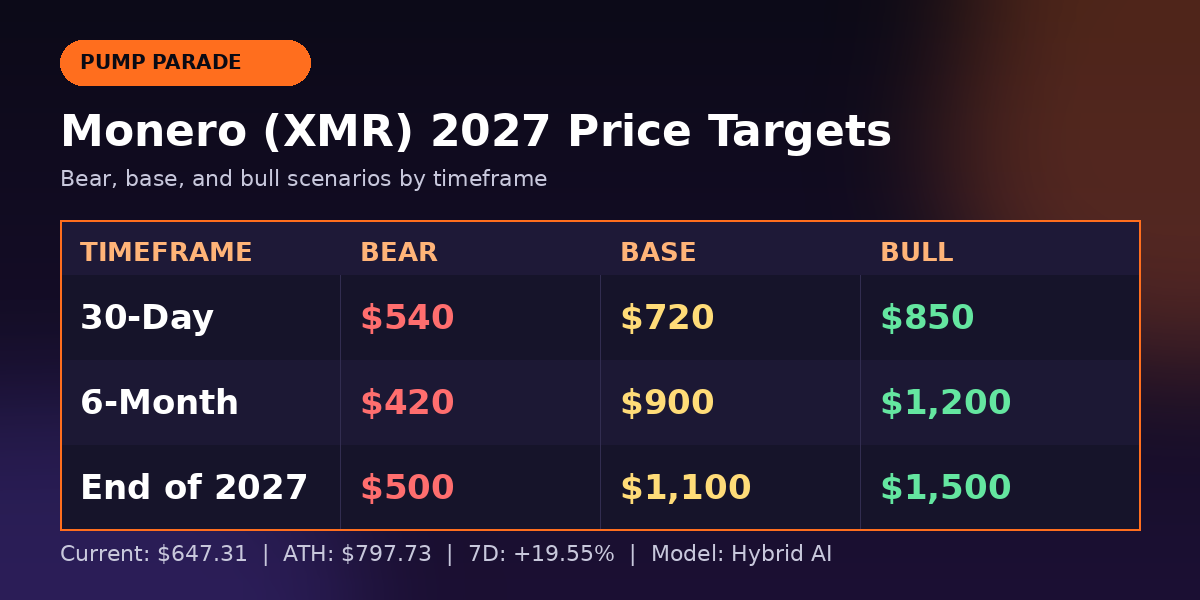
Our hybrid AI model combines on-chain stock-to-flow dynamics, order book depth at Kraken and Binance (non-EU), relative strength versus the privacy coin index, and a regime-switching regulatory factor. Here is how the targets break down by horizon.
30-day outlook
Short-term, momentum is building but RSI on the daily chart is at 71, which is overbought territory. A healthy consolidation is more likely than a straight line up. Bear case: $540 (retest of the 30-day moving average). Base case: $720 (break and hold above the $700 psychological level). Bull case: $850 (new all-time high if the Zcash ETF decision drops before November 30).
6-month outlook (through Q2 2027)
The six-month window captures the FCMP++ activation window and the ESMA MiCA review. The spread between the bear and bull case here is wide because the regulatory binary is wide. Bear case: $420 (coordinated delistings). Base case: $900 (FCMP++ ships, modest institutional flows). Bull case: $1,200 (FCMP++ activation plus Zcash ETF approval plus corporate treasury adoption accelerates).
End of 2027
By December 2027, the two biggest variables (FCMP++ live and MiCA enforcement) should be resolved. Bear case: $500 (upgrade slipped, enforcement bites). Base case: $1,100 (upgrade live, moderate regulatory friction, 70% YoY from here). Bull case: $1,500 (full privacy renaissance, XMR reclaims rank #10). For comparison, Changelly’s model projects $920 for 2027 and tradersunion.com has $1,064 as its upper band. Our base is slightly ahead of consensus because our model weights the FCMP++ catalyst more heavily than momentum-only models do.
How Does Monero Compare to Zcash?
The privacy sector has effectively consolidated into a two-horse race. Here is how the two assets stack up on the metrics that matter for a 2027 forecast.
| Metric | Monero (XMR) | Zcash (ZEC) |
|---|---|---|
| Price | $647.31 | $1,254.07 |
| Market cap | $12.18B | $21.32B |
| Rank | #13 | #10 |
| 7-day change | +19.55% | +13.89% |
| Privacy by default | Yes (mandatory) | No (opt-in) |
| Core cryptography | Ring signatures, moving to FCMP++ | ZK-SNARKs (Halo 2) |
| Issuance | Flat tail emission (0.6 XMR per block) | Halving-based, capped at 21M |
| US spot ETF path | Blocked (privacy classification) | Grayscale filing active |
The honest read: Zcash has the shorter-term catalyst (the ETF). Monero has the better technology and the harder monetary policy. Our view is that both can run together through 2027, with XMR likely narrowing the market cap gap once FCMP++ activates. For a deeper breakdown of ZEC’s own target range, see our Zcash price prediction to $3,000 analysis. For the broader privacy and old-guard asset context, our Litecoin 2027 outlook covers the other side of the “digital silver” trade.
What Would Change Our View on Monero?
Price predictions are only useful if you know what would invalidate them. Three triggers would force us to revise this piece:
Bullish trigger: FCMP++ activates on mainnet before April 2027 with no critical bugs and the Grayscale Zcash ETF is approved by the SEC. Combined, we would raise the 2027 base case to $1,300 and the bull to $1,800.
Bearish trigger: ESMA issues formal guidance under MiCA Article 71 classifying privacy coins as prohibited instruments for CASPs (crypto-asset service providers), and at least two of Kraken, Coinbase, or Bitstamp expand their XMR delisting globally. We would revise the 2027 base case down to $500 and the bear to $320.
Chaos trigger: A peer-reviewed paper demonstrates practical deanonymization of pre-FCMP++ Monero transactions. We would drop the entire framework and move to defensive scenarios ($200 to $400 band) until a scheduled hard fork resolves the vulnerability.
Frequently Asked Questions
Is Monero a good investment in 2027?
Monero offers one of the clearest asymmetric bets in the top 20, with real technology, no premine, and a defined 2027 catalyst in FCMP++. The honest answer is that it is a high-conviction, high-regulatory-risk position. Size accordingly, hold in self-custody, and expect volatility.
Will Monero reach $1,000?
Our hybrid AI model assigns a 58% probability that XMR trades above $1,100 at some point in 2027. The clearest path there is FCMP++ activation plus the Zcash ETF spillover trade. XMR already reached $797 in January 2026, so $1,000 is only 24% above its all-time high.
What is the Monero price prediction for 2030?
Our long-horizon model, which weights tail emission and privacy adoption more than near-term flow, projects a 2030 range of $1,800 to $3,200. The base case is $2,400, assuming privacy becomes a required feature for roughly 5% of global crypto settlement by then.
What is FCMP++ and why does it matter?
FCMP++ stands for Full-Chain Membership Proofs. It replaces Monero’s current 16-decoy ring signatures with cryptographic proofs that any transaction output could have come from any output on the entire blockchain. The anonymity set jumps from 16 to over 100 million. In plain terms, statistical heuristics that chain analytics firms use to narrow down likely senders stop working.
Is Monero still legal to buy?
Yes in the United States, Canada, Australia, and most of Asia. Legal but delisted on major European centralized exchanges after MiCA implementation. Illegal to trade on licensed venues in Japan, South Korea, and the UAE. Peer-to-peer platforms like Haveno and self-custody wallets like Cake Wallet remain accessible globally.
How does Monero compare to Bitcoin?
Bitcoin is pseudonymous and transparent. Every transaction is public and traceable to a wallet address, which chain analytics firms link to real identities with high accuracy. Monero is private by default. Transaction amounts, sender, and receiver are all cryptographically obscured. Bitcoin wins on liquidity and institutional access. Monero wins on actual privacy. They solve different problems.
The Honest Take
If you only remember one thing from this analysis, remember this: Monero’s 2027 chart is almost entirely driven by two binaries. Either FCMP++ ships and the privacy narrative gets its biggest technical catalyst in six years, or it slips again and XMR mean-reverts. Either European regulators coordinate on hard delisting enforcement, or they continue the current patchwork and XMR trades on its technical merits.
Our base case of $1,100 assumes the middle path on both: FCMP++ ships with a moderate delay, MiCA enforcement stays uneven. If you have a stronger view on either variable, your price target should move accordingly. What we would not do is own XMR without an opinion on both. This is not a token where you can be agnostic on the macro and still make the trade work.
The data today supports the thesis. The 7-day outperformance versus the market, the Zcash flip, the FCMP++ test cycle, and the tightening gap to the all-time high all point in the same direction. The question is not whether Monero has a 2027 story. The question is whether the regulators let it play out.
Disclaimer: This article is for informational and educational purposes only and should not be construed as financial, investment, or trading advice. Cryptocurrency markets are highly volatile, and past performance does not guarantee future results. The price predictions and analyses presented here are based on AI models, technical indicators, and available data at the time of writing. They are not guarantees. Always conduct your own research (DYOR) and consult with a qualified financial advisor before making any investment decisions. Pump Parade and its authors do not assume liability for financial losses incurred based on information provided in this article.
External references: live Monero market data from CoinGecko and the Monero Research Lab’s development updates at the official Monero project page.