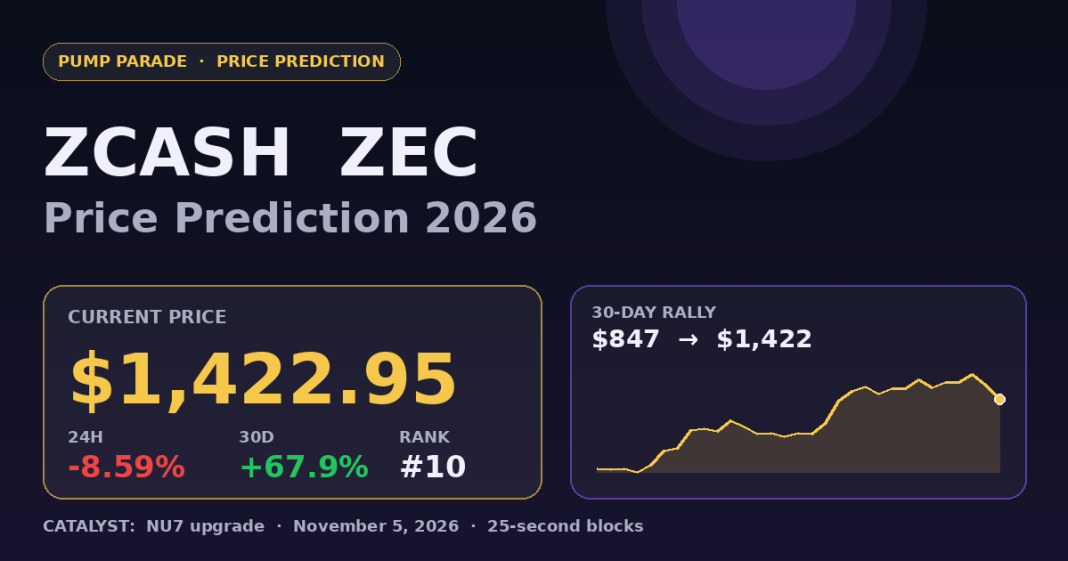
Zcash (ZEC) is trading at $1,422.95 at time of writing, up roughly 68% over the past 30 days and holding above $1,400 for the first sustained stretch since 2018. The Zcash price prediction 2026 conversation has swung from “dead privacy coin” to “top-10 mover” in about six weeks, and the numbers behind that shift are worth pulling apart rather than shouting about.
Two things are driving the move. First, the NU7 network upgrade, scheduled to activate on November 5, 2026, promises 25-second block times and shielded payments up to three times faster. Second, the shielded pool crossed $1 billion in August, giving privacy usage a metric traders can actually track. On-chain volume, wallet integrations, and the fixed 21 million supply cap have turned into a coherent narrative for the first time in years.
This article breaks down where ZEC sits right now, why the market is repricing it, what has to go right for the next leg, what could break the thesis, and where our targets land through 2028. No hopium, no shilling: bull case, bear case, and the honest read.
Key Takeaways
- ZEC trades at $1,422.95, ranked #10 by market cap ($23.2B), with 24h volume of $1.62B and a 30-day gain of 67.9%.
- NU7 mainnet activation on November 5, 2026 cuts block times to 25 seconds and speeds up shielded transactions roughly 3x, per Electric Coin Company.
- Ledger shielded-pool integration and a Coinbase relisting narrative have widened self-custody and on-ramp access materially in Q3.
- Our 6-month base case sits at $2,000 with a bull scenario of $3,000 and a bear scenario at $800, anchored to spot.
- The risk sits with privacy-coin regulation, a Sprout-pool sunset that renders certain legacy funds unspendable, and a parabolic move that has stretched short-term momentum.
Where Zcash Stands Today
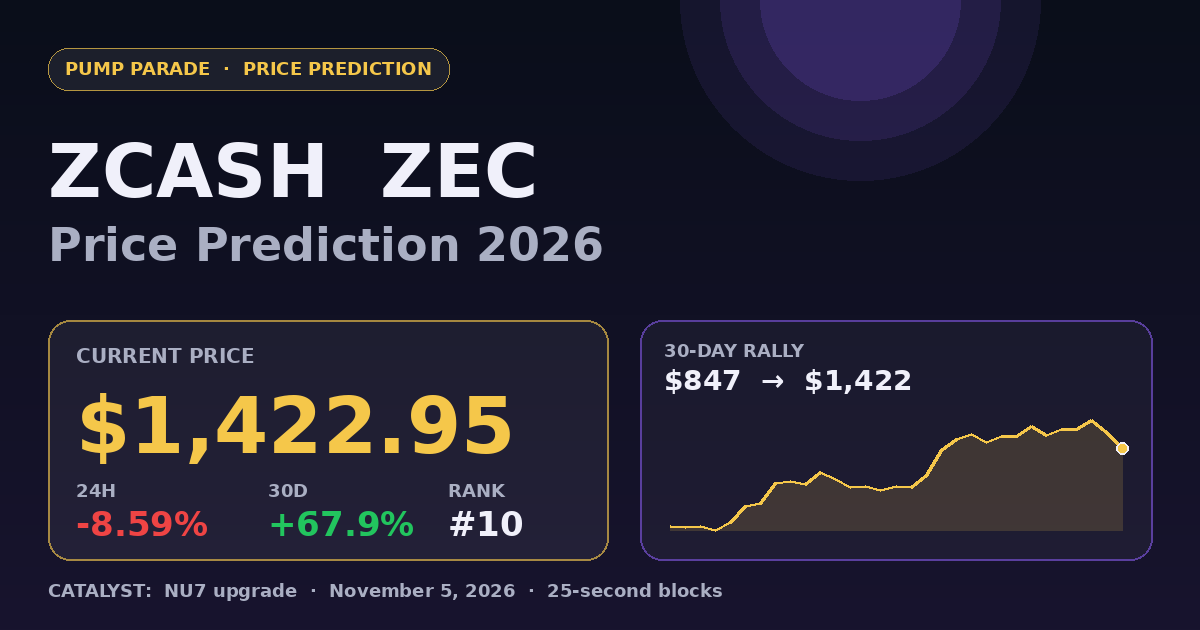
Before we get to targets, the current data. Zcash sits inside the top 10 by market capitalization for the first time since 2017, driven by a 30-day rally from $847 to $1,629 at the interim high on September 27. Today’s tape has cooled roughly 8.6% intraday, which is closer to healthy consolidation than a trend break given the pace of the run.
| Metric | Value |
|---|---|
| Price | $1,422.95 |
| 24h change | -8.59% |
| 7d change | -5.29% |
| 30d change | +67.9% |
| Market cap | $23.23B |
| 24h volume | $1.62B |
| Market cap rank | #10 |
| All-time high | $5,941.80 (Oct 2016) |
| % from ATH | -76.08% |
| Circulating supply | 16.33M / 21M |
Data as of September 29, 2026. Volume has expanded 59% versus the prior 24 hours even during today’s pullback, which is not what a top usually looks like. Supply dynamics are also worth flagging: with a hard 21M cap identical to Bitcoin and the next halving due in 2028, ZEC’s issuance schedule is one of the tighter setups in the top 25.
Why is Zcash Pumping Right Now?
The short answer: privacy is back on the menu, and Zcash is the coin with the freshest technical roadmap in that category. The longer answer breaks into three threads.
First, shielded usage went from academic to measurable. The Zcash shielded pool crossed $1 billion in early August after the Ironwood upgrade activated. That figure matters because the historical knock on Zcash was that most volume moved through transparent addresses, making the privacy tech look like a feature no one used. A billion-dollar shielded pool is not that.
Second, self-custody caught up. Ledger rolled out shielded-pool support inside Ledger Live during Q3, which removes the wallet friction that had kept privacy-conscious users on the sidelines. Combine that with a widely reported Coinbase relisting narrative and the tradable float just got easier to hold, move, and spend privately.
Third, institutional flows appeared for the first time in this cycle. Cypherpunk Technologies, a Nasdaq-listed treasury company, has been publicly accumulating ZEC as a strategic reserve asset. When a listed company treats a mid-cap crypto as reserve-grade, it changes both the supply side and the perception of the asset.
Layer in high-profile advocates like Naval Ravikant, coordinated Twitter/X activity from figures who called earlier privacy-coin rotations, and a macro backdrop where surveillance concerns keep making mainstream headlines, and you get an on-chain plus off-chain story that traders can actually price.
The Bull Case: Can ZEC Hit $3,000 by 2027?
NU7 Upgrade Ships on November 5
NU7 is the largest protocol upgrade Zcash has shipped since Halo 2. According to CoinDesk reporting on the Electric Coin Company roadmap, the target activation is November 5, 2026, and the upgrade cuts block times from 75 seconds to 25 seconds while making shielded transactions roughly three times faster. It also introduces a new fee mechanism inspired by EIP-1559 and, over time, a Bitcoin-style halving schedule that community governance signals support. If it activates on schedule and shielded throughput scales, the “privacy is slow” objection stops being true.
Institutional Treasury Buying Continues
Cypherpunk Technologies is the visible name, but the pattern to watch is whether other listed companies follow. Strategy (formerly MicroStrategy) turned corporate treasury buying into a template for BTC. If even one more Nasdaq-listed vehicle discloses a ZEC allocation, the reflexivity that drove Bitcoin’s 2020 to 2021 institutional rerating becomes at least imaginable for Zcash, and the tradable float is a fraction of BTC’s.
The 2028 Halving Sets Up a Second Wind
Zcash halves in November 2028, cutting block rewards from 1.5625 ZEC to 0.78125 ZEC. Historically, ZEC’s biggest legs have come in the 12 months before and after halvings, though sample size is small. If the market frames NU7 as the software catalyst and 2028 as the supply catalyst, the bridge from a $2,000 base case to a $3,000 to $5,000 tail is analytically defensible rather than pure hopium.
The Bear Case: Could ZEC Fall Back to $800?
Regulatory Pressure on Privacy Coins
The most obvious tail risk. Binance delisted ZEC in several jurisdictions in prior cycles, and any renewed FATF or EU MiCA guidance targeting privacy-preserving assets could pull major exchange support. A single high-profile delisting from a top-5 venue would remove a chunk of liquidity in a market that is already thin relative to its market cap. This is the risk factor that most analysts underweight and that trades least favorably in a bear scenario.
The Sprout Pool Sunset
NU7 is not a pure win. The upgrade renders funds still held in the legacy Sprout pool unspendable after November 5. Cointelegraph and other outlets have warned holders to move ZEC out of Sprout before the deadline. The amounts affected are small in aggregate, but if the sunset generates negative headlines or affects large historic holders, sentiment can wobble regardless of fundamentals.
Parabolic Move, Overheated Momentum
Up 68% in 30 days, up over 200% in 90 days, and printing an 8-year high. In prior ZEC cycles, moves of this magnitude have been followed by drawdowns of 40 to 60% before the next leg. Today’s 8.6% intraday drop is the first sign that the tape is digesting supply. A retest of the $950 to $1,050 breakout zone would be normal and not, by itself, a thesis-breaker. A close below $800 would be.
Zcash Price Prediction 2026: Targets by Timeframe
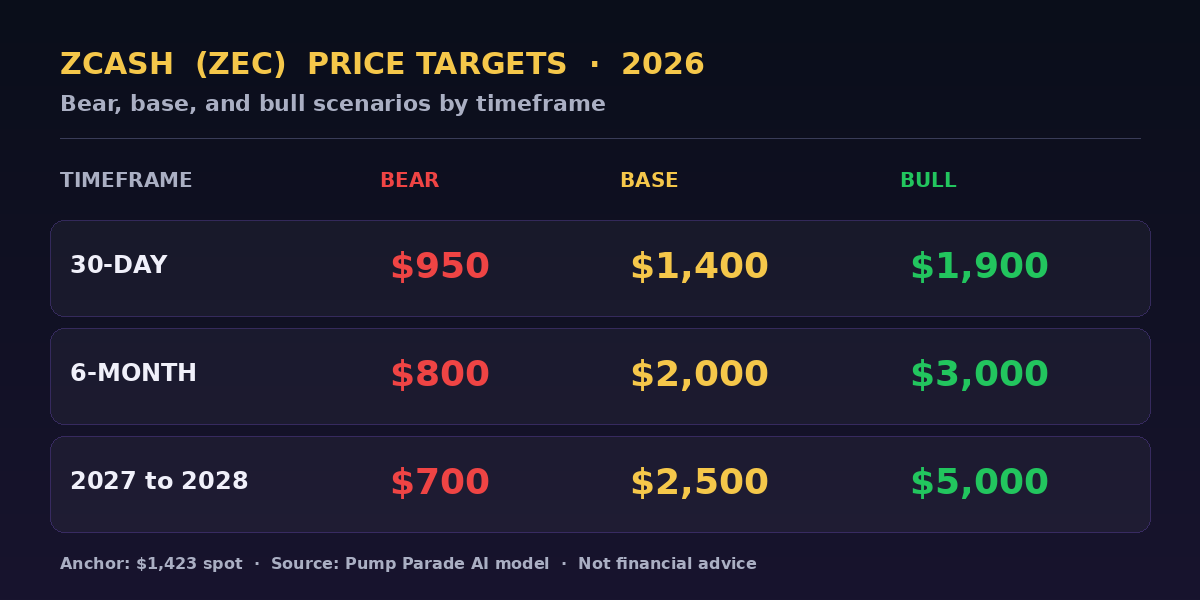
Our hybrid AI model, which weights technical structure, on-chain activity, event probability, and cross-asset correlation, outputs the following ranges. Every target is anchored to today’s spot of $1,422.95 and assumes no black-swan macro shock.
30-Day Outlook (Through Late October 2026)
Base case $1,400: consolidation between $1,200 and $1,600 as the market prices in NU7 execution risk. Bear case $950: a full retest of the breakout zone if BTC pulls back to $80K. Bull case $1,900: a clean melt-up into the upgrade date if shielded pool metrics keep printing.
6-Month Outlook (Through Q1 2027)
Base case $2,000: NU7 ships, shielded volume compounds, and one more treasury company discloses a position. Bear case $800: regulatory action from a major exchange or jurisdiction. Bull case $3,000: institutional flows accelerate and the privacy narrative dominates a broader alt rotation, echoing the Q1 2021 Zcash rally that took it from $70 to $340 in eight weeks.
Long-Term (2027 to 2028)
Base case $2,500. Bear case $700 if the privacy category loses relevance to zk-rollups or FHE alternatives. Bull case $5,000, which is the level Zcash co-founder Zooko Wilcox has publicly cited. Standard Chartered has not published a formal ZEC target, but analysts including Changelly and DigitalCoinPrice have 2026 to 2028 ranges centered between $1,500 and $2,850, roughly consistent with our base scenario. Read our earlier Zcash $2,000 outlook for how the setup has evolved as spot has moved.
Is Zcash Better Than Monero?
The most useful peer comparison is Monero, the other headline privacy coin. Both use different tech, both have different regulatory postures, and both trade at meaningfully different valuations right now.
| Metric | Zcash (ZEC) | Monero (XMR) |
|---|---|---|
| Price | $1,422.95 | $544.12 |
| Market cap | $23.23B | $10.15B |
| Market cap rank | #10 | #15 |
| Max supply | 21M (hard cap) | Tail emission (uncapped) |
| Privacy model | Optional (zk-SNARKs) | Default (ring sigs, stealth) |
| Next major upgrade | NU7, Nov 5, 2026 | FCMP++ (in dev) |
| Ledger hardware support | Yes (incl. shielded) | Yes (transparent view) |
| Major exchange status | Widely listed | Delisted from Binance, Kraken US, others |
The setup, in one line: Monero has stronger privacy defaults, Zcash has stronger institutional optionality. For a fuller side-by-side, see our Monero (XMR) price prediction. If you want compliant-adjacent privacy exposure that can still trade on major venues, ZEC is the cleaner vehicle right now. If you want maximally private cash, XMR still wins on the tech, and pays for it in liquidity.
What Would Change Our View
Three explicit triggers we are watching:
Bullish trigger: a second Nasdaq-listed treasury company discloses a ZEC position, or shielded pool value crosses $2 billion by year-end. Either would justify pulling the 6-month base case toward $2,500.
Bearish trigger: a top-5 exchange announces a ZEC delisting or restricts shielded deposits/withdrawals. Historical precedent says the market discounts this kind of headline by 25 to 40% inside a week.
Neutral trigger: NU7 activates on time but shielded pool growth stalls below $1.2B by January. That would signal a narrative-driven pump rather than genuine usage adoption, and would push our base case back to the $1,000 to $1,400 zone.
Frequently Asked Questions
What is the Zcash price prediction for 2026?
Our 6-month base case for Zcash is $2,000, with a bull scenario at $3,000 and a bear scenario at $800. The wide range reflects genuine uncertainty around the November 5 NU7 upgrade, privacy-coin regulation, and follow-through on institutional treasury demand. Base case assumes NU7 ships on time and shielded pool value keeps growing.
Why is Zcash pumping so hard in 2026?
Three catalysts stacked: the NU7 upgrade activating November 5, Ledger rolling out shielded-pool support in Q3, and Cypherpunk Technologies publicly accumulating ZEC as a treasury asset. The shielded pool also crossed $1 billion in August, giving traders a usage metric they can actually track. That combination retagged ZEC from “dead privacy coin” to “top-10 mover.”
Will Zcash reach $5,000?
$5,000 is the level Zcash co-founder Zooko Wilcox has publicly cited, and it sits inside our 2027 to 2028 bull scenario rather than our 2026 base case. Getting there requires NU7 execution plus sustained institutional inflows plus a broader privacy-narrative rotation. It is analytically possible on the current trajectory, not guaranteed, and comes with real regulatory tail risk.
Is Zcash a good investment in 2026?
Zcash offers concentrated exposure to the privacy-coin narrative with a fixed 21 million supply cap, a top-10 market cap, and a fresh technical catalyst. It also carries above-average regulatory risk and has moved parabolically over 90 days. It fits a research-driven, high-conviction position for investors comfortable with volatility, not a set-and-forget allocation.
What is the Zcash NU7 upgrade?
NU7 is Zcash’s next network upgrade, targeted for November 5, 2026. According to Electric Coin Company and multiple community sources, it cuts block times from 75 to 25 seconds, makes shielded transactions roughly three times faster, adds an EIP-1559-style fee mechanism, and sets the stage for future Bitcoin-style halvings. Legacy Sprout-pool funds become unspendable at activation.
Is Zcash better than Monero?
Neither is strictly better. Monero has stronger default privacy through ring signatures and stealth addresses, but faces heavier exchange delistings. Zcash has optional privacy via zk-SNARKs, better hardware-wallet support, and remains widely listed. For maximum privacy pick Monero, for institutional and mainstream exchange access pick Zcash. Read our Monero price prediction for the XMR side of the trade.
The Honest Take
Zcash is the most interesting privacy trade in crypto right now, and it is also the one most exposed to a policy headline that no model can price. The bull case, NU7 plus institutional flows plus 2028 halving, is legitimate and points to $2,000 as a reasonable 2026 base with $3,000 in reach. The bear case, a top-5 exchange delisting or a stalled shielded pool, is equally real.
What separates ZEC from a hopium trade is that the catalysts are dated and measurable. November 5 is on the calendar. Shielded pool value publishes on-chain. Treasury disclosures hit press releases. That means the thesis has honest ways to invalidate itself, which is more than most crypto rallies offer.
The pattern to watch through year-end: NU7 ships cleanly, shielded pool grows, and one more listed company steps forward. If those three land, $2,000 is where we anchor. If any of the three misses, $1,000 is where we anchor. Position accordingly, and keep the bear case as loud as the bull case, because in a market this volatile the second-order risk is usually bigger than the first-order narrative.
Disclaimer: This article is for informational and educational purposes only and should not be construed as financial, investment, or trading advice. Cryptocurrency markets are highly volatile, and past performance does not guarantee future results. The price predictions and analyses presented here are based on AI models, technical indicators, and available data at the time of writing, they are not guarantees. Always conduct your own research (DYOR) and consult with a qualified financial advisor before making any investment decisions. Pump Parade and its authors do not assume liability for financial losses incurred based on information provided in this article.