Birdeye sits at an awkward but valuable spot in the Solana stack. It is not a wallet, not a trading bot, and not an exchange. It is the screen most active Solana traders glance at twenty times an hour to answer one question: is this token worth touching, and which wallets are already in it?
Born in 2022 as a Solana-only data terminal, Birdeye has since expanded to ten chains and 300-plus exchanges. In 2026, it competes head-on with DexScreener for charting, with Nansen for smart-money wallet intel, and with Helius for raw API data. This is a hands-on review covering features, fees, pros, cons, and a final verdict for traders, researchers, and developers.
TL;DR: Verdict in 30 Seconds
Birdeye scores 8.7 / 10. It is the best free Solana analytics terminal in 2026 and the most cost-effective multi-chain on-chain data source for active traders. The Find Gems screener and smart-money tracker are best-in-class. The mobile app is rougher than the web experience, and the Premium tier feels priced for power users rather than casuals. If you are trading Solana memecoins or researching launchpads daily, Birdeye should be open in a tab.
Best for: Solana traders, memecoin hunters, DeFi researchers, on-chain analysts, indie developers needing affordable token data.
Skip if: You only hold blue-chip BTC and ETH on a CEX. You will not get value out of an on-chain terminal.
What Is Birdeye?
Birdeye is an on-chain analytics platform that aggregates real-time token prices, trades, liquidity, charts, holder distributions, and wallet behavior across Solana and the major EVM chains. The product launched in 2022 as a Solana-native explorer and grew up alongside the Solana DEX boom, ingesting feeds from Jupiter, Raydium, Orca, and Meteora.
In 2026 the platform covers ten chains including Solana, Sui, Ethereum, BNB Chain, Base, Arbitrum, and Polygon, with data flowing in from 300-plus exchanges. Solana memecoins remain its center of gravity, and most of the differentiated features (launchpad discovery, Find Gems screener, Trader Profile) lean heavily into the fast-moving Solana market structure.
The product is split across three surfaces: the consumer web app at birdeye.so, the iOS and Android mobile app, and the Data Services API at bds.birdeye.so for developers and businesses. Each has its own pricing logic, which we will get into below.
Feature Deep Dive
1. Token Discovery and the Find Gems Screener
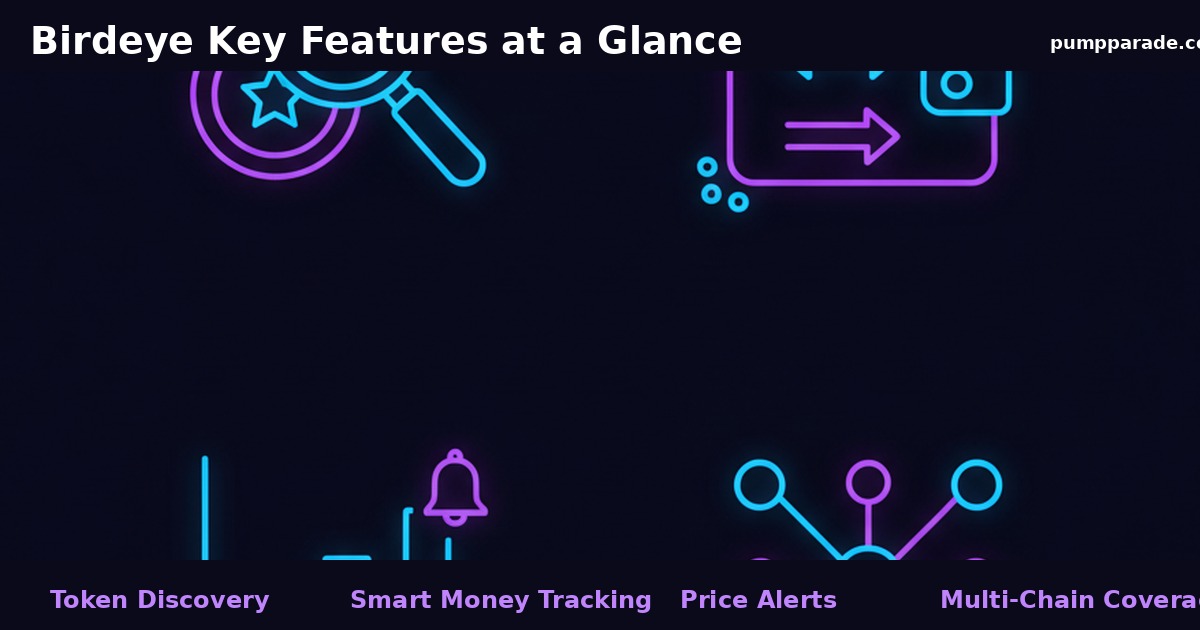
Find Gems is the feature most traders open Birdeye for. It lets you filter the entire Solana token universe by market cap range (micro-caps from $10K to $100K up to mid-caps over $1M), minimum holder count, liquidity floor, 24h volume threshold, mint authority status, freeze authority status, and Twitter/social presence. The filter combinations are granular enough to narrow a universe of tens of thousands of tokens down to a handful of candidates in seconds.
What makes it competitive against DexScreener is the combination of risk filters and signals on the same screen. You can require revoked mint authority, top-10 holder concentration under 25%, and a five-minute volume spike, then sort by buy/sell ratio. That kind of one-screen filtering is rare among free tools.
2. Token Pages and Microstructure
Each token page combines a TradingView-compatible chart, a live trade tape, holder distribution, top traders, pool liquidity depth, security checks (mint authority, top wallet concentration, LP burn status), and an embedded swap widget powered by an aggregator. For Solana memecoins this is essentially everything you need on a single screen, which is why Birdeye has become the default landing page when a token gets shared on Twitter.
3. Smart Money and Wallet Intelligence
Paste any wallet address and Birdeye shows holdings, realized and unrealized PnL, full trade history, and a profitability score. The platform also maintains curated “top trader” and “smart money” leaderboards that tag wallets it considers historically profitable on a given token or sector. This is the cheaper, Solana-first answer to Nansen’s labeled-wallet database, with the caveat that Birdeye’s labels are algorithmic rather than human-curated.
4. Launchpad and New-Token Radar
Birdeye monitors 20-plus launchpads in one feed, including pump.fun, BonkFun, Believe, and Moonshot. New tokens appear within seconds of pool creation, which is faster than most aggregators and is genuinely useful for sniping fresh launches. If you are coming from a Telegram bot setup like Banana Gun, Birdeye is the research layer you flip to before pulling the trigger.
5. Alerts and Watchlists
Configurable alerts cover price thresholds, volume spikes, large trade detection (whale buys or sells over a dollar threshold), liquidity drains, and smart-wallet activity. Delivery is via Telegram, Discord, in-app push, or email. The free tier limits the number of active alerts and watchlist items, which is the main reason most active users eventually upgrade.
6. Multi-Chain Coverage
Solana, Sui, Ethereum, BNB Chain, Base, Arbitrum, Polygon, Optimism, Avalanche, and zkSync are all supported. EVM data is good but not better than DexScreener or DeBank for those chains. Solana is where Birdeye genuinely leads.
7. Mobile App
The iOS and Android apps cover the core flows: token search, watchlists, trader profiles, launchpad monitoring, and push alerts. The app is functional for monitoring but not really built for executing trades. App Store reviews skew middling, and most regular users still prefer the web app on desktop for serious work.
8. Data Services API
For developers, the Birdeye Data Services API exposes token prices, OHLCV candles, trades, wallet portfolios, and pool data across all supported chains. Pricing is tiered by request volume and historical data depth, with a free developer tier and paid tiers scaling up to enterprise. It is a serious competitor to Helius for indexed Solana data at a significantly lower price point for many use cases.
Birdeye Pricing in 2026
Birdeye runs three pricing surfaces that are easy to confuse:
| Product | Plan | Price | What You Get |
|---|---|---|---|
| Web app | Free | $0 | All charts, trending feeds, basic Find Gems, limited watchlists and alerts |
| Web app | Pro | ~$45 / month | Advanced Find Gems filters, expanded alerts and watchlists, CSV exports, premium integrations |
| Data API | Developer | Free tier | Low request volume, basic endpoints |
| Data API | Standard / Business / Enterprise | Tiered | Higher rate limits, full historical depth, websocket streams |
| Mobile app | Free | $0 | Core charts, watchlists, push alerts |
For 95% of retail traders, the free tier is genuinely enough. The Pro upgrade only makes sense if you are running many watchlists, need granular Find Gems filters, or want CSV exports. The Data API is in a different category and competitive against Helius, QuickNode, and Alchemy for Solana data specifically.
Cross-check the live numbers against DeFiLlama and CoinGecko for ground-truth comparison. Birdeye is typically faster but occasionally off on tokens with weird liquidity routing.
Pros
- Best-in-class Solana data freshness. New pools and trades appear within seconds, often faster than DexScreener or CoinGecko.
- Find Gems screener is genuinely powerful. The combination of risk filters and signal filters in one query is rare for a free tool.
- Smart money tracking that actually works. Wallet PnL, trade history, and top-trader leaderboards are useful without an analyst-grade subscription.
- Generous free tier. Most traders never need to upgrade.
- Affordable, well-documented Data API. A real Helius alternative for many use cases.
- Multi-chain coverage. Ten chains and 300-plus exchanges means one tab instead of three.
- Launchpad monitoring across 20+ platforms. Single feed for pump.fun, BonkFun, Believe, Moonshot, and more.
Cons
- Smart-money labels are algorithmic, not curated. A “top trader” tag means historical PnL on this chain, not analyst-verified identity. Nansen wins on label quality.
- Mobile app lags the web experience. Functional for monitoring, not great for fast research workflows.
- EVM coverage is good, not great. If you live on Base or Ethereum, DexScreener or DeBank may serve you better.
- Pro tier pricing feels stiff for casuals. $45/month is fine for daily traders, but a $15 tier with limited Find Gems would expand the audience.
- UI density is high. First-time users routinely report a steep learning curve.
- No native portfolio aggregation across many wallets. For multi-wallet PnL, Zapper or DeBank is still the answer.
Security and Trust
Birdeye is read-only by default. The site does not hold custody of funds. The embedded swap widget routes through Jupiter (on Solana) and external aggregators on EVM chains, so trades execute via your own wallet signing transactions in your browser. The main attack surface, then, is the swap-widget UI itself and the integrations behind it.
The team has been operating since 2022, has institutional partnerships with several Solana-native infrastructure providers, and the Data API is used by trading firms and other dashboards. There have been no public security incidents at the protocol or data-integrity level as of mid-2026. As always, verify what you sign in your wallet rather than trusting a UI label.
User Experience
The web experience is dense, fast, and built for power users. Information density is high, which is great once you know what you are looking at and overwhelming when you do not. The Find Gems screener has a learning curve of about an hour to set up filters that match your style.
Performance is consistently good even on slow connections. Charts load quickly, the trade tape streams in real time, and search has gotten noticeably better in 2026. Dark mode is the default and the only mode, which fits the trader audience.
If you are pairing Birdeye with a wallet, Phantom is the most common combination. The Birdeye swap widget plays nicely with Phantom, Backpack, and Solflare. For execution via DEX aggregator, the data on Birdeye lines up well with Jupiter’s routing on Solana.
Comparison vs Alternatives
The honest framing: Birdeye is the best generalist Solana terminal, but each specialized competitor wins in one dimension.
- vs DexScreener: Birdeye wins on filters, signals, and Solana freshness. DexScreener wins on EVM chain coverage and is slightly more popular for cross-chain memecoin trading.
- vs Nansen: Nansen wins on smart-money label quality and institutional features. Birdeye wins on price (free vs Nansen Pro at $150+/month) and Solana-native focus.
- vs DeBank / Zapper: Those tools win on multi-wallet portfolio aggregation. Birdeye wins on token discovery, screening, and real-time trade data.
- vs Helius API: Helius wins on Solana indexer depth and RPC quality. Birdeye Data API wins on multi-chain coverage and price.
Final Verdict and Rating
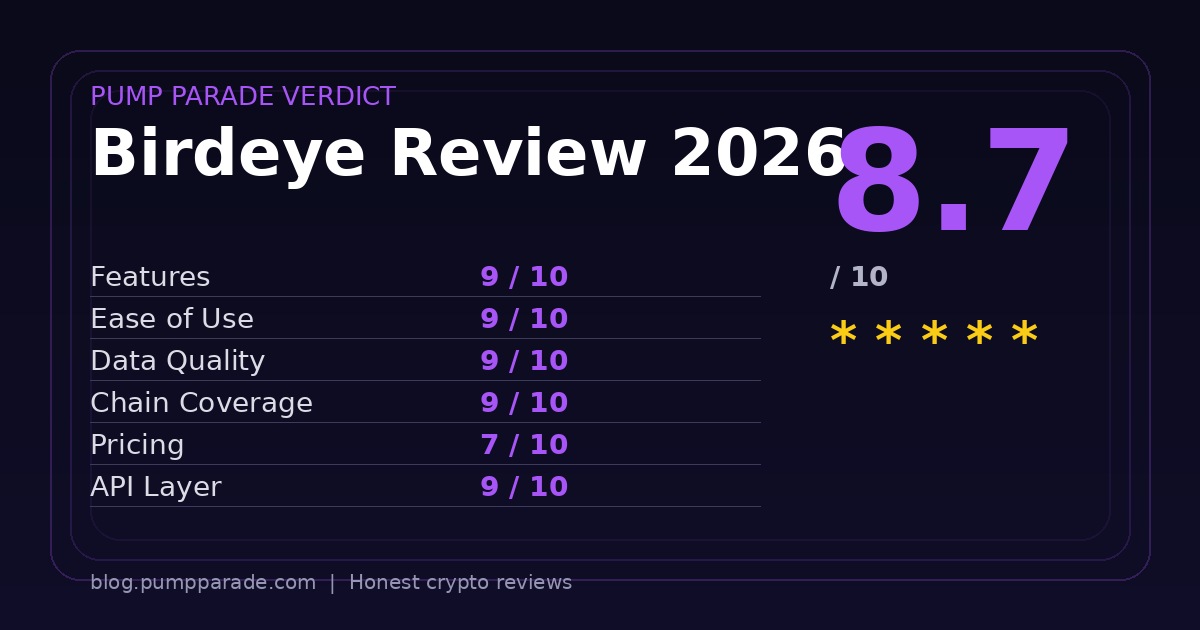
Score: 8.7 / 10.
Birdeye is the single most useful free tool for active Solana traders in 2026. The Find Gems screener, real-time launchpad radar, and smart-money tracker together do the job of three other paid products. The Pro tier is fairly priced for daily users, and the Data API is a serious option for builders. The mobile app and EVM coverage are the weakest links. If you are doing any kind of Solana research and you do not have Birdeye open already, you are working harder than you need to.
FAQ
Is Birdeye free to use?
Yes. The free tier covers charts, trending feeds, basic Find Gems, watchlists with limits, and core token pages. The Pro tier at roughly $45/month unlocks advanced screener filters, expanded alerts, and CSV exports. The Data API has a separate free developer tier plus paid tiers scaling with request volume.
Which chains does Birdeye support in 2026?
Solana, Sui, Ethereum, BNB Chain, Base, Arbitrum, Polygon, Optimism, Avalanche, and zkSync, with data aggregated across 300-plus exchanges.
How does Birdeye compare to DexScreener?
Birdeye is stronger on Solana freshness, Find Gems filters, and integrated smart-money tracking. DexScreener has slightly broader EVM chain coverage and is more widely used outside Solana. Most active Solana traders run both.
Is Birdeye safe to connect a wallet to?
Birdeye is read-only by default and does not custody funds. The optional swap widget routes through external aggregators and your own wallet signs transactions in your browser. Verify every transaction before signing. There have been no public security incidents at the Birdeye platform level as of mid-2026.
Is the Birdeye Find Gems screener better than free alternatives?
For Solana specifically, yes. The combination of risk filters (mint authority, holder concentration, LP burn) with signal filters (volume spike, buy/sell ratio, smart-money inflow) on the same screen is hard to find elsewhere without paying for a premium product.
Does Birdeye have a mobile app?
Yes, on both iOS and Android. The app covers core features for monitoring, watchlists, trader profiles, and push alerts. Power users typically still prefer the desktop web app for research and trading.