The two biggest names in crypto portfolio tracking finally go head-to-head. We tested both in 2026 to find out which one deserves a permanent tab in your browser.
If you hold tokens across more than one chain, you have probably already met the pain of trying to add up your net worth across wallets, exchanges, lending positions, LP tokens, and the random NFT you forgot you minted. Two products dominate this category in 2026: Zapper and DeBank. Both let you punch in a wallet address and see everything that wallet owns. Both are free. Both have been around since the early DeFi summer. But they have grown into two very different products, and picking the right one depends entirely on how you trade and what chains you actually use.
This review compares them across chain coverage, supported protocols, fees, security, social features, mobile experience, and overall UX. By the end you will know exactly which tracker fits your workflow.
TL;DR: The Quick Verdict
- Best for Solana, Bitcoin, and multi-chain users who want to trade in-app: Zapper.
- Best for EVM power users who want the deepest DeFi position parsing and a social feed: DeBank.
- Best free tier: Tie. Both give you the core tracking experience without paying a cent.
- Overall winner for most readers: Zapper, because of its broader chain coverage (including Bitcoin and Solana) and built-in swaps.
If you only ever touch Ethereum, Arbitrum, Base, and other EVM chains, DeBank is still our pick. If your bags live on more than one ecosystem, Zapper wins.
Product Overviews
Zapper
Zapper launched in 2020 and was one of the first tools to make DeFi positions human-readable. In 2026 the consumer app supports 60+ chains including Ethereum, Base, Arbitrum, Optimism, Polygon, BNB Chain, Avalanche, Solana, and Bitcoin. Its data layer powers Coinbase, Rainbow, and other major wallets, which is a strong signal that the underlying infrastructure is enterprise grade.
The standout feature is “Zaps,” one-click multi-step DeFi actions. Want to take ETH, swap it to a stablecoin, and deposit it into a yield vault in one transaction? Zapper handles the whole flow. It is the rare product that lets you go from “tracking” to “doing” without leaving the page.
DeBank
DeBank is the EVM specialist. In 2026 it claims support for 100+ EVM-compatible chains and 1,300+ DeFi protocols, which is genuinely the deepest on-chain coverage in the category. It does not support Solana or Bitcoin, and it never tries to be a swap interface. Instead, it doubles down on two things: parsing complex DeFi positions (concentrated liquidity, lending, staking, derivatives) and Web3 social.
The social layer, called DeBank Stream, is essentially Twitter for wallets. Every post is tied to a verified on-chain identity, so when a whale brags about a 10x trade you can actually verify it. There is also a Web3-native messenger and a “Follow” feature for tracking smart money wallets.
Chain Coverage
This is the single biggest difference between the two products. Zapper covers 60+ networks that span EVM, Solana, and Bitcoin. The Bitcoin support is recent and rare, and the Solana coverage finally caught up to where multi-chain traders need it to be. DeBank stays in EVM land with 100+ chains, including every L2 you have heard of (Base, Arbitrum, Optimism, Linea, zkSync, Scroll, Mantle, Manta Pacific) plus a long tail of newer chains.
If your portfolio touches Solana, Hyperliquid, or Bitcoin, DeBank simply will not show you the full picture. You will end up running two tabs. If you live entirely on EVM rails, DeBank actually has slightly broader chain depth than Zapper at the long tail.
DeFi Protocol Support
DeBank wins on raw protocol count. It parses 1,300+ protocols and is particularly good at the messy ones: Uniswap V3 concentrated liquidity positions with accurate range and fees, Pendle yield-bearing tokens shown with maturity dates, GMX and Hyperliquid perp positions with full PnL, and complex Aave or Morpho lending positions broken out by asset.
Zapper covers 1,500+ apps according to its own data, but in practice the parsing is slightly less detailed for the most obscure protocols. Where Zapper pulls ahead is in showing the actions available next to each position. See a position you want to exit? The Zap button is right there.
Fees and Pricing
Both products have generous free tiers. Here is the honest breakdown.
Zapper. Portfolio tracking, NFT viewing, transaction history, the social feed, and basic swaps are free. Zapper charges a small fee on Zap transactions (typically a few basis points on the swap component, plus the underlying DEX fee). The developer API has paid plans for businesses, but consumer users never have to pay.
DeBank. Everything that matters is free. Multi-chain tracking, wallet following, DeFi parsing, DeBank Stream, and the messenger all cost nothing. The paid extras are vanity items: a custom DeBank ID costs around $96 (one-time), and there are some advanced social features behind a small fee. None of it is required to use the product.
Verdict: free vs free. Neither one nickel-and-dimes the user, which is refreshing in a space where every other tool is trying to launch a token or a Pro tier.
Security and Trust
Crypto trackers are read-only by default, which is the main reason they are safer than the wallets they monitor. You give them a public address, not a private key. That said, security still matters when you connect a wallet to execute a transaction.
Both companies have multi-year track records and have powered millions of dollars in DeFi activity without a major incident. Zapper has been audited multiple times (most recently by Pessimistic and others) and uses well-known router contracts for its Zaps. DeBank’s surface area for risk is smaller because it does not handle transactions itself, but its data has been the source of truth for projects like Lido, Compound, and dozens of fund dashboards.
The realistic risk is not the tracker itself. It is the wallets and approvals you connect through it. DeBank’s approvals dashboard, which shows every token allowance you have ever signed and lets you revoke them, is one of the most useful security features in either product. If you do nothing else after reading this article, go run that scan on your main wallet.
User Experience and Mobile
This is where personal taste kicks in.
Zapper feels like a modern fintech app. The portfolio view is dense without being cluttered, the NFT gallery is genuinely beautiful, and the iOS and Android apps are kept in sync with the web product. The “Activity” feed of recent transactions across the network is also addictive for anyone who likes watching on-chain action in real time.
DeBank is more spreadsheet-like. The web UI is information-dense and prioritizes precision over polish. Power users tend to prefer it because every number is exactly where you expect it to be. The mobile app is solid but not as feature-complete as the web version. DeBank Stream is the wildcard here: if you want to follow the wallets of well-known traders and see what they are doing in real time, no other product offers anything close.
NFT Tracking
Zapper has the better NFT experience overall. High-resolution media, accurate floor prices across the major marketplaces, traits, rarity scores, and one-click listing through aggregators. DeBank has NFT support but treats it as a secondary concern, mostly showing collections with floor prices and basic metadata. If you actually trade NFTs, use Zapper.
Social Features
This is DeBank’s signature win. DeBank Stream turned out to be one of those features people did not know they wanted. You follow a wallet, you see their swaps, mints, and posts. You can verify holdings claims with one click. The trolling is real, the alpha is occasionally real, and the platform has built a small but engaged community of on-chain natives.
Zapper has Farcaster integration and a feed of activity across followed wallets, but it is more of a discovery tool than a social network. It works well, but it is not where the on-chain conversations happen.
Pros and Cons
Zapper Pros
- 60+ chains including Solana and Bitcoin
- In-app Zaps for one-click DeFi actions
- Best-in-class NFT viewing experience
- Polished mobile apps
- Powers Coinbase, Rainbow, and other major wallets (data quality signal)
Zapper Cons
- Slightly thinner parsing for obscure DeFi protocols
- Small fee on Zap transactions
- Social features are an afterthought
DeBank Pros
- Deepest DeFi position parsing in the category
- DeBank Stream social layer with verified wallet posts
- Token approval revoker that may save you from a future drain
- Free across the board for what matters
- Web3 messenger built in
DeBank Cons
- No Solana, no Bitcoin, no non-EVM support
- No in-app swaps or transactions
- UI is more spreadsheet than app
- NFT experience is basic
Side-by-Side: At a Glance
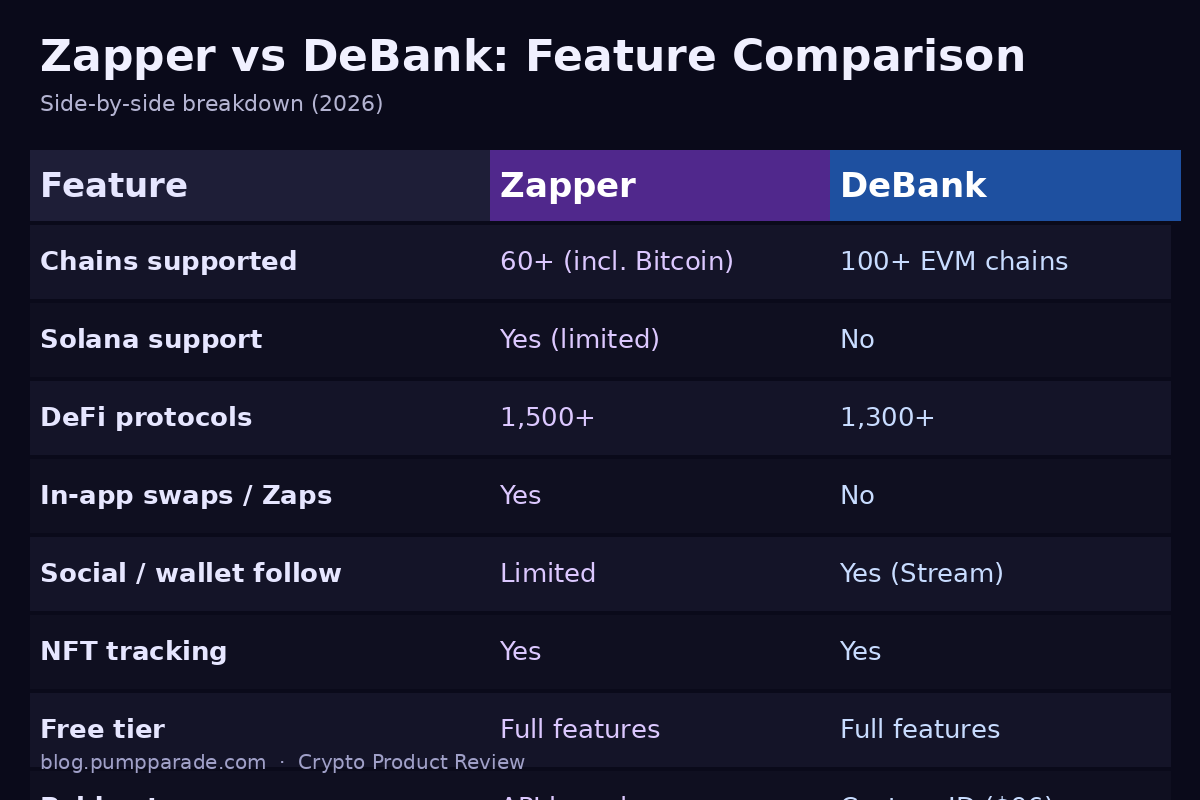
For readers who scrolled straight here, the short version is in the comparison graphic above. The cliff notes:
- Multi-chain breadth: Zapper
- EVM depth and protocol coverage: DeBank
- In-app actions: Zapper
- Social and following: DeBank
- NFTs: Zapper
- Cost: Tie
Who Should Use Which
Pick Zapper if you are a multi-chain user (especially anyone with Solana or Bitcoin exposure), if you actually trade NFTs, or if you want to swap and rebalance without leaving the tracker.
Pick DeBank if you are an EVM-first power user, if you run yield strategies that involve concentrated liquidity or complex lending positions, if you care about token approval hygiene, or if you want to follow the on-chain moves of specific wallets through DeBank Stream.
Honestly, the best workflow for serious users is to use both. Zapper as the daily-driver tracker and execution layer. DeBank for deep EVM audits, approval revokes, and social. They cost nothing, so there is no real downside to running both.
Final Verdict
If we had to pick only one for the average reader of this site, it is Zapper. Solana and Bitcoin support is no longer optional in 2026, and the ability to execute trades without bouncing to another tab is a real productivity win. DeBank is still excellent, and it is the right choice for an EVM-only audience, but Zapper’s chain breadth and Zaps push it over the line.
Rating: Zapper 4.6 / 5 · DeBank 4.4 / 5
Looking for more reviews of trading tools? See our breakdown of Jupiter vs 1inch for the best DEX aggregator in 2026, or our Phantom Wallet review for the best Solana wallet pairing.
FAQ
Is Zapper or DeBank safer to use?
Both are read-only by default, which means giving them your public wallet address does not expose your funds. The risks come from connecting your wallet to sign transactions (Zapper) or signing token approvals on the underlying protocols (both). DeBank’s approval revoker is one of the strongest security tools either product offers.
Does DeBank support Solana?
No. DeBank is EVM-only in 2026. If you have Solana positions you need a different tracker, and Zapper is currently the most complete option that covers both ecosystems.
Do I need to pay for Zapper or DeBank?
No. Both have full free tiers for portfolio tracking. Zapper charges small fees on Zap transactions. DeBank’s paid items (custom ID, advanced social) are entirely optional.
Can I track multiple wallets with both products?
Yes. Both let you bundle multiple addresses into a single portfolio view. Zapper’s “Bundle” and DeBank’s “Watchlist” are equivalent features.
Which one has better NFT support?
Zapper, by a wide margin. The viewer is polished, the floor prices are accurate, and you can list and buy without leaving the app.
Can either replace a tax tool like CoinTracker?
Not really. Both show your current state and recent history beautifully, but neither generates tax-ready cost basis reports across every transaction. Use them as the daily tracker, then export to a dedicated tax tool at year end.
Disclosure: Pump Parade may earn affiliate revenue if you sign up to certain products through the links in this article. This does not influence our editorial verdict. All testing was done with our own wallets.