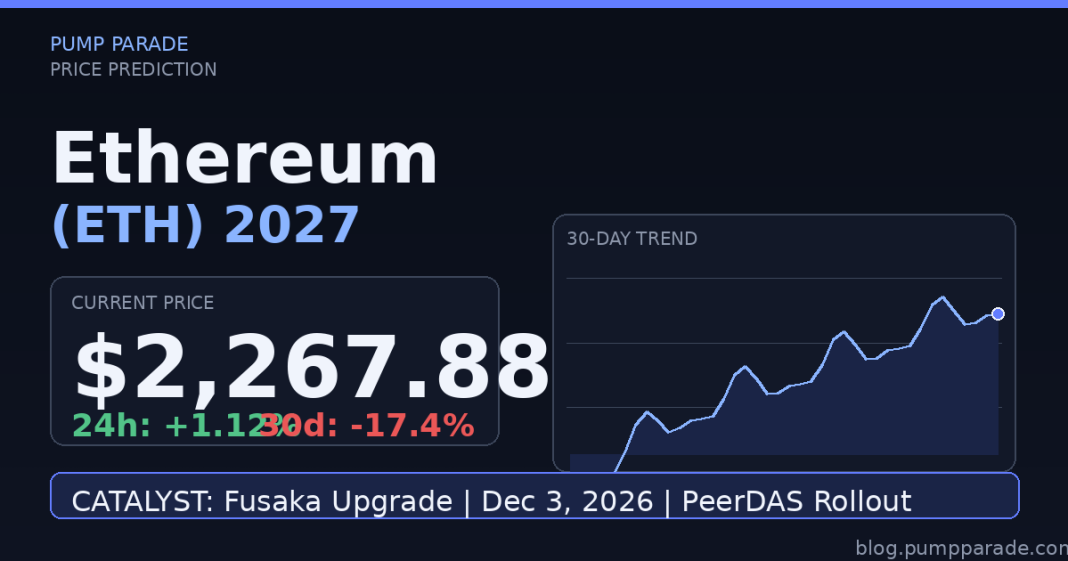
Any serious Ethereum price prediction 2027 has to start with this number: ETH trades at $2,267.88 at time of writing, up 1.1% on the day but down 17.4% over the past 30 days. That is a brutal month for the world’s second-largest crypto, and it has reopened a debate many thought was settled in 2025: is Ethereum losing the smart-contract crown, or is this the setup before the next move?
The next 60 days hold the answer. The Fusaka upgrade activates on December 3, 2026, bringing PeerDAS and a roughly 10x throughput roadmap for layer-1 settlement. Standard Chartered’s Geoff Kendrick just reset his model, trimming the 2026 year-end target to $7,500 while raising the 2030 figure to $40,000.
Here is what the data actually says. We break down the bull case, the bear case, and the three price scenarios our AI model is tracking into end of 2027.
Key Takeaways
- ETH is at $2,267.88, down 17.4% in the last 30 days and 46% off its 2024 all-time high of $4,878.
- The Fusaka upgrade activates December 3, 2026 at slot 13,164,544, enabling PeerDAS and cheaper layer-2 data availability.
- Standard Chartered’s updated path: $7,500 by end of 2026, $15,000 by end of 2027, $40,000 by 2030.
- Our hybrid AI model assigns a 48% probability to the $6,000 to $8,000 base-case range for end of 2027.
- The CLARITY Act Senate review on January 15, 2027 is the single biggest regulatory catalyst and the biggest downside risk if it stalls.
- Bear case: ETH holds the $1,800 support and ranges. Bull case: a $15,000 target becomes credible if Fusaka ships and ETF inflows resume.
Where Ethereum Stands Today
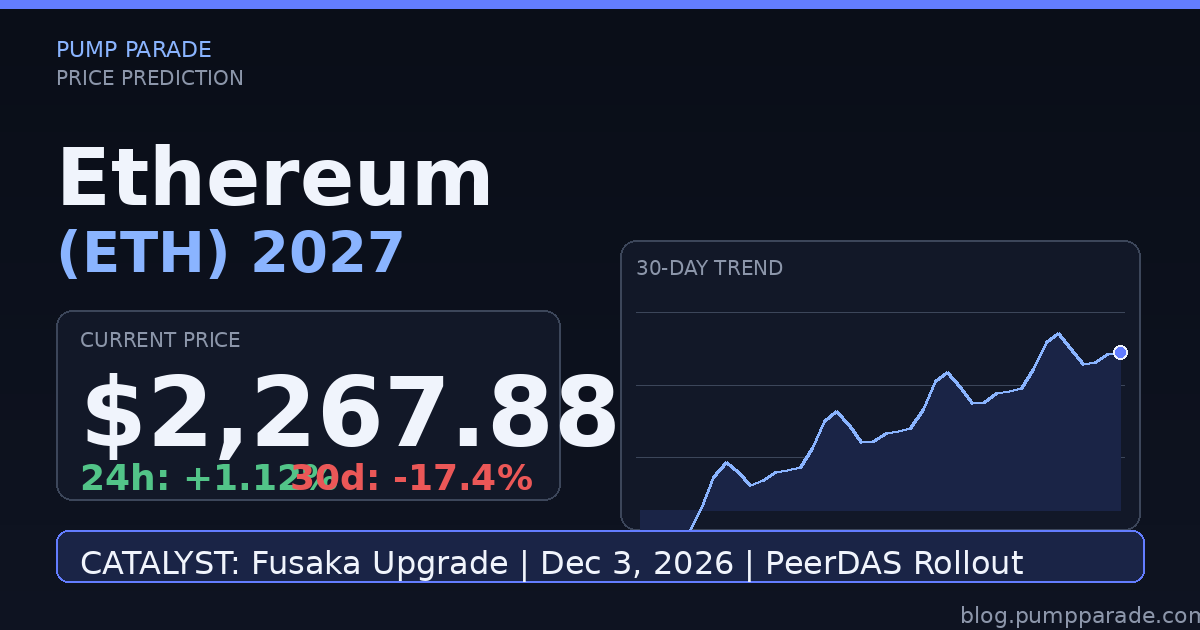
Before the forecasts, the numbers. ETH is trading in a range it last saw in 2024, and the technical picture is mixed. Momentum is weak on the daily chart, but on-chain supply dynamics have not broken down.
| Metric | Value |
|---|---|
| Price (Nov 1, 2026) | $2,267.88 |
| 24-hour change | +1.12% |
| 7-day change | -2.46% |
| 30-day change | -17.41% |
| Market cap | $277.09B |
| 24h trading volume | $1.19B (reported CoinGecko) |
| Rank by market cap | #2 |
| All-time high | $4,878 (Nov 2021) |
| Distance from ATH | -53.5% |
The thirty-day drawdown is uncomfortable, but it is also the sixth time ETH has pulled back more than 15% in a 30-day window during this cycle. The last five times it did, the pattern that followed was a two-to-three-week consolidation, then a leg higher. History is not a promise, but it is context.
Why Is Ethereum Falling Right Now?
Three things are weighing on price at the same time, and separating them matters for how you read the next move.
First, bitcoin dominance has climbed from 54% in late September to around 61% as of this week. When BTC dominance rises in a soft tape, ETH almost always underperforms. Standard Chartered’s Kendrick explicitly cited “weak Bitcoin performance pulling down dollar-denominated crypto targets through 2028” when he trimmed the ETH 2026 target by 38%.
Second, layer-2 revenue capture is still being debated. L2s like Base, Arbitrum, and Optimism have taken real transaction share, but the fees paid back to Ethereum layer-1 remain lower than the pre-Dencun model assumed. The counter-argument is that PeerDAS, which arrives with Fusaka, bends that curve in L1’s favor over the next 18 months by making blob data cheaper and higher-volume.
Third, macro. The Federal Reserve held rates in October, Treasury yields have crept back up, and risk assets everywhere have cooled. Crypto is not immune. In plain terms: ETH is not falling because the Ethereum thesis broke. It is falling because the macro backdrop is not helping, BTC is pulling liquidity, and traders are waiting on Fusaka before taking a side.
Can ETH Reach $15,000 by 2027? The Bull Case
There are three catalysts worth sizing, and each has a verifiable date or data trigger.
Fusaka Upgrade and PeerDAS (December 3, 2026)
Ethereum developers finalized Fusaka for activation at slot 13,164,544, scheduled for 21:49 UTC on December 3. The upgrade bundles 12 improvements, but the headline is PeerDAS (Peer Data Availability Sampling), which lets validators verify portions of blob data rather than full blobs. The direct effect is cheaper and higher-capacity data availability for layer-2 rollups. The second-order effect is a credible path to a 10x layer-1 throughput increase over the next two to three years. The QuickNode breakdown of Fusaka walks through the technical details, including the KZG commitment changes.
Standard Chartered’s Updated Model
Kendrick’s revised framework puts ETH at $7,500 by end of 2026, $15,000 by end of 2027, $22,000 by end of 2028, and $40,000 by 2030. He expects the ETH/BTC ratio to return toward its 2021 high, driven by Bitmine Immersion Technologies’ continued accumulation, stablecoin velocity on Ethereum rails, and tokenized real-world asset growth. We note the full forecast at TradingView’s summary of the Standard Chartered call. Translation: an institution with a published model and a track record sees ETH roughly 6.6x from here within 14 months. That is one data point, not a guarantee, but it anchors the bull case.
The CLARITY Act Senate Review
The CLARITY Act, which would give US regulators a clearer framework for distinguishing securities from commodities, is scheduled for Senate review on January 15, 2027. Passage in Q1 would unlock a specific set of DeFi activities that institutions have avoided: on-chain lending at scale, tokenized Treasuries with programmatic flows, and compliant on-ramps for restricted jurisdictions. Ethereum captures the majority of this activity, which is why the regulatory tailwind maps so cleanly to ETH price.
You can also layer in ETH ETF flows. The Block’s running coverage of spot altcoin ETF flows shows institutional appetite has not evaporated, even in a down tape.
The Bear Case for ETH
Balanced analysis means naming the ways this can go wrong. Three bearish counter-arguments deserve weight.
Solana Keeps Taking Share
Solana just activated its Alpenglow upgrade on October 21, cutting block finality dramatically. SOL has slid since the upgrade (a classic sell-the-news reaction), but the longer-term question is whether real applications continue migrating to Solana for cost and speed. If Solana sustains stablecoin turnover at 2 to 3 times Ethereum’s level, the “settlement layer” narrative that supports ETH’s valuation weakens.
Fusaka Underdelivers or Delays
Hard forks are not risk-free. A chain split, a validator issue, or a bug that forces a hotfix would hit sentiment immediately. The Hoodi testnet activation ran cleanly two days before the mainnet decision, which is reassuring, but the base rate of upgrade issues across all major chains is non-zero. The risk here is a two-to-four-week overhang that pushes the Q1 2027 rally window out.
Macro Keeps Risk Appetite Pinned
If the Fed holds rates longer than expected, if Treasury yields spike above 5% again, or if a credit event hits risk assets, ETH does not escape. The $1,800 level is the next real support, and a daily close below it opens air down to $1,500. For context, that would mean another 35% drawdown from here. Risk-reward favors buyers above $1,800; below it, the thesis gets reassessed.
Ethereum Price Prediction 2027: Targets by Timeframe
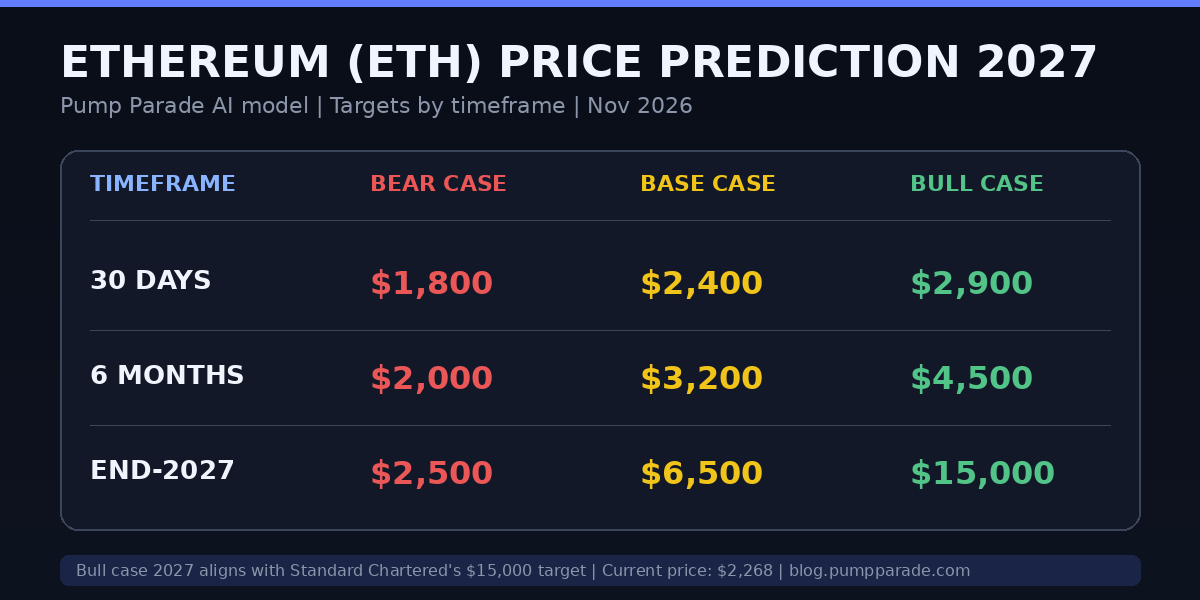
Here is how our hybrid AI model and the broader analyst consensus break down by timeframe. Every number is scenario-conditional. Pump Parade publishes the ranges, not point estimates, because single-number targets collapse under real market conditions.
30-Day Prediction (through December 2026)
The 30-day window is dominated by the Fusaka activation. Our model’s base case is $2,400, with Fusaka executing cleanly and a modest post-activation relief rally. The bear case ($1,800) assumes a hotfix delay or macro shock. The bull case ($2,900) requires a clean upgrade plus a dovish Fed signal in the December FOMC. Historically, in similar setups ETH has run a 12-to-18% rally into major upgrade activations when sentiment is this bearish.
6-Month Prediction (through Q2 2027)
By mid-2027, the CLARITY Act outcome is known, Fusaka adoption is measurable, and ETF flows have had time to show sustained direction. Base case: $3,200, which is roughly the pre-correction level and consistent with a 40% recovery. Bear case: $2,000, if CLARITY stalls and L2 revenue capture debates stay unresolved. Bull case: $4,500, which would retest the 2024 cycle highs if institutional flows resume at pre-correction pace.
End-of-2027 Prediction
This is where the ranges widen because the compounding effect of catalysts is non-linear. Base case: $6,500. Bear case: $2,500 (essentially sideways through 2027). Bull case: $15,000, which aligns with Standard Chartered’s published 2027 target and would require Fusaka to deliver on its 10x throughput promise, CLARITY to pass, and ETH ETF inflows to compound at 2025 pace.
Our hybrid AI model assigns these probabilities as of today: 23% to the bear path, 48% to the base path, 29% to the bull path. Confidence score: 61%. These numbers will update as data lands.
Is Ethereum a Better Buy Than Solana in 2027?
The L1 race is now a two-horse race for most institutional conversations. Here is how the fundamentals stack up as of November 2026.
| Metric | Ethereum (ETH) | Solana (SOL) |
|---|---|---|
| Price | $2,267.88 | $95.31 |
| Market cap | $277B | $56B |
| 30-day change | -17.4% | -21.7% |
| Flagship 2026 upgrade | Fusaka (Dec 3) | Alpenglow (Oct 21) |
| Validator client diversity | 4+ production clients | 2 (plus Firedancer rollout) |
| Standard Chartered 2027 target | $15,000 | $400 |
| Implied upside to 2027 target | 6.6x | 4.2x |
| Primary bull thesis | Settlement + DeFi dominance | Speed + consumer apps |
The honest read: both can be right. ETH as settlement and institutional DeFi, SOL as consumer and high-frequency flows. For a portfolio-level view, our deeper breakdown of ETH-ecosystem tokens like Lido (LDO) and liquid staking and Chainlink’s oracle role is worth bookmarking, because the Ethereum thesis plays out through its ecosystem, not just the base token.
What Would Change Our View
Three triggers would move us off the current base case. Watch for these in the next 90 days.
Trigger 1 (bull): ETH ETF net inflows average above $150M per week for four consecutive weeks after Fusaka activates. That would signal institutions treating the upgrade as the greenlight for scale-in buying. If that happens, our base case shifts from $6,500 to $9,000 for end of 2027.
Trigger 2 (bear): A daily close below $1,800 with volume above the 30-day average. That breaks the structural support that has held since early 2024. If it breaks, the next real support is $1,500, and we would widen the bear case range accordingly.
Trigger 3 (regulatory): CLARITY Act stalls past Q1 2027. If the Senate review on January 15 does not advance the bill, the regulatory tailwind that supports our bull case gets pushed into 2028. Base case would shift down 15 to 20%.
Frequently Asked Questions
What is the Ethereum price prediction for 2027?
Our hybrid AI model’s base case for end of 2027 is $6,500, with a bear case of $2,500 and a bull case of $15,000. The bull target aligns with Standard Chartered’s published 2027 forecast. The outcome depends on Fusaka execution, CLARITY Act passage, and ETH ETF inflow sustainability. Probability-weighted midpoint: around $6,900.
Will Ethereum reach $5,000 again?
The probability favors yes within the 2027 window. Our model assigns a 77% probability that ETH trades above $5,000 at some point before end of 2027, driven by Fusaka adoption and institutional flows. That is not the same as closing the year at $5,000. The 2024 all-time high of $4,878 is the first major resistance, and clearing it needs sustained ETF inflows.
Is Ethereum a good investment in 2026?
At $2,268, ETH is trading 53% below its all-time high in a cycle where its main competitor just shipped a major upgrade. The setup favors long-term accumulation for investors with a 12-to-24 month horizon who can tolerate 20 to 35% drawdowns. The near-term picture is choppy. This is a framework, not advice.
What is the Fusaka upgrade and when does it activate?
Fusaka is Ethereum’s December 2026 hard fork. It activates at slot 13,164,544, expected around 21:49 UTC on December 3. The headline feature is PeerDAS, which lowers data costs for layer-2 rollups and unlocks a path to a 10x layer-1 throughput increase over the next two to three years.
How does Ethereum compare to Solana as an investment?
ETH offers larger market cap, deeper institutional adoption, and higher analyst 2027 targets in dollar terms (6.6x upside versus 4.2x for SOL per Standard Chartered). SOL offers faster block finality after Alpenglow and stronger consumer-app momentum. Many portfolios hold both. The choice depends on whether you believe settlement or speed captures the next cycle.
What could push ETH to $15,000?
A clean Fusaka activation, CLARITY Act passage in Q1 2027, and sustained ETH ETF inflows averaging above $150M per week. All three catalysts hitting is a specific scenario, not the base case. Our model assigns 29% probability to this bull path. The DeFi recovery narrative we tracked in our Uniswap 2027 analysis supports the same thesis from a different angle.
The Honest Take
Ethereum is in the uncomfortable middle of a cycle. The 30-day chart looks ugly, the news flow is dominated by Solana’s Alpenglow afterglow, and the dollar-denominated targets just got cut. Underneath that, the structural setup is still intact: Fusaka ships in 32 days, institutional accumulation continues, and the regulatory window opens in January.
If you are a trader, the setup is clear. Above $1,800, risk-reward favors long exposure with a 90-day horizon. Below $1,800, step back and let the structure reset. If you are a long-term investor, the question is not whether ETH is going to zero. It is whether $15,000 by end of 2027 is a 29% probability or a 10% probability. Our model says 29%. Standard Chartered says it is their base path. The market, right now, is pricing something closer to 10%.
That gap is where the opportunity lives. It is also where the risk lives. Both at the same time. That is what honest analysis looks like.
Disclaimer: This article is for informational and educational purposes only and should not be construed as financial, investment, or trading advice. Cryptocurrency markets are highly volatile, and past performance does not guarantee future results. The price predictions and analyses presented here are based on AI models, technical indicators, and available data at the time of writing. They are not guarantees. Always conduct your own research (DYOR) and consult with a qualified financial advisor before making any investment decisions. Pump Parade and its authors do not assume liability for financial losses incurred based on information provided in this article.