
People keep using “AI investing agent” and “robo-advisor” as if they were the same thing. I spent this week reading the SEC’s robo-adviser bulletin, the pricing pages of three big robos, and milo’s own product pages side by side. They describe two different tools for two different jobs, and mixing them up is how people end up putting the wrong money in the wrong place.
Every fee and quote below comes from the source it is attributed to, checked on Oct 30, 2026. I work on milo, so read the milo parts with that in mind. I tried to be blunt about where the robos are simply better.
The short answer
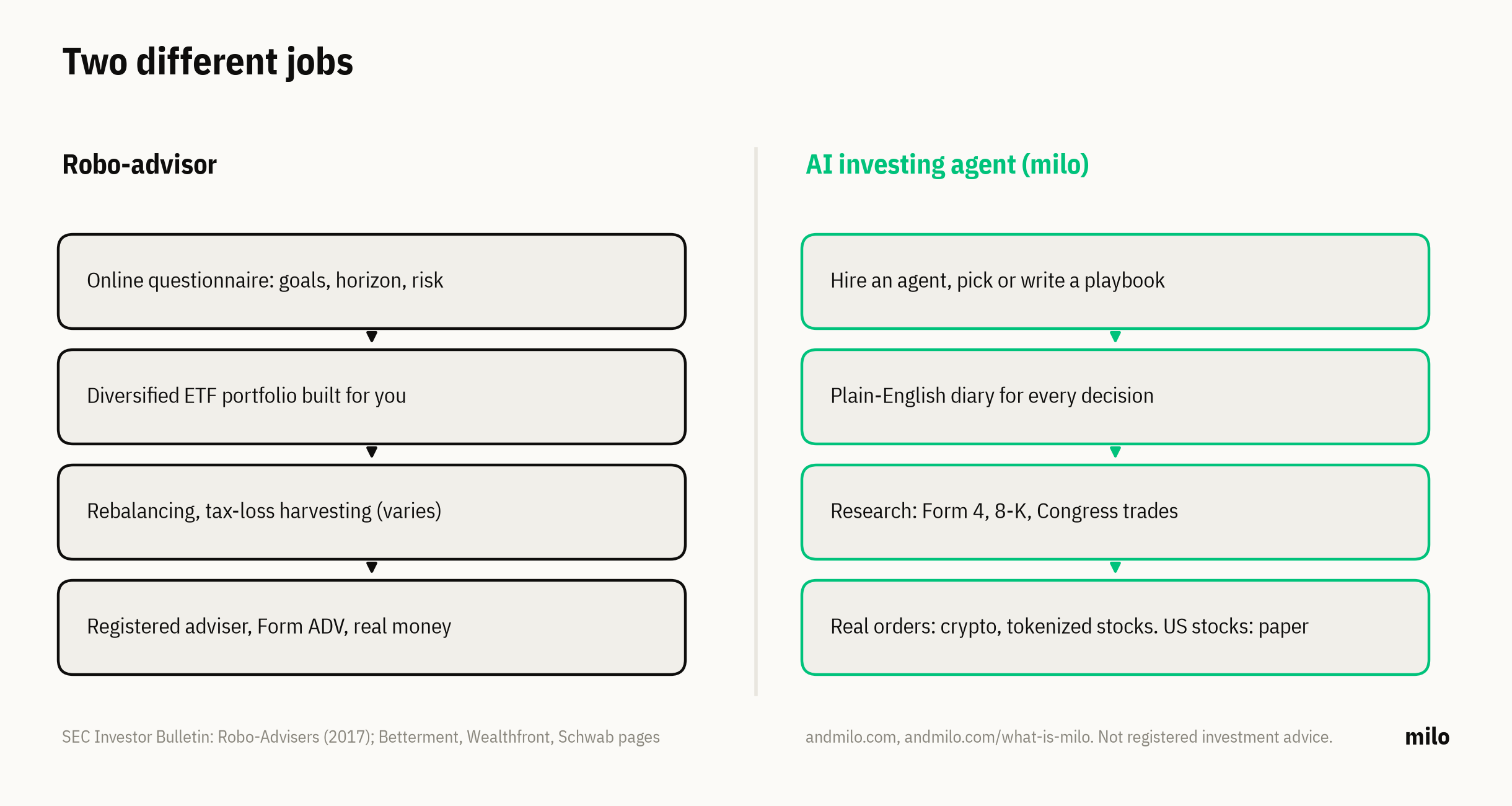
Use a robo-advisor when you want a registered adviser to build and manage a diversified portfolio of real money, often inside an IRA, with rebalancing and tax-loss harvesting. Use an AI investing agent like milo when you want to watch an agent make decisions in plain English, read filings like Form 4 and 8-K in one place, paper test stock ideas, and run crypto agents from a wallet you control. They can sit side by side. One does not replace the other.
What a robo-advisor is, in the SEC’s words
The SEC’s Investor Bulletin: Robo-Advisers (Feb. 23, 2017) is still the cleanest definition I found: “The term ‘robo-adviser’ generally refers to an automated digital investment advisory program.” The next lines describe the whole product: “In most cases, the robo-adviser collects information regarding your financial goals, investment horizon, income and other assets, and risk tolerance by asking you to complete an online questionnaire. Based on that information, it creates and manages an investment portfolio for you.”
The part people skip is the legal one. “Although the services that they provide are automated, robo-advisers in the U.S. must comply with the securities laws applicable to SEC or state-registered investment advisers.” They file a Form ADV, and the bulletin points you to it: “You can find information about these topics in the adviser’s Form ADV Part 1 and Part 2 brochure.” You can look up any firm on the SEC’s Investment Adviser Public Disclosure site before you fund anything.
What FINRA warns about automated tools
FINRA and the SEC put out an Investor Alert on automated investment tools in 2015. It says these tools “range from personal financial planning tools (such as online calculators) to portfolio selection or asset optimization services” all the way “to online investment management programs (such as robo-advisors that select and manage investment portfolios).” So a robo-advisor is one specific kind of automated tool, not a catch-all for anything with an algorithm in it. The line I’d tape to my monitor: “Investors should be wary of tools that promise better portfolio performance.” That applies to AI agents too, milo included.
What three big robos actually charge
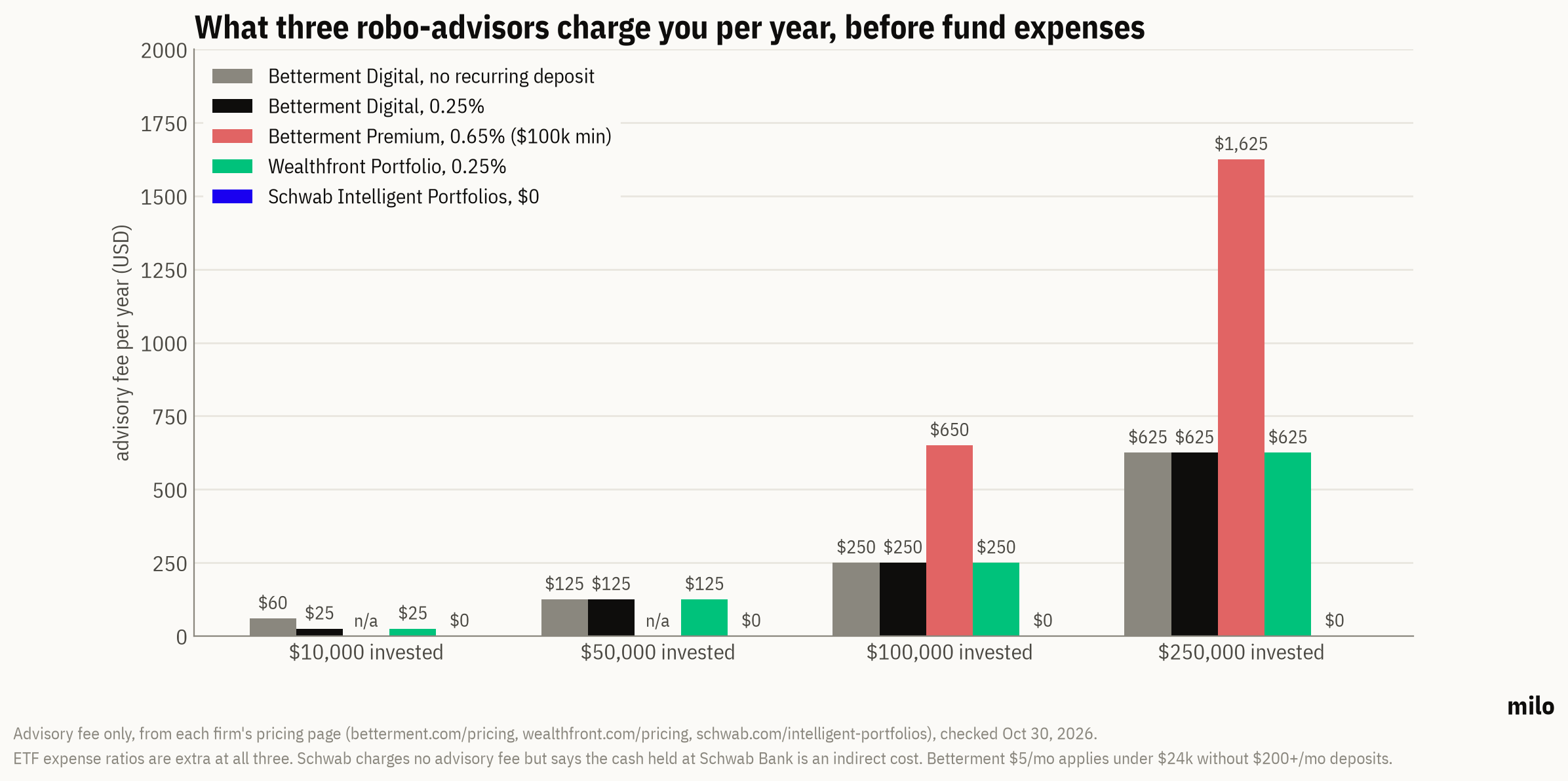
All three of these publish their fees. The catch is that the advisory fee is only one layer. Fund expenses come on top, and in one case the cost sits inside the cash allocation.
Betterment: Digital vs Premium
On Betterment’s pricing page, the Digital plan starts at “$5” a month for a “$0 – $24K balance” and moves to “0.25%” a year once you set up “recurring monthly deposits or transfers totaling $200 or more” or reach “a balance of $24,000 or more.” That small print matters at the low end. On $10,000 with no recurring deposit you pay $60 a year, which works out to 0.6%. Set up a $200 monthly deposit and the same $10,000 costs $25.
Premium is “0.65%” and “requires a minimum of $100,000 in eligible investments” per household. It adds access to financial experts. Above $1 million both plans drop to 0.15% on the $1M to $2M slice and 0.10% above $2M. Betterment is clear that its ETFs “have embedded fund fees” and “these fees are in addition to our management fees.” Moving an account out costs “a flat fee of $75” per account.
Wealthfront: 0.25%
Wealthfront’s pricing page says its advisory fee for The Wealthfront Portfolio is “just 0.25% annually.” It lists automatic trades, expert-built portfolios, tax-loss harvesting and automatic rebalancing. It also claims its “Tax-Loss Harvesting strategy can typically cover our annual fee more than 4.2x over, for Wealthfront Portfolio clients using the Classic portfolio.” That is Wealthfront’s own number about its own clients. Your result depends on your taxes.
Schwab Intelligent Portfolios: no advisory fee, with a cash catch
Schwab Intelligent Portfolios (the robo arm of $SCHW) says “Pay no advisory fee and no commissions” and “Get started with as little as $5,000.” You still “pay the operating expenses on the ETFs in your portfolio, which includes Schwab ETFs.” And Schwab explains how it gets paid: “Schwab does not charge an advisory fee for the SIP Program in part because of the revenue Schwab Bank generates from the cash allocation (an indirect cost of the Program).” In its own sample allocations the cash slice runs from 6.9% for an aggressive 30-year-old to 15.0% for a moderately conservative 65-year-old retiree. Tax-loss harvesting “is available for clients with invested assets of $50,000 or more” and you have to enroll.
So the real cost is advisory fee plus fund expenses plus any cash drag or transfer fees. The SEC bulletin says it directly: “Fees and other costs can greatly impact your return on investment.” I didn’t put net returns for any of these in the chart, because I don’t have a fair like-for-like source for them and I’m not going to invent one.
What an AI investing agent is on milo
milo’s What is milo page (andmilo.com/what-is-milo) describes something else entirely. You hire an AI trading agent, either from a roster or one you write in plain English. It scans for setups, checks them against its playbook and risk limits, and “every decision lands in a diary that explains what it bought or sold, why, and what it is watching next.” Agents compete on a public Arena leaderboard, and you can pause or stop one at any time.
Next to the agents there is a research side: analyst ratings, insider buying and selling from SEC Form 4, congressional trade disclosures, 8-K events, fundamentals and earnings. The stock research page at andmilo.com/stocks says its insider and 8-K data is “Read straight from SEC EDGAR and refreshed every day.”
Here is the part that matters for this comparison. milo can link a brokerage account for regular US stocks, but those trades are paper only for now, so there are no real orders for regular US stocks (tokenized stocks and crypto are real). Real execution on milo is crypto and tokenized stocks, from a Solana wallet generated for you. The site puts it as “milo never holds your money.” The footer on andmilo.com is just as clear about status: “milo agents are not registered investment advice.”
The public side cuts both ways. When I checked the homepage on Oct 30, milo’s own Blue Chip Buy & Hold agent showed -12.2% over 30 days, right there on the leaderboard. A robo won’t show you that kind of number agent by agent, because it isn’t running agents. milo shows it because the whole point is that you can see an agent losing and read why.
Side by side
| Typical robo-advisor (Betterment, Wealthfront, Schwab IP) | milo AI agent + research | |
|---|---|---|
| Core job | Questionnaire in, managed diversified portfolio out (SEC bulletin) | Hire an agent with a plain-English diary, plus Form 4, 8-K and Congress research (andmilo.com) |
| Regulatory status | SEC or state-registered investment adviser, files Form ADV (SEC bulletin) | “not registered investment advice” (andmilo.com footer) |
| How it decides | Your answers on goals, horizon and risk (SEC bulletin) | Agent playbook, allocation limits and risk gates (what-is-milo) |
| Real money | Yes, mostly broad ETFs in taxable and retirement accounts | Crypto and tokenized stocks: real, self-custody. Regular US stocks: brokerage linking exists, but trades are paper only for now |
| Tax-loss harvesting | Yes at all three (Schwab from $50,000, if enrolled) | Not offered on the milo pages I checked |
| IRAs | Schwab IP lists Traditional, Roth, Rollover, Inherited, SEP and SIMPLE IRAs | No IRA accounts on the milo pages I checked |
| Published advisory fee | Betterment $5/mo or 0.25%, Premium 0.65%; Wealthfront 0.25%; Schwab IP $0 plus cash allocation | No wrap-fee schedule comparable to a robo on the pages I used |
| Custody | At the firm’s brokerage, with bank sweeps for cash (Schwab disclosure) | Your own Solana wallet; stocks stay in your own linked brokerage |
| Best for | Hands-off, long-term, diversified money | Watching agent decisions, filing research, paper stock tests, crypto agents |
Where robo-advisors win
I’ll say this plainly because a lot of AI-agent marketing doesn’t. If the money is for retirement or a long-term taxable account and you want to set it up once and leave it alone, a registered robo is the better tool. It is a registered adviser with a Form ADV you can read. It builds a diversified ETF portfolio from your answers. It rebalances, and all three firms here offer tax-loss harvesting. Schwab lists six kinds of IRA. Betterment Premium and Schwab’s 24/7 support give you a human to call. And the fees are published down to the basis point.
milo does none of that robo work. There is no questionnaire building a stock and bond glide path, no tax-loss harvesting product, no IRA, no Form ADV brochure.
Where an AI agent stack fits instead
The agent side is for a different itch. You want to see why a decision was made, not just that your allocation drifted back to 60/40. You want insider filings, Congress trades and 8-Ks for the same stock on one screen, and you want to paper test a stock idea before you’d ever put money on it. Or you want a crypto agent running on-chain from a wallet you own, with every trade narrated and an off switch you control.
I wrote about how to check any AI tool’s track record in Danelfin vs Tickeron, and about what public AI paper-trading experiments actually showed in Can ChatGPT pick stocks?. Same rule here. Read the diary and the losing trades before you trust the winning ones.
If you want to hire a milo agent, read its diary, and keep crypto in a wallet you control, open the app with this link.
Which one should you use?
- Retirement or long-term taxable money, set and forget: start with a registered robo. Read its Form ADV and check it on IAPD.
- You want to read insider, Congress and 8-K filings and paper test stock ideas: milo’s stock research, with no real orders for regular US stocks (tokenized stocks and crypto are real).
- You want an autonomous agent with a public diary trading crypto: a milo agent, funded with money you can afford to watch go down.
- Both: plenty of people keep long-term money in a robo and use an agent as a separate sandbox. I would not move retirement money into an agent.
FAQ
What is the difference between an AI investing agent and a robo-advisor?
A robo-advisor is an automated, registered investment adviser that builds and manages a portfolio from your questionnaire answers (SEC bulletin). An AI investing agent, as milo describes it, is software you hire to research and trade inside playbook limits, with a plain-English diary. milo says its agents are not registered investment advice.
Is an AI trading agent a robo-advisor?
Not by the SEC’s definition, unless the firm is registered as an investment adviser and runs an advisory program. You can check any firm on IAPD. milo’s footer says its agents and research are not registered investment advice.
How much do Betterment, Wealthfront and Schwab Intelligent Portfolios charge?
From their pricing pages on Oct 30, 2026: Betterment Digital is $5 a month, or 0.25% a year with a $24,000 balance or $200+ in monthly deposits, and Premium is 0.65% with a $100,000 minimum. Wealthfront is 0.25%. Schwab Intelligent Portfolios charges no advisory fee, has a $5,000 minimum, and earns revenue on the cash allocation. ETF expenses are extra at all three.
Do robo-advisors offer tax-loss harvesting?
Many do. Betterment and Wealthfront feature it, and Schwab offers it from $50,000 if you enroll. The SEC notes that its value “can depend on your particular tax situation in a given year.”
Can milo replace Betterment or Wealthfront for my IRA?
No. milo is not a registered adviser, and I found no IRA accounts on its pages. For retirement account automation, use a registered robo that offers the account type you need.
Can milo trade stocks for me with real money?
Not regular US stocks, not right now. milo can link a brokerage account, but those stock trades are paper only, so no real orders for regular US stocks (tokenized stocks and crypto are real).
Are AI agents safer than robo-advisors?
Different risks. Robos operate under investment adviser rules and file Form ADV. milo is self-custodied and on-chain, and its own disclaimer says on-chain trading “carries smart-contract and counter-party risk.”
Which should I use?
Match the tool to the job. Long-term diversified real money goes to a robo. Filing research, paper stock tests and crypto agents with diaries go to milo. Many people use both for different money.
For education only. Not investment advice. milo agents and research are not registered investment advice. milo can link a brokerage for regular US stocks, but those trades are paper only for now: no real orders for regular US stocks (tokenized stocks and crypto are real). Competitor fees and features were checked on their own sites on Oct 30, 2026 and may change. Read each firm’s Form ADV and disclosures before funding. Sources: SEC Investor Bulletin: Robo-Advisers (Feb. 23, 2017); FINRA/SEC Investor Alert: Automated Investment Tools (2015); betterment.com/pricing; wealthfront.com/pricing; schwab.com/intelligent-portfolios; andmilo.com, andmilo.com/what-is-milo and andmilo.com/stocks.