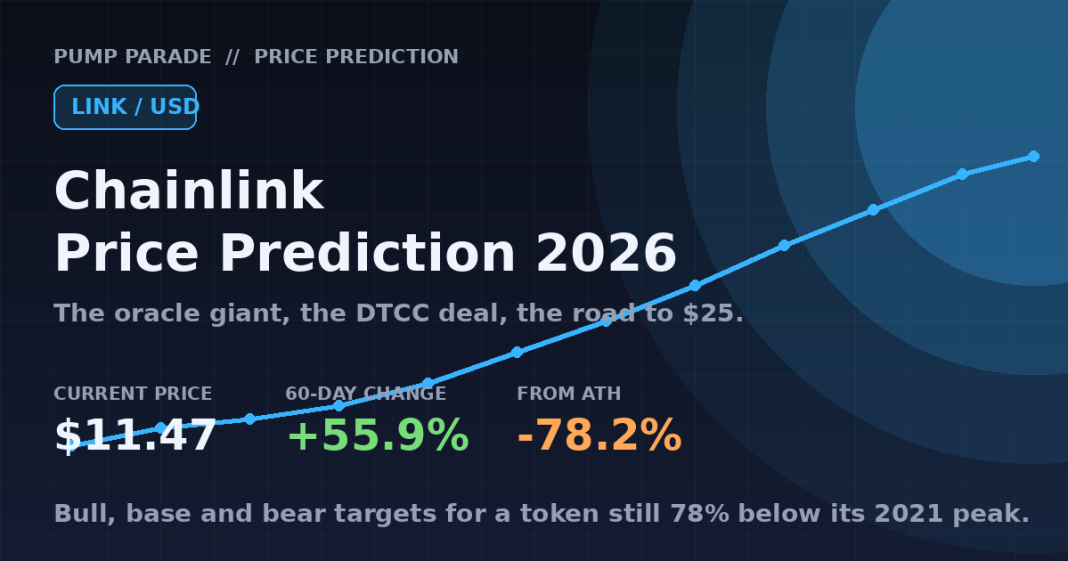
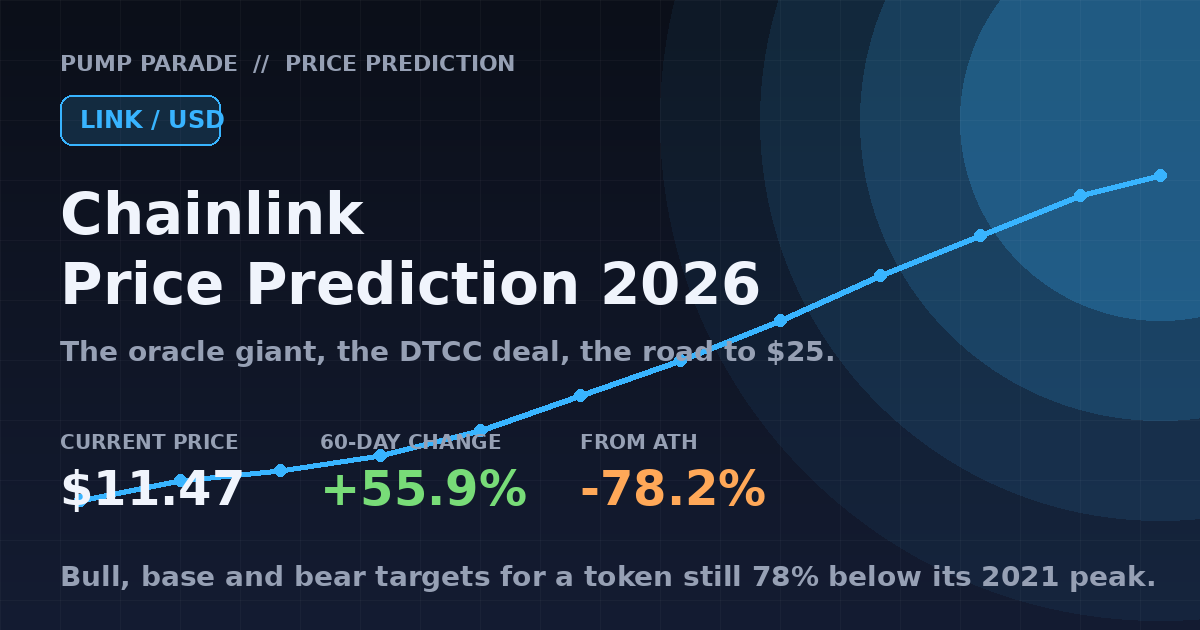
Chainlink price prediction 2026 conversations look very different than they did six months ago. LINK trades at $11.47 today, down 0.8% on the day but up a striking 55.9% over the past 60 days and 17.2% this week. The token that spent most of 2024 and 2025 disappointing holders is suddenly one of the strongest large caps in the market, even as it sits 78% below its May 2021 all-time high of $52.70.
The reason is not just price action. Chainlink secured direct integration wins with DTCC, SWIFT, and 24 of the world’s largest financial institutions over the last twelve months. Its Cross-Chain Interoperability Protocol (CCIP) now supports 60+ blockchains and secures $33.6 billion in cross-chain value, with 2025 transfer volumes up 1,972% year over year.
This piece walks through where LINK sits today, why the price is moving, the bull and bear cases into 2026, target prices by timeframe, how Chainlink stacks up against Pyth Network, and the specific triggers that would change our view.
Key Takeaways
- Current price: $11.47, market cap $8.57B, rank 16.
- Momentum: +55.9% over 60 days, driven by SWIFT and DTCC integration news.
- Base case for 2026: $18 by mid-year if CCIP volumes keep compounding.
- Bull case: $25 to $30 if DTCC Collateral AppChain launches on schedule and BTC holds above $80K.
- Bear case: $9 to $11 range if institutional pilots stall or oracle competition compresses fees.
- Biggest single catalyst: DTCC Collateral AppChain, targeted for Q4 2026.
Where Chainlink Stands Today
Before we forecast anything, here is the honest scoreboard. All figures pulled fresh from CoinGecko at the time of writing.
| Metric | Value |
|---|---|
| Price | $11.47 |
| 24-hour change | -0.81% |
| 7-day change | +17.20% |
| 30-day change | +30.46% |
| 60-day change | +55.86% |
| Market cap | $8.57B |
| 24-hour volume | $377M |
| Circulating supply | 748.1M / 1B max |
| All-time high | $52.70 (May 2021) |
| Distance from ATH | -78.24% |
The number that matters most: +55.86% in 60 days while broader crypto has been mixed. This is not a rising tide lifting all boats. LINK is outperforming its peer group, and that usually signals a story the market is repricing.
Why is Chainlink rising right now?
Two forces are converging. First, institutional integration finally moved from proof-of-concept to production. On May 12, 2026, DTCC confirmed it will adopt the Chainlink Runtime Environment (CRE) for its tokenized Collateral AppChain. That platform handles pricing, valuation, margining, collateral optimization, and settlement for a chunk of the $867 trillion global financial system. Launch is targeted for Q4 2026.
Second, SWIFT’s partnership with Chainlink now lets 11,000 banks connect to public and private blockchains through their existing SWIFT terminals and ISO 20022 messaging. When your bank’s back office already speaks the language, blockchain becomes a plumbing decision, not a strategy debate.
Layer in a broader tokenization narrative (BlackRock’s BUIDL, Ondo’s tokenized treasuries, and the tokenized real-world assets sector crossing $30 billion) and you have the setup for a token that gets used every time an oracle price or cross-chain message needs to be verified.
The Bull Case for LINK in 2026
Catalyst 1: DTCC Collateral AppChain goes live
If DTCC’s Q4 2026 launch ships on time, Chainlink becomes the settlement rail for institutional collateral movement. The Depository Trust and Clearing Corporation processes over $2 quadrillion in transactions annually. Even a rounding-error fraction of that flow routing through CCIP would meaningfully increase LINK’s fee capture and, more importantly, its narrative as the default oracle for tokenized finance.
Catalyst 2: CCIP volume flywheel
CCIP moved $7.77 billion in cross-chain volume in 2025, up 1,972% year over year. If 2026 growth even halves to a 900% pace, CCIP handles $70 billion plus in flows. Every transaction pays a small LINK fee, and the token is used as staking collateral for oracle nodes securing the network. Higher usage means higher staked LINK, which means less circulating supply.
Catalyst 3: Payment Abstraction and fee-token flexibility
Chainlink’s Payment Abstraction lets protocols pay in any accepted token, with the fee auto-swapped into LINK on the back end. This removes the friction that historically held back oracle fee capture. As integrations grow, so does programmatic LINK buy pressure. Standard Chartered and Bernstein analysts have both flagged this as a structural shift in the token’s demand profile.
The Bear Case for LINK in 2026
Risk 1: Institutional pilots stay pilots
The single biggest risk is timing. Every enterprise blockchain story of the last decade has been delayed at least once. If DTCC’s Q4 2026 launch slips into 2027 or gets scaled back, the narrative that is currently pricing in future revenue evaporates fast.
Risk 2: Oracle competition
Chainlink still owns the enterprise moat, but on speed and DeFi-native use cases the competition is real. Pyth Network dominates high-frequency price feeds on Solana. API3 pushes a first-party oracle model. Band Protocol has cross-chain traction. If a live protocol failure or a marquee client defection hits headlines, LINK could give back a chunk of the 60-day rally in a session.
Risk 3: Macro and BTC beta
Bitcoin trades at $78,732 today, down 0.66% on the day. Every large-cap altcoin has a beta to BTC that goes higher during risk-off moves. A sustained break below $70K would drag LINK toward the $9 to $11 zone regardless of how good the fundamentals look. Correlation still eats alpha in bear tape.
What is the Chainlink price prediction for 2026 by timeframe?
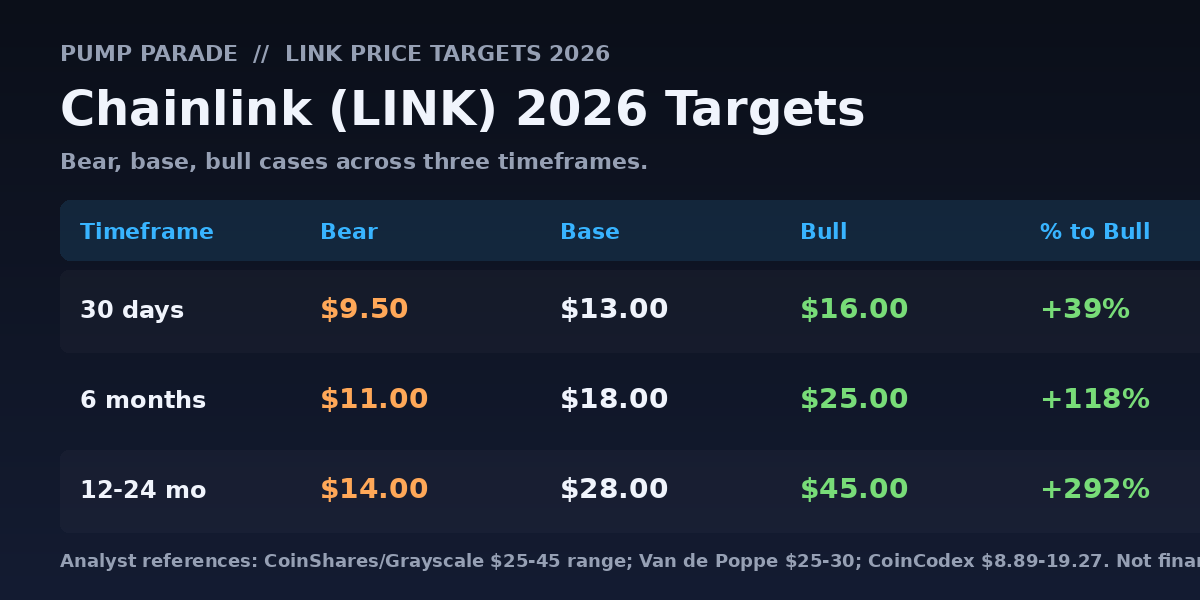
Here is how we model the ranges. These are scenario paths, not promises.
Next 30 days
Momentum favors a push toward $13 on continuation of the current trend, but the token is short-term overbought. Bear scenario: profit-taking pulls LINK back to the $9.50 support that held through July. Base case: consolidation between $12 and $14. Bull case: fresh institutional headline sparks a break to $16.
Six months out (Q1 2027)
This is where the DTCC and SWIFT catalysts land. Bear case: launches slip and LINK ranges $11 to $13. Base case: gradual adoption and steady CCIP growth take LINK to $18. Bull case: DTCC launches on time, tokenization TVL doubles, and LINK reclaims $25. That $25 level lines up with what CoinShares and Grayscale Research have both flagged as a reasonable base target for the year.
Twelve to twenty-four months
Longer horizons widen the cone. Bear case: oracle market fragments and LINK stalls near $14. Base case: $28, reflecting steady growth in CCIP fees, staking capture, and modest multiple expansion. Bull case: $45, requiring BTC in six figures, tokenization TVL past $100 billion, and Chainlink cementing the default-oracle position. Michael van de Poppe recently modeled a $25 to $30 range for 2026 alone, so a two-year $45 print is aggressive but not fantasy.
How does Chainlink compare to Pyth Network?
Pyth is the most direct competitor investors compare LINK to. Different design, different market fit, different tokenomics.
| Metric | Chainlink (LINK) | Pyth (PYTH) |
|---|---|---|
| Market cap | $8.57B | ~$0.6B |
| Chains supported | 60+ | 75+ |
| Data model | Push, aggregated | Pull, first-party |
| Latency | ~1 min updates | Sub-second |
| Cross-chain product | CCIP (production) | Wormhole-based |
| Institutional partners | SWIFT, DTCC, UBS | Cboe, Jane Street |
| Total value secured | $33.6B (CCIP) | ~$8B |
| Best fit | Enterprise, RWA, TradFi | Perps, high-frequency DeFi |
Different weapons for different fights. Pyth wins on speed and DeFi-native perps. Chainlink wins on institutional distribution and enterprise integrations that have taken years to build. For 2026, the institutional side of the trade has the bigger dollars behind it.
What Would Change Our View
- DTCC delay: If DTCC pushes the Collateral AppChain launch past March 2027, cut the base case to $14 to $16 and treat the bull case as invalidated until a new timeline lands.
- CCIP security incident: A verified exploit or extended downtime on CCIP would trigger a rerating. Enterprise partners tolerate technical debt in private, not in headlines.
- Ethereum reversal: If ETH breaks decisively above $3,500 and DeFi TVL follows, LINK’s oracle-fee thesis strengthens meaningfully. Below $2,000 ETH, DeFi contraction hurts LINK’s core revenue base.
Frequently Asked Questions
Will Chainlink (LINK) reach $25 in 2026?
$25 is achievable and sits in the base-to-bull range that CoinShares, Grayscale, and Standard Chartered analysts have modeled. It requires two things: DTCC Collateral AppChain shipping in Q4 2026 as planned, and Bitcoin holding above $80,000 through the second half of the year. If either fails, $18 becomes the more realistic ceiling.
Is Chainlink a good investment in 2026?
LINK sits at a rare intersection of proven institutional traction and deep price drawdown, still 78% below its 2021 peak. That combination favors long-horizon holders more than swing traders. Position sizing matters. Volatility remains high, competition is real, and execution risk on institutional launches is the largest single variable.
What is the Chainlink price prediction for 2027?
Assuming DTCC and SWIFT integrations mature and CCIP volume keeps compounding, most analyst ranges cluster between $22 and $40 for 2027, with a stretched bull case near $60. Bear case if oracle competition intensifies: $12 to $16.
Why is Chainlink price rising?
Two catalysts: DTCC confirmed adoption of the Chainlink Runtime Environment for its Collateral AppChain, and SWIFT’s integration is bringing 11,000 banks a direct line to public and private blockchains. LINK is up 55.9% in 60 days as the market prices in real institutional revenue for the first time in cycles.
How does Chainlink CCIP work?
CCIP is a cross-chain messaging and token transfer protocol secured by decentralized oracle networks and a separate Risk Management Network. Developers use one interface to move data or tokens across 60+ chains. Fees are paid in the source-chain gas token or LINK, with LINK also used as staking collateral by oracle node operators.
Can LINK reach $100?
Not realistically in 2026. At $100, LINK’s market cap would exceed $74 billion, roughly the current size of BNB. That path likely requires 2027 to 2028, a broad tokenization super-cycle, and Chainlink capturing meaningful fees from institutional volume. Possible on a five-year horizon. Improbable on a twelve-month one.
The Honest Take
LINK is one of the cleanest institutional stories in crypto right now. The partnerships are real. The revenue path is more visible than it has been at any point in the last three years. And the token still trades 78% below where it topped in 2021, which means the setup rewards patience rather than chasing.
The bull case for $25 by mid-2027 is defensible on fundamentals. The bear case where LINK ranges between $9 and $14 is equally defensible if institutional pilots stall. Anyone modeling this as a one-way trade is not paying attention.
Watch the DTCC Collateral AppChain launch date. Watch CCIP monthly volume. Watch whether SWIFT integrations move from press release to actual production traffic. Those three signals will do more to determine LINK’s 2026 print than any chart pattern. For readers exploring adjacent oracle-heavy plays, our Aave 2026 outlook covers a protocol that lives or dies on Chainlink feeds.
Disclaimer: This article is for informational and educational purposes only and should not be construed as financial, investment, or trading advice. Cryptocurrency markets are highly volatile, and past performance does not guarantee future results. The price predictions and analyses presented here are based on AI models, technical indicators, and available data at the time of writing. They are not guarantees. Always conduct your own research (DYOR) and consult with a qualified financial advisor before making any investment decisions. Pump Parade and its authors do not assume liability for financial losses incurred based on information provided in this article.