Ethereum (ETH) trades at $1,894 at time of writing, still down roughly 53% from the August 2025 peak near $4,000. The number stings, but the context is more interesting than the price tag. Ethereum is entering the final week before its Glamsterdam upgrade targets mainnet activation, staking ETFs have crossed $250M in assets in weeks, and analyst 2026 targets range from FxPro’s cautious $2,000 to Standard Chartered’s $7,500. Rarely have serious analysts been this far apart on the same asset.
This is the setup that makes an ethereum price prediction 2026 worth writing. The catalysts are real, the downside is real, and the number that matters most in the next 90 days sits just above current price: $2,500. Reclaim it and ETH is back in a technical uptrend. Fail it and $1,600 support is the next test.
Below: where ETH stands today, why it moved, the bull and bear cases with named catalysts, our bear/base/bull targets across three timeframes, a head-to-head against Solana, the FAQ you’re actually searching, and a balanced take.
Key Takeaways
- Current price: ETH is at $1,894, roughly 53% below its August 2025 all-time high near $4,000.
- Bull case: Glamsterdam mainnet activation, $11.18B cumulative ETF inflows, staking ETFs live from BlackRock and Grayscale, staking ratio at 34.23% of supply.
- Bear case: Persistent underperformance vs. BTC and SOL, gas-fee compression on L2s, macro liquidity risk into Q4.
- 2026 targets: Bear $1,600, Base $2,500, Bull $3,400.
- Longer term: Analyst 2026 range spans $2,000 (FxPro) to $7,500 (Standard Chartered), with Citi at $3,175.
Where Ethereum Stands Today
Live spot data from Birdeye puts ETH at $1,894.78 with a modest +0.28% move over the last 24 hours. The bigger picture is more important than the tick. Ethereum’s market cap sits near $228B, retaining its number-two ranking behind Bitcoin but with the ETH/BTC ratio at levels not seen since early 2024.
| Metric | Value |
|---|---|
| Price (USD) | $1,894.78 |
| 24h change | +0.28% |
| Market cap | ~$228B |
| Rank | #2 |
| All-time high | $4,878 (Nov 2021) |
| % from ATH | -61% |
| Staked ETH | ~41M coins (34.23% of supply) |
Two structural changes are worth flagging. First, the staking ratio has climbed to 34.23% of total supply, roughly $77B in staking market cap. That’s supply locked out of active circulation. Second, spot ETH ETFs have absorbed $11.18B in cumulative net inflows since launching in July 2024, per Datawallet’s ETF tracker. BlackRock’s ETHA alone accounts for roughly $11.4B of that flow.
Why Is Ethereum Range-Bound Right Now?
Three forces are pinning ETH near current levels.
ETH/BTC underperformance: Ethereum has trailed Bitcoin for most of the last 18 months. BTC ETF flows have dwarfed ETH ETF flows on an absolute basis, and the “sound money” narrative concentrated capital in Bitcoin. That created a self-fulfilling rotation where every ETH rally faded into BTC strength.
L2 gas-fee compression: The Dencun upgrade in 2024 and Fusaka’s expanded blob capacity in December 2025 lowered L2 costs dramatically. Good for users, harder for ETH burn. Base-layer gas revenue has thinned, weakening the “ultrasound money” flywheel that boosted ETH through 2023.
Wait-and-see positioning: Institutional allocators are watching the Glamsterdam upgrade, expected within days. Big moves before a catalyst are unusual. Most desks are sitting on their hands until they see how the market prices in EIP-7732 and the 200M-gas-limit floor.
The Bull Case for ETH in 2026
Catalyst 1: Glamsterdam Mainnet Activation
The Ethereum Foundation is targeting late August 2026 for Glamsterdam mainnet activation, though the date remains aspirational and subject to devnet readiness. The upgrade ships two heavyweight EIPs: EIP-7732 (Enshrined Proposer-Builder Separation, or ePBS) and EIP-7928 (Block-Level Access Lists). ePBS shifts MEV extraction from off-protocol relays into consensus, reducing centralization risk. Block-Level Access Lists enable faster block validation and set the stage for parallel execution.
The kicker: a proposed gas-limit floor of 200 million, a jump from the current ~60M. That’s more than 3x base-layer throughput, which pressures fees down further but also unlocks new categories of on-chain activity that were previously priced out. Reference: CoinMarketCap Academy on Glamsterdam.
Catalyst 2: Staking ETFs Now Live
January 5, 2026 was the day Grayscale’s ETHE became the first US crypto ETP to distribute staking rewards to shareholders. BlackRock’s ETHB followed on March 12, 2026 and grew from $107M in seed capital to over $250M in its first week. Five more issuers are in the queue.
Why this matters: for the first time, ETH-in-a-wrapper offers 1.9% to 2.6% net yield on top of price exposure. That flips the institutional pitch. BTC has no cash flow, ETH now does. Advisory allocators who couldn’t touch native staking can now access it inside a familiar ETF wrapper. If flows scale the way BTC ETF flows scaled in year two, this is a multi-quarter tailwind, not a headline.
Catalyst 3: Supply Sink Is Real
34.23% of ETH supply is now staked, roughly 41M coins. Add in ETF holdings and long-term wallets, and free-float ETH available for spot markets is at multi-year lows. Historically, tight float plus a demand catalyst equals sharp moves. The setup isn’t a guarantee, but the reflexive math is on the bulls’ side heading into Q4 2026.
The Bear Case for ETH in 2026
Risk 1: Solana and Modular L1s Keep Winning Users
Solana processed record fee revenue in the first half of 2026 and continues to capture the memecoin and consumer-app narrative. Every quarter Ethereum spends explaining L2 UX friction is a quarter Solana spends onboarding retail. For a deeper look at the competitive landscape, see our Solana price prediction.
Risk 2: L2 Fee Compression Weakens the Burn
Post-Fusaka, blob fees are cheap enough that L2s pay pennies to settle to mainnet. That’s great UX, but it means ETH’s deflationary story now depends more heavily on L1 demand for blockspace. If Glamsterdam expands throughput without a matching demand surge, ETH could tip back to net inflationary for extended stretches.
Risk 3: Macro and Regulatory Wildcards
A hawkish Fed pivot, a delay in the next SEC ETF approval window, or renewed enforcement action against a major staking provider could all reprice ETH lower quickly. Crypto beta to macro liquidity has been rising in 2026, not falling. Any risk-off tape and ETH tends to lead the drawdown, not lag it.
Ethereum Price Prediction 2026: Targets by Timeframe
30-Day View (through mid-September 2026)
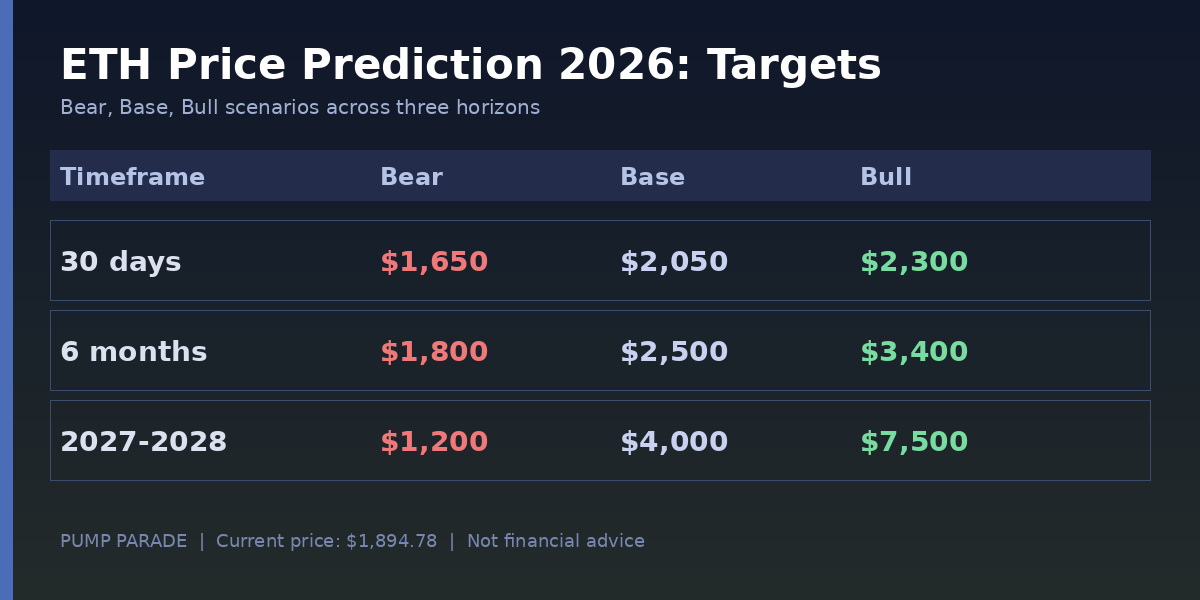
Bear: $1,650. Base: $2,050. Bull: $2,300. The Glamsterdam activation window is the dominant variable. A clean mainnet launch with fast finality metrics could catalyze a run at the $2,300 supply cliff. A delay or bug could send price back toward the $1,600-$1,700 accumulation zone that has held since April.
6-Month View (through Q1 2027)
Bear: $1,800. Base: $2,500. Bull: $3,400. This is the window where staking ETF flows compound. If BlackRock’s ETHB clears $2B in AUM and additional issuers launch, ETH could challenge the $2,500 psychological level and then $3,000. The bull scenario requires a broader risk-on tape plus a resolution of the ETH/BTC ratio downtrend.
Long-Term View (2027-2028)
Bear: $1,200. Base: $4,000. Bull: $7,500. The bear case is a sustained ETH/BTC decline where Ethereum becomes “the DeFi settlement layer” but loses the sound-money narrative entirely. The base case tracks Citigroup’s revised $3,175 target and adds a modest multiple for staking yield capitalization. The bull case aligns with Standard Chartered’s $7,500 revision and requires two things: successful modular-scaling execution and continued institutional inflows via staking ETFs. Bitget Research analyst Ryan Lee also sits in the $7,000 zone for 2026, per CryptoNews’ analyst roundup.
How Does Ethereum Compare to Solana in 2026?
The natural comparison in 2026 is ETH vs SOL. Both are L1 smart-contract platforms with real users and revenue. They occupy different corners of the market.
| Metric | Ethereum (ETH) | Solana (SOL) |
|---|---|---|
| Price | $1,894 | $75.82 |
| Market cap | ~$228B | ~$44B |
| Staking yield (gross) | 3.1% to 3.3% | ~6.5% to 7% |
| Spot ETF live? | Yes (with staking) | Yes (2025 launch) |
| Base-layer TPS | ~15 (L1); L2s hit 500+ | ~2,000-3,000 practical |
| Median fee | ~$0.50 (L1) | ~$0.001 |
| Primary narrative | Institutional settlement, staking yield | Consumer apps, memecoins, high-throughput DeFi |
ETH is the institutional pick. SOL is the retail-and-degen pick. Both can outperform in 2026 for different reasons, and portfolio construction rarely requires choosing one to the exclusion of the other.
What Would Change Our View on ETH?
Three explicit scenario triggers we’re watching.
Bullish flip: ETH holds a weekly close above $2,500 on rising ETF inflows and rising ETH/BTC ratio. That combination would signal a genuine trend change, not a relief rally.
Bearish flip: ETH breaks weekly close below $1,600 while spot ETF flows turn net negative for three consecutive weeks. That would put $1,200 to $1,400 in play and invalidate most 2026 bull cases.
Neutral consolidation: ETH chops between $1,700 and $2,200 into year-end. This is the most probable path if Glamsterdam ships cleanly but macro stays uncertain, and it’s what most option markets are pricing in.
Frequently Asked Questions
Will Ethereum reach $3,000 in 2026?
Possible but not the base case. Reaching $3,000 would require ETH to clear and hold $2,500 first, then absorb another leg of ETF inflows or a clean Glamsterdam catalyst. Citigroup’s 2026 target of $3,175 sits in this zone. FxPro’s target of $2,000 does not. Odds favor the range trade between now and Q1 2027.
Is Ethereum a good investment in 2026?
ETH remains a core infrastructure asset in DeFi, stablecoins, and tokenization, and staking now generates 3.1% to 3.3% gross yield. The counterpoint: ETH has underperformed BTC and SOL for most of 18 months, and past performance does not guarantee future results. Position sizing and time horizon matter more than the buy/sell binary.
What is the Ethereum Glamsterdam upgrade?
Glamsterdam is Ethereum’s next major hard fork, targeted for late August 2026. Its two headline features are EIP-7732 (Enshrined Proposer-Builder Separation) and EIP-7928 (Block-Level Access Lists), which together improve MEV decentralization and enable faster block validation. It also raises the network’s gas-limit floor to 200M.
How high can ETH go by end of 2026?
Analyst 2026 targets span from FxPro’s $2,000 to Standard Chartered’s revised $7,500. Our base case is $2,500 with bull scenarios extending to $3,400 by early 2027 if staking ETF flows compound and macro conditions cooperate.
Why is Ethereum down from its 2025 highs?
ETH is off roughly 53% from its August 2025 peak due to three factors: sustained ETH/BTC underperformance, gas-fee compression from L2 scaling that weakened the burn narrative, and institutional wait-and-see positioning ahead of Glamsterdam. None of these are structural breaks, but they explain the range.
Should I stake my ETH or buy the ETF?
Native staking yields more (3.1% to 3.3% gross) but requires 32 ETH for a solo validator or trust in a pooled provider like Lido or Coinbase. Staking ETFs from BlackRock (ETHB) and Grayscale (ETHE) yield less after fees (1.9% to 2.6% net) but sit inside a brokerage account with tax and custody simplicity. The right answer depends on account type, tax situation, and comfort with self-custody.
The Honest Take
Ethereum in mid-August 2026 is a coiled spring with a real bear case attached. The catalysts stack up: Glamsterdam is days away, staking ETFs are pulling in real money, and the staking ratio keeps compressing free float. The risks are also real: L2 fee compression, sustained BTC and SOL dominance, and any macro shock could reprice ETH lower fast.
The number to watch is $2,500. Reclaim it on a weekly close and the setup shifts from “range trade” to “trend continuation.” Fail it and $1,600 remains the last real support before the 2024 lows come back into view. For a research setup that could move quickly in either direction, that’s a reasonable place to sit and wait for the tape to confirm.
For related reading, see our Bitcoin price prediction and our take on Lido and the ETH staking economy.
Disclaimer: This article is for informational and educational purposes only and should not be construed as financial, investment, or trading advice. Cryptocurrency markets are highly volatile, and past performance does not guarantee future results. The price predictions and analyses presented here are based on AI models, technical indicators, and available data at the time of writing. They are not guarantees. Always conduct your own research (DYOR) and consult with a qualified financial advisor before making any investment decisions. Pump Parade and its authors do not assume liability for financial losses incurred based on information provided in this article.