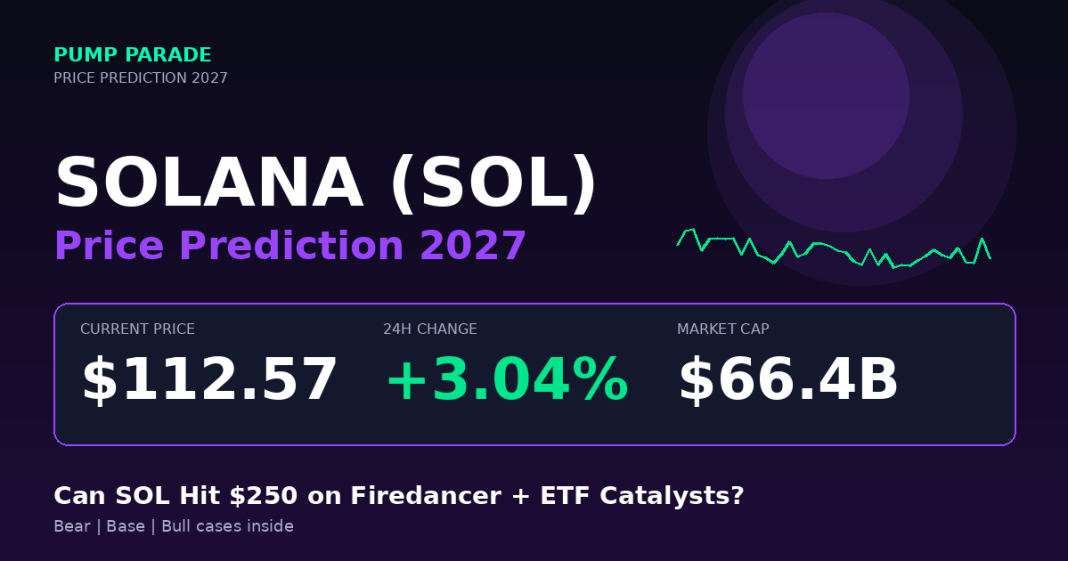
Solana (SOL) is trading at $112.57 at the time of writing, up 3.0% in 24 hours but still 61.6% below its January 2025 all-time high of $293.31. The chart has been grinding sideways, yet the fundamentals look increasingly out of step with the price. Two of the biggest validator upgrades in Solana’s history, Firedancer and Alpenglow, are already live or landing within quarters, and spot Solana ETFs just posted their strongest week since launch at $153 million in weekly inflows. Standard Chartered holds a $250 base case.
That is the backdrop for this Solana price prediction 2027 analysis. We pulled live Birdeye and CoinGecko data, mapped the real catalysts, and stress-tested the bull and bear cases against on-chain activity. The question most traders are actually searching: can SOL retake $200, and then $250, inside the next 12 to 18 months? Below are the targets by timeframe, the three catalysts that would get us there, the three risks that would not, and the levels we are watching.
Key Takeaways
- SOL today: $112.57, +3.0% in 24h, +10.8% over 30 days, 61.6% below ATH of $293.31.
- Base case for end of 2027: $250, aligned with Standard Chartered’s institutional target.
- Bull case: $400 if Firedancer client diversity, Alpenglow sub-second finality, and sustained ETF inflows all land.
- Bear case: A retest of $70 to $85 if ETF demand reverses and memecoin volume drops further.
- Biggest catalyst: Alpenglow mainnet, targeted Q3 2026, cuts finality from ~12.8 seconds to 100 to 150 ms.
- Biggest risk: SOL still correlates heavily with Bitcoin. A BTC drop below $70,000 drags it to the lower bound.
Where Does Solana Stand Today?
Before any forecast, the facts on the ground. The numbers below come from CoinGecko and Birdeye, pulled the morning this piece was written.
| Metric | Value |
|---|---|
| Price | $112.57 |
| 24h change | +3.04% |
| 7-day change | -7.31% |
| 30-day change | +10.81% |
| Market cap | $66.4 billion |
| 24h volume | $2.35 billion |
| Market cap rank | #7 |
| All-time high | $293.31 (Jan 2025) |
| % from ATH | -61.6% |
Rank seven means SOL is still a top-ten asset by every measure that matters: liquidity, market cap, and daily turnover. The 30-day change of +10.8% against a 7-day change of -7.3% tells you we had a strong month that gave back some gains, which is textbook consolidation inside a broader uptrend, not a top. For readers newer to Solana flow, our Photon vs BullX trading bot comparison is a primer on how fast money moves through the chain.
Why is Solana Range-Bound Right Now?
The chart is doing what it should after a 10x run from the 2023 lows: digesting. SOL ran from under $10 in late 2022 to $293 in January 2025, then spent most of 2026 oscillating between $90 and $160. On-chain activity has held up. Fee revenue is well above its 2023 base, Jupiter still routes more DEX volume on most days than any other aggregator in crypto, and Jito has grown liquid staking TVL past most comparables as a percentage of circulating supply.
What has not held up is the pure-degen flow. Memecoin launch volume on Pump.fun has fallen roughly 60% from the February 2025 peak, taking a chunk of chain revenue with it. Standard Chartered flagged this in their February 2026 note, calling the shift “memecoins to micropayments” and cutting their 2026 target to $250 from $350. Fewer traders paying $20 priority fees to snipe dog coins means the chain earns less per block.
Macro matters too. Bitcoin at $83,931 is off its highs, and SOL’s 90-day correlation with BTC sits in the 0.78 to 0.85 range. Until BTC decides where it is going, SOL will mostly follow.
The Bull Case: Three Catalysts That Could Push SOL to $250
1. Alpenglow and Firedancer deliver sub-second finality
This is the most underpriced catalyst in crypto right now. Alpenglow is a consensus rewrite that replaces Proof-of-History and TowerBFT with two components: Votor, which handles fast-finality consensus, and Rotor, which propagates data more efficiently. The Solana Foundation reports 98.27% of voting stake approved it in September 2025. Mainnet integration is targeted for Q3 2026, and the stated goal is cutting finality from roughly 12.8 seconds to between 100 and 150 milliseconds.
In plain terms: if Alpenglow ships cleanly, Solana becomes functionally real-time. Payments, order books, and the micropayment thesis Standard Chartered pivoted toward all become materially more viable. Pair that with Firedancer, Jump Crypto’s independent validator client that went live on mainnet in December 2025 and already attracts more than 20% of network stake, and you have real client diversity for the first time. That is a story institutions can underwrite.
2. Spot ETF inflows pass $5 billion AUM
Spot Solana ETFs went live on October 28, 2025. By end of August 2026, category AUM crossed $1.49 billion with Bitwise’s BSOL alone past $1 billion. The strongest week of 2026 produced $153 million in net inflows, and the single-day peak of $60.9 million was the third-highest since launch.
The pattern looks a lot like Ethereum ETFs in 2024: slow at first, then compounding as more RIAs added them to model portfolios. If Solana ETFs reach even half the AUM pace of ETH ETFs over a comparable window, we are looking at $4 to $6 billion by end of 2027. That is persistent, price-insensitive bid.
3. Real-world asset tokenization leans Solana
Solana already hosts roughly $863 million in tokenized real-world assets, including treasury products from Franklin Templeton, Hamilton Lane, and Ondo. The combination of sub-second finality post-Alpenglow and cents-per-transaction fees makes it the natural choice for anything that needs to settle quickly without eating a $5 gas tax. Solana is the leading non-Ethereum beneficiary of this trend.
The Bear Case: Three Risks That Could Push SOL Back to $70
1. ETF flows reverse
The ETF story cuts both ways. Spot Solana ETFs saw a surge in outflows during the April 2026 drawdown, and $100 million can leave in a week just as easily as it arrived. If BTC breaks $70,000 support and macro conditions tighten, expect SOL ETFs to see sustained outflows. In that scenario, $85 is realistic and $70 is on the table.
2. Alpenglow slips or ships with bugs
Jump Crypto originally targeted Firedancer for Q2 2024 and missed by roughly 18 months. Consensus rewrites are hard. If Alpenglow slips to 2027, the near-term bull narrative loses a leg. A buggy launch that triggers finality or liveness issues on mainnet would reopen the old “Solana is unreliable” critique. The chain has had seven outages since 2021, and institutional risk committees remember.
3. Competition from Ethereum L2s and new L1s
Base, Hyperliquid, Monad, and MegaETH are not sitting still. If a credible EVM-compatible chain hits the latency and cost profile Solana sells on, the “why not just use Ethereum” argument gets easier. For a flavor of how fast new L1 narratives can shift, see our Hyperliquid price prediction, which has eaten real share from Solana’s perps venues.
Solana Price Prediction 2027: Targets by Timeframe
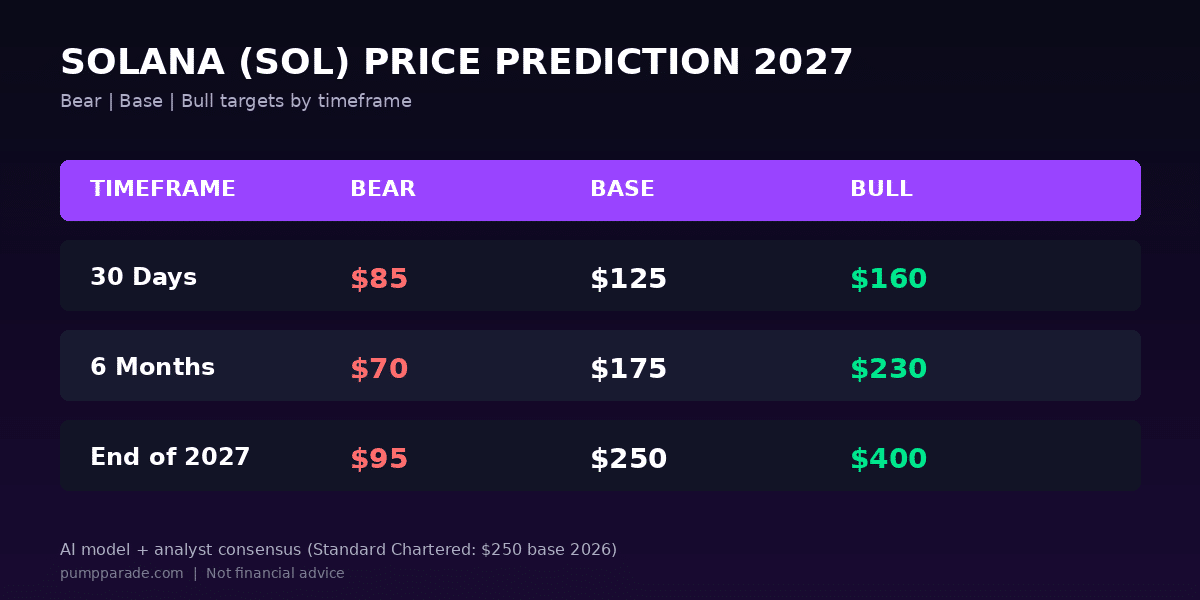
Here is how our hybrid AI model and analyst consensus map onto specific timeframes. The model weighs technical setups (RSI, moving averages, support/resistance), on-chain activity (fees, active addresses, TVL), and sentiment inputs from spot and derivatives flows.
Short-term: 30 days ($85 to $160)
SOL needs to reclaim $125 and hold it for the base case to activate. Below $100 opens a retest of the $85 structural support that held multiple times through 2026. A clean break above $140 on volume would set up a run at $160. Watch the daily close relative to the 50-day moving average near $118.
Medium-term: 6 months ($70 to $230)
This window spans the Alpenglow mainnet target. A successful Q3 2026 launch, combined with continued ETF inflows, maps to a base case of $175 by Q1 2027. The bull case of $230 would require ETF AUM crossing $3 billion and Bitcoin trading above $110,000. A delayed Alpenglow plus a BTC correction is the $70 bear path.
Long-term: End of 2027 ($95 to $400)
Our base case for year-end 2027 is $250, aligning with Standard Chartered’s target and marking a new ATH. The bull case of $400 requires three things: Alpenglow live and stable, ETF AUM past $5 billion, and SOL capturing a majority share of non-ETH stablecoin settlement. The bear case of $95 is a world where ETFs saw net outflows for 2027 and BTC spent the year under $75,000.
| Timeframe | Bear | Base | Bull |
|---|---|---|---|
| 30 days | $85 | $125 | $160 |
| 6 months | $70 | $175 | $230 |
| End of 2027 | $95 | $250 | $400 |
For context, Standard Chartered’s longer-horizon call is $500 by 2029 and $2,000 by decade’s end. Not a forecast we are stapling our name to, but a useful anchor for the upper tail.
How Does Solana Compare to Ethereum?
Any serious SOL analysis has to answer the “why not just use ETH” question. Here is the honest comparison on the metrics that drive long-term price.
| Metric | Solana (SOL) | Ethereum (ETH) |
|---|---|---|
| Price (today) | $112.57 | $2,563 |
| Market cap | $66.4B | $313.0B |
| Avg. tx cost | ~$0.0025 | ~$0.80 (L1) |
| Current finality | ~12.8 sec | ~13 min |
| Validator clients | 3 | 6+ |
| Spot ETF AUM | ~$1.49B | ~$18B+ |
| Staking yield | 6.5% to 7.5% | 3.0% to 3.5% |
Translation: SOL is faster and cheaper, ETH has more client diversity and bigger institutional base. The 2027 thesis is that Solana’s technical edge compounds while its decentralization catches up, closing the trust discount. For contrast on how other high-throughput L1s are getting repriced, our Avalanche price prediction covers a parallel ETF catalyst story.
What Would Change Our View?
Upside revision to $350 to $450: Alpenglow ships in Q3 2026 as planned, SOL ETFs cross $4 billion AUM by Q2 2027, and BTC breaks $120,000.
Downside revision to $65 to $95: Alpenglow slips past Q1 2027, a major chain outage returns, or ETF outflows exceed inflows for two consecutive quarters.
Pattern invalidation: A clean break of the $85 structural low on heavy volume ends the sideways consolidation thesis and opens a measured move to $55 to $60. We would need to see this with falling on-chain activity to put real weight on it.
Frequently Asked Questions
Is Solana a good investment in 2027?
Solana looks attractive relative to its 2024 to 2025 highs, with real catalysts (Alpenglow, Firedancer client diversity, growing ETF AUM) and an active developer ecosystem. SOL remains high-beta to Bitcoin and sensitive to macro, so position sizing matters. The probability favors upside over a 12 to 18-month window, but not without volatility.
Will Solana reach $250 by 2027?
Our base case is yes. Standard Chartered’s Geoff Kendrick holds $250 as his 2026 institutional target. The technical and on-chain picture supports it provided Alpenglow activates on schedule and ETF inflows continue averaging $30 million or more per week. A BTC drawdown below $70,000 is the main thing that would derail the target.
What is the Solana price prediction for 2027?
Our hybrid model indicates a bear case of $95, a base case of $250, and a bull case of $400 for end of 2027. The spread is wide because the Alpenglow outcome and macro conditions both have binary components. Track Alpenglow mainnet activation, weekly ETF flows, and the BTC trend as the signals that narrow the range.
What is Alpenglow and when does it launch?
Alpenglow is Solana’s biggest consensus upgrade since the chain launched. It replaces Proof-of-History and TowerBFT with Votor (fast-finality consensus) and Rotor (data propagation), targeting 100 to 150 millisecond finality versus the current roughly 12.8 seconds. Mainnet integration is targeted for Q3 2026, and 98.27% of voting stake has already approved it.
How does SOL staking yield compare to ETH?
SOL staking yields range from roughly 6.5% to 7.5% annually through validators or liquid staking protocols like Jito. ETH staking yields are closer to 3.0% to 3.5%. The higher SOL yield reflects both higher inflation and a smaller validator base, so it is not a free lunch, but it is a meaningful carry for long-term holders. For wallet options, see our Backpack vs Solflare comparison.
What are the biggest risks to the SOL bull case?
Three things: ETF outflows reversing the institutional bid, Alpenglow slipping or shipping with liveness issues, and credible competition from EVM-compatible chains like Monad or MegaETH. Any one alone is manageable. Two or more at the same time would reset the thesis.
The Honest Take
Here is the thing about Solana at $112: the market is pricing in a lot of execution risk that may not materialize. Alpenglow has 98% stake approval and a credible team behind it. Firedancer is live and growing stake share. The ETF bid is slower than SOL maxis expected, but it is building, and the Bitwise BSOL inflows have been impressive for a product that is barely a year old.
The bear case is also real. A chain outage or a buggy Alpenglow launch would hurt. ETF flows can reverse. BTC is not guaranteed to break out. And the memecoin revenue stream that padded 2024 earnings has shrunk, which means SOL has to grow into its valuation on actual utility (payments, DeFi, RWAs), not casino volume.
Our take: risk-reward favors a core position with staged entries between $85 and $115, scaling out above $200 and reconsidering below $80. That is a framework, not advice. The market owes us nothing, and anyone telling you SOL “will” hit any specific number is selling you something.
Disclaimer: This article is for informational and educational purposes only and should not be construed as financial, investment, or trading advice. Cryptocurrency markets are highly volatile, and past performance does not guarantee future results. The price predictions and analyses presented here are based on AI models, technical indicators, and available data at the time of writing, they are not guarantees. Always conduct your own research (DYOR) and consult with a qualified financial advisor before making any investment decisions. Pump Parade and its authors do not assume liability for financial losses incurred based on information provided in this article.