If you trade on Solana, the odds are high that your swap ends up routing through either Orca or Meteora. Together, they sit at the heart of Solana’s DEX stack, splitting billions in monthly volume and pulling in some of the deepest liquidity outside of Jupiter’s aggregation layer. But they take very different paths to get there, and that difference matters whether you’re a swap-and-forget trader or an LP hunting yield.
This is a head-to-head review of Orca and Meteora for 2026. We compare fees, liquidity models, LP experience, security, token economics, and the situations where one wins over the other. If you’re just here for the verdict, jump to the TL;DR below. Otherwise, keep reading for the full breakdown.
TL;DR: Quick Verdict
Winner for casual swappers: Orca. The cleanest UI on Solana, tight blue-chip pools, and a fee structure that’s easy to reason about.
Winner for LPs and memecoin traders: Meteora. Dynamic fees, automated bin management, and quote-only-fee support on volatile pools give it a real edge on memecoin duty.
Winner for total market share: Meteora. It’s regularly one of the top five DEXs globally by volume in 2026, powered by DLMM sitting under the memecoin firehose.
Winner for LP simplicity: Orca. Meteora rewards LPs who understand what they’re doing. Orca lets you deposit and mostly walk away, especially on stable and blue-chip pools.
Orca Overview
Orca launched in 2021 and quickly earned a reputation as the friendliest DEX on Solana. Its flagship product, Whirlpools, is a concentrated liquidity market maker (CLMM) modeled after Uniswap v3, but tuned for Solana’s fast, cheap execution. LPs pick a price range, deposit two tokens, and earn fees when the pool trades inside that range.
As of mid-2026, Orca sits at roughly $240M in total value locked according to DeFiLlama. Daily volume runs into the hundreds of millions on active days, and Orca hit $6.7B in 30-day volume in Q2 2026, briefly leading every Solana DEX by that metric. Fee tiers on Whirlpools range from 1 basis point on ultra-stable pools up to 200 basis points on long-tail pairs, set at pool deployment.
Orca’s design philosophy is best summarized as “boring wins.” Where other DEXs chase memecoin flow with exotic mechanisms, Orca sticks to a proven CLMM model, invests in UX polish, and lets Jupiter route memecoin volume through it when the price is right.
Meteora Overview
Meteora is a Solana-native liquidity layer built around three main products: DLMM (Dynamic Liquidity Market Maker), DAMM v2 (Dynamic AMM), and Dynamic Vaults. It’s the most experimental of the major Solana DEXs, and that experimentation has paid off during the 2024-2026 memecoin era.
DLMM uses a bin-based liquidity model similar in spirit to Trader Joe’s Liquidity Book on Avalanche, but with dynamic fees that scale with volatility. When a pool goes wild, LPs earn more per swap. When it’s calm, fees settle back down. A Q1 2026 upgrade added quote-only fees, which lets LPs on memecoin pools earn fees denominated purely in SOL or USDC rather than the speculative token, a genuine game-changer for LP survivability.
Total TVL across Meteora sits around $270M, with DLMM alone accounting for roughly $170M according to DeFiLlama. In peak volume weeks, Meteora regularly contributes 9-15% of total global DEX volume and cracks the global top five, which is remarkable for a protocol that’s Solana-only.
Liquidity Models: CLMM vs DLMM
The core technical difference between these two DEXs is how they park liquidity.
Orca’s Whirlpools use continuous concentrated liquidity. As an LP, you pick a min and max price. Your capital sits between those bounds and earns swap fees when the pool price trades through your range. Move outside the range and your position stops earning until price returns. It’s efficient, but it demands active management, especially on volatile pairs.
Meteora’s DLMM breaks liquidity into discrete price bins. Each bin holds liquidity at exactly one price. When someone swaps, they consume bins one at a time, moving through the price ladder. Meteora offers pre-built distribution strategies (Spot, Curve, Bid-Ask) so you don’t have to design a bin curve from scratch, and dynamic fees push the effective rate up during volatile moments to compensate LPs for impermanent loss.
In practice, this means:
- Blue-chip pairs (SOL/USDC, JitoSOL/SOL, mSOL/SOL): Orca and Meteora are close, but Orca’s clean 1bp and 5bp tiers plus deep liquidity tend to give it slightly tighter effective spreads.
- Volatile memecoin pairs: Meteora’s dynamic fees, quote-only fees, and bin flexibility usually win. LPs who’d get vaporized on Orca can actually survive on Meteora.
- Long-tail launches: Meteora’s DBC (Dynamic Bonding Curve) and launch tools give it a real edge for token teams, which drags trader volume there too.
Fees Breakdown
Orca Fees
Whirlpools has multiple fixed fee tiers set at pool creation. Common tiers are 0.01% (ultra-stable), 0.05% (stable), 0.30% (standard), and 1.00% (exotic). A pool creator can also deploy at 2.00% for very illiquid pairs. Of every fee dollar collected, roughly 87% goes to LPs, 12% to the Orca DAO treasury, and 1% to the Orca Climate Fund. Over a rolling 30-day window in mid-2026, Orca has been generating around $2M in fees, with a bit over $240K flowing to protocol revenue.
Meteora Fees
Meteora’s DLMM uses a base fee plus a variable fee component. The variable fee grows with volatility, so during frantic memecoin moves an LP might see 2-4% effective fees on individual swaps. During calm periods it drops back to the base tier. Dynamic vaults and DAMM v2 pools use different mechanics, but the principle is the same: fees flex with market conditions. In May 2025 Meteora briefly generated over $5M in daily fees, exceeding the Solana base layer itself, giving you a sense of how much throughput this thing handles when memecoins go parabolic.
Fees for Traders
If you’re swapping through Jupiter (which routes through both), the fee is embedded in the swap and you rarely notice which DEX filled you. If you swap directly on either site, expect roughly 0.30% on standard pools, less on stables, and more on volatile pairs. Meteora’s dynamic fees can spike during high-volatility windows, which is a feature for LPs and a mild annoyance for traders.
LP Experience
This is where these two DEXs really diverge.
Orca’s LP flow is one of the cleanest in DeFi. Pick a pool, pick a range, deposit. The UI shows you your projected APR based on recent fees, and pool analytics are surfaced clearly. There’s no automated range management inside Orca itself, though third parties like Kamino and Meteora’s own vaults have historically automated Orca LP positions.
Meteora’s LP flow is more powerful and more complex. You choose a strategy shape (Spot for uniform coverage, Curve for tight-around-price, Bid-Ask for wide edge coverage), pick your bin range, and deposit. Dynamic vaults abstract this away by auto-managing bins for you, and DAMM v2 pools work like a more traditional AMM if you want to skip the bin decisions entirely.
A useful mental model: if you’re LPing SOL/USDC and want to set-and-forget, Orca is fine. If you’re LPing a memecoin and want to survive the first 48 hours after launch, Meteora’s dynamic fees and quote-only fees are the more honest choice.
Security & Trust
Both protocols have long track records at this point. Orca has been live since 2021 with no serious exploit on the core Whirlpools contracts. It has been audited by multiple firms including Kudelski Security and Neodyme, and its code is open source. The team is public, based partly out of the US, and its governance token ORCA has been trading since the earliest days of the protocol.
Meteora has been audited by OtterSec, Sec3, and Offside Labs across its DLMM, DAMM v2, and vault contracts. It has also operated without a major exploit, though DLMM as a mechanism is younger than Orca’s CLMM approach. Meteora’s MET token launched in 2026 after a long anticipated distribution to LPs and users, which added a governance and value-accrual layer that Meteora lacked in its first two years.
Neither protocol takes custody of funds. Both are non-custodial AMMs where you interact from your own wallet, so your keys and your wallet security matter more than the DEX itself.
User Experience
Orca is regularly cited as the most user-friendly DEX on Solana. Its UI is clean, its swap page is fast, and the LP dashboard is arguably the best pool analytics view in the ecosystem. There is no dedicated Orca mobile app, but the site works well on mobile browsers.
Meteora’s UI is more powerful and more busy. The DLMM pool page in particular can feel overwhelming for a first-timer because it exposes so much of the mechanism. Once you get used to it, the level of control is a genuine advantage. Meteora also has strong integration with Jupiter, so a huge fraction of its volume comes through Jupiter’s aggregator rather than Meteora’s own UI.
Token & Governance
ORCA has been live since 2021 and is the governance token for the Orca DAO. It captures roughly 12% of pool fees to the DAO treasury, and holders vote on protocol parameters. Circulating supply, treasury policy, and fee direction have been the main subjects of governance since launch. You can read more about ORCA’s value accrual in our Orca price prediction analysis.
MET launched in 2026 and gives Meteora holders a claim on protocol revenue and governance rights across DLMM, DAMM v2, and vaults. The launch itself was a long-running community topic during 2024-2025, with a large portion of supply routed to LPs and community members who’d supported the protocol during its formative years.
Head-to-Head Comparison
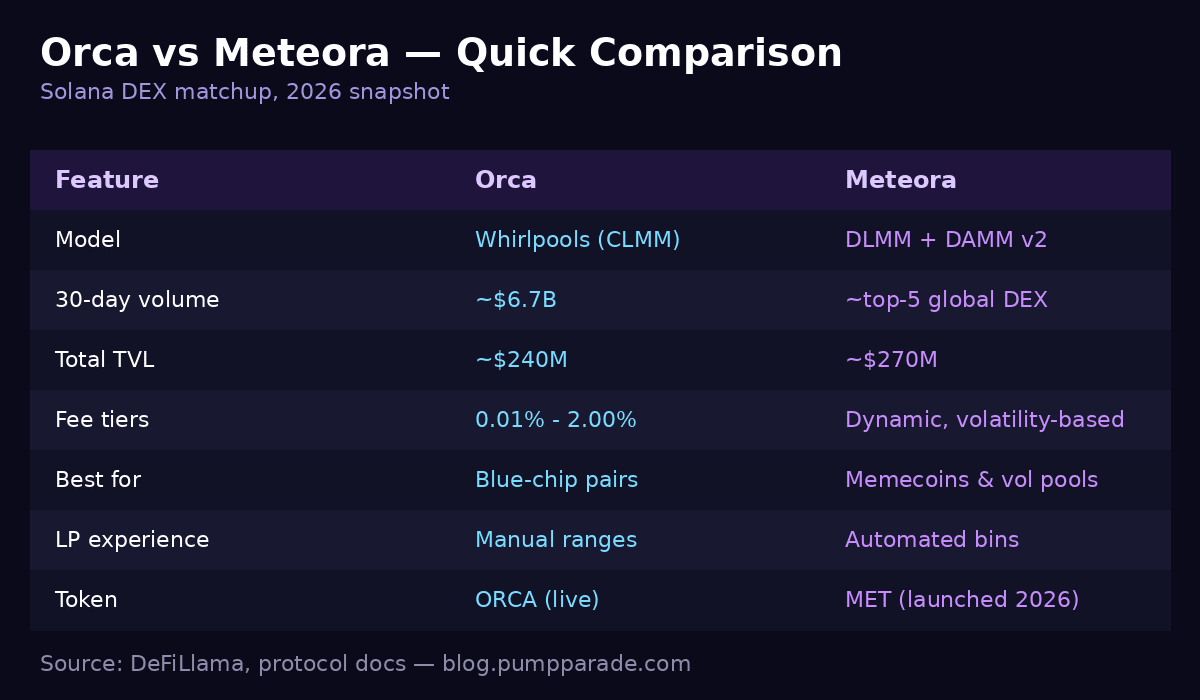
Here’s the quick side-by-side, updated for mid-2026:
Pros & Cons
Orca Pros
- Cleanest UI on Solana, minimal learning curve
- Predictable, fixed-tier fee model
- Deep liquidity on blue-chip pairs, tight spreads
- Long track record with no core exploit
- Active DAO with real fee accrual to ORCA
Orca Cons
- Manual LP range management is a real burden on volatile pairs
- Loses share to Meteora on memecoin volume
- No native automated range management inside the protocol
- TVL has been flat-to-down relative to peak
Meteora Pros
- Dynamic fees compensate LPs during volatile moves
- Quote-only fees are a genuine innovation for memecoin LPs
- Top-five DEX globally by volume in peak weeks
- Full stack: DLMM, DAMM v2, Dynamic Vaults, DBC for launches
- Strong Jupiter integration drives sustained flow
Meteora Cons
- Steeper learning curve for first-time LPs
- DLMM is newer than Orca’s CLMM approach
- UI can feel overwhelming, especially the pool page
- MET is fresh, so long-run value accrual is still being proven
Which Should You Use?
Use Orca if: You want the smoothest swap experience on Solana, you’re LPing blue-chip pairs (SOL/USDC, staked SOL pairs, majors), you value predictable fee tiers, and you don’t want to babysit LP positions.
Use Meteora if: You’re LPing memecoins or volatile pairs, you want dynamic fees that reward you during vol spikes, you’re building or launching a token and want native launch tools, or you value protocol optionality (DLMM + DAMM v2 + Vaults) in one place.
Use both: Honestly, most Solana traders end up interacting with both DEXs regularly, usually via Jupiter aggregation. If you’re serious about DeFi on Solana, understanding how both work makes you a better trader and a better LP.
FAQ
Is Meteora better than Orca?
Neither is universally better. Meteora wins for memecoin LPs and total volume. Orca wins for casual swaps, blue-chip LP positions, and UI simplicity.
Which has lower fees for traders?
Both are competitive. Orca is more predictable with fixed tiers (as low as 0.01%). Meteora’s dynamic fees can be lower during calm periods and higher during volatile ones.
Can I use both through Jupiter?
Yes. Jupiter routes through both Orca and Meteora automatically and picks whichever gives the best fill. That’s the setup we recommend for most swappers.
Is LPing on Meteora risky?
LPing on any AMM carries impermanent loss risk. Meteora’s dynamic fees and quote-only fees reduce that risk on volatile pools, but they don’t eliminate it. Understand the mechanism before you deposit.
Does Orca have a mobile app?
No dedicated app, but the site works on mobile browsers. Most Solana wallet apps embed a swap tab that routes through Orca via Jupiter anyway.
Final Verdict: Orca and Meteora are two of the best-built protocols in Solana DeFi, and they solve different problems. Orca is the cleanest, most beginner-friendly DEX on the chain. Meteora is the most innovative, especially for LPs willing to think in bins. Pick the one that matches your trading style, or use both through Jupiter and let the aggregator sort it out.
This article is for informational purposes only and is not financial advice. DeFi carries smart contract risk, impermanent loss risk, and market risk. Do your own research before providing liquidity or trading on-chain.