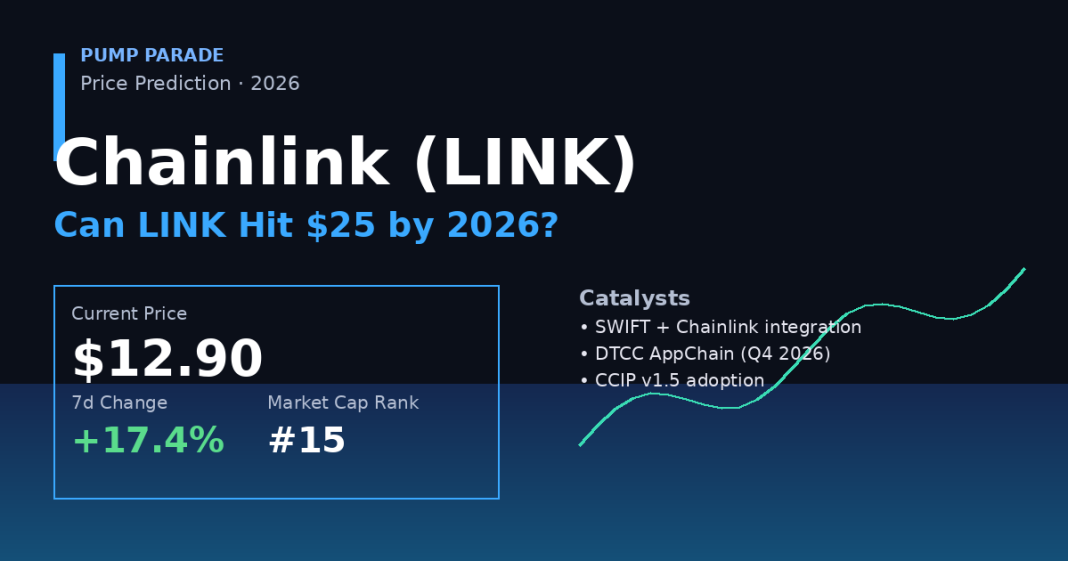
Chainlink (LINK) trades at $12.90 today, up 17% over the past week and back on every institutional-adoption watchlist in crypto. The Chainlink price prediction 2026 question is not really about charts anymore. It is about whether SWIFT, DTCC, UBS, and the rest of the plumbing-layer institutions actually route tokenized value through Chainlink’s oracles and CCIP rails in production, not just pilots.
Here is what the data says, what the catalysts look like, and where LINK could realistically land 30 days, 6 months, and 2 years out.
Key Takeaways
- LINK sits at $12.90, ranked #15 by market cap, with a $9.65B valuation and 76% below its 2021 all-time high of $52.70.
- The DTCC Tokenization Service launches in October 2026, and the DTCC Collateral AppChain (built on Chainlink CRE) targets Q4 2026.
- SWIFT and Chainlink completed a landmark tokenized-bond settlement in January 2026 with UBS Asset Management.
- Base case for end of 2026: $18. Bull case: $25. Bear case: $8 if oracle demand stagnates.
- The biggest single risk is not competition. It is that institutional pilots stay pilots and never produce real fee flow.
Where Chainlink Stands Today
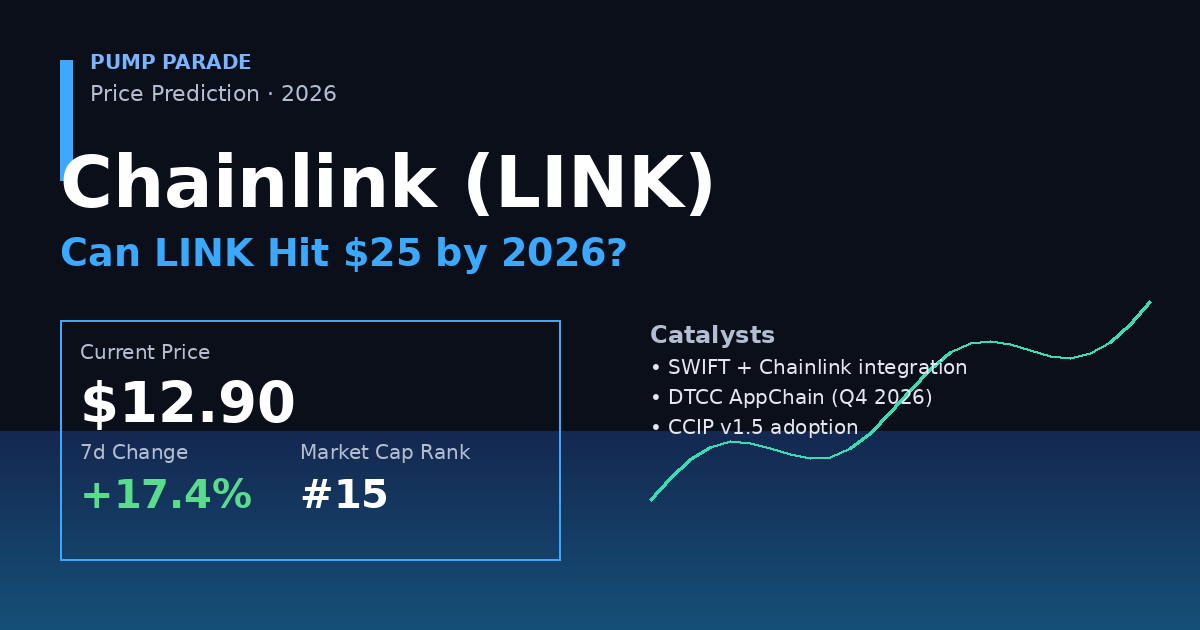
Before any prediction, a snapshot of the state of play. All figures below are from CoinGecko as of September 22, 2026.
| Metric | Value |
|---|---|
| Price (USD) | $12.90 |
| 24-hour change | -1.96% |
| 7-day change | +17.44% |
| 30-day change | +12.13% |
| Market cap | $9.65B |
| 24-hour volume | $580M |
| Market cap rank | #15 |
| All-time high | $52.70 (May 2021) |
| % from ATH | -75.5% |
| Circulating supply | 748M LINK |
| Max supply | 1B LINK |
Two numbers matter most here. First, LINK is still down more than 75% from its 2021 peak, so a “return to ATH” thesis is a 4x call, not a moonshot. Second, the 17% weekly move happened on rising volume, not a low-liquidity squeeze. That usually signals real bid.
Why is Chainlink rallying right now?
The catalyst set is unusually concrete for a crypto rally. In July 2026, the DTCC announced it had successfully converted assets held at The Depository Trust Company into tokens used in real production trades. That was described as the largest tokenization production initiative to date. The follow-on DTCC Tokenization Service is scheduled to launch in October 2026, with the DTCC Collateral AppChain (using Chainlink’s CRE technology) targeted for Q4 2026.
On the payments side, SWIFT completed a landmark interoperability milestone with Chainlink and UBS Asset Management in January 2026, settling tokenized bonds with payments in both fiat and stablecoin rails, including Société Générale’s EURCV. That is not a research paper. That is a production trade.
Traders read those two threads as a signal that Chainlink is becoming the default oracle and cross-chain layer for regulated tokenization. The price is starting to reflect that read. Whether it holds depends on whether pilot volume converts into recurring fee flow.
The Bull Case for LINK
1. CCIP becomes the tokenization rail
CCIP v1.5 launched on mainnet in January 2025 with self-serve token integration and now supports Solana and other high-throughput chains. If tokenized real-world assets scale from single-digit billions to hundreds of billions in value locked, and CCIP captures even a small share of that transfer volume, the fee accrual to LINK is material. Analyst desks including Coingape have flagged CCIP volume as the single cleanest bull signal for LINK.
2. Institutional staking and LINK Staking ETP
A LINK Staking ETP in European or Asian markets would open a compliant on-ramp for pensions, family offices, and asset managers that cannot custody native tokens directly. That kind of vehicle historically pulls billions in AUM within the first 12 months of listing, based on how Ethereum staking products behaved after their launch. Even a modest inflow relative to Ethereum’s ETP would reprice LINK.
3. Corporate actions and asset-servicing standard
Chainlink and 24 of the world’s largest financial institutions (SWIFT, DTCC, Euroclear, SIX, UBS, Wellington Management) are working on a production-grade corporate-actions processing system. If that becomes the de facto standard for reference data across tokenized securities, Chainlink stops being “an oracle project” and starts being financial-market infrastructure. The valuation math changes at that point.
The Bear Case for LINK
1. Pilots that never become products
The most common outcome for enterprise blockchain pilots between 2016 and 2023 was quiet abandonment. Every SWIFT press release could still land in that graveyard. If 2027 arrives with impressive announcements but negligible CCIP fee volume, LINK reverts to trading as a beta play on ETH, and $8 is on the table.
2. Competing oracle and interoperability stacks
Chainlink is not the only oracle. Pyth Network has captured meaningful share in low-latency DeFi price feeds, and LayerZero, Wormhole, and Axelar all compete on the cross-chain messaging side. If one of those becomes the preferred rail for a major institutional deployment, Chainlink’s moat looks narrower.
3. LINK tokenomics and unlock overhang
Roughly 25% of LINK supply is still uncirculated. Even without a fixed unlock cliff, historical distributions from the non-circulating pool have periodically pressured price. A shift in that pattern, or a large ecosystem grant, can create real sell pressure independent of fundamentals.
Chainlink Price Prediction 2026: Targets by Timeframe
30-day outlook (October 2026)
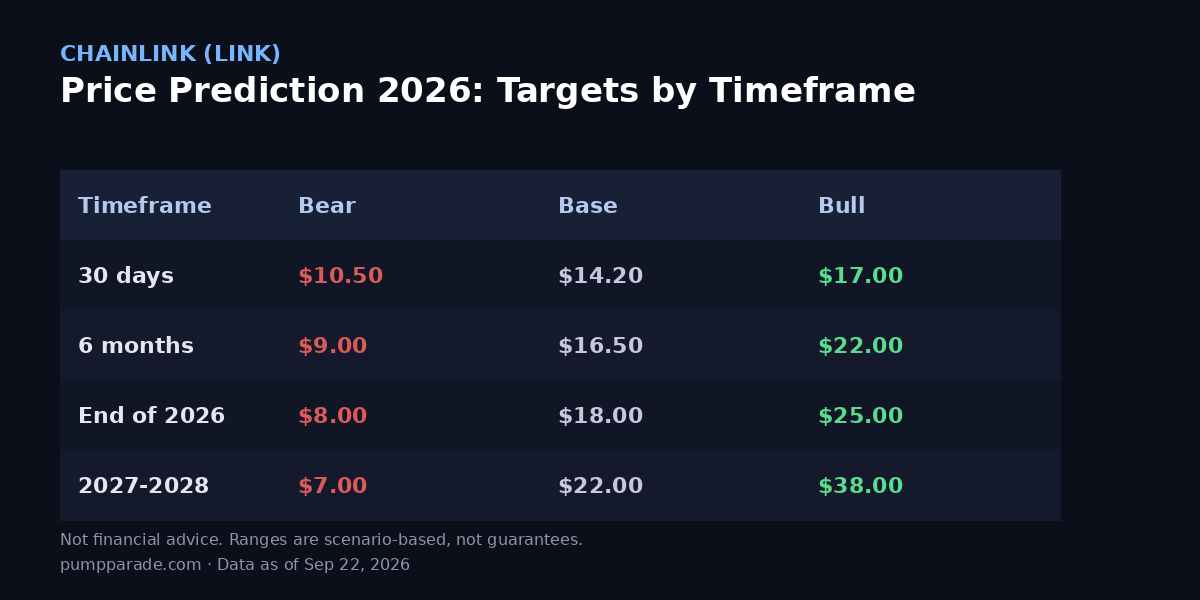
The October DTCC Tokenization Service launch is a scheduled event risk in both directions. A clean production launch with named participants likely pushes LINK toward $17. A delayed or watered-down launch, combined with any broad crypto risk-off move, drops LINK back to the $10.50 area. Base case: $14.20.
6-month outlook (Q1 2027)
Six months out gives room for the Collateral AppChain to reveal early volume data. If CCIP messages per week are trending up meaningfully, LINK can trade to $22. If pilots are still headline-only, $9 is the fade zone. Base: $16.50.
End of 2026
Our base case for December 2026 is $18. That assumes CCIP volume rises modestly, DTCC ships on time, and macro conditions stay neutral. Bull case is $25, which requires a genuine tokenization inflection plus altcoin risk-on. Bear case is $8. For comparison, Changelly models a 2026 range of roughly $22 to $51 with a $38 average, while Coinbase’s mechanical 5% growth model lands near $12.50. The truth is almost certainly somewhere between those two extremes.
2027 to 2028
Longer term, we model a $7 bear, $22 base, and $38 bull. The bull case does not require LINK to become a top-five asset. It requires tokenized RWA volume to move from pilot scale to production scale, and for a non-trivial share of that flow to touch Chainlink infrastructure.
How does Chainlink compare to Pyth Network?
Pyth Network is the most common comparison because both projects sell price data as a product. The two stacks approach the problem very differently.
| Metric | Chainlink (LINK) | Pyth Network (PYTH) |
|---|---|---|
| Market cap | $9.65B | ~$1.1B |
| Live blockchains supported | 60+ | 90+ |
| Primary use case | General-purpose oracle, CCIP, PoR | Low-latency price feeds for perps |
| Institutional partners | SWIFT, DTCC, Euroclear, UBS | Cboe, Jump, Wintermute |
| Cross-chain product | CCIP (production) | Pyth Express Relay |
| Enterprise revenue model | Node fees + CCIP fees | Publisher-subsidized, fee model evolving |
| Token unlock overhang | Moderate (25% not circulating) | High (large unlocks through 2027) |
| Best case for the token | Institutional tokenization rail | Default price layer for on-chain derivatives |
Chainlink wins on institutional integration depth. Pyth wins on speed and DeFi-native traction. They are not truly zero-sum, which is why both can coexist. But for a Chainlink price prediction 2026 model specifically, the SWIFT and DTCC work matters more than the DeFi oracle share war.
What Would Change Our View
Three specific triggers would move us off the $18 base case. First, CCIP weekly message volume printing a durable 3x increase within two quarters. That would be evidence that pilots are converting. Second, a delay or scope reduction in the DTCC AppChain launch beyond Q1 2027. That would push our 2026 target down toward the $12 area. Third, a US spot LINK ETP filing from a top-five issuer. That single event historically re-rates an asset by 20% to 40%.
If you want to model this yourself, our Ethereum Price Prediction 2026 post walks through a similar scenario framework, and our Ondo Finance 2026 outlook covers the tokenized-RWA side of the same thesis from a different angle. For the DeFi read-across, see our Uniswap fee-switch analysis.
Is Chainlink a good investment in 2026?
Chainlink has the strongest institutional-adoption narrative of any layer-1-agnostic crypto asset. If you believe tokenization is the actual real-world use case for public blockchains, LINK is one of the cleanest ways to express that view. If you think tokenization stays a slide-deck word for another 24 months, LINK is a slow-bleed altcoin with a decent floor. Both views are defensible on the current data.
Will Chainlink reach $25 in 2026?
Reaching $25 in 2026 is our bull case, not our base case. It requires broad CCIP adoption, live volume from the DTCC AppChain, and a friendly macro tape. Our base case sits closer to $18. Bear scenarios put LINK back near $8 if oracle usage stalls.
Is Chainlink a good investment in 2026?
Chainlink has the deepest institutional integration story in crypto, with active work involving SWIFT, DTCC, UBS, and Euroclear. That is bullish long term. Short term, LINK still trades like a beta play on altcoin risk. Position size accordingly, and treat any target as a range, not a promise.
What is the Chainlink price prediction for 2027?
Analyst ranges for 2027 span $9 to $65, which tells you nobody really knows. Our own scenario range is $7 (bear) to $38 (bull), with a base near $22. The wildcard is whether tokenized real-world assets scale from pilot volume to trillion-dollar flow.
Why did Chainlink jump this week?
LINK is up roughly 17% over the last seven days on renewed tokenization headlines and broad altcoin bid. The DTCC Tokenization Service is scheduled to launch in October 2026, and the DTCC Collateral AppChain, which uses Chainlink CRE, is targeted for Q4 2026.
How does Chainlink make money?
Chainlink is not a company with revenue in the traditional sense. Node operators earn LINK for delivering data and running services. Enterprise clients pay for CCIP, Proof of Reserve, and Data Streams, often in LINK or stablecoins. That fee flow is what long-term bulls point to when they model value.
What is Chainlink CCIP?
CCIP, or Cross-Chain Interoperability Protocol, is Chainlink’s messaging and token-transfer layer that lets different blockchains talk to each other securely. Version 1.5 shipped in early 2025 with self-serve token integration. It now supports Solana, and it is the rail SWIFT and DTCC are testing for cross-chain settlement.
The Honest Take
Chainlink is not the token that returns 50x in a cycle. It is the one that quietly compounds if the institutional-tokenization thesis actually plays out. The setup is fair: real catalysts are dated on the calendar, price sits well off its highs, and the fundamental story is not a meme. What is missing is proof, in the form of weekly CCIP fee flow and real production volume on DTCC and SWIFT rails.
Disclaimer
This article is for informational and educational purposes only and should not be construed as financial, investment, or trading advice. Cryptocurrency markets are highly volatile, and past performance does not guarantee future results. The price predictions and analyses presented here are based on AI models, technical indicators, and available data at the time of writing. They are not guarantees. Always conduct your own research (DYOR) and consult with a qualified financial advisor before making any investment decisions. Pump Parade and its authors do not assume liability for financial losses incurred based on information provided in this article.