
Looking for the safest, deepest lending pool in DeFi? Aave has been the answer for most of the last five years, and in 2026 it is still the biggest lending protocol in crypto by a wide margin. With $17.2 billion in net TVL, $29.4 billion supplied across 21 chains, and a fresh V3 stack that finally makes cross-chain borrows feel native, Aave is where serious DeFi capital parks itself. But is it the right home for your capital in 2026, or are leaner, faster, higher-yield competitors quietly eating its lunch? This review breaks down fees, features, security, UX, and where Aave still wins versus where it is starting to lose ground.
Quick verdict: is Aave worth using in 2026?
Overall rating: 4.6 / 5. Aave is the default choice for anyone who values battle-tested security and deep liquidity over squeezing out the last basis point of yield. Suppliers get 3-9% on stablecoins depending on the chain, borrowers get some of the tightest interest rate curves in DeFi, and the protocol has never suffered a smart-contract exploit in its main markets. The main knocks: Ethereum gas is still painful for smaller users, and newer protocols like Morpho and Fluid offer meaningfully better rates on some pairs. If you have five figures or more to deploy and prioritize safety, Aave is still the winner. If you are farming with smaller size and chasing max APY, you should at least compare it against alternatives.
What is Aave?
Aave is a decentralized lending and borrowing protocol that lets users supply crypto assets to earn yield or borrow against those assets as collateral. It launched in January 2020 as a rebrand of ETHLend, and quickly became the largest money market in DeFi. In 2026 the protocol runs on 21 chains including Ethereum, Base, Arbitrum, Optimism, Polygon, Avalanche, Sonic, Plasma, Monad, and MegaETH, with Ethereum still hosting roughly 84% of total value locked.
The current version is Aave V3, which introduced isolation mode, efficiency mode (E-Mode), risk-adjusted borrow caps, and Portal, the cross-chain liquidity feature. Aave V4 is on the horizon with a unified liquidity layer and a new “Hub and Spoke” architecture, but V3 is what most users touch today.
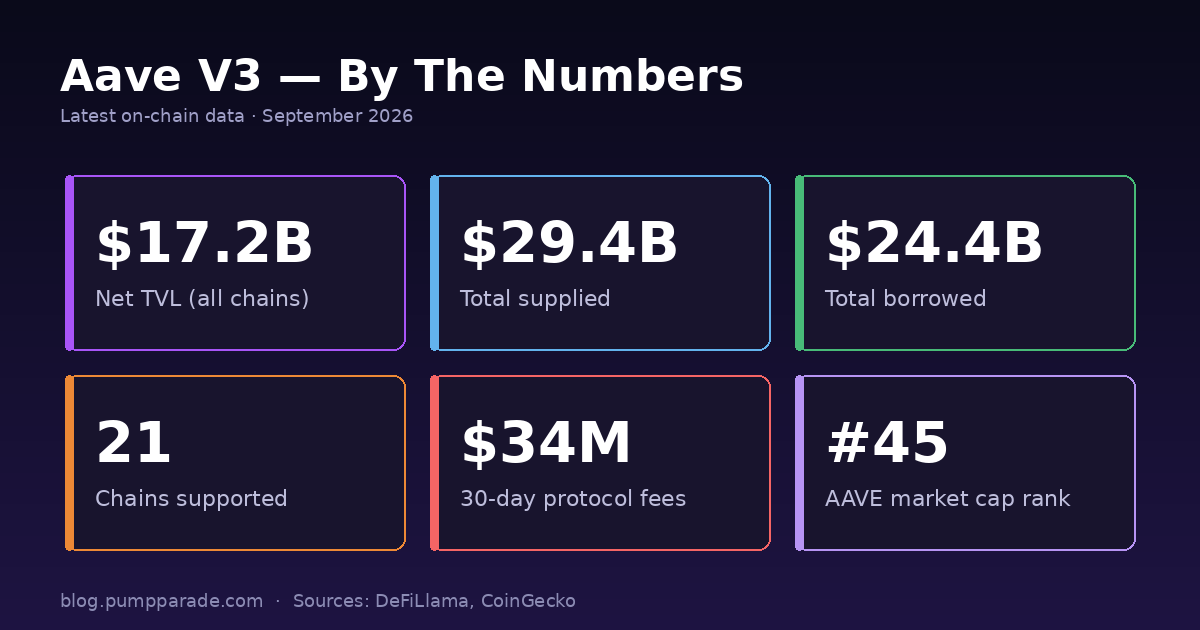
Aave by the numbers (September 2026)
- Net TVL: $17.2 billion
- Total supplied: $29.4 billion
- Total borrowed: $24.4 billion
- Chains live: 21 (Ethereum still hosts $14.5B)
- 30-day protocol fees: $34 million
- All-time protocol fees: $1.83 billion
- AAVE token price: $127.54
- AAVE market cap: $1.97 billion (rank #45)
Data as of September 2026, per DeFiLlama and CoinGecko.
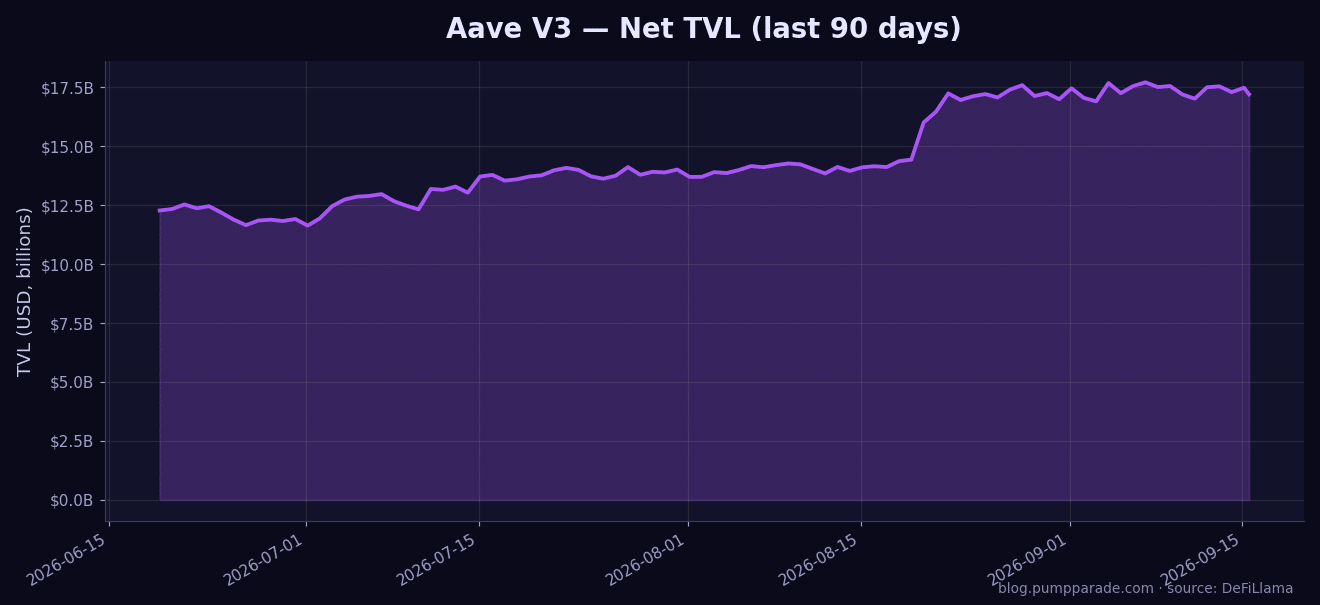
How Aave actually works
Aave is what DeFi people call an “overcollateralized money market.” You deposit an asset (say, ETH), the protocol issues you an interest-bearing aToken 1:1 (aETH), and you can then borrow another asset up to a percentage of your collateral value. Rates are algorithmic: they rise when utilization is high (lots of borrowing demand) and fall when utilization is low (lots of idle supply).
Three features distinguish Aave from generic forks:
- E-Mode (Efficiency Mode): When your collateral and borrowed asset are correlated (e.g. stablecoin-to-stablecoin, or ETH-to-LST), you can borrow up to 93% of collateral value instead of the standard 75-80%. This is the biggest reason yield strategies still route through Aave.
- Isolation Mode: New, riskier assets get listed with strict debt ceilings and can only be used to borrow specific stablecoins. This lets Aave onboard long-tail collateral without threatening the whole protocol.
- GHO: Aave’s native overcollateralized stablecoin. Borrowers can mint GHO against their Aave collateral at a discount if they stake AAVE, and 100% of the interest goes to the DAO treasury. GHO’s circulating supply is now over $250 million.
Fees and pricing: what you actually pay
Aave itself does not charge a deposit or withdrawal fee. The economics come from the spread between supply APY and borrow APY, which the protocol keeps as reserve factor revenue.
Representative rates from the Ethereum V3 market in September 2026:
- USDC: supply ~4.1%, borrow ~5.3% (variable)
- USDT: supply ~4.3%, borrow ~5.6%
- DAI: supply ~3.9%, borrow ~5.1%
- ETH: supply ~1.8%, borrow ~2.7%
- wstETH: supply ~0.4% (yield is in the LST itself), borrow ~0.5% in E-Mode
- WBTC: supply ~0.3%, borrow ~1.5%
Aave also charges a flash loan fee of 0.05% (5 basis points), which is the cheapest flash loan fee among major money markets. Liquidations carry a 5-10% bonus paid to the liquidator, and if you get liquidated on Ethereum V3 you also owe a 4-9% liquidation protocol fee.
The real cost most users forget: gas. A supply on Ethereum V3 currently runs $8-25 depending on network conditions. On Base or Arbitrum, the same transaction costs under $0.20. For anything under $10,000, use an L2.
Security and trust
Aave is the closest thing DeFi has to a blue chip. Track record highlights:
- Live since January 2020, over six years without a smart-contract exploit in its core markets.
- Audited by Certora, OpenZeppelin, Trail of Bits, ABDK Consulting, and Peckshield, with two audits listed on DeFiLlama.
- Formal verification via Certora on the V3 codebase.
- Aave Safety Module: over $400M of staked AAVE and stkGHO acting as a first-loss backstop for the protocol.
- The one meaningful incident was a bad debt situation in November 2022 involving CRV, which was ultimately absorbed by the treasury without user losses.
The DAO governance process is one of the most active in DeFi, with Aave Companies (formerly Aave Labs, now BGD Labs) handling core dev and dozens of external contributors running risk, growth, and integrations.
User experience: how it feels to actually use
The Aave app is one of the cleanest UIs in DeFi. Connect a wallet, pick a market (Ethereum, Base, Arbitrum, etc.), and you see all supply and borrow options in a single dashboard with your health factor prominently displayed. Health factor above 1.0 means you are safe from liquidation; drop below 1.0 and any liquidator can close a portion of your position.
Small quality-of-life wins that matter:
- One-click “supply and enable as collateral” flow.
- Built-in swap and collateral-swap features (routed through Paraswap) so you can rebalance without leaving the app.
- E-Mode is a single toggle, and the app clearly warns you which assets are eligible.
- Mobile web works fine, and there is a well-reviewed Aave Wallet mobile app for iOS and Android that includes native lending and borrowing.
What still frustrates:
- Cross-chain positions are shown per market. There is no single unified dashboard yet showing all your positions across all 21 chains. V4 is supposed to fix this.
- Transaction previews on Ethereum still surprise users with $15+ gas costs when the app said “estimated $3.”
- Some newer L2s show stale rate data for a few minutes after big rate changes.
Pros
- Largest and deepest lending pool in DeFi. You can borrow $50M+ on Ethereum without moving the rate meaningfully.
- Six-year unblemished security record on the main markets.
- 21 chains supported, with real liquidity on Base, Arbitrum, and Optimism (not just an empty deployment).
- E-Mode gives you 93% LTV on correlated pairs, one of the best capital efficiencies in DeFi.
- Cheapest flash loans in the market (5 bps).
- GHO stablecoin adds a native, capped-supply borrowing option.
- Active, credible DAO governance with real accountability.
Cons
- Rates are often 20-80 basis points lower than Morpho or Fluid for suppliers on the same pairs, because those protocols route directly to peers.
- Ethereum gas costs still make small deposits (~$500 or less) economically silly.
- AAVE token has weak direct value accrual today. Most protocol fees still go to the DAO treasury rather than back to token holders, though the “Aavenomics” upgrade is meant to change this.
- The interface is dense; new users can find the health factor and liquidation mechanics intimidating.
- Cross-chain UX is still fragmented; V4 is not live yet.
Aave vs the competition
The lending space has fragmented since 2023. Here is where Aave stands against its biggest 2026 competitors:
- vs Morpho: Morpho routes lenders and borrowers peer-to-peer and often beats Aave rates by 30-70 bps. But Morpho depends on Aave-style pools as backstops, and TVL is under $6B versus Aave’s $17B. Aave wins on depth and pedigree; Morpho wins on rates.
- vs Compound: Compound V3 is smaller (~$2B TVL), simpler, and USDC-only per market. If you only want to borrow USDC against ETH, Compound is fine. For anything else, Aave has more assets and better rates.
- vs Fluid: Fluid (from the Instadapp team) is the fastest-growing lending challenger with a unified vault design that offers higher LTV and better rates on ETH pairs. It is a real threat to Aave on Ethereum, but has minimal cross-chain presence.
- vs Solana-native protocols (Kamino, marginfi, Drift): If you live on Solana, these are cheaper and faster. Aave has no Solana deployment. See our Kamino vs marginfi review for the Solana side.
Who should use Aave?
Use Aave if: you have $10K+ to deploy, you want max security, you need deep liquidity for large borrows, you want to leverage LSTs or LRTs via E-Mode, or you want to mint GHO. It is also the best choice if you plan to use flash loans, since they are cheapest here.
Skip Aave if: you are farming under $1,000 on Ethereum (gas eats you alive, use an L2), you want the absolute best rate on a specific stablecoin pair (check Morpho), or you are Solana-native (use Kamino or marginfi).
Verdict
Aave in 2026 is what “boring” looks like in DeFi, and boring is a compliment. The rates are not always the highest, but they are consistent, the liquidity is real, and the code has held up through five years of exploits that took down almost every competitor at some point. For most users with meaningful capital, Aave should be your first stop and probably your last. Just deploy on an L2 unless your position is large enough to justify Ethereum gas.
Final rating: 4.6 / 5.
Visit Aave · Curious where the AAVE token itself is headed? Read our AAVE price prediction for 2026.
FAQ
Is Aave safe to use in 2026?
Aave has one of the strongest security track records in DeFi, with no smart-contract exploits in its core markets since launching in 2020. Multiple audits from Certora, OpenZeppelin, and Trail of Bits, formal verification, and a $400M+ Safety Module backstop the protocol. No lending protocol is risk-free, but Aave is as close as DeFi gets.
What is the minimum deposit on Aave?
There is no protocol-level minimum, but on Ethereum you should have at least $1,000-$5,000 for gas costs to make sense. On Base, Arbitrum, or Optimism, you can profitably supply from as little as $50 because gas is under $0.20 per transaction.
How does Aave make money?
Aave keeps a “reserve factor” (typically 10-25%) of the interest paid by borrowers. In the last 30 days that generated $34 million in protocol revenue, all flowing to the DAO treasury. GHO borrowing fees also accrue to the DAO.
Do I earn AAVE tokens for supplying?
Aave does not run a continuous liquidity mining program on the main pools in 2026, though the DAO occasionally votes on targeted incentive campaigns for new chains or assets. Your primary yield comes from supply APY, not token emissions.
What is the difference between Aave V3 and V4?
V3 (current) uses separate pools per chain, with Portal for cross-chain liquidity. V4 (coming in 2026) introduces a unified “Hub and Spoke” liquidity layer where a single Ethereum-based hub sources liquidity for all deployments, plus a redesigned rate model. V4 is not live yet. Anything you deposit today is V3.
Can I use Aave without owning AAVE tokens?
Yes. You do not need to hold AAVE to supply or borrow. Holding and staking AAVE only matters if you want to vote in governance, earn Safety Module rewards, or get a GHO borrow discount.