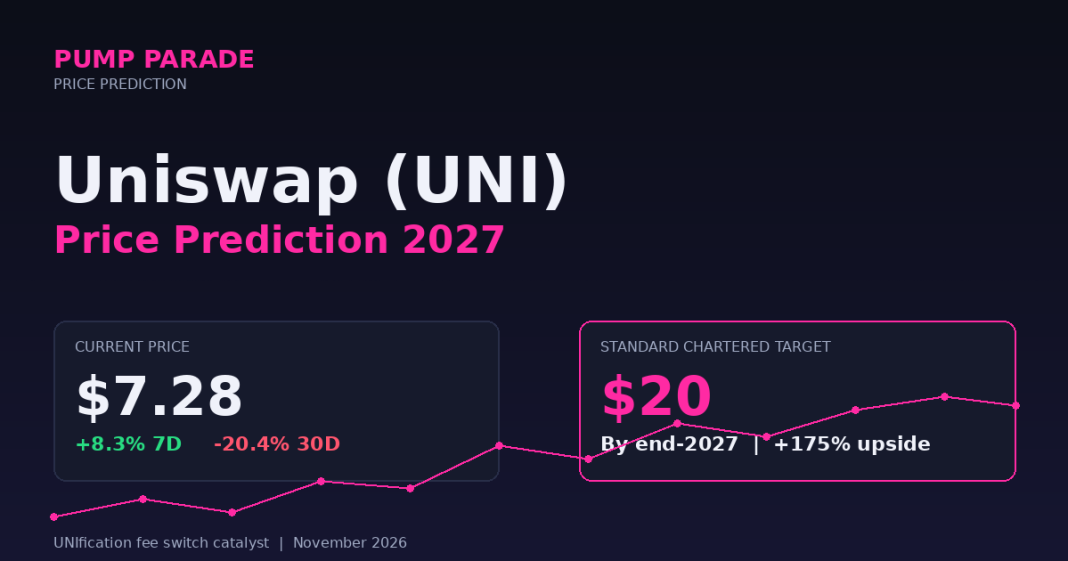
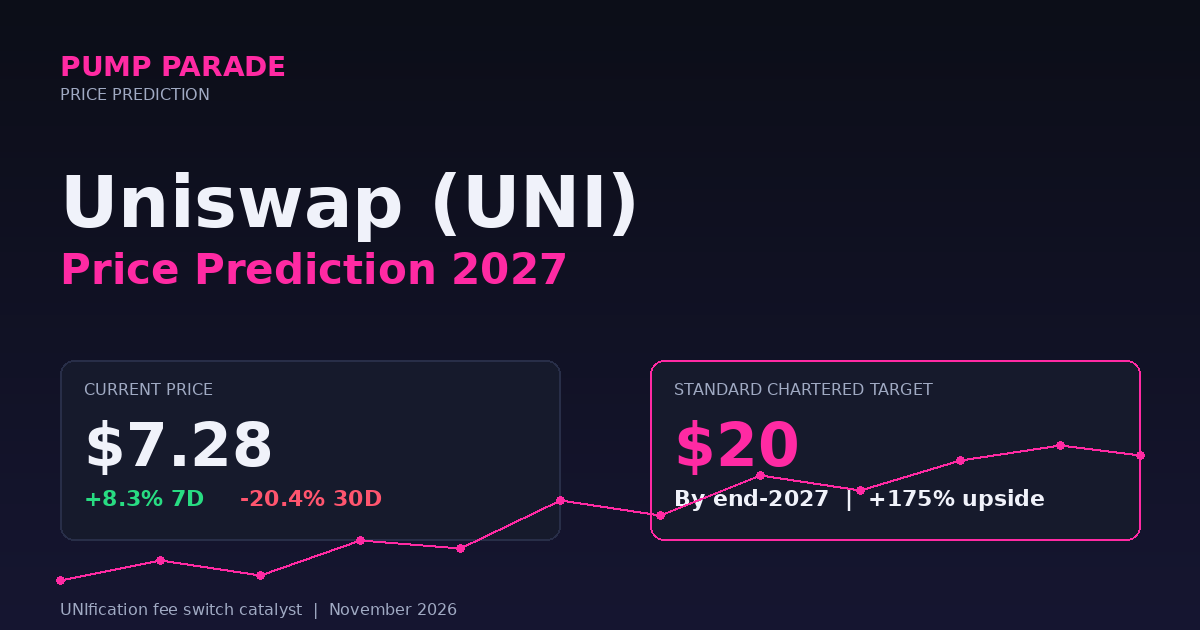
Uniswap (UNI) is trading at $7.28 at the time of writing, up 8.3% over the past 7 days and the strongest-performing large-cap in the top 25 this week. That rally is landing against a brutal 30-day backdrop: UNI is still off 20% on the month and sits 83.8% below its 2021 all-time high of $44.92. In other words, the setup for a Uniswap price prediction 2027 article has rarely been this interesting.
Here is why we are writing this now. In December 2025, Uniswap flipped its long-promised fee switch under the UNIfication proposal, which passed with 99.9% DAO approval. Over 106 million UNI, roughly 10% of the original supply, have already been burned using accumulated protocol fees. Standard Chartered’s Geoffrey Kendrick responded with a $100 end-2030 target, laying out an interim roadmap that puts UNI at $20 by end-2027. The question is whether the tokenomics change is enough to drag UNI off this floor, and what has to happen for that $20 base case to actually print.
We will walk through where UNI stands today, why it is moving, the bull and bear cases, our timeframe-by-timeframe targets, how UNI stacks up against Aave, and the triggers that would change our mind.
Key Takeaways
- Current price: UNI at $7.28, 24h volume $351M, market cap $4.5B, ranked #22 on CoinGecko.
- Standard Chartered’s roadmap: $6.50 end-2026, $20 by end-2027, $40 in 2028, $100 by 2030.
- Fee switch is live: 0.05% of the standard 0.30% trading fee now flows to buybacks and burns. Over 106M UNI (10% of supply) retroactively burned.
- 2025 fundamentals: $1.05B+ in protocol fees, $4T+ lifetime cumulative volume, 50-65% weekly DEX market share.
- Our base case: UNI at $12-$15 by end-2027 if DeFi TVL recovers and Unichain adoption accelerates. Bull case $22. Bear case $4.80.
Where Uniswap Stands Today
Before we project forward, let us look at the numbers that frame the trade. Markets do not care about narratives in a vacuum. They care about narratives colliding with price action, liquidity, and supply dynamics. Here is UNI’s current snapshot, pulled from CoinGecko at time of writing.
| Metric | Value |
|---|---|
| Price | $7.28 |
| 24h change | +3.78% |
| 7-day change | +8.32% |
| 30-day change | -20.4% |
| Market cap | $4.55B |
| 24h volume | $351M |
| Circulating supply | 624.1M UNI |
| CoinGecko rank | #22 |
| All-time high | $44.92 (May 2021) |
| Distance from ATH | -83.8% |
| 90-day range | $3.17 low, $10.72 high |
Two numbers in that table matter more than the rest: the 90-day range and the distance from ATH. UNI ran from $3.17 to $10.72 over the summer, a 238% move. The pullback to $7.28 has retraced about 46% of that move, close to the classic 50% Fibonacci level traders watch for continuation setups. If the retracement holds, this looks like consolidation. If $6.80 breaks, the 90-day uptrend is in trouble.
Why is UNI rallying this week when most of crypto is bleeding?
Three things are driving the +8% weekly move, and the data points to a flows and fundamentals story rather than hype.
First, the burn clock keeps ticking. Since the fee switch went live in December 2025, UNI buybacks have run continuously using 0.05% of every $1 of trading volume routed through the protocol. In 2025, Uniswap generated $1.05B in fees across all chains. Even at a steady state, that is a meaningful supply sink. Analysts tracking the UNIfication burn flow estimate the current rate removes roughly 8-12M UNI from circulation per quarter.
Second, Standard Chartered’s bullish research from June reset the institutional conversation. Geoffrey Kendrick called UNI a top beneficiary of tokenized real-world asset growth, projecting on-chain RWA value to hit $4 trillion by 2028. The timing matters. BlackRock’s BUIDL money market fund is now tradable via UniswapX, giving institutional desks a legitimate on-ramp.
Third, Bitwise filed an S-1 with the SEC for a spot UNI ETF. ETFs do not approve overnight, but the filing itself tends to pull front-running capital, as the Chainlink ETF filing pattern showed. The LINK filing added roughly 25% to its price in the first two weeks post-filing before the broader DeFi correction took over.
What is the bull case for Uniswap in 2027?
Here is where the data gets interesting. Three catalysts form the backbone of the bull thesis, and each has a measurable milestone attached.
UNIfication, the fee switch, and the 100M UNI retroactive burn
The UNIfication proposal is the biggest tokenomics change in Uniswap’s history. The 100M UNI retroactive burn in May represented accumulated fees that had sat in the treasury since the protocol’s early days. That is not a one-time event. The fee switch now routes 0.05% of every trade into an ongoing buyback-and-burn loop.
Translation: UNI has moved from a pure governance token to something closer to a cash-flowing asset with programmatic deflation. For comparison, Ethereum’s EIP-1559 burn removed about 1.5% of ETH supply over its first full year. Uniswap burned 10% in a single retroactive event. The ongoing burn rate adds roughly 3-5% per year on top of that if 2025 fee generation holds.
Unichain’s low-fee, sub-second L2 play
Unichain, the Optimism-stack L2 that Uniswap launched in 2025, is designed to internalize the fee revenue that currently leaks to other chains. Sub-second block times, roughly 95% lower gas than Ethereum L1, and MEV-aware block building are the stated differentiators. The multi-chain fee expansion is estimated at $27M+ in additional annual revenue, which flows back into the burn loop.
If Unichain captures even 20% of Uniswap’s volume by end-2027, that is a meaningful shift in UNI’s cash-flow profile. The risk, as always, is adoption. L2s do not win on specs. They win on liquidity depth, which takes time.
The spot UNI ETF filing and the RWA bridge
Bitwise’s spot UNI ETF filing is the institutional on-ramp catalyst. If approved in 2027 under a friendlier SEC, UNI would join Bitcoin, Ethereum, and Solana as regulated-wrapper exposure for US institutions. BlackRock’s BUIDL fund flowing through UniswapX extends that story in the other direction: institutional capital moving onto the protocol itself.
For the bull case to play out to $20+, you need some combination of the ETF approval, continued burn rate, and DeFi TVL recovering above the 2024 peak. All three are plausible on a 24-month horizon.
The Bear Case for Uniswap
Every bull thesis has a counter. Here are the real risks, not the ones designed to sound balanced.
DEX competition is tightening, especially from perps and intent-based venues
Uniswap’s 50-65% weekly share of DEX volume has slipped from the 70%+ it enjoyed in 2023. Jupiter, Raydium, and Orca have taken Solana spot flow. CowSwap and 1inch have taken aggregator intent flow. Hyperliquid, specifically, is eating into derivatives volume that would otherwise flow through perp DEXs. If you believe Hyperliquid’s roadmap, the perps-plus-spot model is coming for Uniswap’s lunch, not the other way around.
The structural question is whether Uniswap’s v4 hook ecosystem, with its 2,500+ custom pools and $110B+ in processed volume since launch, is a defensible moat or a feature war that gets replicated elsewhere within 18 months.
Fee switch dilution and governance tokenomics risk
Here is the uncomfortable part. The UNIfication proposal passed with 99.9% approval partly because the Uniswap Foundation controls a large chunk of circulating UNI. The foundation held $49.9M in cash and 15.1M UNI at year-end 2025, and token holders approved an additional $165.5M in foundation funding this year. That is good for ecosystem development. It is also a reminder that UNI’s governance distribution is concentrated enough that proposals do not always reflect retail interest.
If a future proposal reroutes burn flow into grants, operations, or liquidity mining, the deflationary thesis weakens. This is not an immediate risk, but it is a 2027-horizon risk worth naming.
Uniswap Price Prediction 2027: Targets by Timeframe
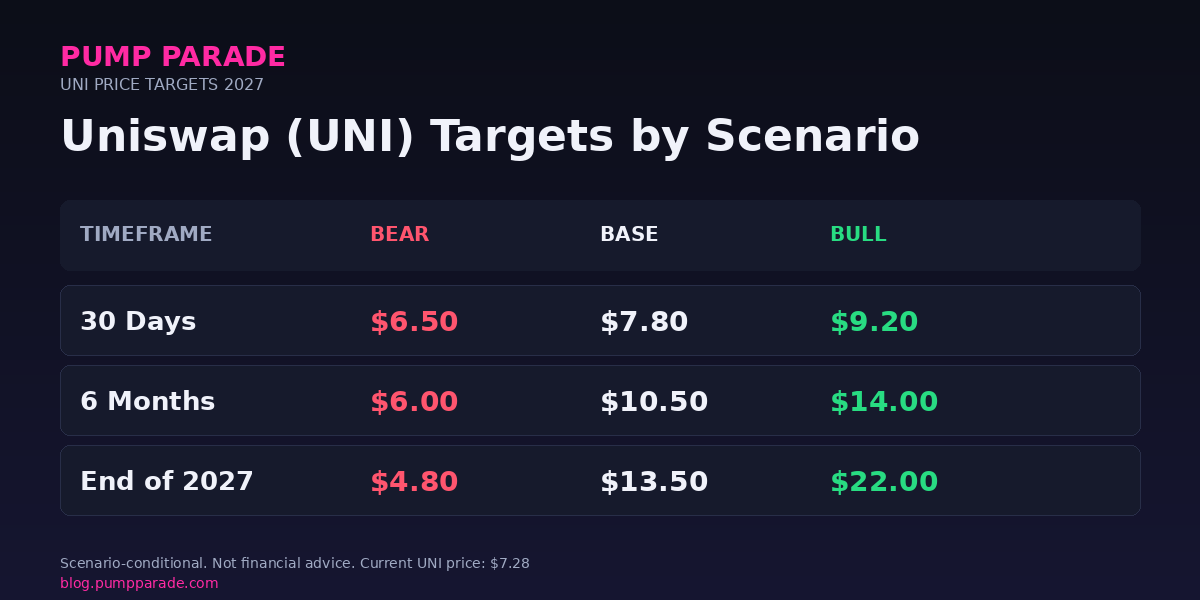
Here is how our model breaks down the Uniswap price prediction for 2027 across three horizons. These are not forecasts. They are scenario-conditional targets based on the catalysts and risks above.
30-day outlook: $6.50-$9.20
Short-term, UNI is pinned between the $6.80 support zone and the $9.00 resistance that capped the September rally. The 50-day moving average sits near $7.90, which is the first level to clear. A clean break above $9.00 opens the path to the 90-day high at $10.72. A rejection takes UNI back to $6.50-$6.80.
6-month outlook: $8.00-$14.00
By mid-2027, three things need to be in motion for the base case to hold. First, the Bitwise UNI ETF should at minimum have a decision date on the SEC calendar. Second, Unichain volume should show accelerating growth, not plateau. Third, DeFi TVL across all chains needs to reclaim at least $150B. If those line up, $12-$14 is a reasonable target. If any one fails, UNI likely churns in the $8-$10 band.
Long-term (end-2027 to 2030): $15 to $100
Standard Chartered’s $20 end-2027 target is the aggressive case for the two-year window. We are more conservative. Our base case puts UNI at $12-$15 by end-2027. The bull case, assuming ETF approval and sustained burn rate, aligns closer to Standard Chartered’s $20. Looking further out, the $100 2030 target from Kendrick requires DeFi to roughly 37x in TVL, which is possible but not probable without significant RWA onboarding. For a comparison framework similar to our Aave 2027 target work, we weight long-dated DeFi predictions at roughly 40-60% confidence.
Here is a comparison with other analyst targets:
| Source | 2027 Target | 2030 Target |
|---|---|---|
| Standard Chartered (Kendrick) | $20 | $100 |
| Changelly consensus | $11-$14 | $28-$42 |
| CoinCodex model | $9-$12 | $18-$30 |
| Pump Parade base case | $12-$15 | $30-$45 |
| Pump Parade bull case | $22 | $75 |
| Pump Parade bear case | $4.80 | $7.00 |
How Uniswap Compares to Aave
Aave is the closest apples-to-apples comparison in large-cap DeFi. Both are blue-chip Ethereum-native protocols. Both have moved from governance-only tokens toward cash-flow-aware designs. Both have multi-chain footprints. Here is how they stack up.
| Metric | Uniswap (UNI) | Aave (AAVE) |
|---|---|---|
| Current price | $7.28 | $138.64 |
| Market cap | $4.55B | $2.14B |
| 24h volume | $351M | $245M |
| 7-day change | +8.3% | +1.8% |
| 30-day change | -20.4% | -24.9% |
| Distance from ATH | -83.8% | -79.0% |
| Primary business | DEX trading fees | Lending interest + liquidation fees |
| Native L2 | Unichain | Aave V4 Hub-and-Spoke |
| Token value accrual | Fee switch + burn | Buyback + staking rewards |
The read: UNI has roughly 2x the market cap, more volume momentum, and a cleaner fee-to-burn mechanic. Aave has lower leverage to a general crypto rally but better defensiveness in a flight-to-safety move because borrowing demand is more resilient than DEX trading volume in a bear market.
What would change our view on UNI?
Here are the three triggers that would force us to re-rate UNI, up or down.
1. Bitwise UNI ETF approval or denial. Approval in 2027 pushes our bull case toward Standard Chartered’s $20. A denial takes $4.00 off the top of our base case and puts us closer to $10 by year-end 2027.
2. Unichain volume share crossing 25% of total Uniswap volume. If Unichain genuinely eats into Ethereum L1 and Base DEX flow, the per-UNI burn rate accelerates meaningfully. A 25% share would roughly double our modeled annual burn, which lifts the base case to $18-$20.
3. A governance proposal rerouting fee switch revenue. If the Uniswap Foundation or a large voter bloc proposes diverting burn flow into grants, LP incentives, or operational funding, the deflationary thesis breaks. That would cap UNI near $10 even in a bull market.
Frequently Asked Questions
Can Uniswap (UNI) reach $20 by 2027?
Standard Chartered’s $20 target for end-2027 is plausible but not our base case. Reaching $20 requires a Bitwise UNI ETF approval, sustained quarterly burns of 8M+ UNI, and DeFi TVL recovering above $200B. We model a 25-30% probability of $20 by December 2027.
Is Uniswap a good investment in 2027?
UNI offers one of the cleanest tokenomics stories in large-cap DeFi after the UNIfication fee switch activation. The main risks are DEX competition, especially from perp venues like Hyperliquid, and potential governance changes to the burn mechanism. For investors with a 2-year horizon, UNI is a reasonable DeFi beta with real cash flows.
What is the Uniswap price prediction for 2027?
Our base case for Uniswap in 2027 is $12-$15, assuming moderate DeFi TVL recovery and continued burn execution. The bull case is $22, driven by ETF approval and Unichain adoption. The bear case is $4.80 if DEX market share continues to erode and the burn narrative weakens.
Will the UNI fee switch cause the price to go up?
The fee switch alone is not enough. The buyback-and-burn mechanic removes roughly 3-5% of UNI supply per year at current fee generation rates. That is a tailwind, not a rocket. For the price to meaningfully re-rate, volume growth and ecosystem expansion through Unichain and v4 hooks have to work in parallel.
Can UNI reach $100?
Standard Chartered’s $100 target is a 2030 figure, not a 2027 one. Hitting $100 would require roughly $62B in UNI market cap, which implies DeFi TVL above $2 trillion and Uniswap retaining 50%+ DEX market share. Possible, but low probability on current trajectories.
What is Unichain and how does it affect UNI?
Unichain is Uniswap’s Optimism-stack L2, built for fast settlement and lower fees. It gives UNI a native home for volume that currently leaks across multiple chains. If Unichain gains traction, more trading fees flow back into the UNI burn loop. For a broader DeFi L2 context, our Solana lending protocol comparison covers how competitive the L1/L2 landscape has become.
The Honest Take
UNI is one of the few DeFi tokens where the tokenomics actually improved in 2026. The fee switch is live. The burn is real. The ETF filing is on the books. Standard Chartered’s $100 target is a stretch, but the $20 waypoint for 2027 is in the ballpark of what the math supports if the catalysts line up.
What we would avoid is treating UNI as a trade for the next 30 days. The short-term tape is messy, DEX market share is still slipping to perp venues, and macro liquidity remains the single biggest variable. The right framework here is probably accumulation on weakness toward $5.50-$6.00, with a 24-month horizon and a willingness to sit through 25% drawdowns.
If you want DeFi exposure in a Trump-admin tokenization cycle, UNI is a credible pick. Just do not confuse “cleaner tokenomics” with “guaranteed upside.” Those are different trades.
Disclaimer: This article is for informational and educational purposes only and should not be construed as financial, investment, or trading advice. Cryptocurrency markets are highly volatile, and past performance does not guarantee future results. The price predictions and analyses presented here are based on AI models, technical indicators, and available data at the time of writing. They are not guarantees. Always conduct your own research (DYOR) and consult with a qualified financial advisor before making any investment decisions. Pump Parade and its authors do not assume liability for financial losses incurred based on information provided in this article.