XRP is trading at $1.01 on Binance, down roughly 1.4% on the day and pinned to the psychological $1 line that has anchored this cycle. Zoom out and the picture gets uglier: XRP is off 9% over the past 30 days, down nearly 30% over the past 90, and sits about 72% below its July 2025 all-time high of $3.65.
That is the setup for our XRP price prediction 2026 analysis. Bulls argue this is a re-accumulation zone with a stack of catalysts: $1.51 billion in U.S. spot ETF inflows, RLUSD hitting a majority share of XRPL stablecoin supply, and a live Binance reward campaign nudging on-chain activity higher. Bears counter that ETF flows have stalled, the CLARITY Act is a coin flip at best, and $1 is the last thing standing between XRP and a much uglier chart.
We are going to lay out both cases with real numbers, compare XRP with its closest peer, run bear, base and bull targets by timeframe, and answer the questions everyone is actually Googling right now.
Key Takeaways
- XRP trades near $1.01, holding critical $1 support after a 30% decline over the past 90 days.
- U.S. spot XRP ETFs have pulled in $1.51 billion in cumulative net inflows, led by Bitwise ($510M) and Franklin Templeton ($427M).
- Ripple’s RLUSD stablecoin now accounts for more than 50% of stablecoin supply on the XRP Ledger, with cumulative volume above $2.5 billion.
- Base case for XRP price prediction 2026: $1.20 to $1.45 recovery range, with $2 in play only on a decisive monthly close above $1.45.
- Standard Chartered’s $8 by year-end 2026 target is the bullish outlier, contingent on sustained ETF inflows and regulatory clarity.
- The CLARITY Act cloture vote on September 15 is priced at just 16% odds on Polymarket, tempering the near-term regulatory tailwind.
Where XRP Stands Today
Let’s start with the numbers, because the story XRP tells depends entirely on where you set the frame. On a one-day chart, XRP looks like every other altcoin in a lethargic August tape. On a one-year chart, it looks like a token that ran hot and is still working off the excess. Here is the snapshot:
| Metric | Value |
|---|---|
| Price (Binance USDT) | $1.0091 |
| 24h Change | -1.39% |
| 7-Day Change | -2.47% |
| 30-Day Change | -9.26% |
| 90-Day Change | -29.64% |
| 24h Volume (Binance pair) | $51.7M |
| Est. Market Cap | ~$60B |
| Market Cap Rank | Top 5 |
| All-Time High (Jul 2025) | $3.65 |
| % From ATH | -72% |
The 52-week trading range spans roughly $0.99 to $3.35. XRP is currently kissing the low end of that range, which is either a gift for accumulators or a warning sign, depending on how you read the flow data.
Why is XRP Range-Bound Right Now?
The honest answer: institutional demand has cooled at exactly the moment retail momentum broke down.
Coming out of the July 2025 peak, XRP was carried by two things: the resolution of the Ripple v. SEC case and the launch wave of U.S. spot XRP ETFs starting in November 2025. Both were textbook “buy the rumor” narratives, and the market did what markets do. It sold the news.
Now the fundamental story is stronger than it has ever been, but the marginal buyer is missing. According to 2026 flow data from 24/7 Wall St, U.S. spot XRP ETFs pulled a monthly high in May, then decelerated through summer. The past three sessions before this analysis saw zero net creation activity across the entire XRP ETF complex.
That is not a collapse. It is worse in some ways: it is indifference. And indifference at $1.00 is what pins a token to a level for weeks at a time.
The Bull Case for XRP in 2026
1. ETF Inflows Are Still Compounding, Just Slower
Yes, the daily numbers have gone quiet, but the cumulative picture is meaningful. U.S. spot XRP ETFs now hold $1.51 billion in cumulative net inflows since the November 2025 launch. Bitwise leads with $510.21 million, and Franklin Templeton’s XRPZ has attracted $426.53 million. Between them, those two funds account for roughly 62% of all XRP ETF assets.
To put that in context, XRP hit $1.51 billion in institutional wrapper inflows faster than most people expected given the muted price action. The story here is that ETFs are functioning as a slow accumulator, not a rocket. That matters more for a 12-month view than a 12-day view.
2. RLUSD Is Turning XRPL Into Real Payments Rails
Ripple’s USD-pegged stablecoin, RLUSD, is doing something few crypto payment narratives ever do: producing verifiable throughput. Cumulative RLUSD trading volume has cleared $2.5 billion since launch, and Ripple minted an additional 811,026 RLUSD on August 6 alone. The supply now represents more than half of all stablecoin value on the XRP Ledger.
Why does that matter for the token? Because RLUSD settlement generates real fee activity, real burn, and real reason for banks and payment providers to actually route through XRPL. The FXRP-collateralized lending pool on Flare, currently valued at $280 million, is a concrete example of XRP being used as productive collateral rather than a speculative bag.
3. The Institutional Infrastructure Buildout
Ripple made strategic investments in ZILO, a provider of technology for tokenized investment funds, and Licuido, a UK-regulated platform for digital asset collateral. Both integrations plug straight into XRPL, extending the ledger’s role in institutional asset servicing.
Standard Chartered’s much-quoted $8 XRP target by end of 2026 is not built on retail sentiment. It is built on the assumption that this infrastructure work compounds into meaningful settlement volume. If they are directionally right, XRP re-rates. If they are wrong, we get $1.20 and change into year-end.
The Bear Case for XRP in 2026
1. The Chart Is Ugly and Momentum Is Absent
A 72% drawdown from the all-time high is not a “healthy correction.” It is a full-cycle unwind. XRP has spent the past three months trending down and consolidating just above $1, and every rally attempt has been sold. Until the token puts in a higher high on the weekly timeframe, technicians will treat every bounce as a chance to distribute, not accumulate.
2. ETF Flows Have Genuinely Stalled
The cumulative $1.51 billion is impressive. The recent print is not. When new spot ETF products stop pulling money, the token’s price action tends to reflect that with a lag. If the flow data does not turn back up by early autumn, the “institutional demand” leg of the bull thesis weakens materially.
3. The CLARITY Act Is Not a Sure Thing
The proposed CLARITY Act would classify XRP as a digital commodity under CFTC oversight, ending the last real regulatory tail risk. It also faces a cloture vote in the Senate on September 15, and prediction markets are not optimistic. Polymarket is currently pricing the vote at just 16% odds. If it fails, we get a “priced for perfection” airpocket in XRP.
XRP Price Prediction 2026: Targets by Timeframe
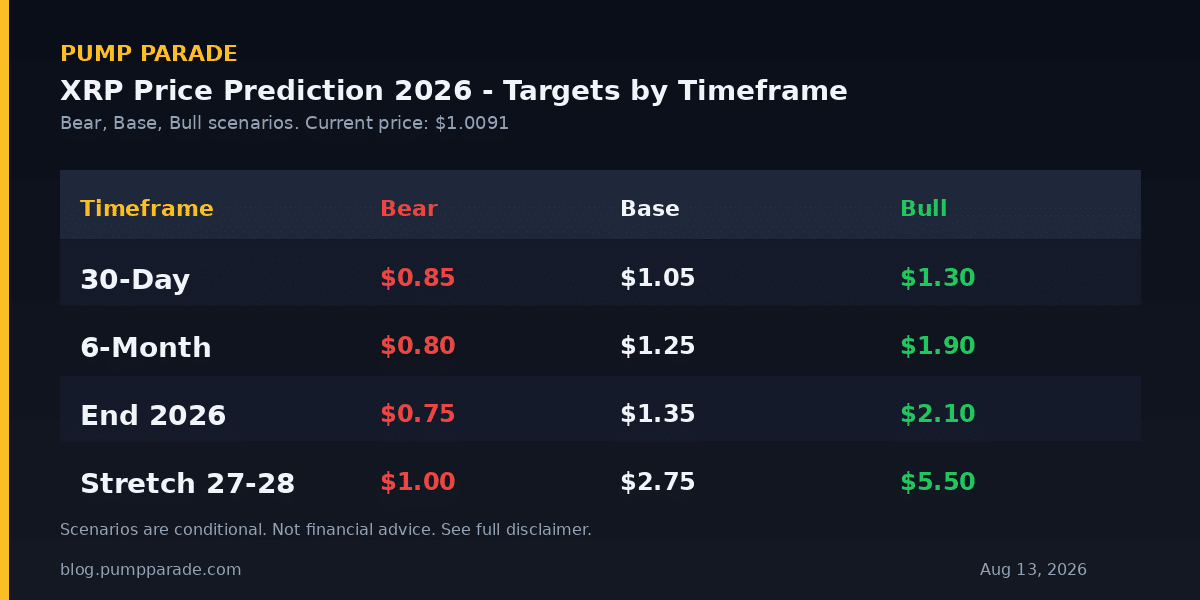
Here is our framework. These are not guarantees. They are conditional scenarios based on the flow data, technical setup, and catalyst calendar as of this writing.
| Timeframe | Bear | Base | Bull |
|---|---|---|---|
| 30-Day | $0.85 | $1.05 | $1.30 |
| 6-Month | $0.80 | $1.25 | $1.90 |
| End of 2026 | $0.75 | $1.35 | $2.10 |
| Stretch (2027-2028) | $1.00 | $2.75 | $5.50 |
Short-Term (30 days)
XRP is compressing on the daily. Realized volatility is at cycle lows, which historically resolves in a move of 20% or more in either direction within four to six weeks. The base case holds $1 support and grinds back toward $1.20 as the Binance RLUSD reward campaign feeds transactional activity. The bear case is a clean break of $0.99, opening a fast $0.85 test. The bull case needs a reclaim of $1.20 with volume.
Medium-Term (6 months)
This is where the flow data matters. If ETF inflows re-accelerate into Q4 seasonality, our base case sees XRP grinding into the $1.25 to $1.45 zone. A monthly close above $1.45 is the technical trigger that opens $1.90. In the bear case, sustained ETF apathy plus a broader alt-market drawdown keeps XRP capped under $1.10 and eventually breaks $0.95.
End of 2026 and Longer
Analyst targets diverge sharply here. Mainstream consensus, as compiled by outlets covering Ripple price forecasts through 2026, clusters near $1.20 to $1.50 by year-end, with an aggressive bull path toward $2.00 to $3.00 requiring both ETF re-acceleration and CLARITY passage. Standard Chartered’s $8 remains an outlier, plausible only if XRPL captures a step-function share of institutional payment settlement.
Historically, in similar setups where a top-5 altcoin holds a psychological round-number support for more than 60 days on decreasing volume, the resolution is a move of 30% or more within the following quarter. Direction depends on the catalyst that breaks the coil.
How Does XRP Compare to Stellar (XLM)?
Every XRP analysis eventually gets compared to Stellar. Same origin story (Jed McCaleb co-founded both), same cross-border payments pitch, wildly different scale. Here is where they stand in mid-August 2026:
| Metric | XRP | XLM |
|---|---|---|
| Price | $1.01 | ~$0.22 |
| Market Cap Rank | Top 5 | Top 25 |
| Native Stablecoin | RLUSD (Ripple) | USDC (via SEP-24) |
| Spot ETF (US) | Live, $1.51B AUM | None |
| Institutional Focus | Banks + payments + tokenization | Remittances + NGO |
| Regulatory Status | SEC case resolved 2025 | Never charged |
| Drawdown From ATH | -72% | -70% |
The upshot: XRP has the institutional wrapper and the stablecoin flywheel; XLM has the cleaner regulatory record but no ETF, no proprietary stablecoin engine, and a smaller enterprise footprint. If you want more granular context on the sister asset, our Stellar (XLM) price prediction 2026 analysis covers XLM’s setup and $0.50 target case.
Will XRP Reach $2 in 2026?
This is the question the search data says everyone is asking, so let’s answer it directly.
To hit $2 from $1.01, XRP needs to roughly double in less than five months. That is not unusual for XRP historically. It happened in Q1 2025 in a matter of weeks. The question is whether the catalyst stack lines up.
Our read: $2 is possible but not the base case. To get there, three things need to happen in roughly the following order. First, XRP needs to reclaim $1.20 on rising spot volume. Second, ETF flows need to turn positive on a rolling 30-day basis, ideally with at least one $50M+ inflow week. Third, either the CLARITY vote surprises to the upside on September 15, or RLUSD supply crosses a psychological milestone (think $5 billion cumulative volume) that shifts the fundamental narrative.
Miss any of the three, and $2 stays out of reach in 2026. Hit all three, and $2 is not just achievable, it is likely conservative.
What Would Change Our View
Three explicit scenario triggers we are watching:
- Weekly close below $0.95. This breaks the year-long floor and opens a measured move to $0.75 to $0.80. Bear case activated.
- Monthly close above $1.45. This clears cycle resistance and re-opens the $1.90 to $2.10 path. Bull case activated.
- Two consecutive weeks of $30M+ average daily ETF inflows. This resets the institutional demand narrative and would materially raise our base case toward $1.60.
Anything else is noise until price acts on it.
Frequently Asked Questions
Will XRP reach $2 in 2026?
Reaching $2 in 2026 is plausible but not our base case. It requires a reclaim of $1.20 with volume, sustained ETF inflow re-acceleration, and either CLARITY Act passage or a step-change in RLUSD adoption. Without those catalysts, XRP is more likely to end the year in the $1.20 to $1.45 range.
Is XRP a good investment right now?
XRP offers an asymmetric setup at $1: the downside to psychological support is roughly 20%, while a full bull-case reclaim of $2 offers 100% upside. That risk-reward is more attractive than earlier in the cycle, but XRP still requires patience and clear invalidation levels. It is a position, not a trade.
What is the XRP price prediction for 2026?
Our base case XRP price prediction 2026 target is $1.35 by year-end, with a bear scenario of $0.75 and a bull scenario of $2.10. Standard Chartered’s outlier target of $8 requires assumptions on institutional adoption that most base cases do not carry.
Can XRP reach $3 again?
Yes, but likely not in 2026. A return to $3 would require the same conditions as the $2 case plus a fresh wave of retail momentum. That combination looks more realistic on a 2027 to 2028 horizon, where our stretch bull case sees $5.50 as the aggressive ceiling.
Why is XRP falling in 2026?
XRP is not really “falling” so much as it is drifting. The catalysts that drove the 2024 to 2025 rally (SEC case resolution, ETF launches) are now priced in, ETF inflows have stalled, and no fresh narrative has replaced them yet. That produces a range-bound tape rather than a directional trend.
How high can XRP go long term?
Long-term ceiling estimates vary widely. Conservative long-term models put XRP in a $2 to $4 range by 2027 to 2028. Aggressive institutional-adoption cases (Standard Chartered, some cross-border payment analysts) reach $8 to $12. The variance comes down to how much of global settlement flow XRPL captures.
The Honest Take
XRP is a token in the middle of a story rewrite. The old story was “waiting for regulatory clarity.” That story is over. The new story is “does the infrastructure buildout convert into real settlement volume, and does that show up in the ETF flow data?”
Right now, the answer is a shrug. RLUSD is scaling, tokenization partnerships are shipping, ETFs are quietly compounding, and the chart is doing nothing. That combination almost always resolves, and when it does the move is meaningful. Our best guess is that resolution happens later than the bulls want and earlier than the bears expect.
If you already hold XRP, this is a level worth defending. If you do not, it is a token worth watching, with clear invalidation at $0.95 and clear confirmation at $1.45. What it is not, at least right now, is a screaming buy. And that is fine. Not every setup is a home run swing.
For traders looking at other majors at similar drawdown levels, our Solana (SOL) price prediction 2026 breakdown and TRON (TRX) price prediction 2026 analysis apply a similar framework to different setups.
Disclaimer: This article is for informational and educational purposes only and should not be construed as financial, investment, or trading advice. Cryptocurrency markets are highly volatile, and past performance does not guarantee future results. The price predictions and analyses presented here are based on AI models, technical indicators, and available data at the time of writing. They are not guarantees. Always conduct your own research (DYOR) and consult with a qualified financial advisor before making any investment decisions. Pump Parade and its authors do not assume liability for financial losses incurred based on information provided in this article.