TRON trades at $0.3294 today, up roughly 1% on the week and about 25% below its December 2024 all-time high of $0.44. That looks quiet on the surface. Under it, the numbers are anything but. TRON now settles more USDT than Ethereum, holds more than $85 billion in stablecoin supply, and just crossed 74 million wallet holders. This TRON price prediction 2026 asks the question the market is actually pricing right now: can TRX finally break $0.50 and rerate as the world’s biggest stablecoin settlement layer?
The setup has real teeth. USDT transfers on TRON hit trillions in Q1 2026. The SEC lawsuit against Justin Sun and the TRON Foundation was dismissed with prejudice in March. A joint task force with Tether and TRM Labs has already frozen $344 million linked to illicit flows, giving regulators one less reason to squeeze the network. Yet TRX price has barely moved. That gap between fundamentals and price is what makes this a setup worth monitoring.
We’ll walk through where TRX sits, why it’s stuck, the bull and bear cases with named catalysts, a target grid for the next 30 days, 6 months, and end of 2026, plus how TRON stacks up against Ethereum for stablecoin market share.
Key Takeaways
- Current price: $0.3294, market cap $31.3B, ranked #8 by market cap.
- Bull case for 2026: a break above $0.50 opens a path to the $0.80 to $1.20 range if stablecoin dominance keeps compounding.
- Base case: $0.35 to $0.50 by year-end 2026, consistent with mainstream analyst ranges from Changelly, Coinpedia, and Coinbase.
- Bear case: a slide to $0.20 to $0.25 if Tether reallocates supply toward Ethereum or a fresh regulatory shock lands.
- The real story: TRON now hosts 46%+ of global USDT supply. That’s the fundamental to watch, not the daily candle.
Where TRON Stands Today
TRX is a top-10 asset that trades like it wants to be forgotten. The chart has been coiled between $0.28 and $0.36 for weeks. Volume sits around $235 million a day, which is thin for a network settling trillions in stablecoin transfers. Here’s the snapshot as of August 9, 2026.
| Metric | Value |
|---|---|
| Price | $0.3294 |
| 24h change | +0.12% |
| 7-day change | +0.97% |
| Market cap | $31.3B |
| 24h volume | $235.5M |
| Market cap rank | #8 |
| All-time high | $0.4404 (Dec 2024) |
| % from ATH | -25.2% |
The narrative underneath those numbers is doing more work than the price. TRON now hosts about $85 billion in USDT, more than any other chain. According to Justin Sun’s Q1 2026 disclosures, the network moved trillions of dollars in stablecoin transfers over three months. For a network that most casual traders still think of as “the Justin Sun chain,” that’s a serious utility footprint.
Why is TRON price stuck below $0.35 right now?
TRX looks range-bound for three reasons that all pull in the same direction.
First, TRON is a boring asset. It doesn’t have the meme energy of a Solana memecoin cycle or the ETF narrative Ether has. Boring is not a bug for stablecoin infrastructure, but it is a headwind for narrative-driven price action.
Second, supply concentration is a discount factor. Analysts at MEXC and independent researchers estimate that Justin Sun and affiliated wallets control roughly 63% of circulating TRX. Every rally is met with the question of whether insider distribution will cap it. That fear alone shaves multiple off the token.
Third, the market is waiting for a catalyst that converts stablecoin dominance into TRX demand. Right now, USDT usage generates fee revenue that gets burned as energy and bandwidth, but the link between “more USDT on TRON” and “higher TRX price” is indirect. When it becomes direct, the range breaks.
The Bull Case for TRX in 2026
USDT dominance is compounding, not plateauing
TRON now holds more than $85 billion in USDT, ahead of Ethereum, and just crossed 74 million USDT holders according to Tether disclosures cited by Blockchain.news. Sun’s public target is $100 billion in TRON-hosted USDT by early 2027. If the network sustains its current compounding rate, that milestone lands inside our forecast window and becomes the marketing event every crypto exchange front-page can carry.
The SEC case is finally closed
The US Securities and Exchange Commission case against the TRON Foundation and Justin Sun was dismissed with prejudice by a US federal judge in March 2026. That eliminates the biggest overhang on TRX, unlocks a plausible Coinbase US listing, and clears the way for compliant products in Sun’s orbit. A Coinbase listing alone typically adds 15% to 25% to a mid-cap altcoin’s market cap within a week.
The deflation tipping point is inside the window
TRX has a burn mechanism tied to network activity. Every USDT transfer consumes energy and bandwidth, and a portion of the associated fees is burned. Independent modeling from crypto.news suggests TRX becomes structurally net-deflationary sometime in 2027 if stablecoin transfer volume keeps its current trajectory. Markets tend to front-run that inflection by six to nine months, which means late 2026 is a plausible pricing window.
The Bear Case for TRX in 2026
Tether can migrate liquidity elsewhere
TRON’s biggest strength is a single-issuer dependency. Tether has already announced a multi-chain strategy that expands supply on Ethereum layer-2s and newer chains. If USDT growth on TRON stalls or reverses, the core investment thesis takes a real hit. This is the risk analysts at K33 and Bernstein have flagged repeatedly through 2026.
Insider concentration and unlocks
Justin Sun and affiliates reportedly control around 63% of TRX supply. The 27 super representatives model concentrates governance further. This isn’t a fatal flaw, but it does mean any rally to $0.50 or above invites profit-taking from a small set of holders whose selling can visibly move the tape. Institutional allocators price this in as a persistent discount.
Regulatory risk isn’t zero, even post-settlement
TRM Labs continues to report that TRON hosts a disproportionate share of illicit crypto volume, most recently pegged near 58%. The T3 Financial Crime Unit has been aggressive in freezing sanctioned wallets, including $344 million in coordinated freezes reported by Blockchain.news. That’s progress, but a fresh enforcement action from OFAC, the DOJ, or a European regulator would land squarely on TRX price.
TRX Price Prediction 2026: Targets by Timeframe
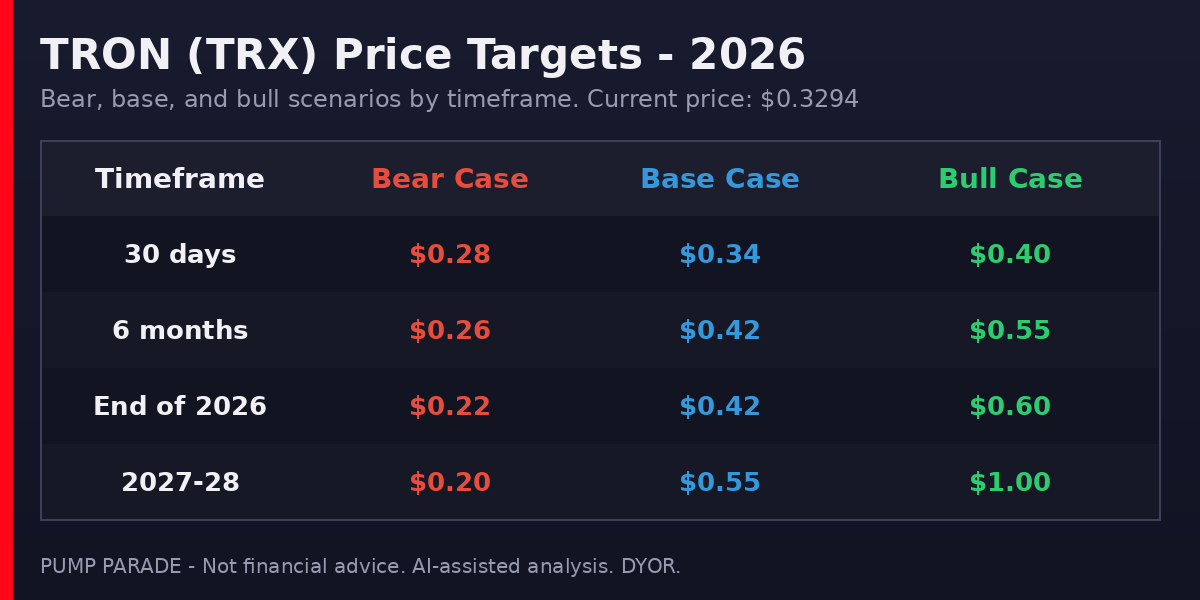
Here’s how we’re framing the next four windows. These are analytical ranges built from on-chain data, competitor forecasts, and probable catalyst timing. They are not price commitments.
Next 30 days (through early September 2026)
Bear: $0.28. Base: $0.34. Bull: $0.40. Near-term action is trading the range. A confirmed break of $0.36 on strong stablecoin inflow days opens the door to $0.40. A loss of $0.30 on rising exchange balances signals distribution and points back to $0.28.
Six months (through Q1 2027)
Bear: $0.26. Base: $0.42. Bull: $0.55. This window catches the potential $100 billion USDT-on-TRON milestone, a possible Coinbase listing, and the first serious deflation-narrative coverage. Any two of those together historically resolves ranges upward.
End of 2026
Bear: $0.22. Base: $0.42. Bull: $0.60. This aligns with the mainstream analyst spread. Changelly and Coinpedia model 2026 highs in the $0.55 to $0.60 range. Coinbase’s CMC-AI and Bitcoin Foundation both flag $0.50 as the pivotal 2026 level. Cross that convincingly and the $0.80 to $1.20 range from crypto.news becomes the 2027 conversation.
Longer term (2027 to 2028)
Bear: $0.20. Base: $0.55. Bull: $1.00. Reaching $1 requires TRX to become genuinely net-deflationary while stablecoin dominance persists. Reasonable, not guaranteed.
How Does TRON Compare to Ethereum for Stablecoin Settlement?
The most useful comparison for TRX isn’t another Layer-1 for smart contracts. It’s Ethereum, the network TRON overtook in USDT supply. Here’s the head-to-head on the metrics that actually matter for a stablecoin settlement layer.
| Metric | TRON | Ethereum L1 |
|---|---|---|
| USDT hosted | ~$85.3B | ~$70B |
| USDT holders | 74M+ | Est. 6M |
| Avg USDT transfer cost | Sub-$1 | $2 to $10 |
| Finality | ~3 seconds | ~12 seconds |
| Consensus | DPoS, 27 SRs | Proof-of-Stake, ~1M validators |
| Decentralization score | Low | High |
| Token supply concentration | ~63% top holders | ~30% top holders |
| Regulatory clarity (US) | Improved post-SEC dismissal | Established |
For a full picture on where ETH sits in this same rerating debate, our Ethereum price prediction 2026 breaks down the ETH-side setup.
Will TRX hit $0.50 by end of 2026?
The path exists but requires alignment. TRX needs to hold above $0.30 through summer, reclaim $0.36 on real volume, and then absorb one of these three catalysts cleanly: (1) TRON crossing $100 billion in hosted USDT, (2) a confirmed Coinbase US listing, (3) a Tether policy change that reallocates supply back toward TRON at Ethereum’s expense.
Our base case is that at least one of those triggers hits inside 12 months and pushes TRX into the $0.42 to $0.50 corridor by year-end 2026. Whether it closes above $0.50 depends on how quickly momentum funds rotate in once the level breaks. We give it a 35% probability of a clean weekly close above $0.50 by December 31, 2026.
What Would Change Our View
Three explicit triggers that would force us to revise upward or downward.
Upgrade the target if: USDT supply on TRON crosses $100 billion before Q1 2027, or Coinbase lists TRX on its main exchange. Either alone pushes the base case toward $0.55 and the bull case above $0.70.
Downgrade the target if: Tether announces a formal strategy shift favoring Ethereum layer-2s or Plasma, or Justin Sun-linked wallets execute a visible distribution above 500 million TRX inside a 30-day window. Either would signal that the setup we’re describing is breaking and would drop the base case toward $0.28.
Rethink the whole thesis if: the DOJ, OFAC, or a European regulator opens a new enforcement action against Sun, the TRON Foundation, or a major exchange for TRON-related activity. That kind of shock re-rates the token to bear-case levels regardless of on-chain fundamentals.
How TRX Fits Alongside Other 2026 Setups
If you’re building a broader “stablecoin infrastructure and settlement” sleeve, TRX is one leg. Real-world asset issuance is another. We’ve covered Ondo’s 2026 setup for the RWA angle and AAVE’s 2026 outlook for the stablecoin credit angle. A basket of the three is one way to express a “stablecoins are eating finance” thesis without over-concentrating.
Frequently Asked Questions
Will TRON (TRX) reach $1 in 2026?
Reaching $1 in 2026 is possible but not the base case. It would require TRX to first break decisively above $0.50, then absorb a major catalyst such as crossing $100 billion in hosted USDT or the beginning of net-deflationary supply. Mainstream analyst ranges from Changelly and Coinpedia land at $0.35 to $0.60 for 2026, with $1 more realistic as a 2027 scenario if compounding holds.
Is TRON a good investment in 2026?
TRON has real utility as the largest stablecoin settlement layer in crypto, with over 46% of global USDT supply. That’s a defensible moat. It also carries real risks: insider concentration around 63% and regulatory overhang despite the dismissed SEC case. TRX may suit a long-term holder who wants exposure to stablecoin adoption but understands the governance discount that comes with it.
What is the TRON price prediction for 2026?
Our base case is $0.35 to $0.50 by year-end 2026, with a bull case of $0.60 and a bear case of $0.22. This aligns with the analyst spread from Changelly, Coinpedia, Coinbase’s CMC-AI, and Bitcoin Foundation. The $0.50 level is the single most important price in the year: reclaim it and the door opens to $0.80 or higher in 2027.
Why does TRON dominate USDT?
TRON’s appeal for USDT is simple: sub-dollar transfer fees, 3-second finality, and deep exchange integration for retail flow in Asia, Latin America, and Africa. Ethereum L1 transfer costs of $2 to $10 don’t work for a worker sending $50 home. TRON became the settlement rail because it solved the small-transfer economics no other chain matched at scale.
Is TRON safe from SEC action now?
The specific SEC case against Justin Sun and the TRON Foundation was dismissed with prejudice in March 2026, meaning it cannot be refiled on the same facts. That significantly reduces one class of regulatory risk. It does not eliminate all US enforcement risk, since the DOJ, OFAC, and state regulators operate independently and TRM Labs continues to flag illicit-flow concentration on TRON.
Can TRX hit $0.50 by year end?
We give it roughly a 35% probability of a clean weekly close above $0.50 by December 31, 2026. The path requires TRX to reclaim $0.36 on real volume, then land at least one catalyst from the trigger list: $100 billion in hosted USDT, a confirmed Coinbase listing, or a Tether allocation policy shift back toward TRON.
The Honest Take
TRX is not a moonshot. It’s a rerate-or-range trade on the most boring but most important use case in crypto, which is stablecoin settlement. The bull case runs through the $0.50 level and hinges on stablecoin dominance keeping its current trajectory. The bear case is credible: single-issuer dependency on Tether, real insider concentration, and lingering compliance headline risk.
What makes this setup interesting rather than a pass is asymmetry. Downside from $0.33 to bear-case $0.22 is roughly 33%. Upside from $0.33 to bull-case $0.60 is roughly 82%, with a longer-tail 2027 scenario in the $1 range if the deflation narrative confirms. That’s the kind of risk-reward that rewards a small, patient allocation more than a large tactical position.
Watch three data points weekly: USDT supply hosted on TRON, TRON’s share of global stablecoin transfers, and the delta between TRX price and TRON network revenue. When those three line up in the same direction for a month, the range breaks. Until then, TRX is a monitor-not-chase setup.
Disclaimer
Disclaimer: This article is for informational and educational purposes only and should not be construed as financial, investment, or trading advice. Cryptocurrency markets are highly volatile, and past performance does not guarantee future results. The price predictions and analyses presented here are based on AI models, technical indicators, and available data at the time of writing. They are not guarantees. Always conduct your own research (DYOR) and consult with a qualified financial advisor before making any investment decisions. Pump Parade and its authors do not assume liability for financial losses incurred based on information provided in this article.