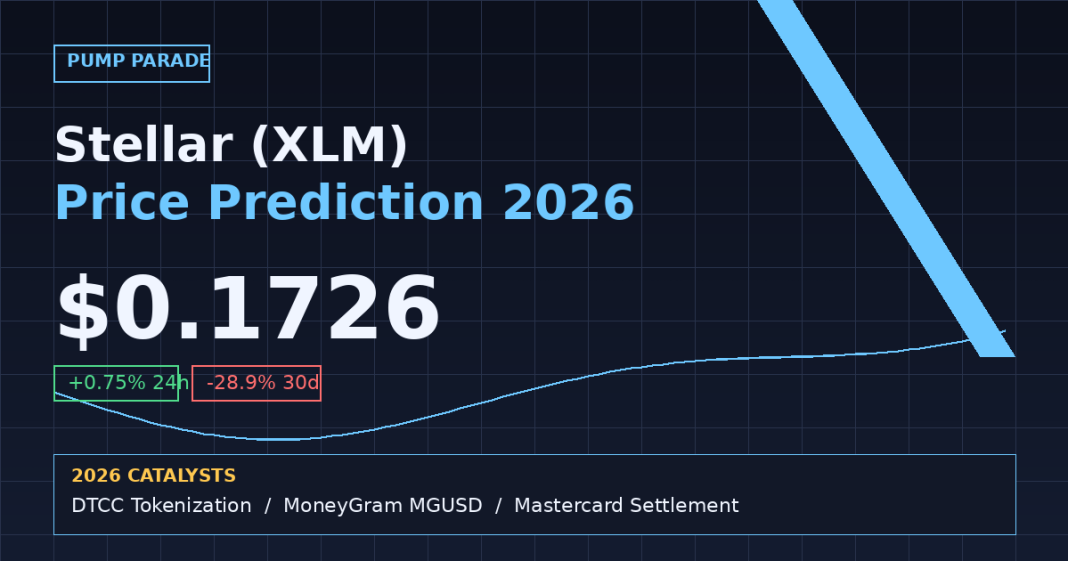
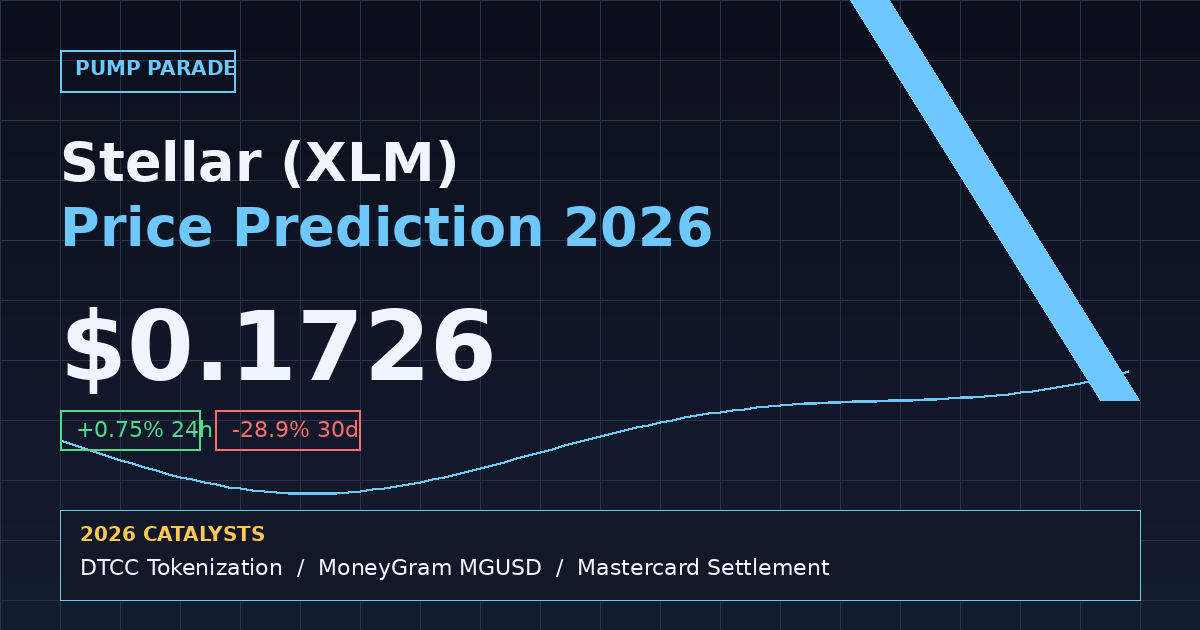
Stellar (XLM) trades at $0.1726 at the time of writing, down 28.9% over the past 30 days and sitting roughly 80% below its 2018 all-time high of $0.88. That kind of drawdown usually means one of two things in crypto: a project quietly dying, or a setup forming for the next leg. Our Stellar XLM price prediction 2026 argues this is closer to the second case, but only if a specific list of catalysts actually lands.
Stellar’s H1 2026 has been one of the most consequential stretches in the network’s history. The SEC and CFTC formally designated XLM a digital commodity on March 17. MoneyGram launched its MGUSD stablecoin on Stellar on June 2 with Bridge, M0, and Fireblocks as partners. Mastercard added Stellar to its stablecoin settlement program on June 10. And the DTCC, which clears the bulk of US securities trades, has confirmed plans to tokenize US Treasuries, ETFs, and Russell 1000 stocks on Stellar starting in H1 2027.
This article breaks down what Stellar is, why XLM is bleeding despite arguably the strongest fundamental setup it has had in years, where the price could realistically go through 2026, and what would change our view.
Key Takeaways
- Current price: $0.1726 (rank #16), down 17.8% in 7 days and 28.9% in 30 days. Volume has held near $121M daily, suggesting the selloff is macro, not Stellar-specific.
- Three real 2026 catalysts: MoneyGram MGUSD (live June 2), Mastercard stablecoin settlement (joined June 10), and the DTCC tokenization pilot targeting H1 2027.
- Network is growing: Stellar payment volume hit a $5.5B all-time high in H1 2026, up 72% year over year. RWA market cap on Stellar climbed 91% quarter over quarter to $1.52B.
- 2026 base case: $0.28 (+62% from current). Bear case $0.12. Bull case $0.50 if a spot XLM ETF filing lands and DTCC pilot details ship on time.
- Honest watchout: XLM has spent years trading sideways even when fundamentals improved. Tokenomics overhang from the 50B fixed supply and competition from XRP and Ripple Payments are real, not noise.
Where Stellar Stands Today
Before the forecast, here is the snapshot. Numbers below come from CoinGecko at the time of writing.
| Metric | Value |
|---|---|
| Price | $0.1726 |
| 24h change | +0.75% |
| 7d change | -17.82% |
| 30d change | -28.91% |
| Market cap | $5.86B |
| 24h volume | $121M |
| Market cap rank | #16 |
| Circulating supply | 33.97B XLM |
| All-time high | $0.876 (Jan 2018) |
| % from ATH | -80.3% |
Two numbers stand out. The 30-day drawdown of 29% puts XLM in the same bucket as the 2022 bear bottom and the March 2020 COVID flush. Historically those zones produced positive 12-month returns more often than not, though the pattern is not a guarantee. Daily turnover near $121M on a $5.86B float also means the market is liquid enough for institutional players to position without crashing the book. That matters for an ETF case.
Why Is XLM Down Right Now?
Stellar’s drop is mostly macro. Bitcoin is off 18% over the same 30-day window. Ethereum is off 22%. The risk-off bid has hit almost every altcoin in the top 50 except a handful of memecoins and stablecoin-adjacent tokens. XLM’s beta to broader crypto liquidity is high, and rate uncertainty around the Fed’s next move has dragged speculative assets lower.
Stellar-specific selling pressure also exists. The Stellar Development Foundation (SDF) periodically distributes XLM from its strategic budget, and rumors of an SDF transfer in early June added local supply. None of the announced 2026 catalysts have translated into sticky demand yet because the on-chain flows from MoneyGram and Mastercard route through stablecoins, not XLM itself. Investors are waiting for proof that institutional usage actually drives token velocity before bidding the asset.
The result is a fundamentally improving network whose token price is still tied to crypto’s macro tape. Whether that disconnect closes is the central question of any honest XLM or XRP forecast right now.
The Bull Case for XLM
1. DTCC Tokenization Goes Live
The Depository Trust & Clearing Corporation settles the majority of US securities transactions. Its DTC subsidiary has confirmed plans to connect a tokenization service to Stellar, with tokenized US Treasuries, ETFs, and Russell 1000 stocks targeted for H1 2027. Even a partial launch in late 2026 would represent the largest tokenization use case Stellar has ever attracted. RWA market cap on Stellar is already up 91% quarter over quarter to $1.52B, ranking the network second in the tokenized treasury category.
If DTCC ships even a test deployment in 2026, XLM becomes the settlement rail for a flow of assets measured in tens of billions. That is the kind of catalyst Ondo Finance bulls have been pricing in for similar reasons.
2. MoneyGram MGUSD and Mastercard Settlement
MoneyGram launched its MGUSD stablecoin on Stellar on June 2, 2026, with Bridge, M0, and Fireblocks as partners. Mastercard’s stablecoin settlement program added Stellar on June 10. MoneyGram processes around $200B in annual global transaction volume. Even a small percentage migrating to Stellar-native rails compounds quickly. Stellar’s payment volume is already at a $5.5B all-time high, up 72% year over year. The point: 2026 is the first year that growth has institutional logos attached, not just developer counts.
3. Spot XLM ETF Filing in 2026
XLM cleared the regulatory prerequisite that mattered most: the SEC and CFTC formally designated Stellar a digital commodity on March 17, 2026. That is the same status Bitcoin and Ethereum had before their spot ETFs launched. Canary Capital already filed for a mixed altcoin ETF that includes XLM, XRP, SOL, ADA, and LINK. A standalone XLM spot ETF filing from a major issuer in 2026 would force a repricing similar to what XRP, SOL, and LTC saw at their own filing moments. Analyst Ali Martinez has flagged an inverse head-and-shoulders structure on the weekly XLM chart targeting $1 if the pattern completes.
The Bear Case for XLM
1. The XRP Problem
Stellar and XRP target the same use case: cross-border value transfer for financial institutions. XRP has the larger market cap, the stronger US legal status post-Ripple settlement, more bank-facing distribution through Ripple Payments, and the better-known brand among traditional finance. Some of Stellar’s institutional wins, including portions of MoneyGram’s flow, could just as easily have gone to Ripple. If XRP captures the next wave of bank pilots, XLM struggles to differentiate beyond the developer-friendly Soroban smart-contract layer.
2. Tokenomics Overhang
Stellar’s total supply is fixed at 50B XLM, with 34B circulating. The Stellar Development Foundation still controls a meaningful portion of the non-circulating supply and uses it to fund ecosystem development. SDF distributions are predictable, but they are still net new supply hitting the market. Until a clearer burn mechanism or supply-lock policy is in place, XLM trades with a structural sell-pressure tax that XRP, after Ripple’s escrow modifications, partly addressed.
3. Catalysts Are 2027 Stories
The biggest 2026 catalysts, DTCC tokenization and a potential XLM ETF, are not actually scheduled for 2026 delivery. DTCC’s stated target is H1 2027. ETF approvals, even after a filing, typically take 240 days. That means much of XLM’s bull case is really a 2027 story being front-run in 2026. If macro conditions stay weak through year-end, XLM could spend the entire year between $0.12 and $0.22 while the underlying thesis quietly improves.
Stellar (XLM) Price Prediction 2026: Targets by Timeframe
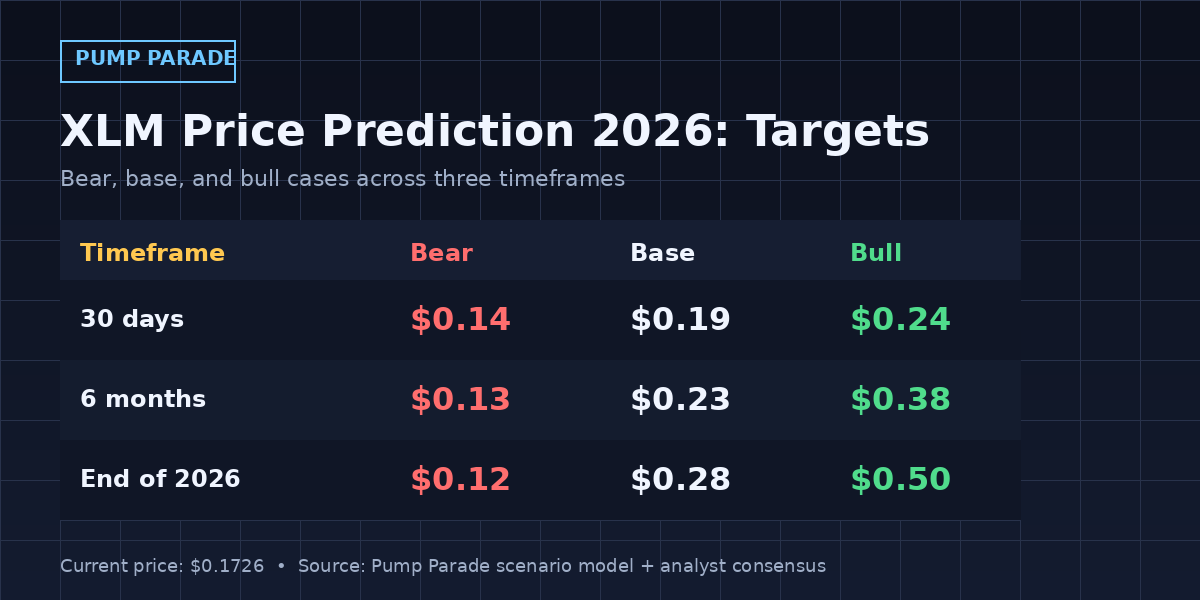
Our framework breaks the year into three horizons: the next 30 days, the next 6 months, and full-year 2026. Targets cite analyst ranges from Changelly, Coinpedia, and CoinCodex for comparison, plus our own scenario logic.
| Timeframe | Bear | Base | Bull |
|---|---|---|---|
| 30 days | $0.14 | $0.19 | $0.24 |
| 6 months | $0.13 | $0.23 | $0.38 |
| End of 2026 | $0.12 | $0.28 | $0.50 |
Short-Term (30 days)
RSI on the daily chart is hovering near oversold but has not flipped into a clean reversal signal. Local resistance sits at $0.19, then $0.22. Local support is the $0.15 to $0.16 range that has held twice since April. A bounce to the $0.19 to $0.21 zone over the next month is the most likely path if Bitcoin stabilizes above $58K. A break of $0.15 opens the door to $0.12, where Stellar last traded in mid-2024.
Medium-Term (6 months)
By end-of-year 2026, the dominant variable is whether MoneyGram volume on Stellar shows up in network metrics, and whether DTCC publishes a firm timeline. Base case: XLM works back to the $0.22 to $0.28 range, roughly where Changelly’s average and CoinCodex’s median projections cluster. Bull case is $0.38 on the back of a spot ETF filing landing in Q4. Bear case is $0.13 if macro weakness extends and SDF supply hits a tepid bid.
Full-Year 2026
For comparison, Coinpedia carries the most aggressive 2026 projection in the SERP at $2.50, conditional on XLM reclaiming both $0.50 and $1.00 as resistance. CoinCodex models XLM trading mostly between $0.18 and $0.20 through 2026. Changelly’s range is $0.22 to $0.38. Standard Chartered has not published a public XLM target. Our base case of $0.28 sits roughly at the midpoint of credible analyst ranges and assumes ETF filing without 2026 approval, plus continued payment volume growth.
How Does Stellar Compare to XRP?
The XLM versus XRP comparison is the one every payment-rail bull eventually has to make. Here is how the two stack up on the metrics that matter for an institutional thesis.
| Metric | Stellar (XLM) | XRP |
|---|---|---|
| Price (current) | $0.1726 | $1.05 |
| Market cap | $5.86B | $65.3B |
| Rank | #16 | #6 |
| Smart contracts | Yes (Soroban, live) | Yes (EVM sidechain, live) |
| Major bank partners | MoneyGram, Mastercard, DTCC | Bank of America, SBI, Tranglo |
| US ETF status | Designated commodity, no spot filing yet | Designated commodity, spot ETFs live |
| Native stablecoin | MGUSD, PYUSD, USDC | RLUSD |
| Transaction speed | 3-5 seconds | 3-5 seconds |
XRP is the bigger, better-resourced, more institutionally distributed competitor. Stellar’s argument is that it owns more of the stablecoin issuance and tokenization mindshare in 2026 (PYUSD, MGUSD, DTCC) and trades at roughly an 11x lower market cap. For a comparable thesis on payment-rail tokens with utility catalysts, see our coverage of Chainlink and the SWIFT catalyst.
What Would Change Our XLM View?
Three concrete triggers would force us to revise the base case.
Upgrade trigger: A major issuer (BlackRock, Fidelity, or Grayscale) files an S-1 for a spot XLM ETF in Q3 or Q4 2026. That would push our 2026 bull case from $0.50 toward $0.70 and shift the base case to roughly $0.35.
Downgrade trigger: DTCC publishes a hard delay on the Stellar tokenization pilot or selects an alternative chain. That would invalidate the highest-conviction long-term catalyst and pull our 2026 bear case toward $0.10.
Macro trigger: Bitcoin breaks decisively below $52K and stays there for more than two weeks. In that scenario XLM follows the broader risk-off move, and any 2026 base case below the $0.20 line becomes plausible.
Frequently Asked Questions
Is XLM a good investment in 2026?
XLM is a high-beta bet on Stellar capturing institutional tokenization and cross-border payments flow. The fundamental setup is the best it has been in years, but the token price has not yet responded. Risk-tolerant investors with a 2-year horizon may find the current setup attractive. Short-term traders should respect the $0.15 support and resistance overhead.
Will Stellar reach $1 in 2026?
A $1 XLM in 2026 is possible but not the base case. It requires roughly a 5.8x move from current prices and at least two of the three major catalysts (DTCC, MoneyGram volume, ETF filing) to land. CoinCodex’s model places the $1 milestone in 2047, while Coinpedia’s bullish case sees $2.50 if multiple resistance levels break. The realistic 2026 ceiling sits closer to $0.50.
What is the XLM price prediction for 2026?
Our base case is $0.28 by end of 2026, with a bear case of $0.12 and a bull case of $0.50. Analyst ranges from Changelly ($0.22 to $0.38), CoinCodex ($0.18 to $0.20), and Coinpedia (up to $2.50) bracket those numbers. The wide spread reflects how much hinges on catalyst timing rather than network fundamentals.
Why is XLM falling in 2026?
The 30-day drop is mostly macro. Bitcoin is down 18% and Ethereum is down 22% over the same window. Stellar-specific selling from SDF distributions and the lag between institutional partnerships and on-chain XLM demand are secondary factors. The network is growing while the token consolidates, which is a common pattern at altcoin cycle lows.
Will there be an XLM ETF in 2026?
A standalone XLM spot ETF is unlikely to be approved in 2026, even if filed. Canary Capital’s mixed altcoin ETF already includes XLM. A major issuer filing for a standalone XLM spot product would itself act as a price catalyst, with approval more likely in 2027. Stellar’s commodity designation from the SEC and CFTC clears the most important prerequisite.
How is Stellar different from XRP?
Both target cross-border payments, but Stellar emphasizes open-source smart contracts (Soroban) and stablecoin issuance (PYUSD, MGUSD, USDC), while XRP focuses on bank-facing payment corridors via Ripple. Stellar’s market cap is about 11x smaller, which means more upside if the institutional thesis plays out and more downside if XRP captures the bigger bank deals.
The Honest Take
Stellar in 2026 looks like a network with the strongest fundamental setup in its history and a token price that has not noticed yet. The MoneyGram, Mastercard, and DTCC partnerships are real, dated, and on-chain verifiable. The Soroban smart-contract layer is shipping. The commodity designation removes a regulatory tail risk that haunted XRP for years. None of that has translated to price.
The honest read is that XLM is a slow-build thesis in a market that rewards fast narratives. Token velocity from institutional flows tends to lag adoption by 6 to 12 months. If you are looking for a 10x in 90 days, this is not the trade. If you are looking for a top-20 token with credible institutional partners trading at a 30% discount to its 90-day average, the setup is worth monitoring. Our base case of $0.28 by end-2026 assumes the catalysts work on roughly their announced timelines, which in crypto is itself a bullish assumption. The bull case to $0.50 requires the ETF narrative to ignite. The bear case to $0.12 requires DTCC to slip or stall.
For traders, the relevant levels are clean: $0.15 support, $0.19 first resistance, $0.22 the line that separates downtrend from base. Manage position size accordingly.
Disclaimer: This article is for informational and educational purposes only and should not be construed as financial, investment, or trading advice. Cryptocurrency markets are highly volatile, and past performance does not guarantee future results. The price predictions and analyses presented here are based on AI models, technical indicators, and available data at the time of writing, they are not guarantees. Always conduct your own research (DYOR) and consult with a qualified financial advisor before making any investment decisions. Pump Parade and its authors do not assume liability for financial losses incurred based on information provided in this article.