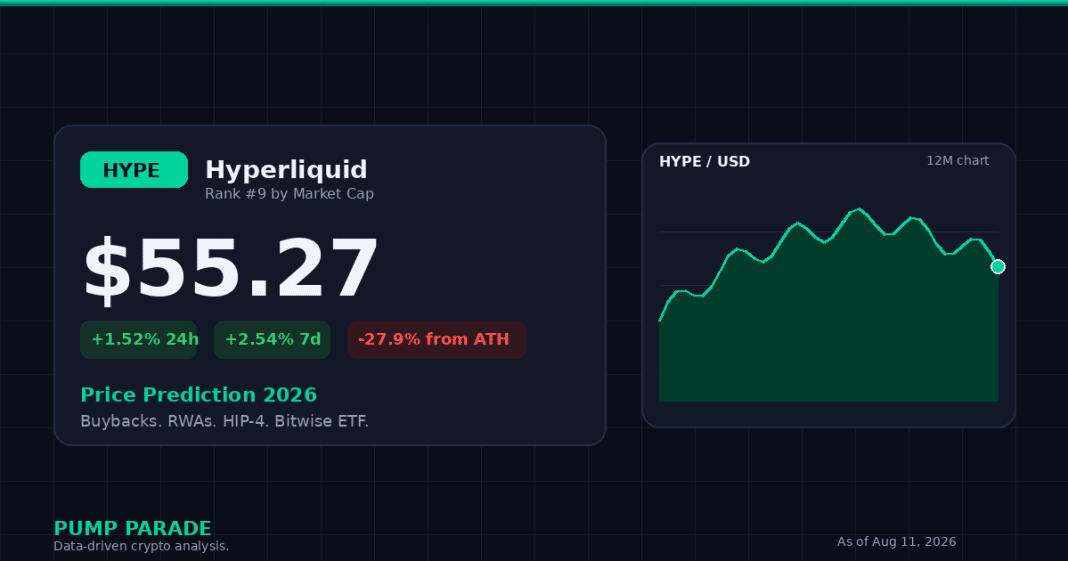
HYPE trades at $55.27 in early August 2026, down roughly 28% from the June all-time high of $76.67. That is not a collapse. That is a token digesting the biggest 6-month run in perpetual DEX history while the market waits for the next narrative catalyst. Q2 delivered a 79.2% HYPE gain against a 14.1% Bitcoin decline, and revenue snapped back to an ~$840M annualized run rate. Yet spot ETF flows just flipped to their first monthly outflow.
Which side wins the next 90 days? This Hyperliquid price prediction 2026 lays out the bull case, the bear case, and specific price targets across three timeframes, grounded in on-chain data, protocol revenue, and the RWA plus HIP-4 catalysts nobody is fully pricing in yet.
If you want the short version, HYPE reclaiming $75 by year-end requires three things: sustained RWA volume growth, HIP-4 prediction markets going live on mainnet, and ETF flows turning positive again. Two of three probably gets you $65-$70. All three opens a path to $85+.
Key Takeaways
- HYPE trades at $55.27, down 28% from the $76.67 all-time high set on June 16, 2026.
- Roughly 97-99% of protocol fees flow into the Assistance Fund, which has bought about 44.4M HYPE off the open market to date.
- RWA-linked open interest hit a record $3.6B in July, with 52% of platform volume already coming from tokenized real-world assets.
- Bull case: HIP-4 prediction markets, RWA growth, and Bitwise ETF flows drive HYPE back to $75-$85 by December 2026.
- Bear case: fee decay outpaces buybacks and unlock supply pressure caps HYPE below $50 through year-end.
- Base case target: $60-$68 by December, assuming steady revenue and neutral ETF flows.
Where Does HYPE Stand Today?
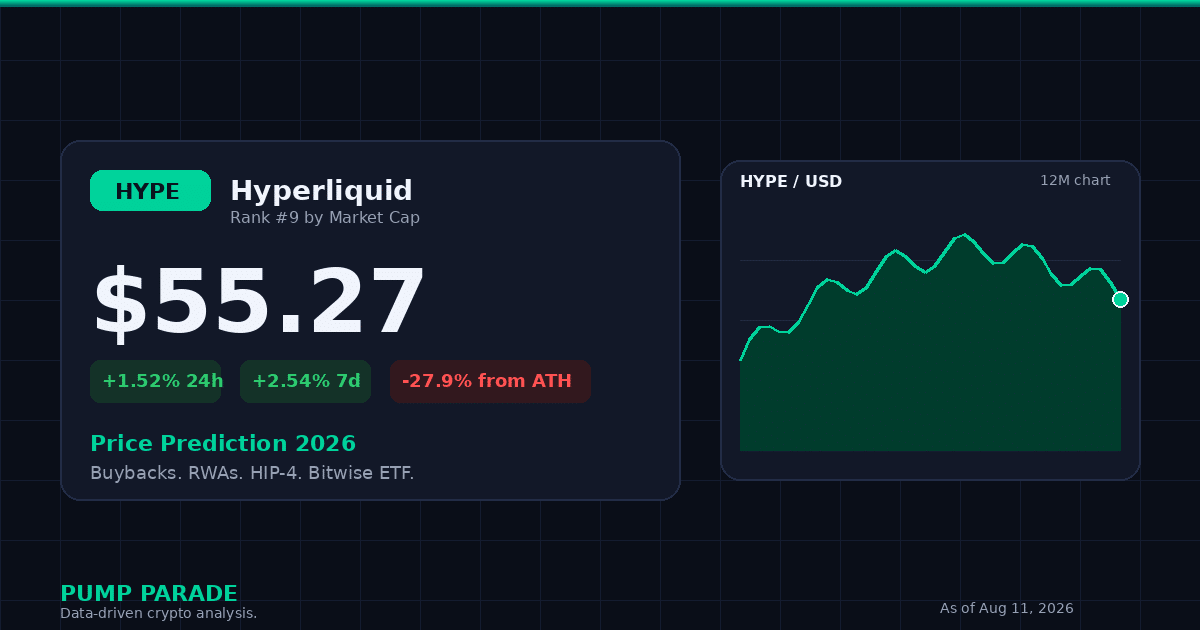
Hyperliquid sits at rank 9 by market cap, with HYPE priced at $55.27 and a fully diluted valuation north of $18B. Trading volume has stayed elevated even through the summer chop, and the token has held the $50 psychological level on every retest since the June high. That is the setup you want if you are looking for a base.
Here is the snapshot as of August 11, 2026:
| Metric | Value |
|---|---|
| Price (USD) | $55.27 |
| 24h Change | +1.52% |
| 7-Day Change | +2.54% |
| Market Cap | ~$18.4B |
| Market Cap Rank | #9 |
| All-Time High | $76.67 (June 16, 2026) |
| % From ATH | -27.9% |
| Annualized Revenue | ~$840M |
Two data points to hold onto. First, HYPE has already round-tripped a full pump cycle in 2026, which means the current price is not built on airdrop hype anymore. It is built on cash flow. Second, roughly $18-$20 of the current $55 print is directly attributable to the Assistance Fund’s buyback bid over the trailing 12 months. Take away the buybacks and HYPE looks very different.
Why Is HYPE Trading Sideways Right Now?
Three overlapping forces have pinned HYPE between $50 and $60 for most of July and August. Understanding them matters more than any short-term chart pattern.
The first is a mechanical supply-demand mismatch. The Assistance Fund deploys $53M to $83M per month in open-market buybacks depending on fee revenue. At the current 30-day fee run rate, monthly emissions arriving from vesting schedules and validator rewards are roughly ten times the monthly demand the protocol itself provides. Buybacks are large, but they are not a floor by themselves.
The second is macro. Bitcoin has been range-bound between $60K and $72K since May, and altcoin beta compresses in a Bitcoin chop tape. HYPE has held up better than most L1s, but the tape has not let it break out either.
The third is the ETF picture. HYPE spot ETFs recorded a $4.55M net outflow in July, the first monthly outflow after two strong months. Cumulative inflows still stand at $288.59M, which is meaningful, but the direction of flow matters more than the absolute number for a token this reflexive.
The Bull Case
Prediction markets go permissionless via HIP-4
Hyperliquid is opening HIP-4 to permissionless deployment. Any operator willing to lock 500,000 HYPE, roughly $31.7M at current prices, can spin up their own prediction market on the platform. That is a structural HYPE demand mechanism (both stakers and validators lock supply) and a competitive shot at Polymarket. If HIP-4 attracts meaningful volume, revenue re-rates upward and the buyback engine gets stronger, per CryptoSlate reporting.
Real-world assets keep eating the volume mix
RWA-linked open interest hit a record $3.6B in July 2026, and RWAs already account for 52% of platform trading volume. A Cryptobriefing projection puts that at 75% by 2027. RWAs bring institutional flow, longer holding periods, and more stable fee generation than perpetual futures on memecoins. If that mix continues to shift, HYPE stops trading like a DeFi token and starts trading like an exchange equity with a token buyback program attached.
The Bitwise BHYP ETF and institutional access
The Bitwise Hyperliquid ETF (BHYP) went live earlier this year, joined by filings from 21Shares and others. Bitwise is the largest fund by AUM. If August or September delivers a return to positive net inflows, HYPE gains an institutional bid on top of the Assistance Fund’s mechanical buyback bid. That is the two-bidder setup that produced the June rally.
The Bear Case
Fee decay outpaces the buyback
The buyback engine is powerful, but it is a function of fees, and fees are cyclical. A quiet Bitcoin market cuts perp volume, and lower perp volume cuts the Assistance Fund’s dry powder. If the ratio of net emissions to buyback demand widens further from its current ~10x level, price gravity is downward regardless of narrative.
Unlock overhang and validator selling
HYPE still has meaningful supply arriving through team, investor, and validator schedules. Even at slow drip rates, tokens hitting exchanges add to the mechanical selling pressure that buybacks have to absorb. This is why any monthly fee slowdown compounds quickly.
Prediction-market execution risk
HIP-4 sounds great on paper. Execution is not free. Oracle risk, dispute resolution, and market-making depth are all non-trivial. If early permissionless markets deliver a high-profile failure or exploit, the narrative flips and Hyperliquid loses the “safer than Polymarket” positioning it needs to attract institutional operators.
Hyperliquid Price Prediction 2026: Targets by Timeframe
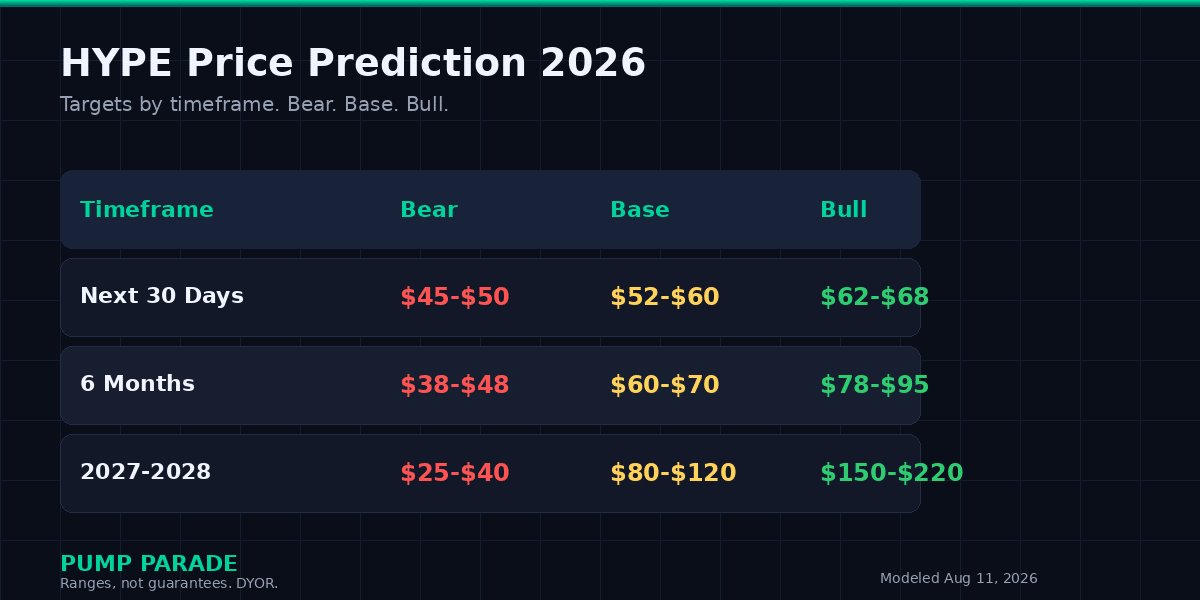
The tables below reflect three scenarios modeled from current revenue run-rate, buyback dry powder, and observed ETF flow sensitivity. They are ranges, not point predictions.
Next 30 Days (through mid-September 2026)
| Scenario | Target | Trigger |
|---|---|---|
| Bear | $45-$50 | ETF outflows continue, BTC breaks $58K |
| Base | $52-$60 | Current range holds, no HIP-4 mainnet news |
| Bull | $62-$68 | HIP-4 mainnet date confirmed, ETF flows flip positive |
6 Months (through February 2027)
| Scenario | Target | Trigger |
|---|---|---|
| Bear | $38-$48 | RWA volume growth stalls, fee run rate cuts 30%+ |
| Base | $60-$70 | RWA share reaches 60%, ETF AUM adds $300M+ |
| Bull | $78-$95 | HIP-4 attracts multiple large operators, BTC breaks $80K |
Long-Term (2027-2028)
| Scenario | Target | Trigger |
|---|---|---|
| Bear | $25-$40 | Competitor perp DEX takes 30%+ market share |
| Base | $80-$120 | RWA share hits 75%, HYPE trades like exchange equity |
| Bull | $150-$220 | Prediction markets become dominant, Arthur Hayes thesis plays out |
For context, Arthur Hayes has publicly targeted $150 for HYPE, citing organic volume, buyback demand, and HIP-4 expansion, according to CryptoSlate. That is roughly our bull-case long-term target.
How Does Hyperliquid Compare to dYdX?
The closest structural competitor to Hyperliquid is dYdX. Both are perp DEXs with native tokens, both have transitioned toward increased decentralization, and both compete for the same institutional order flow. The comparison below focuses on the metrics that matter for a price prediction.
| Metric | Hyperliquid (HYPE) | dYdX (DYDX) |
|---|---|---|
| Market Cap | ~$18.4B | ~$400M |
| Rank | #9 | Outside top 100 |
| Annualized Revenue | ~$840M | ~$60M |
| Native L1 | Yes (custom) | Yes (Cosmos) |
| Buyback Mechanism | Assistance Fund, 97-99% of fees | Partial fee share to stakers |
| Spot ETF Listed | Yes (Bitwise BHYP) | No |
| RWA / Prediction Market Roadmap | HIP-4 + tokenized RWAs live | Roadmap in discussion |
| Q2 2026 Token Return | +79.2% | -12% |
The takeaway is that Hyperliquid is not really competing on the same axis anymore. It has become the reference perp DEX with meaningful institutional infrastructure, while dYdX is battling for share. That gap explains why HYPE trades at a premium and also why any misstep gets punished harder.
For a fuller side-by-side of perp DEX architecture and fees, see our earlier Hyperliquid vs GMX comparison.
What Would Change Our View
Three specific triggers would move us out of the base case in either direction.
First trigger, bullish: HIP-4 permissionless prediction markets ship to mainnet with at least three external operators locking the 500K HYPE stake within 60 days of launch. That is a durable demand shock that removes 1.5M+ HYPE from circulating supply.
Second trigger, bearish: HYPE ETF net outflows extend to three consecutive months, or the Assistance Fund reduces its buyback percentage below 90% of fees. Either signals that the mechanical bid buyers depend on is losing force.
Third trigger, structural: A competitor perp DEX with a credible token model, real institutional partnerships, and lower fees takes 20%+ of Hyperliquid’s daily perp volume within two quarters. Market share compression is the one thing the buyback engine cannot fix.
Frequently Asked Questions
Will HYPE reach $75 by end of 2026?
Our base case does not get HYPE back to $75 by December, but our bull case does. The path requires HIP-4 mainnet launch, sustained RWA growth toward 60% of platform volume, and ETF flows flipping positive again. Two of three probably gets you $65-$70. All three unlocks $75-$85.
Is HYPE a good investment right now?
HYPE at $55 is trading at roughly 22x annualized revenue, which is reasonable for a growth token with a working buyback engine. The upside case is real but hinges on execution catalysts, not just macro. Position size accordingly, and treat it as a high-beta bet on the perp DEX category, not a defensive holding.
What is the HYPE price prediction for 2027?
Base case for 2027 targets $80-$120, assuming RWA volume share reaches 75% and prediction markets add a second meaningful revenue line. Bull case pushes toward $150-$220, matching Arthur Hayes’s public thesis. Bear case brings HYPE back to $25-$40 if competitors compress market share.
Why is HYPE down from its all-time high?
HYPE is down about 28% from the June 16, 2026 ATH of $76.67 because macro has been sideways, ETF flows recently turned negative for the first time, and supply-side unlocks are outpacing buyback demand by roughly 10x at the current fee run rate. None of these are structural breaks. They are cyclical.
What is HIP-4 and why does it matter for HYPE price?
HIP-4 is Hyperliquid’s upgrade that added fully collateralized prediction markets in February 2026. The pending enhancement opens the system to permissionless deployment, requiring operators to lock 500,000 HYPE per market. That locked supply plus additional fee revenue makes HIP-4 one of the highest-conviction HYPE demand catalysts through year-end.
Is Hyperliquid safer than centralized exchanges?
Hyperliquid runs a permissioned validator set and a custom L1, so it is more decentralized than a CEX but less than a fully public chain. Custody is non-custodial, and there is no single point of failure like a CEX exit. That said, oracle risk and validator risk are real. Treat it as a middle ground.
The Honest Take
HYPE is one of the cleanest fundamental stories in crypto right now, and that is exactly why the market gives it very little room to disappoint. Revenue is real. The buyback engine is real. The catalyst pipeline through year-end (HIP-4 permissionless, continued RWA growth, ETF flows) is real. If two of those three fire, $65-$75 is a reasonable target for December.
But HYPE is also a token where the mechanical supply and demand math determines a lot of the price, and right now emissions run at roughly 10x the buyback bid. That gap has to close, either through more fees or fewer tokens hitting the market. Anyone underwriting a HYPE-back-to-$75 thesis needs to have a view on which of those two variables moves first.
If you are watching one thing over the next 30 days, watch the HIP-4 mainnet launch date. If you are watching two, add the monthly ETF flow print. The signal-to-noise ratio on those two data points is higher than the price chart.
For related coverage on liquid staking and DeFi yield opportunities in the same ecosystem, our Pendle price prediction and Aave price prediction are worth a look.
Disclaimer: This article is for informational and educational purposes only and should not be construed as financial, investment, or trading advice. Cryptocurrency markets are highly volatile, and past performance does not guarantee future results. The price predictions and analyses presented here are based on AI models, technical indicators, and available data at the time of writing. They are not guarantees. Always conduct your own research (DYOR) and consult with a qualified financial advisor before making any investment decisions. Pump Parade and its authors do not assume liability for financial losses incurred based on information provided in this article.