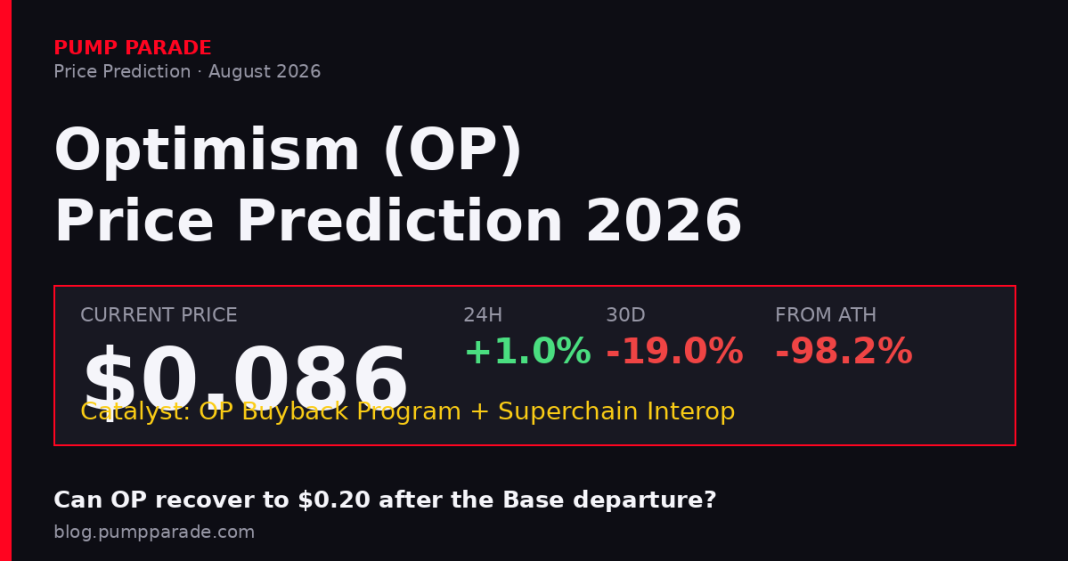
Optimism (OP) trades at roughly $0.086 as of August 2026, down 98% from its March 2024 all-time high of $4.84 and down 19% in the last 30 days. The Optimism price prediction picture in 2026 got messier in February, when Coinbase’s Base chain announced its migration off the OP Stack, wiping out roughly 96.5% of the Optimism Collective’s gas fee base overnight. The token dropped 28% in 48 hours and printed an all-time low of $0.12 shortly after, according to Coindesk reporting.
The bull case did not disappear. It just got harder. This article breaks down where OP stands right now, the two catalysts that could still take it back to $0.20 by year end, the risks that could send it lower, and what price triggers would change our view.
Key Takeaways
- OP trades near $0.086, roughly 98% below its all-time high, with a $200M market cap and rank 162.
- The OP token buyback program, live since February 2026, directs 50% of net Superchain sequencer revenue into monthly OP purchases.
- Base’s migration off the OP Stack removed the largest single source of sequencer fees, creating a real revenue hole.
- Our base case sees OP between $0.10 and $0.14 by year end 2026, with a $0.20 bull target only if interop ships on time and TVL grows.
- A close below $0.075 would invalidate the bullish setup and open the door to fresh lows.
Where Optimism (OP) Stands Today
The Optimism price prediction conversation has to start with the current setup. OP is a governance token for the Optimism Collective, the entity behind the OP Stack and the broader Superchain. It launched in June 2022 and has spent most of the last two years in a downtrend against both Bitcoin and Ethereum.
Here is the snapshot at time of writing, sourced from CoinGecko:
| Metric | Value |
|---|---|
| Price | $0.086 |
| 24h change | +1.0% |
| 7d change | -8.8% |
| 30d change | -19.0% |
| Market cap | $200M |
| 24h volume | $26M |
| Rank | 162 |
| All-time high | $4.84 (Mar 2024) |
| From ATH | -98.2% |
Volume to market cap sits around 13%, which is healthy for a token in a downtrend. It means real traders are still positioning, not just holders sitting on bags.
Why is Optimism trading this low right now?
Two forces are pressing on OP at the same time.
The first is the Base departure. In its February 2026 engineering post, Base announced it would consolidate its infrastructure under a unified, Base-operated stack to speed up its own development cycle. Base was not just any OP Stack chain. On-chain data cited by The Defiant and CCN pegged Base at roughly 96.5% of the Optimism Collective’s total gas fee revenue. That is a single point of failure most token holders had not priced in.
The second is the broader Layer 2 fee compression story. Since the Dencun and Pectra upgrades on Ethereum, blob fees have collapsed and every rollup is competing for a smaller pie. Even without the Base news, sequencer revenue across the Superchain would be under pressure. Combine the two and you get the current chart: a long slide, punctuated by that February air pocket, followed by low-volume grinding sideways.
The bright spot is that whales have been quietly accumulating. On-chain data cited by CCN showed large wallets adding OP in the days immediately after the Base news, betting that the sell-off was overdone. That does not guarantee a bottom, but it does mean informed money is not treating this as a zero.
The Bull Case for OP in 2026
Catalyst 1: The OP token buyback program
In January 2026, Optimism governance passed a proposal (84.4% in favor) to direct 50% of net Superchain sequencer revenue into monthly OP token buybacks over a 12-month pilot, per Coindesk’s coverage. The program went live in February 2026.
Before the Base news, the ecosystem was generating around 5,868 ETH annually in sequencer revenue, which mapped to roughly $8M of buy-side pressure per year. That is not enormous for a $200M market cap token, but it is real, recurring, and gives OP something Ethereum-first governance tokens have historically lacked: a value accrual mechanism tied to actual network usage. Post-Base, the run rate is materially lower, but the mechanism is still active. Every dollar of Superchain revenue converts to structural OP demand.
Catalyst 2: Superchain interop rollout
The Interop Layer is scheduled to ship across the Superchain in late 2026. Native cross-chain messaging, ERC-7802-compliant asset bridging, shared fault proofs, and eventually a shared sequencer fee pool are the four building blocks. If interop lands and works, the Superchain stops being a loose federation of Layer 2s and starts behaving like one unified network. That could pull new chains in, retain remaining OP Stack chains like Unichain and World Chain, and give the buyback program more revenue to feed on.
Catalyst 3: Ethereum L2 narrative rotation
Layer 2 tokens have been out of favor for most of 2026, which historically is when they set up their best entries. If Ethereum recovers toward its 2026 targets, the L2 basket typically follows with a beta of 1.5 to 2.0. OP, being one of the most beaten-down names in the group, has room to snap back harder if the rotation materializes.
The Bear Case for OP in 2026
Risk 1: The Superchain revenue hole
Base was 96.5% of the collective’s gas fees. Unichain, World Chain, Mode, Zora, and the other 12 or so Superchain members will not fill that gap quickly. If Superchain revenue stays depressed through the end of 2026, the buyback program becomes a footnote instead of a floor. This is the single biggest risk on the board.
Risk 2: More OP Stack defections
Base leaving lowers the switching cost for other chains to follow. If Unichain or World Chain announces a similar move in the second half of 2026, OP could revisit the $0.075 support and break it. Watch OP Labs communications closely for any hints of retention issues.
Risk 3: Governance token discount
Even with the buyback, OP is still primarily a governance token. In a market that increasingly wants revenue-accruing tokens with clear cash flow (compare with Aave’s fee switch narrative), pure governance tokens tend to trade at a persistent discount. That structural headwind does not go away just because the price is low.
Optimism Price Prediction 2026: Targets by Timeframe
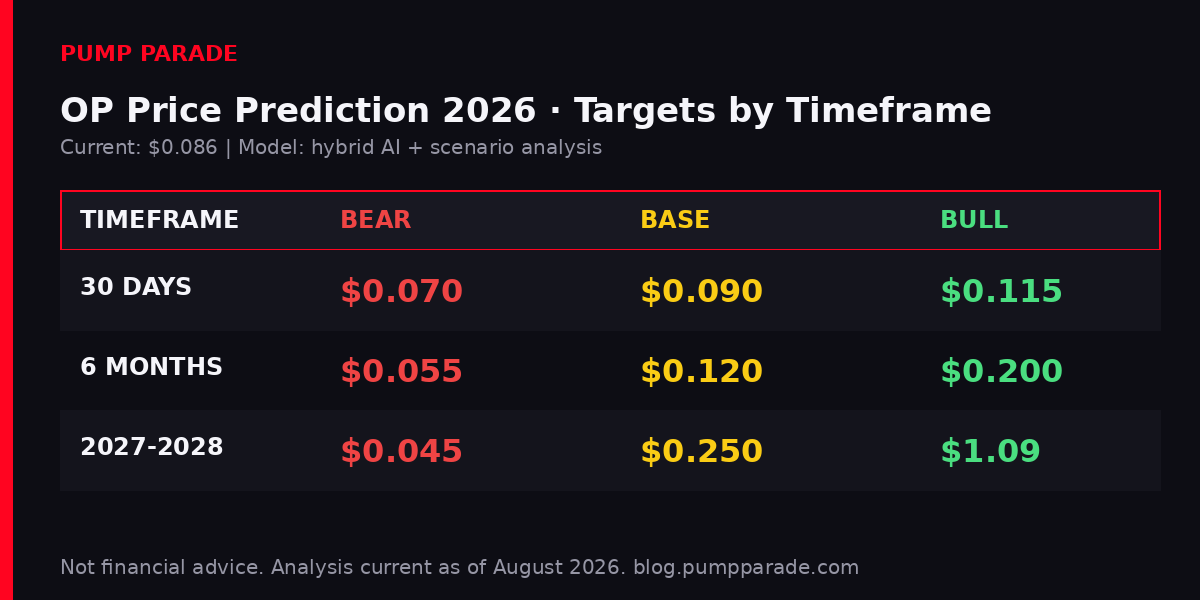
Our AI model and manual scenario work converge on a fairly tight range for the rest of 2026, with a wider band for 2027 as interop either lands or stalls.
| Timeframe | Bear | Base | Bull |
|---|---|---|---|
| 30 days | $0.070 | $0.090 | $0.115 |
| 6 months | $0.055 | $0.120 | $0.200 |
| 2027 to 2028 | $0.045 | $0.250 | $1.09 |
Short term (30 days)
Our AI model assigns roughly a 60% probability that OP stays within a $0.075 to $0.115 range over the next 30 days. Volume is thin, no major catalyst is dated inside the window, and the buyback flow provides a soft floor. The bull scenario requires either a broader crypto rally or a positive announcement from OP Labs about a new Superchain member.
Medium term (6 months)
This is where the interop timeline matters. If the Interop Layer ships in Q4 2026 as planned and OP Labs can point to a chain or two joining the Superchain, our base case is a re-rating toward $0.12 to $0.14. The $0.20 bull target, roughly 2.3x from spot, requires both interop shipping AND Superchain TVL growing 40 to 60% over the next 6 months. That is the growth range referenced in Coinbureau and KuCoin analyst forecasts.
Long term (2027 to 2028)
Consensus 2027 targets from Coindataflow, Cryptopolitan, and Kraken cluster in the $0.10 to $1.09 range, with Coinpedia calling for a 2026 high near $1.09. Our own model is more conservative because of the Base overhang: base case $0.25 by end 2027, bull case $1.09 only if the Superchain regains meaningful market share against Arbitrum Orbit and zkSync’s Elastic Chain.
How does Optimism (OP) compare to Arbitrum (ARB)?
Arbitrum is the natural comparison. Both are optimistic rollups, both have governance tokens with limited direct fee accrual, and both are fighting the same L2 fee compression story.
| Metric | Optimism (OP) | Arbitrum (ARB) |
|---|---|---|
| Price | $0.086 | $0.28 |
| Market cap | $200M | $1.4B |
| Ecosystem model | Superchain (interop) | Orbit chains (sovereign) |
| Direct fee accrual | Yes (50% buyback since Feb 2026) | Timeboost proceeds only |
| Largest chain | OP Mainnet (post-Base) | Arbitrum One |
| From ATH | -98.2% | -95% |
OP is smaller, more beaten down, and has a cleaner value accrual mechanism thanks to the buyback. Arbitrum is larger, more diversified across chains, and has more resilient revenue. If you are picking one for pure asymmetry, OP wins on setup. If you are picking one for downside protection, ARB wins on scale. Neither is a slam dunk.
What would change our view on OP price?
Three specific triggers would move us off the current base case:
Bullish trigger: A new top-15 chain announces it will launch on the OP Stack and join the Superchain. That would signal the ecosystem is still winning developer mindshare despite Base and would justify moving the 6-month base case toward $0.15 and the bull case toward $0.25.
Bearish trigger: A weekly close below $0.075. That is the multi-month support that has held every dip since April 2026. A close below opens the door to $0.055 and possibly a full retest of the $0.045 psychological floor.
Neutral-to-bearish trigger: The Interop Layer slips past Q1 2027. If the timeline drifts, the buyback becomes the only meaningful catalyst, and $0.10 to $0.12 becomes the ceiling for the next 12 months.
Frequently Asked Questions
Will OP recover in 2026?
A partial recovery is realistic if the buyback flow holds and the Interop Layer ships on schedule. Our base case sees OP between $0.10 and $0.14 by year end 2026, roughly 15% to 60% above the current $0.086. A full recovery to prior highs is not in the cards this year, given the Base revenue loss and broader L2 fee compression.
Is Optimism a good investment in 2026?
OP offers asymmetric setup at these levels but comes with real risk. The buyback program creates structural demand, and the token trades 98% below its all-time high. That said, the largest revenue source departed in February, and Layer 2 governance tokens face persistent headwinds. Size the position for the downside, not the upside.
Will OP hit $1?
Not in 2026. A $1 target would require an 11.6x move from current levels, which would need both a full crypto bull cycle and a decisive win on Superchain interop and TVL. Consensus analyst targets from Coinpedia and Kraken put $1.09 in the 2027 to 2030 window, not 2026.
What happened when Base left the OP Stack?
Base announced its migration to a unified, Base-operated stack in February 2026. OP dropped 28% in 48 hours and later printed an all-time low of $0.12. Base had contributed roughly 96.5% of Superchain gas fees, so the departure materially reduced the buyback program’s expected impact. Whales bought the initial dip.
Is Optimism dead?
No, but the growth thesis has narrowed. Optimism is not shutting down, the OP Stack is still active, and Unichain, World Chain, and other Superchain members continue to operate. The token can still recover from here. What is dead is the pre-Base thesis of Optimism as the dominant Layer 2 with unstoppable revenue growth. The new thesis is smaller, slower, and rests on interop delivery.
How does the OP token buyback work?
The Optimism Foundation directs 50% of net Superchain sequencer revenue into monthly OP buybacks. The program launched in February 2026 as a 12-month pilot after 84.4% governance approval. It creates a structural, recurring source of buy-side demand tied directly to how much the Superchain is used.
The Honest Take
Optimism is a broken chart with a real product. That combination attracts contrarian buyers and repels momentum traders in equal measure, which is roughly why the price grinds sideways in low volume. The buyback program is genuinely differentiating. The Base loss is genuinely damaging. Interop is genuinely important. All three are true at the same time, and none of them is priced in with certainty.
The tradable setup is a range: $0.075 on the downside, $0.115 on the upside, with a break in either direction meaningful. Above $0.115 on volume, the path to $0.15 and then $0.20 opens up. Below $0.075 on a weekly close, the bear thesis takes over. In between, this is a patience trade, not a conviction trade. For readers watching the broader Ethereum ecosystem, keep an eye on how Uniswap’s Unichain performs on OP Stack, since Unichain volume is now one of the most visible tests of whether the Superchain can grow without Base.
Disclaimer: This article is for informational and educational purposes only and should not be construed as financial, investment, or trading advice. Cryptocurrency markets are highly volatile, and past performance does not guarantee future results. The price predictions and analyses presented here are based on AI models, technical indicators, and available data at the time of writing, they are not guarantees. Always conduct your own research (DYOR) and consult with a qualified financial advisor before making any investment decisions. Pump Parade and its authors do not assume liability for financial losses incurred based on information provided in this article.