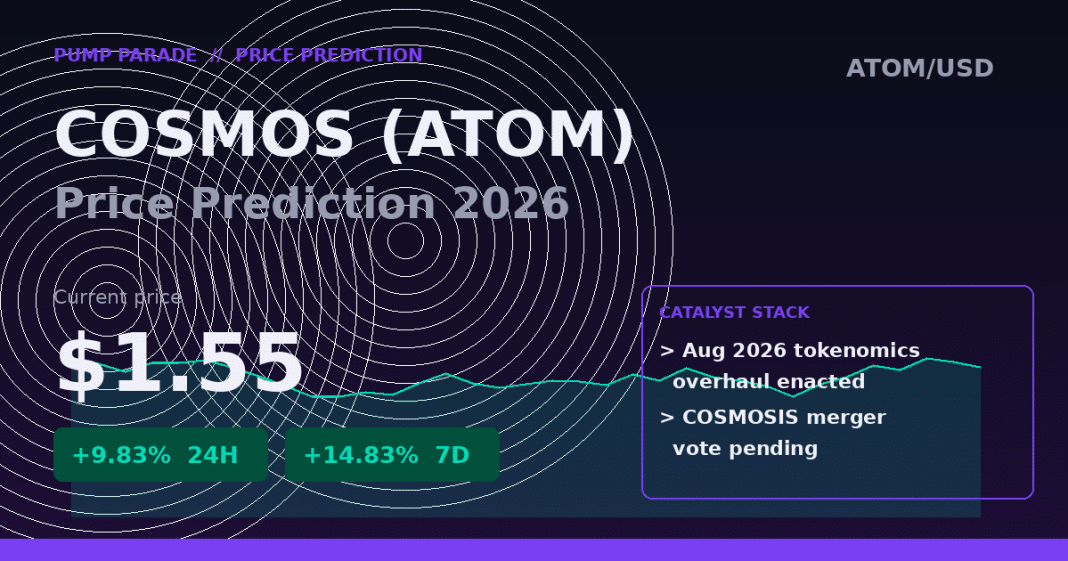
Cosmos ATOM price prediction 2026 conversations look completely different than they did six months ago. ATOM is trading at $1.55, up 9.8% in 24 hours and 14.8% over the last week. That is the strongest weekly move ATOM has printed all summer, and it is landing right as the Cosmos Hub finalizes the most aggressive economic overhaul in its history.
The Hub just enacted a tokenomics rewrite in August 2026 that swaps out inflationary rewards for a fee-driven buyback-and-burn model. The Osmosis merger proposal, first published in March by co-founder Sunny Aggarwal, is grinding through governance. And Interchain Security keeps quietly adding paying consumer chains that route fees back to ATOM stakers.
So the real question is not whether ATOM bounces. It already bounced. The question is whether the fundamentals finally justify a re-rating toward $3, $5, or higher, or whether this is just another oversold pop inside a five-year downtrend. Here is what the data says.
Key Takeaways
- ATOM trades at $1.55, market cap $606M, ranked #90, still down 96.5% from its January 2022 all-time high of $44.55.
- The August 2026 tokenomics overhaul flips ATOM from inflationary to potentially net deflationary under sustained fee volume.
- The Osmosis merger would convert roughly 665 million OSMO at a 0.0355 ratio and route DEX revenue back to ATOM stakers.
- Base case for late 2026: $2.00 to $3.25. Bull case if merger passes and burns activate: $3.50 to $5.50.
- Biggest risk: governance stalls, the merger fails, and ATOM slips back into its multi-year descending channel.
Where Cosmos (ATOM) Stands Today
Before we get to targets, look at what the market is pricing right now. This is not a moonshot chart. This is a battered layer-1 with a real recovery setup and a live catalyst calendar.
| Metric | Value |
|---|---|
| Price | $1.55 |
| 24h change | +9.83% |
| 7d change | +14.83% |
| Market cap | $606 million |
| 24h volume | $45.2 million |
| Market cap rank | #90 |
| All-time high | $44.55 (Jan 2022) |
| % from ATH | -96.5% |
Volume expanded roughly 280% in the last 24 hours. That is the tell. A 15% weekly rally with contracting volume is a bounce inside a downtrend. A 15% rally with a nearly 4x volume expansion is participation, and participation is what separates real trend reversals from bear market rallies.
Why is ATOM rallying right now?
Three things are stacking at the same time, and that is unusual for a token that has spent most of 2026 grinding lower inside a descending channel.
First, the August 2026 tokenomics overhaul officially enacted this month. Cosmos is moving from a high-inflation staking model to a fee-driven buyback and burn. Under the new design, protocol revenue accrues to ATOM through repurchases instead of being diluted away by fresh emissions. In plain terms: the Hub finally decided to stop paying its stakers with its own printing press.
Second, the Osmosis merger is progressing through governance. Osmosis co-founder Sunny Aggarwal published the COSMOSIS proposal in March 2026. If it passes, roughly 665 million OSMO gets converted into ATOM at a 0.0355 exchange ratio, and Osmosis, which generated about $5.5 million in revenue last year against only $550,000 in operating costs, funnels that profit stream to ATOM holders. That is not a governance rounding error. That is DEX revenue rerouted to the Hub.
Third, Interchain Security continues to add consumer chains that pay ATOM stakers directly. Every chain that rents Hub security is a permanent fee source. It is a slow-compounding story, but it is a story where the direction is clear.
Stack a real economic redesign, a merger that would consolidate liquidity and governance, and a growing appchain economy paying fees back to the Hub. Now you understand why the tape moved.
The Bull Case for ATOM
Deflationary tokenomics finally activate
This is the biggest one. If the new fee-burn model captures enough revenue to offset remaining emissions, ATOM becomes structurally scarce. Similar shifts on other networks (think ETH’s EIP-1559 flip) preceded meaningful re-ratings. The market has never priced ATOM as a deflationary asset because it has never been one. That could change fast.
Osmosis merger passes
The COSMOSIS proposal, if approved by both chains, does three things at once: reduces circulating supply pressure (converted OSMO gets locked into staking incentives), consolidates DEX revenue under the Hub, and eliminates a competing governance token in the ecosystem. Analysts at CryptoRank flag a $3.50 to $5.50 range for late 2026 as achievable if the merger executes cleanly and the burn model produces measurable supply reduction.
IBC Eureka and CometBFT scaling
The technical roadmap is aggressive: IBC Eureka expands interoperability beyond the Cosmos zone, and CometBFT performance work targets 10,000+ TPS on the Hub. If shipped on schedule, this repositions Cosmos as serious modular infrastructure instead of a stagnating layer-1. Markets pay a premium for credible throughput narratives, and Cosmos historically underprices delivery.
The Bear Case for ATOM
Governance stalls, merger fails
Cosmos governance is famously slow and philosophically divided. The Osmosis merger requires approval on both chains. If either side fails to reach quorum or the community rejects the OSMO-to-ATOM conversion ratio, the primary near-term catalyst evaporates. That would likely send ATOM back toward the $1.20 to $1.35 support zone.
Inflation offsets outrun burns
The new tokenomics only work if fee revenue is large enough to actually turn the burn into net negative supply. If Hub throughput and Interchain Security adoption stay modest, ATOM’s issuance continues to outpace burns, and the deflationary narrative dies before it starts. Bearish analyst targets from Changelly cluster around $1.41 to $1.67 for December 2026.
Competition from purpose-built rivals
Modular blockchain competitors, from Celestia to purpose-built appchain platforms, are moving fast. Cosmos still has a technological moat around IBC, but “we shipped interop first” is a fading argument when execution speed becomes the differentiator. The bear case is not that Cosmos disappears. It is that it stays a top-100 asset instead of climbing back into the top 30.
ATOM Price Prediction 2026: Targets by Timeframe
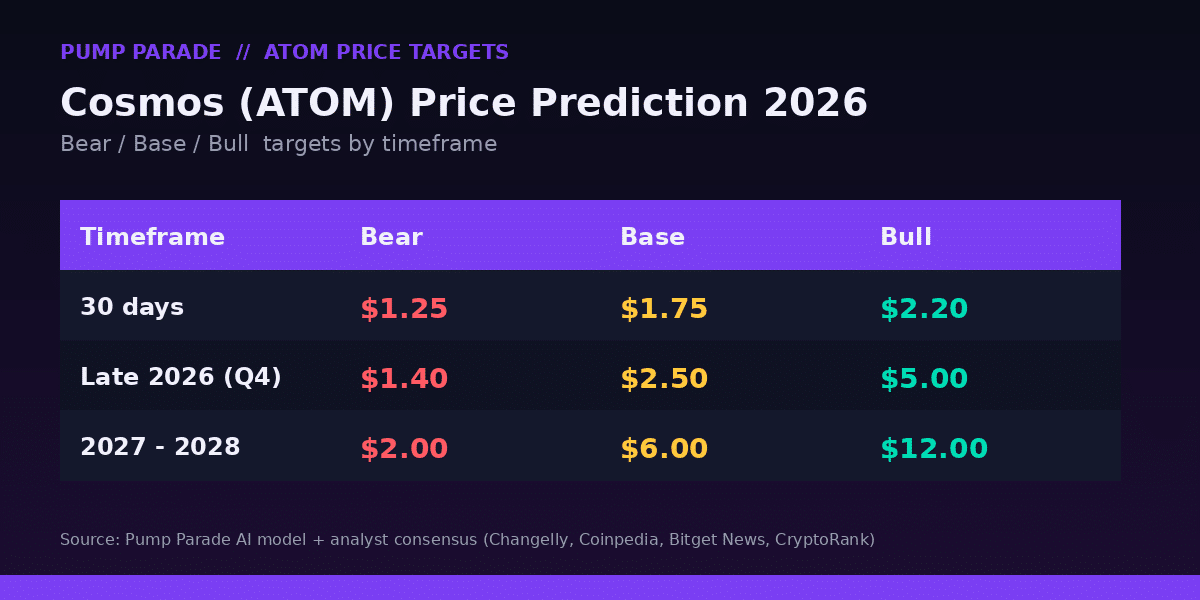
Here is how we map the bear, base, and bull cases across three timeframes. These are scenario ranges, not point forecasts. Every target assumes the reader tracks the invalidation triggers listed further down.
| Timeframe | Bear | Base | Bull |
|---|---|---|---|
| 30 days | $1.25 | $1.75 | $2.20 |
| Late 2026 (Q4) | $1.40 | $2.50 | $5.00 |
| 2027-2028 | $2.00 | $6.00 | $12.00 |
30-day outlook
Short-term momentum favors the bulls after the volume expansion, but ATOM needs to hold above $1.42 to keep the reversal thesis intact. A break of that level puts the $1.25 to $1.30 zone back in play. Upside is capped at roughly $2.20 without a clear governance win.
6-month outlook
By Q4 2026 the market will know whether the Osmosis merger actually passed and whether the burn model is producing measurable supply reduction. Base case is a slow grind into the $2.00 to $3.25 range, matching independent analyst forecasts. Bull case, if both catalysts land clean, extends to $5.00. That would be a 3x from current price, in line with what Coinpedia and Coinbase model under favorable ecosystem conditions.
Long-term (2027-2028)
Multi-year targets are wildly divergent. Changelly’s model reaches into the high-single-digits for 2027 under moderate growth assumptions. Bitget News flags a $12 aspirational scenario tied to sustained IBC growth and successful modular positioning. We think $6 is a realistic long-term base if execution stays on track, and $12 requires a broader risk-on cycle where mid-cap L1s meaningfully re-rate. See CoinMarketCap’s live ATOM page for real-time market context as this plays out.
How does Cosmos (ATOM) compare to Polkadot (DOT)?
The closest apples-to-apples comparison is Polkadot (DOT). Both are interop-focused layer-1s with app-chain economies, and both spent 2025-2026 trying to reboot their tokenomics. Here is how they stack up right now.
| Metric | Cosmos (ATOM) | Polkadot (DOT) |
|---|---|---|
| Interop model | IBC (permissionless) | XCM (shared security) |
| Consensus | CometBFT | GRANDPA/BABE |
| App-chain security | Optional (ICS) | Shared by default |
| Tokenomics 2026 | Fee burn (new) | JAM redesign |
| Ecosystem strength | dYdX, Neutron, Celestia lineage | Parachain slots, Kusama |
| Market cap | $606M | ~$4.5B |
| % from ATH | -96.5% | -94% |
DOT has more market cap and more institutional attention. ATOM has the simpler upgrade story and lower entry price. If you believe interop is a winner-take-most category, DOT is the safer bet. If you believe the modular thesis rewards permissionless chain-launching plus a live catalyst calendar, ATOM has more asymmetric upside from these levels.
Is ATOM a good investment in 2026?
The bull side: ATOM is priced like a failed layer-1 and about to be tested against active catalysts. If any two of the three (tokenomics burn, Osmosis merger, ICS growth) deliver, the current $1.55 will look like an entry point in retrospect. The bear side: ATOM has disappointed for three straight years, governance moves slowly, and the market has learned to fade Cosmos catalysts. Both takes have receipts.
The honest framing: ATOM is a medium-conviction recovery trade with clearly defined invalidation levels. It is not a long-term thesis you set and forget. It is a setup where the next 90 days will tell you whether the recovery holds. Position accordingly.
What Would Change Our View
Three explicit scenario triggers to watch:
- Bullish trigger: Osmosis merger governance passes with clean quorum on both chains AND the first monthly burn report shows net negative supply. That would validate the deflationary case and open the $3.50 to $5.50 zone.
- Bearish trigger: ATOM loses the $1.42 support on daily close with rising volume, and the merger vote fails or gets postponed. That combination sends the setup back into the descending channel with $1.20 the next real support.
- Long-term invalidation: Twelve months of the new tokenomics model produce burns smaller than continued emissions. That would mean the redesign is not materially deflationary, and the market will re-price ATOM as an inflating asset again.
Cosmos ATOM Price Prediction: What are the top FAQs?
Will Cosmos ATOM reach $5 in 2026?
Under a bull case where the Osmosis merger passes and the new fee-burn model produces net deflationary supply, $5 is achievable by late 2026. That is roughly a 3x from current price. Under a base case, ATOM trades in the $2.00 to $3.25 range. Under a bear case, it stays sub-$1.75 for most of the year. The catalyst calendar over the next 90 days will tell you which path is unfolding.
Is Cosmos ATOM a good investment in 2026?
ATOM offers asymmetric upside from current levels because it is priced near multi-year lows while active fundamental catalysts are approaching governance decisions. The risk is that Cosmos governance is historically slow and past catalysts have underdelivered. Treat it as a medium-conviction recovery trade with defined stop levels, not a long-term buy-and-hold thesis.
Why has ATOM underperformed for so long?
ATOM’s core problem was that value accrual to the Hub never matched the growth of the wider Cosmos ecosystem. Chains built on Cosmos SDK, from dYdX to Celestia, captured huge value without paying meaningful fees back to ATOM holders. High inflation on the Hub compounded the pain. The August 2026 tokenomics overhaul directly addresses both issues, which is why this setup is different.
What is the Osmosis merger and why does it matter?
The COSMOSIS proposal, published in March 2026 by Osmosis co-founder Sunny Aggarwal, would convert about 665 million OSMO into ATOM at a 0.0355 ratio and merge Osmosis DEX infrastructure directly into the Cosmos Hub. It matters because it consolidates DEX liquidity under the Hub, routes DEX revenue to ATOM stakers, and reduces circulating governance token supply across the ecosystem.
What is the long-term ATOM price prediction for 2027-2028?
Analyst forecasts vary widely. Changelly and Coinpedia cluster around $4 to $8 for 2027 under moderate growth. Bitget News highlights $12 as an aspirational scenario tied to sustained IBC adoption and modular thesis validation. Our base case for 2027-2028 sits at $6 with $12 achievable only in a broader risk-on cycle where mid-cap layer-1s meaningfully re-rate.
How does ATOM compare to other Cosmos ecosystem tokens?
ATOM secures the Hub and now captures fees from Interchain Security consumer chains. Tokens like Injective (INJ) and Celestia (TIA) use Cosmos SDK but have separate token economies. If the Cosmos thesis is right long term, all three benefit, but ATOM is the coordination asset with the clearest catalyst calendar in Q3-Q4 2026.
The Honest Take
ATOM in August 2026 is not a story about ripping to new highs. The all-time high is $44.55 and we are 96% below that. The story is whether a battered, undervalued layer-1 with a fresh economic redesign and a live merger vote can grind back into the $3 to $5 range where the market takes it seriously again.
The catalyst stack is real. The volume expansion is real. The competition is also real, and Cosmos governance has a documented history of underdelivering. If you are trading this, size it as a recovery play with $1.42 as your invalidation level and $5 as your bull target for late 2026. If you are long-term allocating, wait for the first monthly burn report to confirm the tokenomics are actually working before adding size.
Either way, this is the most interesting setup ATOM has offered in eighteen months. Watch it closely.
Disclaimer: This article is for informational and educational purposes only and should not be construed as financial, investment, or trading advice. Cryptocurrency markets are highly volatile, and past performance does not guarantee future results. The price predictions and analyses presented here are based on AI models, technical indicators, and available data at the time of writing, they are not guarantees. Always conduct your own research (DYOR) and consult with a qualified financial advisor before making any investment decisions. Pump Parade and its authors do not assume liability for financial losses incurred based on information provided in this article.