Choosing between Binance and Bybit in 2026 is the single most consequential decision most crypto traders will make this year. Pick the right one and you get deep liquidity, low fees, and a product shelf that stretches from spot and futures to Earn, launchpads, and payments. Pick the wrong one and you pay 20% more in fees, miss the token listing that mattered, or find yourself locked out of the derivatives contract you actually wanted to trade.
Both exchanges have grown fast. Binance now sits above 300 million registered users and processed roughly $34 trillion in product volume across 2025, according to its year-end disclosures. Bybit crossed 70 million users in May 2025 and holds about 21% of global derivatives market share. On paper they look similar. In practice, they target different traders.
This head-to-head goes deeper than fee tables. We benchmark spot and futures costs, product breadth, security track records, regional access, and the user experience that actually matters when you are 10 minutes into a liquidation spiral. By the end you will know which platform fits your trading style, and which one is worth skipping.
Visit Binance or visit Bybit if you already know what you want. Otherwise, read on.
TL;DR: Which Exchange Wins in 2026?
Short on time? Here is the quick verdict.
- Pick Binance if you want the deepest spot liquidity in crypto, the broadest Earn and staking menu, lower futures taker fees at base tier, and a one-stop shop for everything from launchpads to card payments.
- Pick Bybit if you lean heavily on copy trading, want a cleaner derivatives interface, prize fast new token listings, or trade altcoin perpetuals where Bybit often has quoted-tight spreads.
- Avoid both if you are in the United States. Binance.US is a limited standalone and Bybit does not serve US users at all. US residents should look at Kraken or Coinbase instead.
Binance is the better all-rounder. Bybit is the better specialist. The rest of this review explains why, with numbers.
Quick Comparison Table
Here is the 2026 snapshot side by side before we dig into each category.
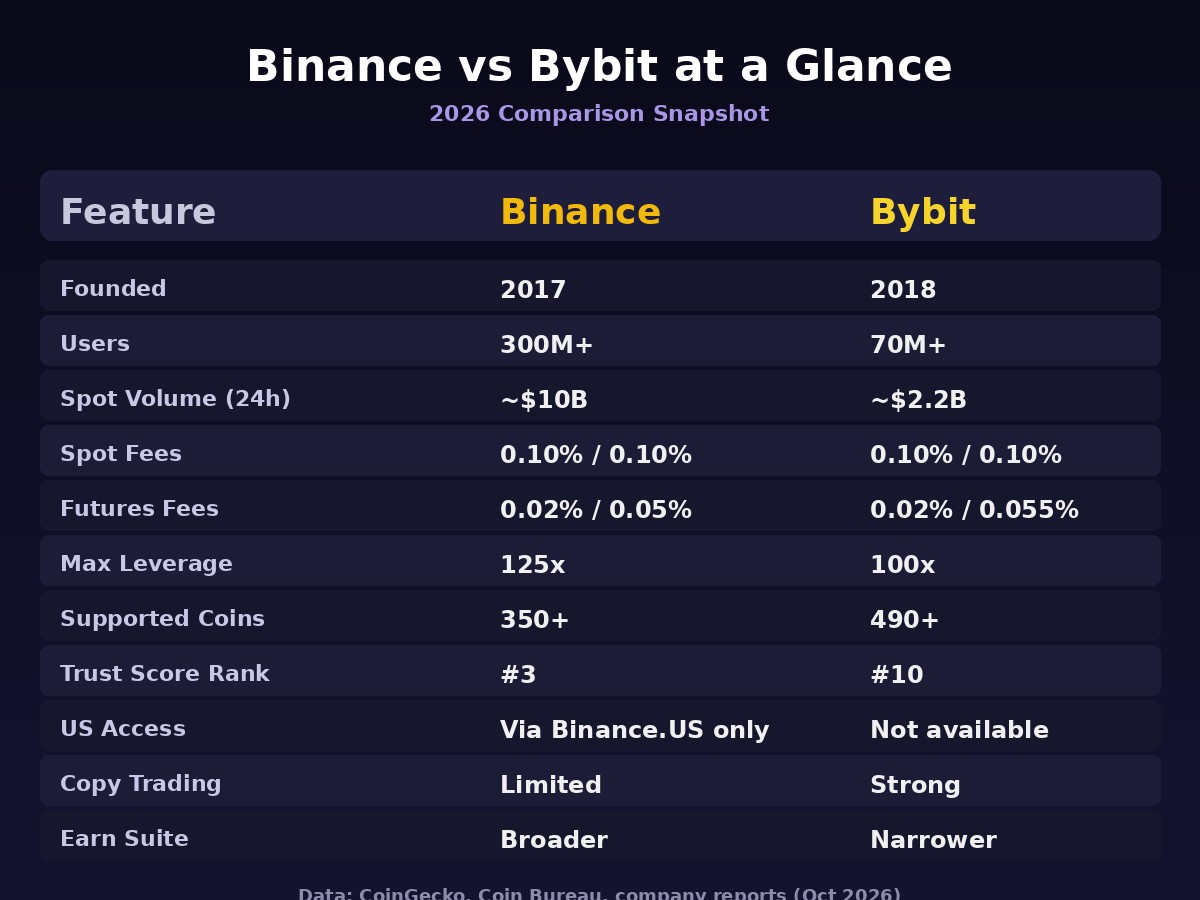
Both exchanges list identical spot fees at the base tier. The real differences show up in futures taker fees, product depth, and non-fee factors like security track record and regional access. We break each down below.
Company Overview
Binance launched in July 2017 under Changpeng Zhao, raised capital via its own BNB token sale, and within two years became the largest crypto exchange by trading volume. It is now headquartered in the Cayman Islands with a regulated hub in Abu Dhabi, holds 29 global certifications per its own disclosures, and spans spot, futures, options, margin, Earn, launchpad, NFT, Pay, and Alpha (its Web3 trading layer).
Bybit launched in March 2018 out of Singapore and originally focused on perpetual futures. Over the next few years it expanded into spot, options, Earn, and copy trading. It is incorporated in the British Virgin Islands and holds a MiCAR license in Austria that covers 29 EEA countries. Bybit built its reputation on fast execution and derivatives-first UX, and that identity still shapes the product today.
The two exchanges have different center of gravity. Binance is a universal platform. Bybit is a derivatives platform with everything else bolted on.
Spot Trading: Fees and Liquidity
Spot fees at the base tier are identical: 0.10% maker and 0.10% taker on both platforms. The real differences surface in the discounts available for active users.
Binance offers a 25% discount when fees are paid in BNB, dropping the effective rate to 0.075% maker and 0.075% taker. VIP tiers unlock further reductions, with VIP 9 going as low as 0.012% maker and 0.024% taker. BNB holders also get discounted withdrawal fees and priority access to launchpad events.
Bybit runs VIP tiers that reduce fees based on 30-day trading volume and BIT or asset holdings. Standard VIP 1 is 0.075% maker and 0.080% taker, with the top VIP Pro tier reaching 0.005% maker and 0.025% taker. Bybit frequently runs promotional zero-fee pairs for new listings, which is more aggressive than Binance.
Liquidity is where Binance pulls ahead decisively. Per CoinGecko data as of October 2026, Binance processes roughly 122,100 BTC in 24-hour spot volume (around $10 billion at current prices), compared to Bybit’s 27,000 BTC (around $2.2 billion). That is nearly 5x the depth, which translates to tighter spreads on majors and less slippage on size.
Binance also lists around 350+ cryptocurrencies on spot, while Bybit lists roughly 490+ coins. Bybit’s longer list skews toward newer tokens and memecoins; Binance’s list skews toward established assets with higher volume. If you are hunting fresh launches, Bybit is often faster to list. If you are trading majors, Binance is the deeper book.

Derivatives: Futures, Options, and Leverage
Both exchanges built their reputations on derivatives, and this is where the comparison gets interesting.
Binance Futures offers USDT-margined and COIN-margined perpetuals, plus quarterly futures and a growing options suite. Base fees are 0.02% maker and 0.05% taker, with VIP tiers bringing takers down to 0.017%. Max leverage reaches 125x on select contracts, though most pairs are capped lower based on open interest and user tier. Options are available on BTC and ETH with European-style settlement.
Bybit Derivatives focuses on perpetual futures with USDT, USDC, and inverse (coin-margined) pairs. Base fees are 0.02% maker and 0.055% taker, slightly higher taker than Binance at the standard tier. Max leverage is 100x, and Bybit was one of the first exchanges to launch USDC-margined perpetuals, which appeals to traders who want segregated collateral.
Bybit’s edge in derivatives shows up in two places. First, its copy trading product is genuinely best in class, with over 800,000 followers and transparent leaderboards. Binance has copy trading but treats it as a secondary feature. Second, Bybit’s altcoin perpetual listings tend to be faster, which matters when a new meme or small-cap launches and you want leveraged exposure within hours.
For sheer volume, Binance still dominates. Open interest and daily derivatives turnover on Binance exceeds Bybit by a wide margin. For specialized derivatives tooling, Bybit holds its ground.
Earn, Staking, and Yield Products
This is where the gap between the two exchanges widens most dramatically.
Binance Earn is the broadest yield shelf on any centralized exchange. It includes:
- Simple Earn: flexible and locked savings on 300+ assets
- ETH Staking: liquid staking with WBETH as the receipt token
- SOL Staking: liquid staking with BNSOL
- Dual Investment: structured products with defined upside and downside
- Launchpool: stake BNB to earn new tokens before they list
- Megadrop: a newer launchpad variant
- On-chain yield: curated DeFi strategies without leaving the Binance app
Bybit Earn is narrower. It covers flexible savings, basic staking on a smaller list of assets, structured products, and on-chain yield routed through its Web3 wallet. The APRs are often competitive, but the menu is a fraction of what Binance offers. If you want a one-click way to put spare USDT to work across 10 different strategies, Binance has it. Bybit will have 2 or 3.
For passive-income traders this gap matters. Binance treats Earn as a core pillar. Bybit treats it as a side feature.
Security and Trust
Security is the single most important criterion when picking an exchange, and here the two platforms have very different stories.
Binance maintains the SAFU fund (Secure Asset Fund for Users), an insurance pool that covered losses from its 2019 hack of 7,000 BTC. The exchange publishes a monthly proof-of-reserves report using Merkle tree verification, and holds over $162.8 billion in user assets per its year-end 2025 disclosures. CoinGecko gives Binance a trust score rank of #3 among all exchanges.
Bybit publishes proof of reserves on the same cadence and claims 1:1 asset backing. Its trust score rank sits at #10. The more complicated piece of Bybit’s security story is the February 2025 Ethereum cold wallet hack, in which attackers linked by the FBI to North Korea’s Lazarus Group drained roughly $1.4 to $1.5 billion in ETH and related tokens. Bybit kept processing withdrawals throughout the incident, reimbursed affected users from its own treasury within hours, and has since overhauled its custody architecture.
How you weight this depends on your priorities. Bybit’s post-hack response was arguably the most professional in crypto history and demonstrated real reserves. But the fact that a hack of that scale occurred less than two years ago is a real data point. Binance’s own 2019 hack was smaller in absolute dollars and happened under different custody tech.
Both exchanges run bug bounties, 2FA (with hardware key support), withdrawal address whitelisting, and anti-phishing codes. Neither is uninsurable in principle, but Binance has the longer uneventful track record since 2019.
User Experience: Mobile, Web, and Pro Interfaces
Binance’s web interface is dense. It gives you power at the cost of a steep learning curve. The Advanced view is a professional-grade order book platform with depth charts, order history, position management, and 200+ chart indicators via TradingView integration. The Classic view strips everything back to the essentials. For new users this can be overwhelming.
Bybit’s web interface is cleaner by design. The Spot and Derivatives tabs are visually consistent, order entry is streamlined, and the overall look is closer to a modern SaaS product than Binance’s older design. Mobile apps on both platforms are strong, with Binance leaning denser and Bybit leaning cleaner.
For first-time crypto users Bybit is easier to onboard. For power users who want every lever within reach, Binance’s density is a feature rather than a bug.
Fiat Access and Payment Methods
Binance supports fiat deposits in 80+ currencies via bank transfer, SEPA, Faster Payments, Binance Pay, and the Binance Card. Peer-to-peer markets (P2P) are the strongest in the industry and let users in restricted regions buy crypto with local payment methods. Binance Pay works at tens of thousands of merchants globally.
Bybit supports fiat on-ramps via credit card, bank transfer in select regions, and the Bybit Card. Its P2P market is smaller than Binance’s. For users in emerging markets who need flexible fiat rails, Binance’s P2P advantage is significant.
Regional Availability and Compliance
Both exchanges have patchwork regulatory status, and getting this wrong can mean account closures.
Binance is unavailable in the United States (use Binance.US instead, which has only around 200 assets), Canada, the Netherlands, Cuba, North Korea, Iran, and Crimea. It holds licenses or registrations in dozens of jurisdictions and is actively pursuing MiCA compliance in the EU.
Bybit is restricted in the United States, Canada, Singapore, Hong Kong, Mainland China, Dubai (post-regulation), and several other jurisdictions. The MiCAR license in Austria opens up most of the EEA. Bybit does not plan to re-enter the US market in the near term.
If you are a US resident, neither is an option. Consider our Kraken review or Coinbase review for US-friendly alternatives.
Pros and Cons
Binance Pros
- Deepest spot liquidity in crypto (around $10B daily)
- Broadest Earn and staking suite in the industry
- BNB fee discount of 25% stacks with VIP tiers
- Launchpad, Launchpool, and Megadrop for free token distributions
- Strong P2P markets for fiat on-ramps in 80+ currencies
- Lower futures taker fee at base tier (0.05% vs 0.055%)
- SAFU insurance fund and no major hack since 2019
Binance Cons
- Interface can overwhelm new users
- Not available in the US (Binance.US is a limited substitute)
- Has faced ongoing regulatory scrutiny in multiple regions
- Launchpad allocations have become harder to win at scale
- Country restrictions apply more broadly than some competitors
Bybit Pros
- Cleaner and more modern interface, especially for derivatives
- Industry-leading copy trading product with 800K+ followers
- Faster listings for new tokens and memecoins
- USDC-margined perpetuals for segregated collateral
- Transparent VIP tiering with achievable thresholds
- MiCAR license covers the EEA
- Impressive post-hack response in 2025 reinforced its reserves credibility
Bybit Cons
- 2025 hack of $1.4 to $1.5 billion is still a recent data point
- Narrower Earn and staking menu than Binance
- Not available in the US at all
- Lower spot liquidity on majors (around $2.2B daily vs $10B)
- Slightly higher futures taker fee at base tier
- Smaller fiat on-ramp network
Who Should Pick Which
The right answer depends on how you trade.
Pick Binance if you are:
- A long-term holder who wants the broadest Earn menu and the deepest spot book
- A fiat-first user in a region where P2P matters
- An active trader who will hit VIP tiers and benefit from BNB discounts
- Someone who wants a true one-stop crypto platform including payments and launchpads
Pick Bybit if you are:
- A derivatives-first trader who prizes clean execution and USDC margin
- A copy-trading participant, either as a follower or a lead trader
- An altcoin hunter who wants early access to new listings
- A European user who values the MiCAR license and audit cadence
For most readers, Binance is the safer default. But if any of the Bybit bullets describe you, do not force the Binance choice.
Final Verdict
In 2026 Binance remains the king of centralized crypto exchanges. The combination of deepest liquidity, broadest Earn suite, strongest fiat rails, and lower base-tier futures taker fees is hard to beat. Its 300 million user base and $34 trillion annual volume are not an accident. For a trader who wants a single platform to cover every use case, Binance is the pick.
Bybit is not far behind, and in several categories it wins outright. Copy trading, USDC-margined derivatives, altcoin listing speed, and a cleaner interface are all genuine advantages. The 2025 hack is a real knock, but the response arguably demonstrated the exchange’s financial health better than any proof-of-reserves report could have.
Our final scorecard: Binance 4.6 out of 5 and Bybit 4.3 out of 5. If you can only pick one, go Binance. If you trade derivatives primarily, keep a Bybit account on the side.
Ready to try either? Open a Binance account or sign up for Bybit. For other exchange reviews, see our Kraken review or recent Raydium review.
Frequently Asked Questions
Is Binance safer than Bybit?
Binance has the longer uneventful track record, with no major hack since 2019 and the SAFU insurance fund as a backstop. Bybit suffered a $1.4 to $1.5 billion hack in February 2025, but reimbursed users immediately from treasury and overhauled its custody. Both now publish regular proof-of-reserves reports. In terms of raw history, Binance edges ahead; in terms of post-incident response, Bybit demonstrated real financial strength.
Which exchange has lower fees?
Spot fees are identical at 0.10% maker and taker on both platforms at the base tier. On futures, Binance has a slightly lower taker fee (0.05% vs 0.055%). Binance offers a 25% BNB fee discount, which can stack with VIP tiers. Bybit’s VIP tiering is more achievable at mid-volume levels and can match Binance at upper tiers. Overall, Binance is marginally cheaper for most traders.
Can I use Binance or Bybit in the United States?
Neither global platform supports US users. Binance operates a separate limited US entity called Binance.US with roughly 200 assets. Bybit does not serve US users at all. US residents should consider Kraken, Coinbase, or Gemini for compliant alternatives.
Does Bybit have copy trading, and is it worth it?
Yes, Bybit’s copy trading is one of the best in the industry, with over 800,000 followers and transparent leaderboards showing lead trader performance, drawdown, and win rate. It is particularly useful for new traders who want exposure to active strategies without managing positions themselves. Binance offers copy trading too, but it is less developed and less central to the product.
Which exchange is better for altcoin trading?
Bybit tends to list new altcoins and memecoins faster than Binance, and its perpetual futures menu for small-cap tokens is often more aggressive. Binance has deeper liquidity on established altcoins but can be slower to list new tokens. If early access is your edge, Bybit is often the better venue; if liquidity on established assets matters more, Binance wins.