If you interact with more than one EVM chain, you already know the pain. You switch networks manually, you sign transactions blind, and every so often a shady contract quietly drains a token you approved months ago. Rabby Wallet, built by the team behind DeBank, tries to fix all three problems in a single browser extension. In 2026, is it good enough to replace MetaMask as your daily EVM wallet? Here is the full breakdown.
Quick Verdict: 4.6 / 5
Rabby is the safest, most DeFi-friendly EVM wallet you can install today. Its pre-transaction simulation, one-click approval revocation, and auto chain switching solve real problems that MetaMask has ignored for years. The only reason not to use it: you need Solana, Bitcoin, or another non-EVM chain. Rabby is EVM-only, so most active users end up pairing it with a Solana wallet like Phantom.
Best for: Active DeFi users, multi-chain EVM traders, anyone tired of signing blind.
Skip if: You only touch Solana or Bitcoin, or you want a single wallet for every ecosystem.
What Is Rabby Wallet?
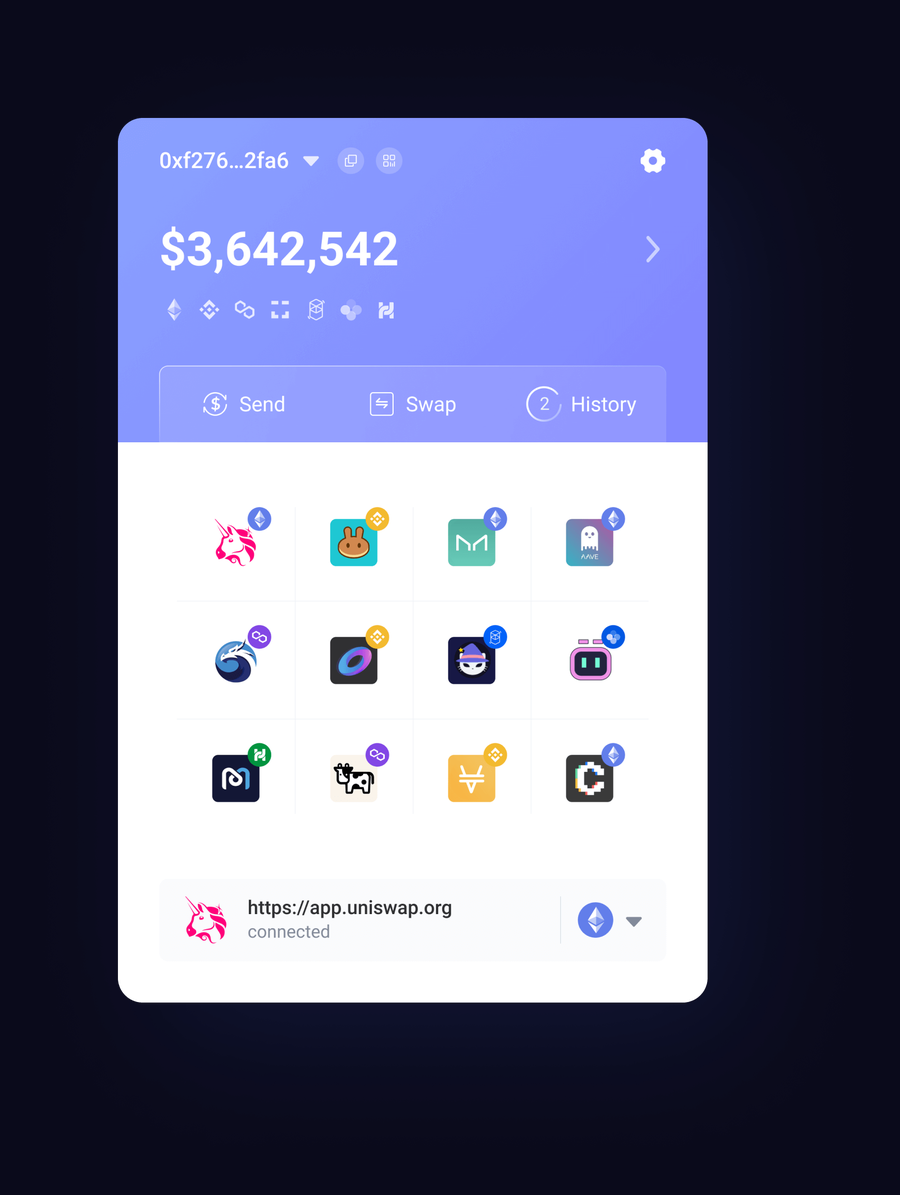
Rabby is a non-custodial browser extension and mobile wallet designed specifically for Ethereum and EVM-compatible chains. It launched in 2021 as a companion product to DeBank, the leading DeFi portfolio dashboard, and has grown into one of the most trusted alternatives to MetaMask for power users.
The wallet is fully open source under the MIT license and audited by two independent firms: Least Authority (2024, re-reviewed 2025) and SlowMist (2025). That is a stricter license than MetaMask, whose code is source-available but proprietary.
Rabby supports over 100 EVM chains out of the box, including Ethereum, Arbitrum, Optimism, Base, Polygon, BNB Chain, Avalanche, Blast, Scroll, Linea, and dozens more. There is no manual RPC setup. You visit a dApp on any supported chain and Rabby switches automatically.
Rabby Wallet Key Stats (2026)
- Type: Non-custodial browser extension, iOS and Android mobile apps
- Chains supported: 100+ EVM networks
- Built by: DeBank team
- License: MIT open source
- Audits: Least Authority (2024, 2025), SlowMist (2025)
- Native token: None
- Cost: Free to download and use
- Hardware wallet support: Ledger, Trezor, Keystone, GridPlus, imKey, OneKey
Feature Deep Dive
1. Pre-Transaction Simulation
This is the headline feature and the main reason people switch. Before you sign anything, Rabby runs the transaction on its own simulation nodes and shows you exactly what will happen. Which tokens leave your wallet, which arrive, which contracts get called, and whether the transaction is likely to revert.
MetaMask has been catching up in this area but Rabby has done it longer and does it more clearly. If you approve a token, Rabby tells you the exact spender address and how much you are approving. If a contract looks malicious, you see a red warning before your signature ever hits the network. In a year where phishing kits have gotten scarily good at mimicking real dApp UIs, this alone is worth switching for.
2. Automatic Chain Switching
Open a Base dApp and Rabby switches to Base. Move to an Arbitrum protocol and it switches to Arbitrum. You never see the “wrong network” popup that has annoyed MetaMask users since 2020. For anyone who touches more than two chains per session, this saves a stunning amount of time.
3. Approval Management
Rabby ships with a built-in Approvals page that lists every active token allowance across every EVM chain you have used. You can sort by risk, filter by contract, and revoke permissions in a single click without paying a separate service like Revoke.cash. In an era when a lot of DeFi exploits trace back to stale approvals from long-dead protocols, this feature is a real safety win.
4. Built-In Swap Aggregator
Rabby integrates a swap aggregator that routes across major EVM DEXs and aggregators (0x, 1inch, ParaSwap, Uniswap, KyberSwap, and OpenOcean depending on chain). Quotes are transparent and you can compare all sources side by side before choosing.
The swap adds a small routing fee that is baked into the quote you see, which is competitive with MetaMask’s swap and cheaper than Coinbase Wallet’s. For anyone who does a lot of small swaps, this saves the friction of hopping to a separate DEX aggregator.
5. Multi-Chain Portfolio View
Because Rabby is built by the DeBank team, its portfolio view is one of the strongest in any wallet. You get a unified balance across every EVM chain, DeFi position tracking for hundreds of protocols, and NFT display. If you have used DeBank as a standalone dashboard, this is essentially that experience baked into your wallet.
6. Mobile App
Rabby launched its mobile app for iOS and Android in late 2025, and by 2026 feature parity with the extension is close but not identical. Transaction simulation, chain switching, and approvals all work on mobile. The swap aggregator is available. Hardware wallet support on mobile is limited compared to the extension.
Fees & Pricing
Rabby is free to download and free to use. There is no subscription, no premium tier, and no paywall for advanced features. The only cost is the standard gas fee for every on-chain transaction, which goes to network validators, not to Rabby.
The one place Rabby earns revenue is the built-in swap aggregator, which adds a routing fee (typically 0.25 percent) that is included in the quoted price. If you find a better rate elsewhere you can, of course, use a different DEX and pay only gas.
Compared to Phantom, which now charges a small percentage on its swap product, and MetaMask, which takes a higher swap fee, Rabby’s economics are trader-friendly.
Security & Trust
This is where Rabby genuinely stands apart.
- Fully open source under MIT license. Anyone can audit the code, and independent researchers regularly do.
- Two rounds of professional audits from Least Authority and SlowMist. Reports are public.
- Non-custodial by design. Your seed phrase never touches Rabby’s servers. Private keys are encrypted locally with a password of your choice.
- Hardware wallet support for Ledger, Trezor, Keystone, GridPlus, imKey, and OneKey. Air-gapped signing is supported for Keystone and Ngrave.
- Anti-phishing risk scanner that cross-checks contract addresses against known scam databases and flags suspicious approvals in real time.
No wallet is a silver bullet against user error, but Rabby’s default settings assume you might sign something dangerous and try to stop you first. That is the right posture in 2026.
User Experience
The UI is clean, dense, and clearly built for people who know what a router contract is. If you are brand new to crypto, MetaMask’s more guided onboarding might feel gentler. If you have been through more than a handful of transactions, Rabby feels faster and more informative.
The dashboard shows your total balance across all chains with a single glance at DeFi positions, tokens, and NFTs. Swap history, activity, and pending transactions all live in one panel. The signing flow itself is where Rabby shines: every popup shows the simulated result before you commit.
Onboarding takes about two minutes. You install the extension, create a wallet or import a seed phrase, set a password, and you are done. No email, no KYC, no account creation.
Pros
- Best-in-class pre-transaction simulation, which prevents most common scam signatures
- Automatic chain switching across 100+ EVM networks
- One-click approval management, no third-party revoke tool needed
- Fully open source (MIT) with public audits from Least Authority and SlowMist
- Free to use with no premium tiers
- Strong hardware wallet support including air-gapped options
- Excellent multi-chain portfolio view courtesy of the DeBank team
- Competitive built-in swap aggregator
Cons
- EVM-only, so no Solana, Bitcoin, XRP, TRON, Sui, or Cosmos support
- Mobile app is newer and slightly less polished than the extension
- UI can feel dense for absolute beginners
- Swap aggregator routing fee, though small, is still a fee
- No native fiat on-ramp inside the extension, so you need Coinbase, MoonPay, or a similar service to get in
Rabby vs MetaMask: The Short Comparison
The clearest way to think about Rabby is as MetaMask with the defaults set for 2026 instead of 2019. Both are free EVM wallets, both are non-custodial, both support hardware wallets. Where they differ:
- Transaction safety: Rabby simulates every transaction by default. MetaMask’s simulator exists but is less thorough.
- Chain switching: Rabby is automatic. MetaMask still asks you to approve every switch.
- Approvals: Rabby ships an approval manager. MetaMask sends you to a third-party site.
- License: Rabby is MIT open source. MetaMask is source-available but proprietary.
- Portfolio view: Rabby uses DeBank data and shows DeFi positions natively. MetaMask’s portfolio view is more limited.
- Ecosystem lock-in: MetaMask has broader dApp compatibility as the default, though Rabby has closed the gap significantly and now works with 99 percent of major EVM dApps.
For pure EVM DeFi work in 2026, Rabby is the better daily driver. If you need MetaMask for a specific dApp integration you can run both at the same time without conflicts.
Who Should Use Rabby?
Active DeFi users on Ethereum L1 and L2s. The simulation alone justifies the switch.
Multi-chain EVM traders. Auto chain switching removes real friction if you routinely bounce between Arbitrum, Base, Optimism, Polygon, and BNB Chain.
Anyone tired of stale approvals. The built-in approval manager is worth the download by itself.
Not for you if: You are Solana-first or Bitcoin-first. For Solana, see our Phantom Wallet review or Backpack Wallet review. For cold storage across many chains, look at Ledger vs Trezor.
Final Verdict: 4.6 / 5
Rabby is the safest, most DeFi-native EVM wallet you can install in 2026. The pre-transaction simulation, approval manager, and auto chain switching collectively solve the three biggest sources of user pain and user loss in the EVM ecosystem. It is free, open source, audited, and backed by a team with a strong track record.
The only real limitation is that it is EVM-only. If your on-chain life spans Solana, Bitcoin, or Cosmos, you will still need a second wallet. But for the EVM half of your portfolio, Rabby is the wallet to beat, and MetaMask has yet to catch up.
Visit Rabby Wallet to download the browser extension or mobile app.
FAQ
Is Rabby Wallet safe?
Yes. Rabby is non-custodial, fully open source under MIT, and has been audited by Least Authority (2024, 2025) and SlowMist (2025). Private keys are stored locally and encrypted with a password you set. That said, no wallet can protect you from every mistake, so hardware wallet use is still recommended for large balances.
Does Rabby support Solana?
No. Rabby is an EVM-only wallet. For Solana, use Phantom or Backpack.
Is Rabby free?
Yes. The wallet is free to download and use with no subscription tier. Rabby earns revenue from a small routing fee (around 0.25 percent) baked into its built-in swap aggregator. You are free to use a different DEX and pay only gas.
Can I use Rabby with a hardware wallet?
Yes. Rabby supports Ledger, Trezor, Keystone, GridPlus, imKey, and OneKey. Keystone and Ngrave offer air-gapped signing for maximum security.
Rabby vs MetaMask, which is better?
For active DeFi users in 2026, Rabby is the stronger daily driver thanks to its simulation-first design, auto chain switching, and native approval manager. MetaMask still has broader ecosystem defaults. Many users install both.
Can I import my MetaMask wallet into Rabby?
Yes. Rabby accepts standard 12 or 24 word seed phrases and private keys, so you can import your existing MetaMask wallet in under a minute. Your assets stay on-chain either way, so both wallets can display the same balances.