Hedera (HBAR) is trading at $0.0675, up 2.57% over the last 24 hours and still sitting roughly 88% below its 2021 all-time high. The network just posted a record 346,943 daily transactions on August 12, T. Rowe Price added HBAR to an actively managed crypto ETF, and the CLARITY Act is inching toward a Senate floor vote. If you searched for a Hedera price prediction 2026, you are trying to answer one question: does any of that add up to a real move, or is this another quarter of the same enterprise story we have heard for years?
This article works the numbers. We pull current market data from Binance, compare analyst targets from Cryptopolitan, Changelly and Coinpedia, stress test the bull case against the bear case, and give you 30-day, 6-month, and long-term price ranges you can actually track. No hopium, no shilling, and a clear list of what would change our view.
Key Takeaways
- HBAR trades at $0.0675, up 2.57% in 24 hours, still 88% below its September 2021 all-time high of $0.5701.
- The base case for a Hedera price prediction 2026 clusters around $0.10 to $0.20, with analyst targets ranging from $0.18 (Cryptopolitan) to $0.35 (Coinpedia bull case).
- Three catalysts matter: the CLARITY Act, spot HBAR ETF flows via T. Rowe Price and Grayscale filings, and enterprise transaction growth (Aug 12 record: 346,943 daily txs).
- The bear case: HBAR was excluded from Mastercard’s list of eight approved settlement blockchains, and enterprise pilots convert to production slowly.
- Our AI model favors a base target near $0.10 by mid-2026, with a bull scenario at $0.20 if regulatory and ETF catalysts stack in Q1.
Where HBAR Stands Today
Hedera has been the definition of range-bound in 2026. After failing to reclaim $0.10 in March, HBAR has spent most of the summer chopping between $0.055 and $0.085. The 2.57% bounce over the last 24 hours pushed price back above the $0.0665 pivot that has acted as short-term resistance since July.
Here is the snapshot at time of writing, sourced from Binance and CoinGecko:
| Metric | Value |
|---|---|
| Price | $0.0675 |
| 24h change | +2.57% |
| 24h high / low | $0.0680 / $0.0658 |
| Market cap rank | ~#30 |
| 24h volume (HBAR) | 56.9M HBAR |
| All-time high | $0.5701 (Sep 2021) |
| % from ATH | -88.2% |
| Daily tx record | 346,943 (Aug 12, 2026) |
The mix matters. A token 88% off its high with rising on-chain activity and stalled price is either a coiled spring or a value trap. Our job is to tell you which one the data supports.
Why is HBAR range-bound right now?
Three things are pinning HBAR in the $0.06 to $0.08 zone.
First, the market has already priced in a lot of the “enterprise blockchain” story. Google, IBM, Boeing and Deutsche Telekom have been on Hedera’s governing council for years. Traders want the next catalyst, not the existing one.
Second, spot HBAR ETF flows are real but small. The July 23 print showed roughly $540,000 in daily inflows. That is enough to move a low-cap altcoin, but not enough to overpower profit-taking from wallets that bought under $0.05 in Q1.
Third, altcoin correlation to Bitcoin has been high, and Bitcoin has been sideways. Until BTC breaks its range or altseason narrative flows return, individual altcoin catalysts get muted.
The Bull Case for HBAR in 2026
1. The CLARITY Act finally passes
The CLARITY Act creates a clear regulatory framework separating securities from commodities in US crypto markets. HBAR, alongside XRP and XLM, is one of the tokens that benefits most from this classification clarity because it has faced years of ambiguity about whether it is a security under US law. If the bill clears the Senate this quarter, expect a re-rating in payment and enterprise tokens. Similar clarity events (XRP’s 2023 court win, spot BTC ETF approval) drove 40% to 70% moves in the following 90 days.
2. Institutional ETF wrapper expands
T. Rowe Price, which manages roughly $1.5 trillion in assets, has added HBAR to an actively managed crypto ETF. Grayscale and 21Shares have separate filings that reference HBAR. Institutional wrappers do not need to attract billions to move HBAR: with a circulating market cap under $3 billion, even $50M to $100M in monthly ETF flows can shift the marginal price meaningfully.
3. Real network usage is climbing
The August 12 record of 346,943 daily transactions is not synthetic. Hedera’s fee model (fractions of a cent per transaction) has attracted supply chain, carbon credit and RWA (real-world asset) tokenization projects that generate steady on-chain volume rather than speculative spikes. If enterprise pilots convert into production revenue by year end, the fundamental case tightens.
The Bear Case for HBAR in 2026
1. Mastercard’s exclusion signals institutional preference
Mastercard’s Crypto Partner Program lists eight approved blockchains for institutional settlement. XRP’s ledger is on that list. Hedera is not. That is a specific, checkable data point that undermines the “HBAR is the enterprise winner” narrative. In a world where corporates pick one or two chains for real money movement, exclusion compounds.
2. The enterprise story is a slow burn
Enterprise pilots do not move like DeFi TVL. A supply chain client that signs a Hedera pilot in Q1 might generate $50k of on-chain fees in Q4. That is great for the network, but it is not the kind of catalyst that moves a token 3x. Traders wanting a 2026 breakout need retail flows, and retail follows narratives, not procurement cycles.
3. Broader altcoin macro is unproven
Bitcoin dominance has held above 55% for most of 2026. Historically, HBAR outperformance requires BTC dominance to roll over and capital to rotate down the risk curve. If that rotation does not happen, HBAR grinds sideways regardless of ETF flows or CLARITY. This is the risk that most bull-case models under-weight.
Hedera Price Prediction 2026: Targets by Timeframe
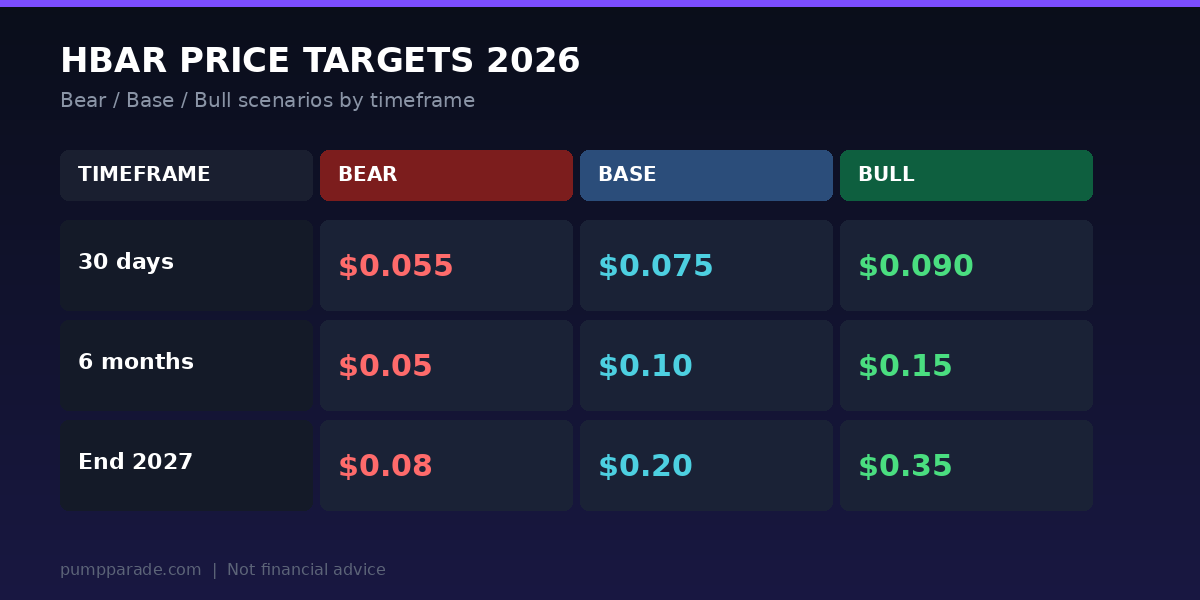
Here is our framework, cross-checked against analyst estimates from Cryptopolitan, Changelly and Coinpedia. All numbers assume you are willing to re-check them as macro shifts.
30-day (through mid-September 2026)
Bear: $0.055. Base: $0.075. Bull: $0.090. The immediate resistance is $0.075 (July high). A daily close above that opens $0.085, then $0.095. On the downside, losing $0.062 exposes the summer low near $0.055.
6-month (through Q1 2027)
Bear: $0.05. Base: $0.10. Bull: $0.15. This range brackets the two paths: either the CLARITY Act plus continued ETF inflows re-rate the token into the $0.10 to $0.15 zone, or macro chops the altcoin bid and HBAR retests $0.05. Base case: $0.10 is the round number that historically acts as both magnet and lid.
Long-term (end of 2027 and beyond)
Bear: $0.08. Base: $0.20. Bull: $0.35. A Hedera price prediction 2026 that extends to end of 2027 needs to price in either enterprise revenue that actually shows up in on-chain fees, or a full crypto bull cycle. Cryptopolitan places HBAR near $0.24. Coinpedia’s bull scenario reaches $0.35 to $1.05, but the higher end assumes a repeat of 2021 mania. Our base at $0.20 is what the current setup supports without heroic assumptions.
For a broader read on how ETF flows are affecting altcoin pricing, our Ethereum price prediction 2026 walks through the same catalyst framework for ETH.
How does Hedera compare to XRP?
The most useful comparison for HBAR is XRP: both are payment and enterprise plays, both use non-standard consensus, both spent years fighting regulatory uncertainty. Here is how they stack up as of today.
| Metric | HBAR | XRP |
|---|---|---|
| Price | $0.0675 | $1.004 |
| 24h change | +2.57% | +0.86% |
| Consensus | Hashgraph (aBFT) | Ripple Protocol Consensus |
| Founders | Leemon Baird, Mance Harmon | Chris Larsen, Jed McCaleb |
| Governing body | Hedera Council (39 orgs) | Ripple Labs |
| On Mastercard settlement list | No | Yes |
| Spot ETF exposure | T. Rowe active ETF, Grayscale filing | Multiple spot ETF filings |
| Circulating supply | ~42.4B HBAR | ~59.6B XRP |
XRP has the retail brand, the Mastercard nod, and a Ripple sales team that runs point on enterprise integrations. HBAR has better tech on paper (aBFT hashgraph is genuinely different from a chain) and a broader governing council. If you want to go deeper on the direct competitor, read our XRP price prediction 2026.
What would change our HBAR view?
Three specific triggers would push us to update the base case.
Upside trigger: HBAR closes two consecutive weeks above $0.10 on rising volume, with spot ETF net inflows above $5M per day. That combination has historically preceded 40% to 80% moves in mid-cap payment tokens. If it happens, we shift the base case to $0.15 and open a bull case at $0.30.
Downside trigger: The CLARITY Act stalls in the Senate and BTC dominance climbs above 60%. In that scenario, altcoin flows dry up and HBAR retests $0.05. We would move the base to $0.075 and the bull ceiling to $0.12.
Regime change trigger: Mastercard adds Hedera to its approved settlement list, or a top three ETF issuer files a spot HBAR ETF. Either would signal that institutional preference is broadening beyond XRP, and would justify targets in the $0.20 to $0.35 zone.
Frequently Asked Questions
Will HBAR reach $1 in 2026?
Almost certainly not. A move to $1 from current levels is roughly a 15x from $0.0675 and would require HBAR to reclaim its 2021 all-time high and then double it, in a single year. No analyst we tracked (Cryptopolitan, Changelly, Coinpedia base cases, LeveX) forecasts $1 by end of 2026. The realistic 2026 ceiling is $0.20 to $0.35 in a strong bull scenario.
Is HBAR a good investment in 2026?
HBAR is a leveraged bet on two specific outcomes: US regulatory clarity via the CLARITY Act, and spot HBAR ETF flows continuing to build. If both hit, the risk-reward from $0.0675 looks favorable. If neither does, HBAR grinds sideways. It is not a passive hold: you need to track catalysts. As always, size positions to your risk tolerance and never allocate money you cannot lose.
What is the Hedera price prediction 2026?
Our base case is $0.10 by mid-2026, with a bear scenario at $0.05 and a bull scenario at $0.20 if the CLARITY Act passes and ETF flows accelerate. Third-party analyst estimates cluster in a similar zone: Cryptopolitan at $0.18 to $0.24, Coinpedia base at $0.20, LeveX at $0.10 to $0.30.
Why is Hedera going up today?
HBAR is up 2.57% in the last 24 hours on a mix of factors: reclaiming the $0.0665 short-term resistance, follow-through from the August 12 daily transaction record, and continued spot ETF inflows via the T. Rowe Price active crypto ETF. It is a technical bounce inside a larger range, not a confirmed trend reversal.
Is Hedera better than XRP?
Technically, hashgraph consensus offers faster finality and lower fees than XRP’s ledger. Commercially, XRP has the bigger enterprise integration footprint and inclusion in Mastercard’s settlement list. If you weight tech, HBAR wins. If you weight distribution and institutional adoption, XRP wins. The market currently rewards distribution.
Will the CLARITY Act affect HBAR price?
Yes, likely positively. HBAR is one of the tokens most exposed to US regulatory ambiguity because Hedera has US-based governance and enterprise sales motion. If the CLARITY Act creates a clean commodity classification path, we would expect a 30% to 60% re-rating within 90 days of passage, based on comparable events (spot BTC ETF approval, XRP court win).
The Honest Take
Hedera is a coin with real technology, a legitimate enterprise footprint, and a slow-moving narrative. That combination has been true for four years, and HBAR is still 88% off its high. The 2026 setup is different in two ways that matter: US regulatory clarity is closer than at any point since 2021, and institutional wrappers (ETFs) exist for the first time. That is enough to justify a base case of $0.10 to $0.15, but not enough to justify buying the “HBAR to $1” narrative.
The trade is: catalyst-driven, sized modestly, with clear invalidation. If HBAR loses $0.055 on a weekly close, the setup is broken. If it closes above $0.10 on volume, the story has legs. Anything in between is noise, and noise is where most traders lose money.
For readers who want the RWA angle on why enterprise blockchains matter in 2026, our Ondo price prediction 2026 covers the tokenization thesis in depth.
Disclaimer: This article is for informational and educational purposes only and should not be construed as financial, investment, or trading advice. Cryptocurrency markets are highly volatile, and past performance does not guarantee future results. The price predictions and analyses presented here are based on AI models, technical indicators, and available data at the time of writing, they are not guarantees. Always conduct your own research (DYOR) and consult with a qualified financial advisor before making any investment decisions. Pump Parade and its authors do not assume liability for financial losses incurred based on information provided in this article.