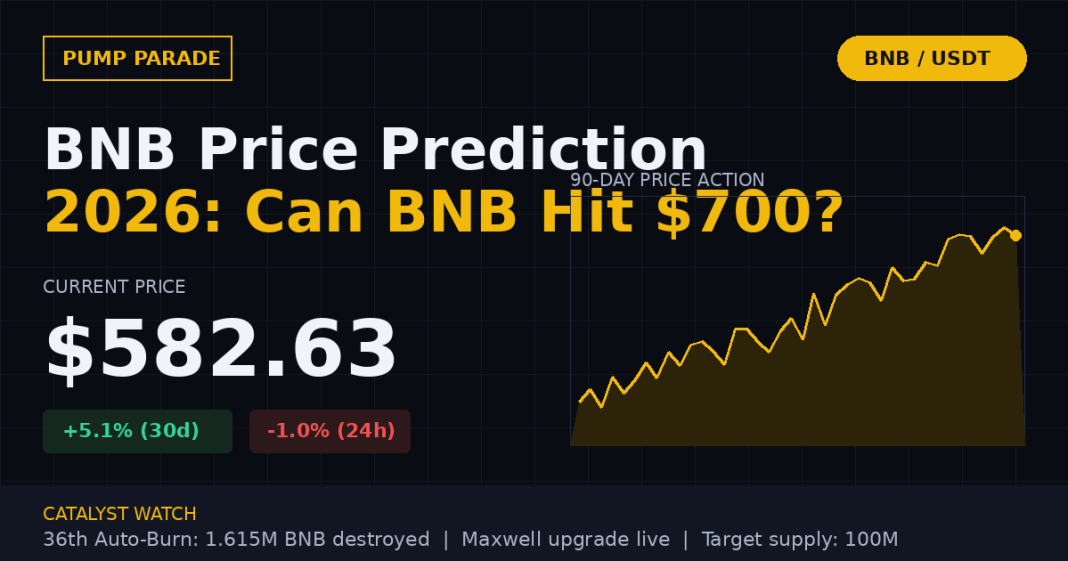
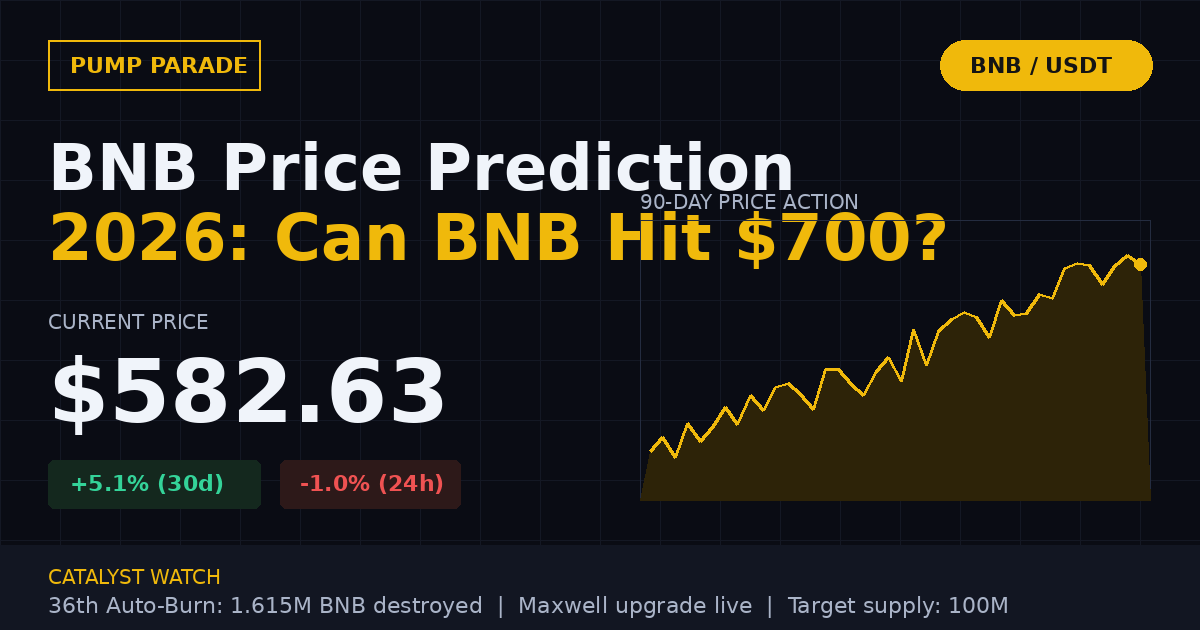
BNB is trading at $582.63 at time of writing, up 5.1% over the past 30 days and holding above the $580 support that traders have been watching all summer. The number that matters more, though, is 1,615,827. That is how many BNB tokens Binance permanently destroyed on July 15 in the 36th quarterly Auto-Burn, worth roughly $932 million at the burn price. Circulating supply now sits at 133.17 million, marching toward the 100 million target that Binance has committed to.
Yet BNB still sits 57% below its October 2025 all-time high of $1,369.99. So the real BNB price prediction 2026 question is not “will burns matter.” Burns clearly matter. The question is whether the Maxwell hardfork rollout, sustained BNB Smart Chain activity, and a friendlier macro backdrop are enough to push BNB back to $700, or higher, before the year ends. Here is what the data actually says, both directions.
Key Takeaways
- Current setup: BNB at $582.63, +5.1% over 30 days, holding above the $580 support zone but 57% below its October 2025 ATH.
- Bull case: $700 to $850 by year-end 2026 if Auto-Burn cadence continues, BNB Chain DEX volume holds, and BTC reclaims $100K.
- Base case: $600 to $680 range through Q4 2026 as supply tightens but macro stays cautious.
- Bear case: $450 to $520 if $580 breaks, regulatory pressure on Binance intensifies, or the BSC DEX flow rotates back to Solana.
- Key catalyst: The next quarterly burn in October 2026 and the Fermi upgrade rollout are the two datable events worth marking on your chart.
- What would invalidate the bull case: A weekly close below $560 with volume expansion, or a Binance-specific regulatory event out of the US or EU.
Where BNB Stands Today
BNB is the fourth-largest cryptocurrency by market cap, sitting between XRP and TRON on most exchanges. It powers the Binance ecosystem, pays trading fees at a discount, and serves as the native gas token for BNB Smart Chain. That triple utility, exchange token plus gas token plus reward token, is the reason BNB has historically outperformed pure L1 competitors during Binance-heavy trading periods.
Here is the snapshot the market cares about right now:
| Metric | Value |
|---|---|
| Price | $582.63 |
| 24h change | -1.04% |
| 7d change | +3.09% |
| 30d change | +5.13% |
| Market cap | $77.61 billion |
| 24h volume | $601.1 million |
| Rank (by market cap) | #4 |
| All-time high | $1,369.99 (Oct 13, 2025) |
| % from ATH | -57.5% |
| Circulating supply | 133.17M BNB |
| Target end-state supply | 100M BNB |
Two numbers on that table matter more than any indicator. First, the 57% drawdown from ATH tells you BNB has been in a slow-grind correction for nine months. Second, the 24-point gap between current supply and the 100M target tells you that supply-side pressure is one-directional. Every quarter, more BNB gets removed. Nothing puts new BNB into circulation.
Why is BNB drifting sideways right now?
Three things explain the range-bound action. Bitcoin is still trapped below $65,000 and has failed twice to reclaim $70,000 in the past 60 days. When BTC ranges, exchange tokens tend to range harder, because trading volume dries up and the fee-discount narrative loses urgency. Second, the September to July rotation into Solana ecosystem tokens pulled speculative capital away from BSC, temporarily. Third, and most quietly, some large holders have been booking profits from the $1,000+ zone throughout the first half of 2026, adding steady overhead supply.
The counterweight is real, though. BNB Chain’s 2026 tech roadmap put block times at 0.45 seconds and finality at 1.1 seconds after the Maxwell hardfork. That is genuinely competitive with Solana on a technical basis, and it changes what kinds of applications can ship on BSC. The question is whether developers rotate back. The July burn number, $932 million, suggests real usage is still there. It is a lagging indicator, but it is not zero.
The Bull Case for BNB in 2026
1. The Auto-Burn is doing exactly what it was designed to do
The 36th quarterly burn removed 1,615,827 BNB from circulation, valued at $932 million. That is the third burn of 2026 alone, and the mechanism does not stop until total supply hits 100 million. At the current rate, roughly 6.5 million BNB per year, BSC is on track to reach the 100M target within the decade, not the century. Meanwhile, BEP-95 continues to burn a fixed fraction of every gas fee in real time. Roughly 291,000 BNB have been destroyed under BEP-95 since its introduction.
Deflationary supply is not a price catalyst by itself, but paired with steady demand it is a slow, mechanical tailwind. It is why BNB has historically held its floor better than pure L1s during risk-off periods.
2. BNB Chain is quietly winning on speed and cost
Post-Maxwell, BSC produces blocks every 0.45 seconds with 1.1-second finality. Fees remain fractions of a cent for most swaps. That combination has driven a steady rise in stablecoin volume on the chain and a growing share of real-world asset tokenisation projects choosing BSC over Ethereum. If DeFi and RWA volume continues to migrate toward chains with sub-second finality, BSC is one of two credible destinations, the other being Solana.
3. Analyst targets are clustering above $700
Aggregated forecasts from Changelly ($630 December 2026 average), Binance’s own consensus prediction ($803 for 2026), and InvestingHaven ($1,100 peak) all imply significant upside from the current $583 level. Even the more conservative Coinbase model puts BNB near $566 in 2026, meaning the downside baseline sits close to current price. Skew is asymmetric to the upside, at least on paper.
The Bear Case for BNB in 2026
1. Regulatory overhang has never fully lifted
Binance’s 2023 settlement with US authorities closed a chapter but not the book. Regulatory scrutiny of centralized exchanges continues in the EU under MiCA, and enforcement actions against Binance-branded products in specific jurisdictions can materially move BNB. Any new investigation, restriction, or delisting announcement is a fast tail-risk that discounts pretty severely, and it is not something a chart can predict.
2. Competition from Solana and Ethereum L2s is real
Solana continues to dominate memecoin flow and retail speculation, and Ethereum’s L2 ecosystem is aggregating serious DeFi TVL. BSC’s response has been faster blocks and lower fees, which is the right technical answer, but developer mindshare does not move on specs alone. If BSC’s DEX volume share slips further, the demand side of the BNB value equation weakens even as supply tightens.
3. The $580 level is the whole ballgame
Technically, BNB has bounced off the $560 to $580 zone three times in the past four months. That level is now the market’s line in the sand. A weekly close below $560 on expanding volume would signal that buyers who defended the range are exhausted. Historically, that pattern precedes moves back to the next major support, which sits closer to $450 to $480.
BNB Price Prediction 2026: Targets by Timeframe
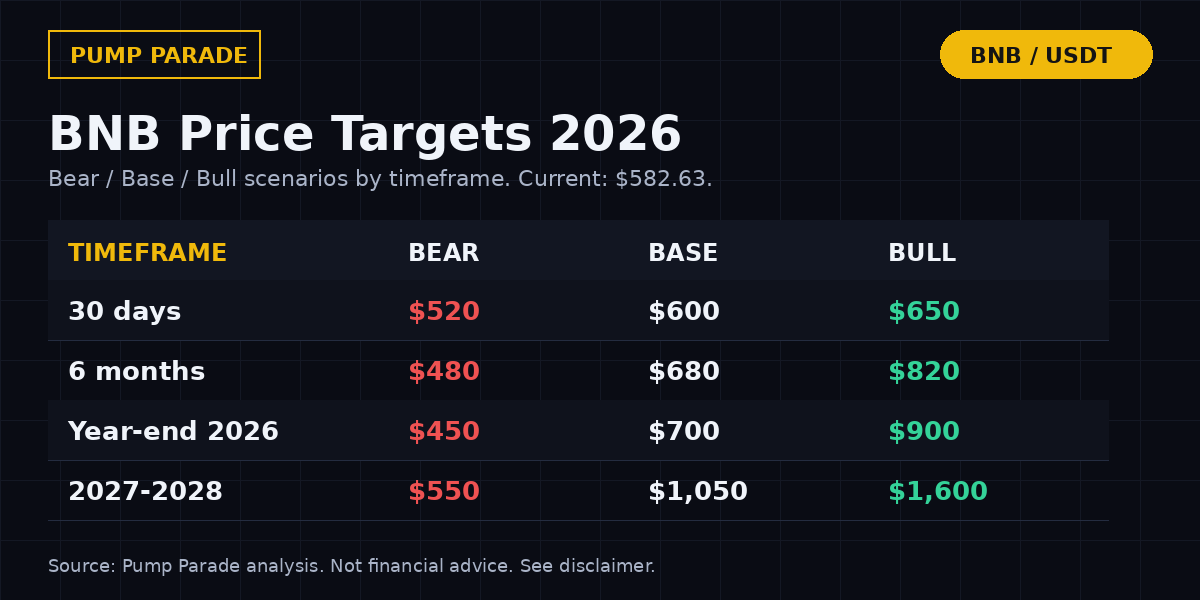
Here is how we break the BNB price prediction 2026 outlook by horizon. Each row assumes the catalysts and risks discussed above, weighted against current market structure.
| Timeframe | Bear | Base | Bull |
|---|---|---|---|
| 30 days | $520 | $600 | $650 |
| 6 months | $480 | $680 | $820 |
| Year-end 2026 | $450 | $700 | $900 |
| Long-term (2027-2028) | $550 | $1,050 | $1,600 |
Short-term (30 days)
Base case: BNB grinds between $580 and $640, resolving neither direction until BTC picks a side. Bull case: a fast BTC move above $70,000 pulls BNB toward $650 with the September burn expectations building. Bear case: a BTC breakdown below $60,000 drags BNB to a $520 retest.
6-month outlook
By Q1 2027, we would expect two more quarterly burns to have happened and Fermi-related network activity to be visible on-chain. Base case puts BNB at $680, a touch below the $700 psychological level. The bull scenario, $820, requires BSC DEX volume share to grow and macro conditions to lean risk-on.
Long-term (2027 to 2028)
If the 100M supply target compresses meaningfully by late 2027 and Binance retains its exchange dominance, the $1,050 base case is plausible. The bull case, $1,600, is essentially a new all-time high scenario, which historically requires either a Bitcoin blow-off top or a Binance-specific structural catalyst. Both are possible, neither is guaranteed. For context, InvestingHaven’s 2026 peak call sits at $1,100.
How does BNB compare to Ethereum in 2026?
The two are often positioned as rivals, but the honest comparison is more nuanced. Ethereum is the developer-standard L1 with the largest DeFi ecosystem. BNB is the exchange-token-plus-fast-L1 hybrid with tighter tokenomics. Here is how the two stack up on the metrics that matter for price direction.
| Metric | BNB | Ethereum (ETH) |
|---|---|---|
| Current price | $582.63 | $1,862.44 |
| Market cap | $77.6B | $224.8B |
| Rank | #4 | #2 |
| Block time | 0.45s (post-Maxwell) | ~12s |
| Finality | 1.1s | ~13 minutes |
| Supply model | Deflationary (target 100M) | Deflationary (EIP-1559 burn) |
| Circulating supply | 133.17M | ~120.3M |
| Ecosystem lead | Exchange integration, RWA | DeFi, L2 stack, ETF flow |
| 30d change | +5.1% | +15.0% |
The takeaway is not that one wins. It is that BNB and ETH serve different portfolio roles. ETH is the beta play on the entire Ethereum stack including L2s. BNB is a more concentrated bet on Binance’s franchise value plus the deflationary math. If you already hold ETH, BNB adds ecosystem diversification. If you already hold BNB, ETH adds developer-ecosystem exposure. For a broader macro view, see our Bitcoin price prediction 2026, since BTC direction still drives most of the alt-L1 basket.
What Would Change Our View on BNB?
Three specific triggers would push us to revise the base case in either direction.
Trigger 1 (bullish): A weekly close above $650 with sustained BSC DEX volume above $2B daily. That combination would confirm that both the technical and fundamental drivers are aligned, and it would open a path to $750 to $820 relatively quickly.
Trigger 2 (bearish): Any new US or EU regulatory action against Binance or a Binance-branded product. This includes fines above $500 million, spot-market restrictions in a major jurisdiction, or forced delistings from Binance.US. The market has repriced these events aggressively in the past.
Trigger 3 (bearish): A weekly close below $560 with volume above the 30-day average. That combination invalidates the $580 support thesis and typically opens a move toward $480 within four to six weeks. Similar patterns have played out three times in BNB’s history since 2021.
If you want to see how other ecosystem tokens are pricing in similar risk-reward setups, our Cardano ADA price prediction 2026 covers a comparable L1 in a different market position.
Frequently Asked Questions
Will BNB reach $1,000 in 2026?
It is plausible but not the base case. Reaching $1,000 requires roughly 72% upside from the current $583 level. Forecasts that call for it, including InvestingHaven’s $1,100 peak, assume a bullish macro backdrop, sustained BSC activity, and continued burn cadence. Our base case sits at $700 by year-end. $1,000 becomes a realistic target if BTC breaks decisively above $80,000 in Q4.
Is BNB a good investment in 2026?
BNB has three structural tailwinds: deflationary tokenomics, direct exchange utility, and post-Maxwell technical competitiveness. It also has real risks, mostly regulatory. For long-term holders comfortable with centralized-exchange exposure, BNB offers a more defensive risk-reward than most altcoins. For traders, the $560 to $650 range is the near-term structure to work with. Never allocate more than you can afford to lose.
What is the BNB Auto-Burn and how does it work?
Auto-Burn is BNB’s quarterly supply-reduction mechanism. Every quarter, Binance destroys a calculated amount of BNB based on the average price and block production during that quarter. The July 15, 2026 burn removed 1.615 million BNB, worth $932 million. Burns continue until total supply reaches 100 million, roughly 24% below current circulation. A separate mechanism, BEP-95, burns a portion of every gas fee in real time.
What is the Maxwell upgrade on BNB Chain?
The Maxwell hardfork was completed in 2025 and reduced BNB Smart Chain block times from three seconds to 0.45 seconds, with finality dropping from 7.5 seconds to 1.1 seconds. The result is a chain that feels closer to Solana on user-facing latency while retaining full EVM compatibility. Follow-up upgrades, Lorentz and Fermi, extended the performance work in 2026.
How does BNB compare to Ethereum?
BNB is faster, cheaper, and more centralized than Ethereum. Ethereum has the deeper developer ecosystem, larger DeFi TVL, and an ETF product driving spot flow. BNB has tighter supply mechanics and direct exchange utility. They serve different portfolio functions rather than competing for the same slot.
What is the biggest risk to the BNB price in 2026?
Regulatory action against Binance is the largest tail risk. Because BNB’s value is tied to exchange utility, any restriction on Binance’s operations in a major jurisdiction can trigger sharp downside. The technical risk is a weekly close below $560, which would invalidate the multi-month support base and open a move toward $480. Similar risk-reward setups are playing out in other high-utility tokens, our UNI price prediction 2026 walks through a comparable exchange-token structure on the DEX side.
The Honest Take
BNB in 2026 is not a moonshot. It is not a broken chart either. It is a top-five asset with a mechanical supply-reduction schedule, a real technical roadmap that is executing, and a large concentrated risk in the form of ongoing regulatory scrutiny. The base case, $700 by year-end, is a modest 20% move from here. The bull case, $900+, requires macro cooperation and a clean regulatory backdrop. The bear case, sub-$500, requires either a BTC breakdown or a Binance-specific event.
For traders, the range is $560 to $650. For long-term holders, the burn schedule keeps working whether or not you check the chart. For everyone, the honest answer is that BNB’s next major move is more likely to come from a Binance headline than from a chart pattern. Watch the news feed as closely as the price feed.
Data current as of publication. Prices sourced from CoinGecko. Burn figures sourced from BNB Chain official announcements.
Disclaimer: This article is for informational and educational purposes only and should not be construed as financial, investment, or trading advice. Cryptocurrency markets are highly volatile, and past performance does not guarantee future results. The price predictions and analyses presented here are based on AI models, technical indicators, and available data at the time of writing, they are not guarantees. Always conduct your own research (DYOR) and consult with a qualified financial advisor before making any investment decisions. Pump Parade and its authors do not assume liability for financial losses incurred based on information provided in this article.