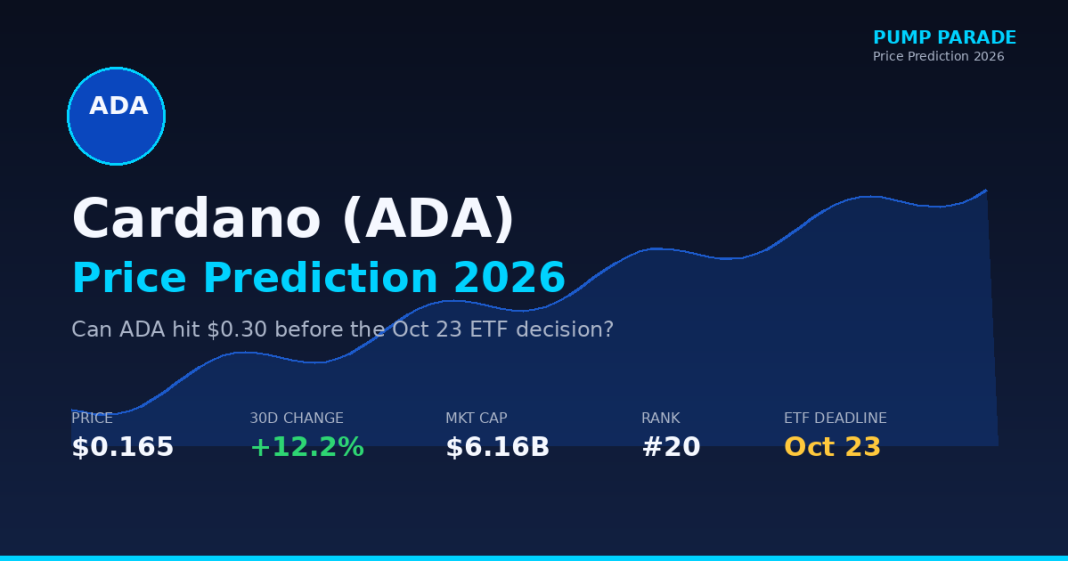
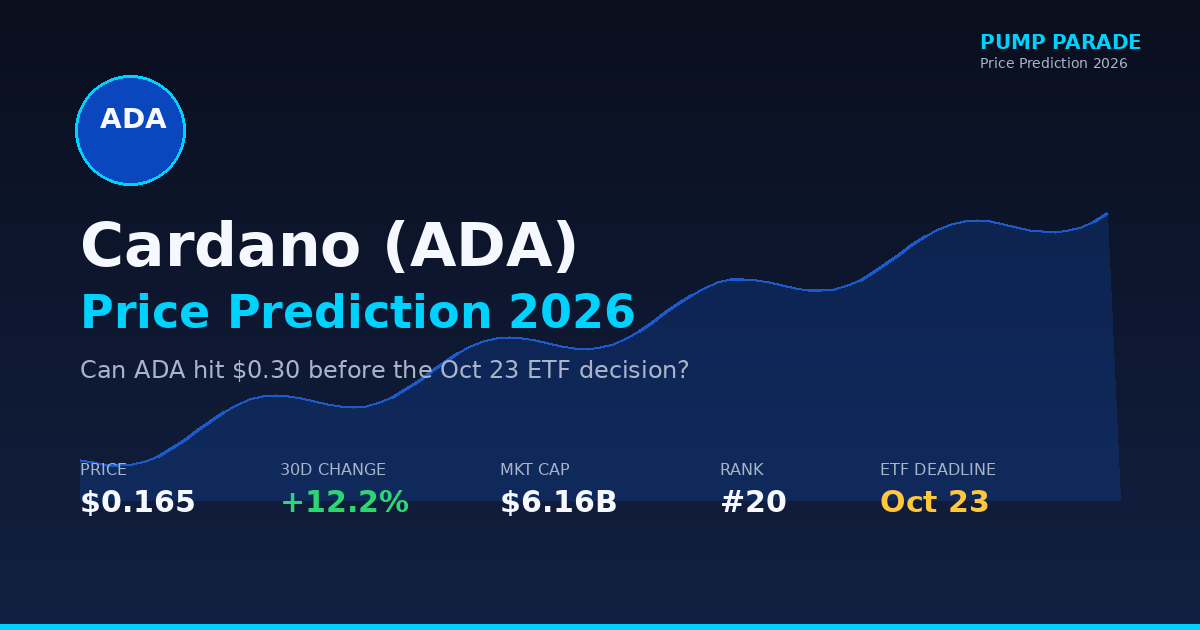
Any serious Cardano ADA price prediction 2026 has to start with a strange fact: ADA trades at $0.165 as of July 27, 2026, up 12.2% over the last 30 days but still sitting roughly 95% below its September 2021 all-time high of $3.09. For a project ranked #20 by market capitalization with a $6.16B market cap and 60% of its float staked, that is a strange place to be. The chart looks tired. The narrative looks anything but.
Behind the sleepy price action, three catalysts are quietly stacking up for the second half of 2026. CME Cardano futures went live in February, starting the six-month regulated-futures clock the SEC now requires for spot ETF approval. That clock runs out on August 9. Grayscale’s spot ADA ETF sits on a maximum 75-day review window with a final decision deadline of October 23, 2026. And Cardano’s Midnight privacy sidechain and continued Hydra scaling work sit alongside the ETF timeline as fundamental catalysts.
This Cardano ADA price prediction 2026 breaks down where ADA stands today, why the market has stopped caring, the specific catalysts that could push it toward $0.30, and the bear-case scenarios that could send it back below $0.12. We walk through 30-day, 6-month, and 2027-28 targets, compare ADA to Solana on the metrics that matter, and answer the questions traders are actually searching. Here is the honest, data-first read.
Key Takeaways
- ADA trades at $0.165 as of July 27, 2026, up 12.2% in 30 days but down 79.8% year over year.
- The single biggest near-term catalyst is the Grayscale spot ADA ETF decision, with a final SEC deadline of October 23, 2026.
- Base case: ADA reaches $0.24 by year-end 2026 if the ETF is approved and Hydra activity keeps building.
- Bull case: $0.32 to $0.50 if ETF approval coincides with a broader altcoin rotation and Midnight adoption picks up.
- Bear case: A rejection or delay could send ADA back to the $0.12 to $0.13 support zone.
- Cardano remains behind Solana on DeFi TVL and daily active users, and that gap is the core bear argument.
Where Cardano (ADA) Stands Today
Cardano is the seventh-most-searched altcoin on Google in 2026 and the 20th-largest crypto by market cap. Below is a snapshot of the numbers we are working with at time of writing, pulled from CoinGecko.
| Metric | Value |
|---|---|
| Price | $0.165 |
| 24h change | +0.11% |
| 7d change | +1.4% |
| 30d change | +12.2% |
| Market cap | $6.16B |
| 24h volume | $158M |
| Market cap rank | #20 |
| All-time high | $3.09 (Sep 2021) |
| % from ATH | -94.7% |
Two numbers matter more than the rest. First, the 30-day gain of 12.2% is happening on modest volume, which means the move is being driven by patient accumulation rather than a leverage-fuelled short squeeze. Second, roughly 60% of the circulating supply is staked, which structurally reduces sell pressure and puts a floor under drawdowns. ADA rarely has a violent flush lower on staking-heavy weeks. It usually just grinds.
Why Is Cardano Trading Like the Market Forgot It Exists?
The short answer: capital rotation. Since the March 2026 Hyperliquid HYPE flippening, when a revenue-generating perp DEX passed ADA in market cap, altcoin traders have pivoted toward chains that produce fees and buybacks. Cardano does not have that story. Its DeFi TVL sits in the $380M-$550M range depending on the source, which is a rounding error next to Ethereum’s $60B+ or Solana’s $8B+.
The longer answer is that Cardano’s academic, peer-reviewed development pace has been a strength for security and a liability for narrative velocity. The Voltaire era transition to community governance is arguably the most significant governance experiment in crypto, but “governance milestone” does not pump a chart the way “meme launchpad revenue” does. That is the honest gap.
What has kept a bid under ADA through the quiet stretch is the ETF pipeline. Filings from Grayscale, VanEck, 21Shares, Bitwise and Canary Capital have removed the tail risk of “no institutional path” and replaced it with a concrete, dated question: does spot ADA get approved this fall? For a good read on how enterprise-focused L1s are being repriced by the same investor cohort, our Hedera (HBAR) 2026 breakdown covers a similar setup.
What Could Push ADA to $0.30 by Year-End 2026?
1. Grayscale spot ETF decision on October 23
This is the catalyst. CME ADA futures went live February 9, 2026, which starts the six-month regulated-futures clock the SEC now requires under its generic listing standards. ADA becomes formally eligible on August 9. If Grayscale, NYSE Arca or any co-issuer files immediately, the maximum 75-day review window lands the final decision on October 23. Multiple applicants including Bitwise, Canary Capital and 21Shares have parallel filings, so approval likely triggers a wave of simultaneous launches rather than a single-issuer product.
Historical analog: XRP’s futures-first pathway saw a 35% run-up in the six weeks before the review deadline, then a “sell the news” retrace before the actual approval week bid returned.
2. Hydra scaling finally leaves the demo phase
Hydra is Cardano’s Layer-2 payment channel network, and it has demonstrated close to 1 million transactions per second in gaming environments. The relevant question is not the benchmark. It is whether real applications, not test harnesses, actually route volume through Hydra heads at scale. If two or three consumer apps ship on Hydra in Q4 2026, the “Cardano is technically capable but nobody uses it” argument loses its most-cited example.
3. Midnight sidechain unlocks institutional privacy demand
Midnight is Cardano’s zero-knowledge privacy partner chain, with a federated validator set that reportedly includes Google Cloud, MoneyGram and Vodafone. Enterprise interest in on-chain settlement has been bottlenecked by data confidentiality requirements that public blockchains cannot solve natively. A working privacy sidechain with real institutional validators is the exact product that unlocks the treasury and settlement use cases that RWA teams like Ondo and Chainlink have been publicly asking for.
What Could Send ADA Back Below $0.13?
1. ETF rejection or delay past 2026
The base case above assumes approval by October 23. A delay into 2027 or an outright rejection removes the primary catalyst driving accumulation. In that scenario, ADA likely retests $0.13 support quickly and could probe $0.11-$0.12 if broader altcoin sentiment sours. The SEC’s stance on ADA’s commodity classification is not fully settled, and a Chair Atkins comment can move the odds materially in either direction.
2. Continued market-share erosion to revenue-generating L1s
Ethereum, Solana, and now Hyperliquid all produce measurable protocol revenue that gets returned to token holders through buybacks, burns or yield. Cardano has no such mechanism. In a market that has clearly repriced “productive” tokens above “narrative” tokens, ADA structurally underperforms peers on flow. If DeFi TVL on Cardano does not cross $1B by year-end, this argument gets louder.
3. Voltaire treasury governance stumbles
The Cardano treasury holds roughly $71M in ADA earmarked for core protocol funding. Community governance is new, and one bad allocation vote, one contentious controversy about founder influence, or one high-profile developer departure can meaningfully damage institutional confidence right before an ETF decision window. Execution risk is elevated during the transition year.
Cardano (ADA) Price Prediction 2026: Targets by Timeframe
30-day outlook (August 2026)
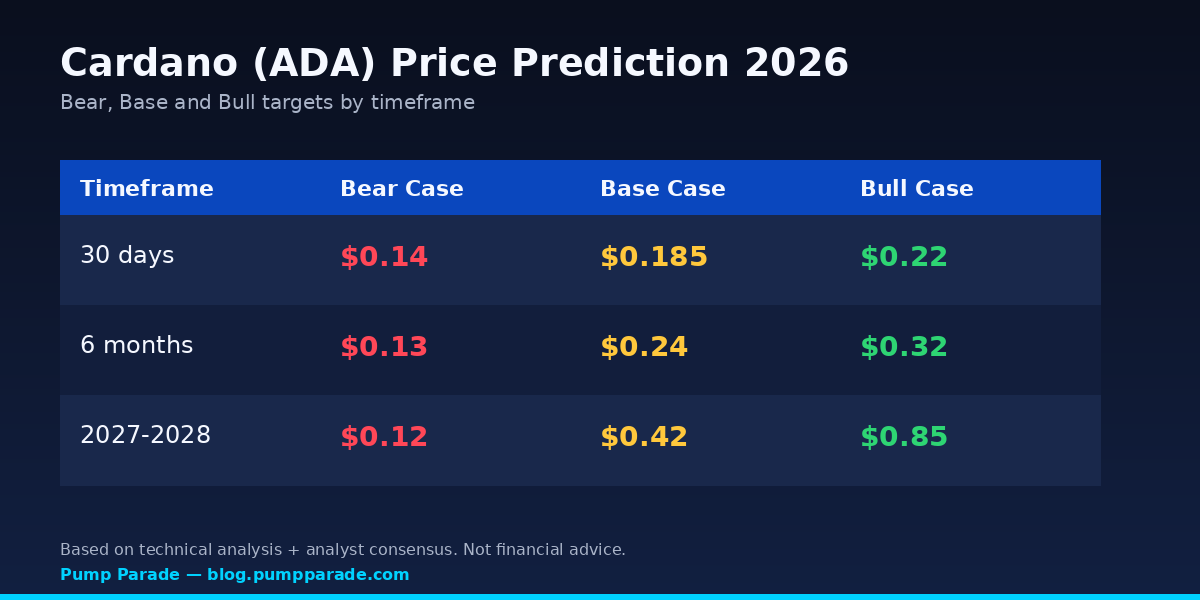
Base case: $0.18. The August 9 futures-eligibility date is a positive event with limited immediate price impact but sets up positioning into September. Bear case: $0.14 if BTC breaks $60K support and drags altcoins lower. Bull case: $0.22 if an unexpected Grayscale filing goes public before month-end.
6-month outlook (through year-end 2026)
Base case: $0.24, driven by ETF approval on or near October 23 and a modest Q4 altcoin rotation. Bear case: $0.13 on rejection or delay, retesting the June 2026 lows. Bull case: $0.32 to $0.50 if approval coincides with a broader risk-on move and Hydra ships a real consumer app.
2027-2028 long-term outlook
Base case: $0.42, assuming ADA participates in the post-cycle recovery but continues to lag Solana and Ethereum on relative flow. Bull case: $0.85 or higher if Midnight scales into an actual institutional settlement rail. Bear case: $0.12, the level analysts at Benzinga and CoinCodex flag as the structural floor if TVL keeps eroding.
Where our targets sit versus consensus
For context on the range, Coinfomania’s ML model projects an average of $1.15 for 2026 with a high of $1.60. Cryptopolitan’s hybrid model splits the middle at $1.20 average. Benzinga’s aggregated forecast is much more conservative at $0.48-$0.57. Our base case of $0.24 sits closer to the CoinCodex algorithmic model, which projects $0.26-$0.47 for the year. The wide spread across analysts is itself a signal: no one is sure, and that is the correct posture.
How Does Cardano Compare to Solana in 2026?
Solana is the closest L1 comparison for ADA in 2026: both are proof-of-stake, both target smart contract throughput, both had a spot-ETF pathway pending. The gap on activity is the key story.
| Metric | Cardano (ADA) | Solana (SOL) |
|---|---|---|
| Price (July 27, 2026) | $0.165 | $76.38 |
| Market cap | $6.16B | $44.55B |
| Rank | #20 | #7 |
| 30d change | +12.2% | +6.6% |
| DeFi TVL (approx.) | ~$500M | ~$8B |
| Staking ratio | ~60% | ~65% |
| ETF status | Grayscale filing, Oct 23 deadline | Multiple spot ETFs live since 2025 |
| Slot time / block time | ~20 seconds | ~400 ms |
The read from the table is straightforward. Solana is where the activity lives. Cardano is where the discount lives. For a longer read on the L1 competitive set, our Avalanche 2026 breakdown covers a similar recovery setup, and our earlier ETF-window analysis is the best backdrop for how the futures timeline evolved.
What Would Change Our View
Three specific triggers would move us off the base case:
1. A closed ETF decision before October 23. If the SEC uses its accelerated approval pathway or a Grayscale filing lands earlier than expected, both the base and bull targets move up by roughly 20%.
2. Cardano DeFi TVL breaking above $1B. That would signal Hydra and Midnight are actually attracting sticky capital, not just headlines. It would justify pulling long-term targets toward the Coinfomania range near $1.15.
3. A public governance failure. If a Voltaire treasury vote goes badly and ADA holders reject a core-development budget, or if there is a high-profile founder controversy, bear-case targets get pulled down and the ETF narrative loses some support.
Frequently Asked Questions
What is the Cardano ADA price prediction for 2026?
Our base case has ADA reaching $0.24 by year-end 2026, assuming Grayscale’s spot ETF is approved on or near the October 23 SEC deadline. Bear case is $0.13 on rejection or delay, and bull case reaches $0.32 to $0.50 if approval coincides with an altcoin rotation and Hydra ships a consumer app that actually gets used.
Will ADA reach $1 in 2026?
Reaching $1 in 2026 would require roughly a 6x move from the current $0.165 price, and no realistic base case supports that. Even the most bullish analyst models, like Coinfomania’s ML projection at $1.60, assume conditions well beyond current setup. A $1 ADA looks more like a 2027 to 2028 scenario if Cardano regains meaningful DeFi market share.
Is Cardano a good investment in 2026?
ADA is a reasonable asymmetric bet if you believe the ETF gets approved and Cardano can reverse its DeFi TVL decline. The downside is defined at $0.12 to $0.13 support, and the upside is defined by the October 23 catalyst plus long-term Midnight and Hydra execution. It is not a good investment for anyone looking for quick returns, and it is not a good investment if you cannot stomach a further 20% drawdown.
When is the Cardano spot ETF decision?
Grayscale’s spot ADA ETF has a maximum SEC review window of 75 days after its August 9, 2026 eligibility date under the streamlined ETF approval framework. That puts the final decision deadline on October 23, 2026. Bitwise, 21Shares and Canary Capital have parallel filings with similar timelines, so multiple products could launch simultaneously if approved.
Why has ADA underperformed in 2026?
ADA has underperformed newer L1s like Solana and Hyperliquid because it does not generate meaningful protocol revenue that gets returned to token holders. Cardano’s DeFi TVL sits near $500M compared to Solana’s $8B and Ethereum’s $60B+, and the market has clearly repriced revenue-generating chains above research-first ones in 2026. That gap is the core bear argument.
What is the Cardano Midnight sidechain?
Midnight is Cardano’s zero-knowledge privacy partner chain, built to support institutional and enterprise use cases where public transaction data is a blocker. The federated validator set reportedly includes Google Cloud, MoneyGram and Vodafone, giving it real-world credibility. If Midnight attracts genuine institutional volume in 2026, it becomes the strongest fundamental case for ADA outside of the ETF catalyst.
The Honest Take
Cardano in mid-2026 is a bet on two things: that the ETF gets approved by October 23, and that at least one of Hydra, Midnight or Voltaire produces a fundamental result that changes the “no activity” narrative before year-end. Neither is guaranteed. Both are plausible.
The setup rewards patient positioning, not chasing. Downside is defined at $0.12 to $0.13. Upside is defined at $0.30 in the base case and $0.50 in the bull case over the next six months. That is a risk-reward profile that some traders will find compelling and others will correctly ignore as too catalyst-dependent. What ADA is not, for anyone paying attention, is a passive hold. This is a token where the next three months matter more than the last three years, and you need to have a view on the catalysts, not just the ticker.
Disclaimer: This article is for informational and educational purposes only and should not be construed as financial, investment, or trading advice. Cryptocurrency markets are highly volatile, and past performance does not guarantee future results. The price predictions and analyses presented here are based on AI models, technical indicators, and available data at the time of writing, and they are not guarantees. Always conduct your own research (DYOR) and consult with a qualified financial advisor before making any investment decisions. Pump Parade and its authors do not assume liability for financial losses incurred based on information provided in this article.