If you have ever swapped a freshly launched Solana token, provided liquidity to a memecoin pair, or used an aggregator like Jupiter, there is a strong chance your trade touched Meteora without you ever noticing. Meteora has quietly become one of the most important pieces of liquidity infrastructure on Solana, powering a huge share of the chain’s swap volume through its dynamic liquidity pools. But is it actually a good place to provide liquidity, and should traders care which DEX their order routes through? This Meteora review for 2026 breaks down the features, fees, security, and real numbers so you can decide for yourself.
Quick Verdict: Is Meteora Worth It in 2026?
Meteora earns a strong 4.3 out of 5. It is the most advanced liquidity layer on Solana, with a Dynamic Liquidity Market Maker (DLMM) that lets liquidity providers concentrate capital and earn volatility-adjusted fees, plus dynamic pools that put idle assets to work. For active LPs and projects launching tokens, it is arguably the best option on the chain. For passive holders who just want set-and-forget yield, the learning curve and impermanent loss risk are real and worth taking seriously.
Best for: active liquidity providers, memecoin and new-token launches, and protocols that need deep, programmable liquidity.
Skip if: you want a simple swap interface and never plan to provide liquidity (use an aggregator instead).
You can explore the protocol directly at the official Meteora website.
What Is Meteora?
Meteora is a decentralized exchange and liquidity protocol built on Solana. Rather than positioning itself purely as a trading front end, it describes its mission as building the most secure, sustainable, and composable yield layer for Solana and the broader DeFi ecosystem. In practice that means Meteora is where liquidity lives, and other apps, aggregators, and trading bots tap into that liquidity to execute swaps.
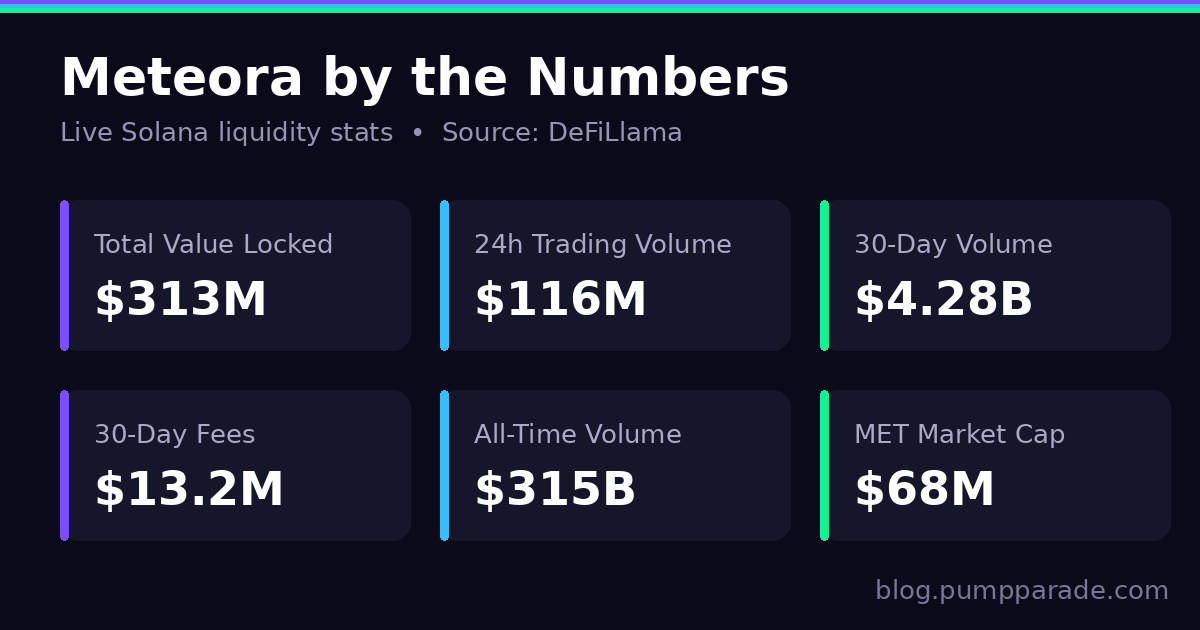
The numbers tell the story of how central it has become. According to DeFiLlama, Meteora holds roughly $313 million in total value locked, processes around $116 million in daily trading volume, and has cleared more than $4.28 billion in volume over the last 30 days. Its all-time trading volume sits north of $315 billion, and it has generated over $1.42 billion in cumulative fees for liquidity providers and the protocol. Those figures place Meteora among the top decentralized exchanges on Solana by activity.
Features Deep Dive
Meteora is best understood as a toolkit of liquidity products rather than a single pool type. Here are the pieces that matter most.
DLMM: The Dynamic Liquidity Market Maker
The DLMM is Meteora’s flagship product and the reason most LPs are here. Instead of spreading liquidity evenly across an infinite price curve like a classic constant-product AMM, DLMM divides liquidity into discrete “price bins.” Think of each bin as a shelf that holds tokens available for trade at a specific price. Liquidity providers choose which bins to fund, which lets them concentrate capital exactly where they expect most trading to happen.
This concentration means LPs can earn far more in fees per dollar deposited than they would in a traditional pool, because their capital is not diluted across price ranges where nobody is trading. The trade-off is that concentrated positions need active management, and if price moves out of your selected bins, your position stops earning fees until you rebalance.
The standout feature is dynamic fees. DLMM automatically adjusts the fee a pool charges based on market volatility. When prices are swinging hard, fees rise to compensate liquidity providers for the extra risk they are taking. When the market calms down, fees fall to keep the pool competitive and attract volume. This volatility-aware pricing is one of the clearest advantages Meteora holds over older AMM designs.
DAMM v2: Dynamic AMM Pools
For LPs who want something closer to the simple, passive experience of a classic pool, Meteora offers DAMM v2. It behaves like a familiar constant-product pool, but with a meaningful upgrade: idle assets sitting in the pool are automatically lent out to Solana lending protocols, generating an extra layer of yield on top of the trading fees the pool already collects. That composability, stacking lending yield onto swap fees, is a recurring theme across Meteora’s design and is conceptually similar to how lending markets like Kamino Finance put deposited capital to work.
Dynamic Vaults and Alpha Vault
Dynamic Vaults are Meteora’s yield-optimization layer. They automatically rebalance idle capital across lending protocols to chase the best risk-adjusted yield, and they feed liquidity into the DAMM pools. The Alpha Vault is a launch tool that gives projects a fairer way to bootstrap liquidity and protect early participants from bots and snipers during a token launch. This launch tooling is a big reason Meteora has become the default liquidity venue for new Solana tokens.
The MET Token
Meteora launched its native MET token in October 2025 with a fixed supply of 1 billion tokens, 48 percent of which entered circulation at the token generation event. MET is a governance token: holders can vote through the Meteora DAO on protocol upgrades, fee structures, and emissions. It also serves as a reward, with MET incentives directed toward LPs in DLMM and DAMM pools, especially around new token launches. At the time of writing MET trades around $0.13 with a market capitalization near $68 million, which is modest relative to the protocol’s volume and gives the token room to grow if usage holds.
Fees and Pricing
For traders, Meteora’s fees are competitive and often invisible, because most users reach Meteora pools through an aggregator that simply routes to the cheapest path. For liquidity providers, the fee structure is where Meteora gets interesting.
In DLMM pools, the base fee is set by the pool creator and can theoretically range anywhere from 0.01 percent to 99 percent. In practice, the active, high-volume pools you would actually trade in use base fees between roughly 0.04 percent and 0.20 percent to stay competitive with Solana routing. On top of that base fee sits the dynamic component that scales with volatility.
Fee distribution is also worth understanding. Standard DLMM pools direct about 5 percent of total collected fees to protocol reserves, with the remainder going to liquidity providers. Launch pools can allocate up to 20 percent during their early, high-volatility phase. Over the last 30 days, the protocol and its LPs collectively earned roughly $13.2 million in fees, which underlines how much real economic activity flows through these pools.
Pros and Cons
Pros
- The most capital-efficient liquidity design on Solana thanks to DLMM bins and dynamic fees.
- Deep liquidity and very high volume, so traders get tight pricing and low slippage.
- DAMM v2 stacks lending yield on top of swap fees for more passive LPs.
- Best-in-class launch tooling (Alpha Vault) for projects bootstrapping a new token.
- Strong audit history from multiple respected firms.
- A live governance token (MET) that aligns the community with protocol growth.
Cons
- DLMM has a real learning curve; concentrated positions need active management.
- Impermanent loss can be significant, especially in volatile memecoin pairs.
- Passive LPs may find the interface and strategy choices overwhelming at first.
- MET token is still young, and emissions-driven yields can fade as incentives taper.
Security and Trust
Liquidity infrastructure lives or dies on security, and Meteora has invested heavily here. Its DLMM, Dynamic Pool, Alpha Vault, and Dynamic Vault contracts have been audited by multiple respected firms, including Offside Labs, Sec3 (formerly Soteria), OtterSec, Quantstamp, Halborn, and Oak. The Offside Labs audit of the DLMM smart contracts surfaced findings that were addressed and fixed by the development team, and the project publishes its audit reports openly. Multiple independent audits across different products is exactly the posture you want from a protocol holding hundreds of millions in deposits.
That said, no smart contract is risk-free, and the larger risk for most users is not a hack but impermanent loss and poorly chosen bin ranges. Treat audits as a baseline of safety, not a guarantee of profit.
User Experience
Meteora’s app has matured considerably. The interface cleanly separates DLMM pools, dynamic pools, and vault strategies, and it surfaces useful data like pool fees, volume, and estimated yields so LPs can make informed decisions. For someone who already understands concentrated liquidity, the experience is smooth and powerful. For a newcomer, there is undeniably a lot to absorb, from choosing bin ranges to understanding how dynamic fees affect returns.
Most traders, however, will never open the Meteora app at all. They will swap through an aggregator like Jupiter or a trading bot, and Meteora simply provides the underlying liquidity. In that sense Meteora’s best user experience is the one you never see. If you do want to compare it against other on-chain venues, our breakdown of Raydium vs Orca is a useful companion read.
Verdict and Rating
Meteora is the most sophisticated liquidity protocol on Solana, and for active liquidity providers and token launches it is close to essential. The DLMM design genuinely improves capital efficiency, the dynamic fee model is smarter than the static fees of older AMMs, and the security track record is reassuring. The main caveat is that this power comes with complexity and real impermanent loss risk, so it rewards users who are willing to learn and manage their positions.
Final rating: 4.3 / 5. If you are an active LP or launching a Solana token, start at the Meteora app and begin with a small position to learn how bins and dynamic fees behave before scaling up. If you only ever swap, you are probably already using Meteora through an aggregator, and that is perfectly fine.
Frequently Asked Questions
Is Meteora safe to use?
Meteora’s core contracts have been audited by several leading firms including Offside Labs, Sec3, OtterSec, Quantstamp, and Halborn, and reports are published publicly. No DeFi protocol is risk-free, and for most LPs the bigger practical risk is impermanent loss rather than a contract exploit.
What is the difference between DLMM and DAMM?
DLMM uses concentrated liquidity in discrete price bins with volatility-based dynamic fees, offering higher fee potential but requiring active management. DAMM v2 is a more passive, classic-style pool that also lends out idle assets for extra yield.
How much does it cost to trade on Meteora?
Trading fees depend on the pool, but active DLMM pools typically use base fees of roughly 0.04 percent to 0.20 percent, plus a dynamic component that rises with volatility. Solana network fees are minimal.
What is the MET token used for?
MET is Meteora’s governance token. Holders vote through the Meteora DAO on upgrades, fees, and emissions, and MET is also used to reward liquidity providers, particularly around new token launches.
Is Meteora good for beginners?
As a trader using an aggregator, yes, because the experience is seamless. As a liquidity provider, the DLMM has a learning curve, so beginners should start small with the more passive DAMM pools before attempting concentrated positions.
This review is for informational purposes only and is not financial advice. Always do your own research before providing liquidity or trading. Data sourced from DeFiLlama and official Meteora documentation, accurate as of May 2026.