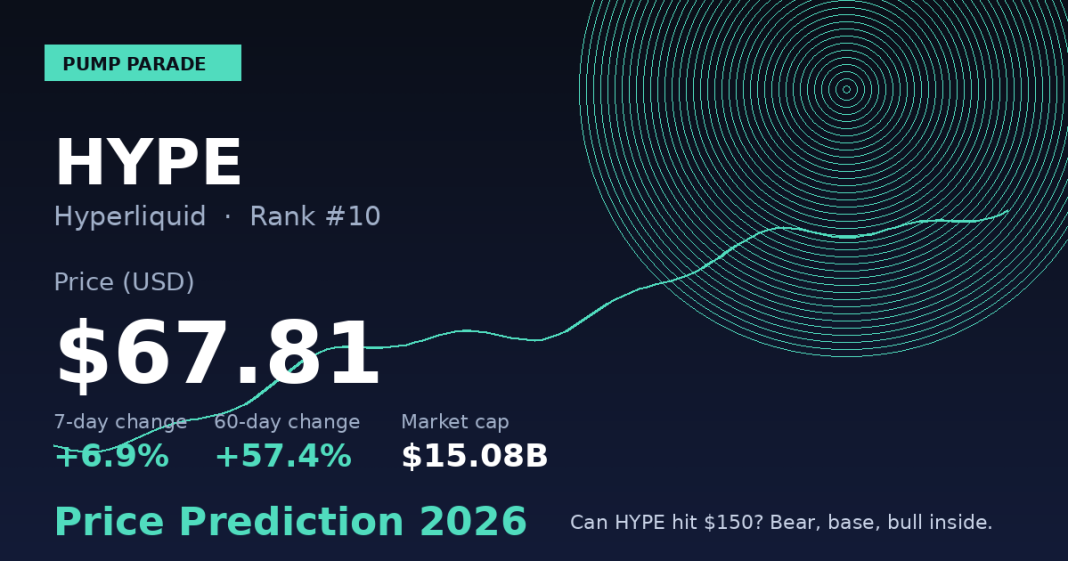
Hyperliquid trades at $67.81, up nearly 7% over the last week and 57% over the last two months. The perpetual futures exchange now sits at a $15 billion market cap, ranked tenth in crypto. Yet Arthur Hayes is publicly targeting $150 by August, a level that would double the token in six weeks. That is the tension every Hyperliquid HYPE price prediction 2026 model has to resolve.
The setup is unusual. A $645 million core-contributor unlock landed on July 6, and the price barely moved. The reason is mechanical: Hyperliquid’s Assistance Fund already holds about 45.65 million HYPE, roughly 4.6 times the size of that unlock, and the protocol routes 97 to 99 percent of trading fees into open-market HYPE buybacks. So while other Layer 1s bleed against their unlock cliffs, HYPE has a structural bid absorbing supply.
This article breaks down where HYPE trades now, what could push it to $100 and $150, what could send it back to $40, how it stacks up against Jupiter and dYdX, and what specific triggers would flip our view. All numbers are current as of writing, all catalysts are named, and no target is repeated without a condition attached.
Key Takeaways
- HYPE trades at $67.81 with a $15.08B market cap, 11.6% below its June 16 all-time high of $76.70.
- The buyback engine repurchases roughly 7% of market cap per year, funded by 97 to 99% of trading fees.
- Three US spot HYPE ETFs are now trading with $172M+ in combined net inflows, per SoSoValue data.
- Bull case: $150 if the buyback stays intact and HyperEVM traction accelerates. Bear case: $38 if unlocks meet volume decay and ETF outflows.
- Base case for year-end 2026: $85 to $105, contingent on holding the $60 support and clearing $76.70 on volume.
- The real risk isn’t the July 6 unlock: it’s the string of monthly 9.92M HYPE unlocks that run through 2027-2028.
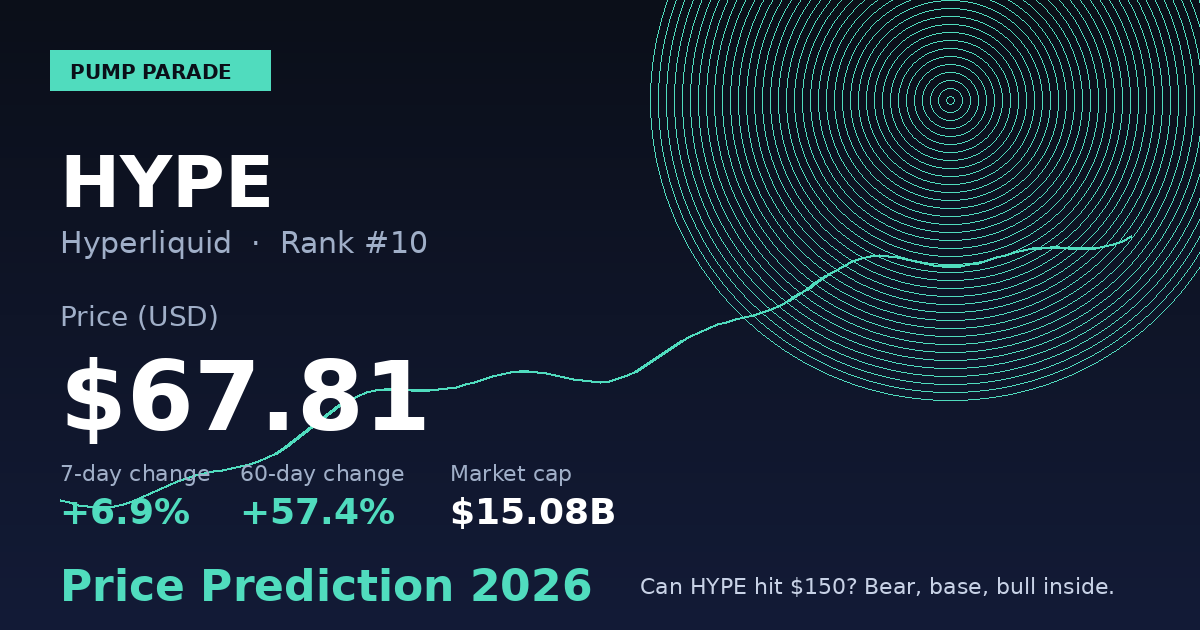
Where does Hyperliquid trade today?
Before we get to price targets, the numbers. Hyperliquid is not a speculative small-cap. It is a top-ten asset by market cap with real revenue, real users, and a fully diluted valuation that already reflects significant expectations.
| Metric | Value |
|---|---|
| Price | $67.81 |
| 24h change | -0.3% |
| 7-day change | +6.9% |
| 30-day change | +8.0% |
| 60-day change | +57.4% |
| Market cap | $15.08B |
| Fully diluted valuation | $64.77B |
| 24h volume | $389.7M |
| Market cap rank | #10 |
| All-time high | $76.70 (June 16, 2026) |
| % from ATH | -11.6% |
| Circulating supply | 222.4M HYPE |
| Max supply | 1,000,000,000 HYPE |
Two numbers matter more than the rest. The $64.77B FDV means the market is already pricing HYPE as if most of that billion-token supply exists, even though only 22% has unlocked. That is the bear whisper under every green candle. The $15.08B market cap on $389M of daily volume is a healthy volume-to-cap ratio for a top-ten asset, and much of that volume is on its own platform, generating fees that flow back into buybacks.
Why is HYPE consolidating just below its all-time high?
HYPE topped $76.70 on June 16, then pulled back into the mid-$60s and has traded in a $63 to $71 band for three weeks. Two things caused the pullback and two things have kept the floor firm.
The pullback drivers were the July 6 unlock overhang and profit-taking after a 57% two-month rip. Traders who bought under $50 in April took gains ahead of the vesting event. Nothing unusual there.
What has kept HYPE from breaking lower is more interesting. First, the Assistance Fund keeps buying every hour of every day, roughly $2 million of mechanical HYPE demand at recent fee levels. Second, spot ETF flows have stayed positive, with SoSoValue showing $172M in net inflows across the three US products. Third, the July 6 unlock actually cleared without a supply flush, because the Assistance Fund reserve is 4.6x the unlock size and the market knew it. That is a rare setup for a token vesting event.
The Bull Case: Three Real Catalysts
1. The buyback engine is a structural bid
This is the number that keeps coming up in every serious HYPE thesis. Hyperliquid routes 97 to 99% of trading fees into open-market HYPE purchases. Buybacks totaled roughly $317M in Q3 2025, $255M in Q4 2025, and about $192M in Q1 2026. The Motley Fool noted the team is buying back around 7% of market cap per year, roughly four to five times what Ethereum or BNB return to holders. Over 41 million HYPE tokens have already been burned or removed from circulation, worth over $1 billion at current prices.
If quarterly buybacks resume the Q3-Q4 pace as perpetual volume recovers, mechanical demand alone could offset most of the remaining 2026 unlock supply. That is the mathematical spine of any $100-plus target.
2. HyperEVM and product expansion
Hyperliquid is no longer a single perpetuals venue. HyperEVM opened the door to independent apps building on Hyperliquid infrastructure, and a new social trading app now routes perpetual futures through Hyperliquid, expanding reach into retail flows. Over 200 perpetual markets are live, from majors to long-tail. Prediction markets and options are the next expected rails. Each new fee source compounds the buyback.
3. Spot ETF flows plus institutional pipes
Three US spot HYPE ETFs are live and pulling positive inflows, according to SoSoValue. Recent data shows $116M in 24-hour net bridged inflows into the protocol. That is fresh institutional capital, and it plugs into a token where 99% of fees route to buybacks. This is the flywheel Arthur Hayes is betting on when he sets his $150 target. If ETFs keep steady inflows through Q3, the bid gets thicker just as unlocks are absorbed by the Assistance Fund.
The Bear Case: What Could Break HYPE
1. Unlocks are monthly and run for years
The July 6 unlock was 9.92 million HYPE, worth roughly $645M. There is another 9.92 million on August 6. Then September. Then every month, through 2027 and into 2028. Tokenomist data shows only around 22% of the 1 billion max supply has unlocked as of mid-2026. If perpetual volume falls and buybacks shrink to $100M per quarter, the Assistance Fund reserve depletes faster than new HYPE enters. That is a compounding bear scenario few HYPE bulls model honestly.
2. Regulatory pressure from CME, ICE, and Singapore
CME and ICE, two of the largest US derivatives venues, urged US regulators to review Hyperliquid over manipulation and sanctions risks. Singapore added HYPE to its Investor List, a soft restriction. This is what regulatory friction looks like at the top: incumbents complain when a decentralized upstart eats their lunch. But the risk to price is real. A meaningful US enforcement action could delist ETFs, freeze new institutional inflows, and force perpetual volume back onto centralized venues.
3. Competition from Jupiter, dYdX, and future forks
Hyperliquid does not have a moat by patent, only by execution. Solana-native perp DEXs like Jupiter continue to grow. dYdX is rebuilding on its own chain. Aster and Ostium are competing on specific product niches. If HYPE’s flywheel slows and fees redistribute, the buyback shrinks proportionally. This is the real threat: not a single competitor killing HYPE, but a slow fee dilution that starves the engine.
Hyperliquid HYPE Price Prediction 2026: Targets by Timeframe
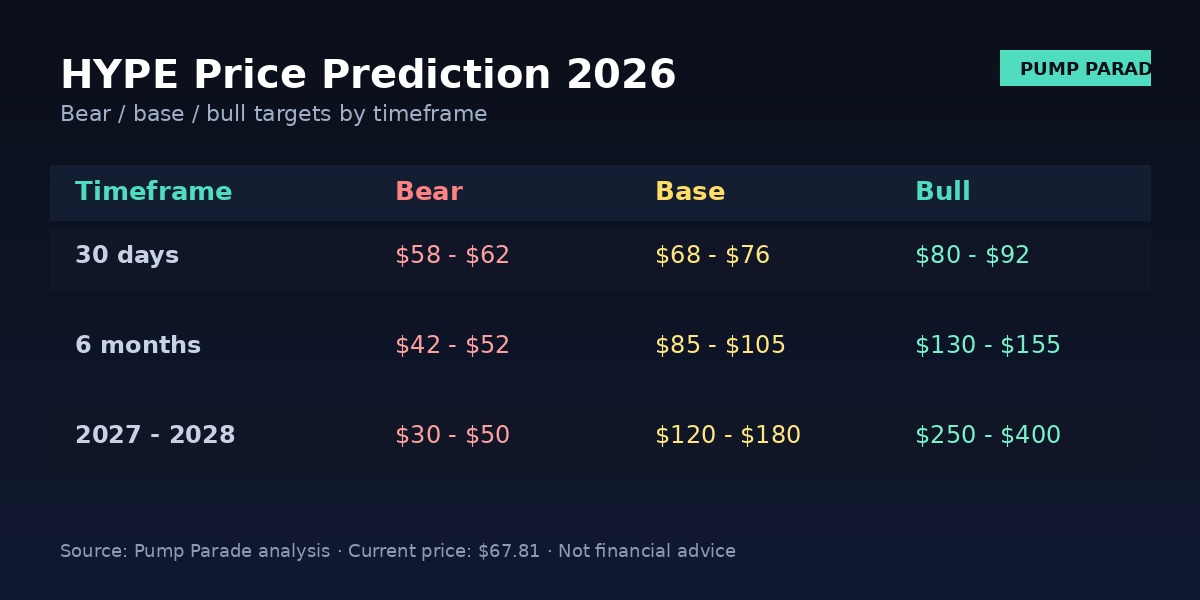
Every target below has a condition. If the condition does not hold, the number does not hold. That is how forecasts should work.
30-day outlook (through early August 2026)
- Bear: $58 to $62. If macro softens or the August 6 unlock triggers pre-emptive selling.
- Base: $68 to $76. Range trade continues, ETF flows stay positive, no macro shock.
- Bull: $80 to $92. Break above $76.70 ATH on volume, with the ETF flow narrative accelerating.
6-month outlook (through January 2027)
- Bear: $42 to $52. Requires two-quarter volume decline plus a US regulatory action.
- Base: $85 to $105. Buyback maintains pace, HyperEVM ships incremental products, ETF assets grow to $500M+.
- Bull: $130 to $155. Arthur Hayes’ target range. Requires ETFs above $1B, options and prediction markets going live at scale, and macro tailwind.
Long-term (2027-2028)
- Bear: $30 to $50. Fee compression from competition plus multiple years of unlocks unabsorbed by buybacks.
- Base: $120 to $180. Hyperliquid becomes the dominant on-chain derivatives venue with a maturing product suite.
- Bull: $250 to $400. Category-defining outcome. Requires institutional derivatives migrating on-chain and HYPE capturing the fee stream.
For comparison, CoinCodex’s algorithmic model currently projects HYPE between $70 and $110 through year-end 2026. That is inside our base case. Bitwise, one of the ETF issuers, has publicly discussed HYPE at $100+ as a reasonable 2026 outcome.
How does Hyperliquid compare to Jupiter and dYdX?
Every perp DEX token pitches a buyback story. The details are where they diverge. If you want the full Solana perp DEX picture, our Jupiter JUP 2026 outlook covers the closest competitor in more depth.
| Metric | Hyperliquid (HYPE) | Jupiter (JUP) | dYdX (DYDX) |
|---|---|---|---|
| Market cap rank | #10 | Mid-tier | Mid-tier |
| Fee share to token | 97-99% | ~50% to JUP | Partial staking rewards |
| Chain | Hyperliquid L1 + HyperEVM | Solana | dYdX Chain (Cosmos) |
| Product breadth | Perps, spot, EVM apps | Aggregation, perps, DCA | Perps only |
| Institutional access | 3 US spot ETFs live | No ETF | No ETF |
| Buyback funding | Trading fees direct | Protocol revenue | Insurance fund |
| Primary risk | Multi-year unlock schedule | Solana-cycle correlation | Volume migration to competitors |
The differentiator is fee share. When 97 to 99% of every dollar of Hyperliquid trading fees goes into HYPE buybacks, the token behaves like an equity in a cash-flowing business. Compare that to Ethena’s yield economics in our ENA 2026 breakdown, or the buyback dynamics we covered in the AERO 2026 analysis. Different mechanisms, same underlying question: does the token capture value, or does the protocol?
What could change the HYPE thesis?
Three specific triggers would move us off the current base case.
Trigger 1: Quarterly buyback drops below $100M. That would signal fee compression from competition or a volume cycle low. If Q3 2026 buybacks come in under $100M, we would cut the base case by 20 to 25 percent.
Trigger 2: Aggregate ETF assets exceed $1B by Q4 2026. That is roughly a 6x from current levels. If it happens, the bull case moves from tail scenario to base scenario and $130-plus becomes the target.
Trigger 3: A specific US enforcement action against Hyperliquid or its ETFs. This is the most binary outcome. A settlement or restraining order would likely cut HYPE by 30 to 50 percent in the near term and push the six-month target into the $40 to $55 range.
Frequently Asked Questions
Is Hyperliquid a good investment in 2026?
Hyperliquid has legitimate fundamentals rare in crypto: real revenue, a mechanical buyback tied to fees, and a top-ten market cap. It is a defensible thesis for investors who understand perpetual futures and can tolerate a multi-year unlock schedule. It is not appropriate for investors seeking low volatility or already at maximum crypto exposure.
Will HYPE reach $100 in 2026?
HYPE hitting $100 requires a roughly 47% move from $67.81 and depends on three things: buybacks staying above $150M per quarter, ETF flows staying net positive, and Hyperliquid holding perpetual volume market share. Prediction markets in mid-2026 leaned toward HYPE clearing $80, with fewer than half betting on $100. Reasonable but not guaranteed.
Will HYPE reach $150 by August 2026?
Arthur Hayes set a public $150 target for August 2026. That implies a 121% move in six weeks, which would require ETF inflows accelerating, a decisive break of the $76.70 ATH, and macro tailwinds all firing together. Possible in a strong crypto rally, but historically rare. Treat it as an upside scenario, not a base case.
What is the biggest risk to HYPE holders?
The multi-year unlock schedule is the underrated risk. Monthly 9.92M HYPE unlocks continue through 2027 and 2028. If Hyperliquid loses perpetual volume share to Jupiter, dYdX, or a new competitor, buybacks shrink while unlocks stay constant. That is the compounding bear case.
How does HYPE make money for holders?
HYPE holders benefit primarily through buybacks. Hyperliquid routes 97 to 99% of trading fees into open-market HYPE purchases via the Assistance Fund. Those tokens are effectively removed from circulation, tightening supply. There is no direct dividend, but the buyback pace has been running near 7% of market cap per year, higher than most Layer 1s return to holders.
Can HYPE hit a new all-time high in 2026?
The June 16, 2026 all-time high was $76.70. Given HYPE is currently 11.6% below that level and consolidating, a new ATH is plausible if ETF flows continue and buyback pace holds. The technical path requires clearing $73 on volume, then absorbing sellers at $76.70. Analysts note that a break above $76 to $77 with volume opens the path to $90 and $100.
The Honest Take
Hyperliquid is one of the cleaner fundamental stories in crypto right now. The buyback mechanic is not marketing, it is a routing rule enforced by the protocol. The ETFs are not vaporware, they are trading products with real inflows. The unlocks are the tension, not a killshot, because the Assistance Fund sits 4.6x above the July unlock size.
That said, the FDV is $64B, which means the market has already priced significant success. A $150 print by August requires everything going right at once, and that includes macro. A $40 print by Q1 2027 requires a volume collapse plus regulatory shoe drop, and neither is our base case. Somewhere in between, closer to $85 to $105 by year-end, is where the risk-adjusted math points.
If you own HYPE, watch quarterly buyback totals, watch ETF net inflows weekly, and watch whether HyperEVM ships products that pull external fees onto the platform. If you are looking to enter, the range of $60 to $65 has been a repeated bid zone this quarter. A decisive close under $58 would break that structure.
The bull case is real. The bear case is real. The pop-culture “$150 or bust” framing is not how serious money thinks about a top-ten asset. Neither is “unlock apocalypse.” Both extremes miss the actual mechanic driving HYPE’s price: fees in, buybacks out, and a supply schedule the market can see coming.
Disclaimer: This article is for informational and educational purposes only and should not be construed as financial, investment, or trading advice. Cryptocurrency markets are highly volatile, and past performance does not guarantee future results. The price predictions and analyses presented here are based on AI models, technical indicators, and available data at the time of writing, they are not guarantees. Always conduct your own research (DYOR) and consult with a qualified financial advisor before making any investment decisions. Pump Parade and its authors do not assume liability for financial losses incurred based on information provided in this article.