
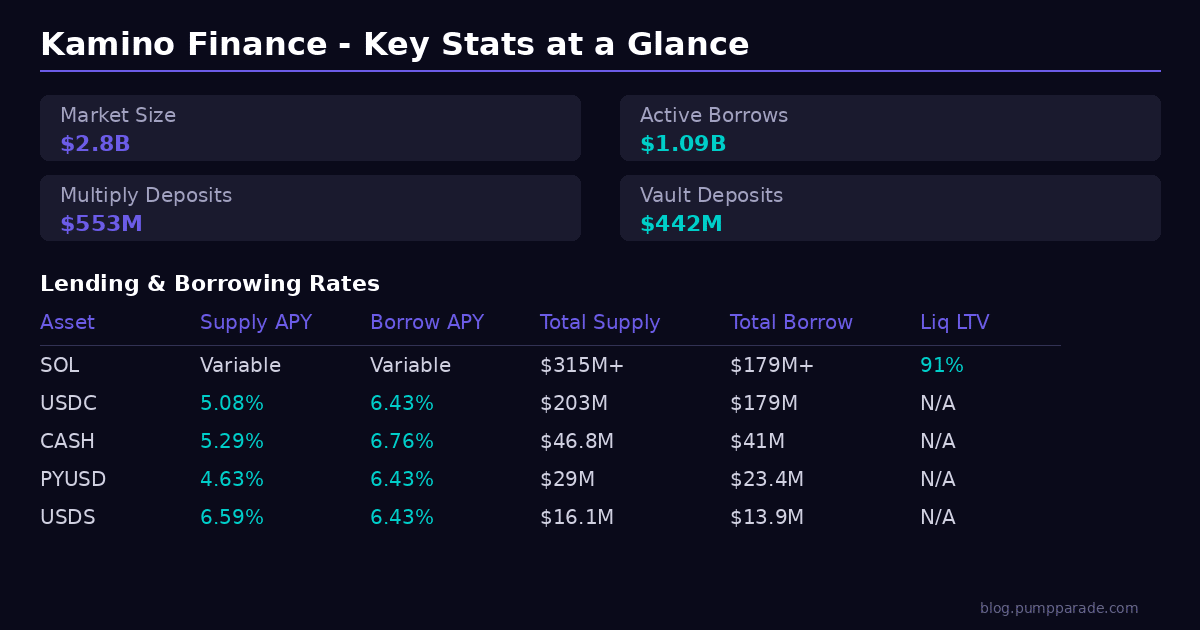
If you’ve been in the Solana DeFi space for more than five minutes, you’ve probably seen Kamino Finance mentioned in every other conversation about lending, leverage, and yield. With nearly $2.8 billion in total market size and over a billion dollars in active borrows, Kamino has quietly become the backbone of Solana’s lending infrastructure.
But does the protocol actually deliver on its promises? Is it safe? And more importantly, is it the right place for your capital in 2026?
We spent weeks digging through every feature, testing the UI, and analyzing the numbers. Here’s our full, no-fluff review.
Quick Verdict: 8.5/10
Bottom line: Kamino Finance is the most complete DeFi lending and leverage platform on Solana. It combines automated lending, leveraged yield strategies, and a growing set of real-world asset markets into a single protocol. The interface is clean, the security track record is spotless, and the yields are competitive. The main downsides are the Solana-only limitation and a learning curve for the leverage products. If you’re a Solana DeFi user looking for a one-stop shop for lending and leverage, Kamino is the clear frontrunner.
What Is Kamino Finance?
Kamino Finance is a decentralized finance protocol built natively on Solana. Launched in September 2022, it started as an automated liquidity management platform and has since evolved into Solana’s largest lending and leverage venue. The protocol is developed by a team led by CEO Gonzalo Parejo and CTO Rodrigo Perenha (a former Mercado Libre engineer), backed by institutional investors including Flourish Ventures.
At its core, Kamino does three things: it lets you lend assets to earn yield, borrow against your holdings, and amplify your returns through leveraged strategies. What sets it apart from simpler lending protocols is its “Multiply” product, which automates complex looping strategies that would normally require multiple manual transactions.
The numbers speak for themselves. As of April 2026, Kamino’s total market size sits at $2.8 billion with $1.09 billion in active borrows. That makes it the largest lending protocol on Solana and one of the top lending platforms globally by TVL, according to DeFiLlama data.
Core Features Deep Dive
K-Lend: Lending and Borrowing
The bread and butter of Kamino is K-Lend, its peer-to-pool lending system. If you’ve used Aave or Compound before, the concept is familiar: deposit assets to earn interest, or use your deposits as collateral to borrow other assets. What makes K-Lend interesting is its architecture.
The protocol uses a tier-based risk management system that categorizes assets into Isolated Debt, Isolated Collateral, and General tiers. This means volatile memecoins don’t share the same risk pool as blue-chip assets like SOL and USDC. It’s a thoughtful design choice that protects lenders while still allowing the protocol to list newer, riskier assets.
Current lending rates are competitive. USDC suppliers earn around 5.08% APY, while borrowers pay approximately 6.43%. Stablecoin rates like CASH and PYUSD hover in similar ranges. For SOL-denominated positions, rates are variable and depend on utilization. The protocol also supports 26 different markets spanning SOL, liquid staking tokens (LSTs), BTC, RWA tokens, xStocks, and even memecoins.
One standout feature is “scam wick protection,” which prevents liquidations during sudden, artificial price spikes. If you’ve ever been liquidated by a flash crash that recovered seconds later, you’ll appreciate this safeguard.
Multiply: Leveraged Yield
Multiply is where Kamino really differentiates itself. This feature lets you amplify your exposure to yield-bearing assets through automated looping. In plain English: you deposit an asset, the protocol borrows against it, redeposits the borrowed funds, and repeats the loop to multiply your yield exposure.
The results can be impressive. As of this writing, the eUSX Loop offers a maximum APY of 31.83%, while PRIME loops reach 11.87% and stable loops like USDG sit around 4.67%. Total deposits in Multiply currently exceed $553 million with $433 million in active borrows.
Leverage goes up to 8.3x on certain positions thanks to K-Lend’s eMode mechanism, which allows higher loan-to-value ratios for correlated asset pairs. The entry and exit process uses flash loans (with a tiny 0.001% fee) to automate what would otherwise require dozens of manual transactions.
A word of caution: leverage amplifies both gains and losses. If the underlying yield drops below your borrow rate, your position goes negative. And in volatile markets, liquidation risk is real. This isn’t a set-and-forget product for beginners.
Earn Vaults
For users who want exposure to Kamino’s yield opportunities without managing positions manually, Earn Vaults provide a simpler entry point. These are curated portfolios managed by expert partners, organized into risk tiers: Conservative, Balanced, and Aggressive.
Top-performing vaults include the Sentora PYUSD vault at 6.19% APY with $286 million in TVL, and the RockawayX RWA USDC vault at 4.91%. With 23 vaults available, there’s a range of risk/return profiles to choose from. Each vault clearly labels its strategy and accepted collateral types, making it straightforward to understand what you’re getting into.
Real-World Asset (RWA) Integration
One of Kamino’s most forward-looking moves has been its push into real-world assets. In December 2025, the protocol began accepting SEC-registered tokenized equities from Superstate as collateral. By March 2026, it had partnered with Anchorage Digital for institutional custody and reached over $1 billion in RWA lending volume.
The Borrow page now includes dedicated RWA and xStocks filters, letting users borrow against tokenized versions of traditional financial assets. This institutional angle positions Kamino uniquely among Solana DeFi protocols and signals a roadmap aimed at bridging traditional finance and crypto.
Fees Breakdown
Kamino’s fee structure is transparent and competitive for the DeFi space. Here’s what you’ll pay across the platform’s main products.
For lending and borrowing, the primary cost is the interest rate spread between supply and borrow APY. USDC lenders earn roughly 5.08% while borrowers pay 6.43%, creating about a 1.35% spread for the protocol. Similar spreads apply across other stablecoins. There are no explicit deposit or withdrawal fees for lending.
On the Multiply side, each entry and exit uses a flash loan mechanism that charges 0.001% per transaction. Given that these automate what could be 10+ manual transactions, the cost is negligible. Origination fees and potential liquidation fees also apply to borrowed positions, though these are standard across DeFi lending.
Transaction costs on Solana itself remain minimal, typically under $0.01 per transaction. Compared to Ethereum-based lending protocols where gas fees can eat into yields, this is a significant advantage for smaller position sizes.
Pros and Cons
What We Like
All-in-one DeFi hub. Instead of bouncing between separate lending, leverage, and liquidity protocols, Kamino packages everything into one interface. This reduces counterparty risk and simplifies your DeFi workflow considerably.
Spotless security record. Since launching in September 2022, Kamino has suffered zero security breaches or bad debt events. The protocol has completed four formal security audits (including verification by Certora and Osec) and maintains a $1.5 million bug bounty program. In a space where exploits are common, this track record stands out.
Capital efficiency. The eMode mechanism and Multiply product let advanced users extract significantly more yield from their capital than simple lending alone. LP positions can be used as collateral without exiting, and concentrated liquidity management reduces slippage.
Institutional credibility. The Anchorage Digital partnership, RWA integration, and Superstate collaboration signal that Kamino is building for institutional adoption, not just retail DeFi users. This could drive significant TVL growth over time.
Clean, functional UI. The interface is well-organized, with clear labeling of risk tiers, APY breakdowns, and market statistics. Filtering by asset category (SOL, LSTs, RWA, Memes) makes navigation intuitive even with 26+ markets.
What Could Be Better
Solana-only. Kamino currently operates exclusively on Solana. While this is a strength for Solana ecosystem users, it limits access for users on Ethereum, Arbitrum, or other chains. Multi-chain expansion is on the roadmap but not yet delivered.
Leverage complexity. The Multiply product, while powerful, requires a solid understanding of leverage mechanics, liquidation thresholds, and yield dynamics. Beginners could easily over-leverage without understanding the risks.
KMNO token performance. The KMNO governance token is currently trading around $0.02, approximately 92% below its all-time high of $0.25. While this doesn’t directly affect protocol functionality, it raises questions about tokenomics and future incentive sustainability.
Network dependency. As a Solana-native protocol, Kamino’s availability is tied to Solana network uptime. While Solana’s reliability has improved significantly, historical outages remain a concern for users relying on time-sensitive leverage positions.
Security and Trust
Security is arguably Kamino’s strongest selling point. The protocol has undergone four formal security audits: three by Certora (using mathematical formal verification) and one by Osec (a six-month comprehensive review). All audits confirmed zero critical vulnerabilities in the lending and vault systems.
Beyond audits, Kamino runs an advanced fuzzing campaign with Ackee Blockchain that tests millions of instruction sequences for edge cases. The protocol also integrated Chainlink Data Streams for low-latency, tamper-resistant price feeds, reducing oracle manipulation risk.
The $1.5 million bug bounty program and 24/7 in-house security monitoring add additional layers of protection. With $2.8 billion in assets under management and zero incidents in over three years of operation, Kamino has built one of the strongest security track records in DeFi. For context, that’s a longer clean streak than most Ethereum lending protocols can claim.
User Experience
Kamino’s interface strikes a good balance between information density and usability. The top navigation cleanly separates the core products: Swap, Lend, Borrow, Multiply, Liquidity, and Portfolio. Each section loads quickly (a Solana advantage) and presents data in well-organized tables with sortable columns.
For lending, the Earn Vaults page highlights top-performing vaults with APY, deposits, risk tier, and collateral count at a glance. The Borrow page includes smart filtering by asset category (SOL, xStocks, BTC, LSTs, RWA, Memes), which is helpful given the growing number of markets.
The Multiply page could use better educational content for new users. While there’s a “How it works” link, the concept of looping and leverage isn’t immediately intuitive. Advanced users will feel at home, but first-time DeFi users might find the learning curve steep.
Mobile support is still in development, which is a gap. However, the web interface is responsive enough to be usable on mobile browsers in a pinch. Wallet connection supports all major Solana wallets including Phantom and Backpack.
KMNO Token
Kamino’s native token, KMNO, serves as the protocol’s governance token. With a maximum supply of 10 billion tokens and roughly 4.3 billion in circulation, the token trades at approximately $0.02 with a market cap of around $87 million.
KMNO holders can participate in on-chain governance votes that control protocol parameters, incentive programs, and strategic direction. Staking KMNO also provides reward boosts on the platform. The token’s governance framework includes an elected Risk Council that manages dynamic risk parameters across lending markets.
The elephant in the room is the price. KMNO is down roughly 92% from its all-time high of $0.25, reflecting broader market conditions and token unlock pressure (core contributors have a 12-month lockup followed by 24-month linear vesting). Whether the token represents a value opportunity or a red flag depends largely on your conviction in Kamino’s growth trajectory and the broader Solana ecosystem.
How Kamino Compares
In the Solana DeFi landscape, Kamino’s closest competitors are marginfi and Drift Protocol. Kamino leads in TVL and product breadth. While marginfi focuses primarily on lending/borrowing and Drift emphasizes perpetual trading, Kamino combines lending, leverage, and liquidity management under one roof.
Compared to Ethereum-based protocols like Aave, Kamino offers similar functionality with dramatically lower transaction costs. However, Aave benefits from multi-chain deployment and deeper liquidity in certain markets. For Solana-native users, Kamino is the clear choice. For multi-chain DeFi users, the Solana-only limitation is worth considering.
If you’re active in the Solana trading ecosystem and use tools like Photon or BullX for trading, Kamino can complement your workflow by putting idle capital to work between trades. And if you’re using Jupiter for swaps, Kamino integrates seamlessly as part of the broader Solana DeFi stack.
Verdict: 8.5/10
Kamino Finance has earned its position as Solana’s leading DeFi lending protocol. The combination of a comprehensive product suite, institutional-grade security, competitive yields, and a clean interface makes it the strongest all-in-one DeFi platform on Solana in 2026.
Best for: Intermediate to advanced DeFi users on Solana who want lending, leverage, and yield optimization in a single protocol. Also excellent for users interested in RWA exposure through DeFi.
Not ideal for: Complete DeFi beginners who might be overwhelmed by leverage mechanics, or multi-chain users who need cross-chain functionality today.
If you’re already operating on Solana and want to put your capital to work, Kamino Finance deserves a serious look. Just remember: with leverage products, always start small and understand the liquidation risks before sizing up.
Frequently Asked Questions
Is Kamino Finance safe to use?
Kamino has one of the strongest security track records in DeFi. The protocol has completed four formal security audits with zero critical vulnerabilities found, maintains a $1.5 million bug bounty program, and has had zero security breaches since launching in September 2022. That said, all DeFi protocols carry inherent smart contract risk, so never deposit more than you can afford to lose.
What is the minimum deposit to use Kamino?
There’s no official minimum deposit requirement. However, since Kamino operates on Solana where transaction fees are under $0.01, even small deposits are practical. For Multiply (leverage) positions, you’ll want enough capital that the yield generated meaningfully exceeds the borrow cost.
How does Kamino Multiply work?
Multiply automates a “looping” strategy. You deposit an asset, the protocol borrows against it, redeposits the borrowed funds to earn additional yield, and repeats this process multiple times. The result is amplified exposure to the underlying yield. This process uses flash loans to execute all loops in a single transaction, keeping the user experience simple despite the complexity underneath.
Can I use Kamino on mobile?
Kamino doesn’t have a dedicated mobile app yet, though mobile UI development has been announced as a priority. The web interface is responsive enough to work on mobile browsers, and you can connect via mobile wallets like Phantom. A full mobile experience is expected in the near future.
What is the KMNO token used for?
KMNO is Kamino’s governance token. Holders can vote on protocol parameters, incentive allocations, and strategic decisions through on-chain governance. Staking KMNO also provides reward boosts on the platform. The token currently trades around $0.02 with a maximum supply of 10 billion.