pump.fun made the memecoin launchpad category a real business, printing hundreds of millions in fees at its peak. Believe took a very different angle: reply to a tweet, and your token is live on Solana in seconds. In 2026 both are still going, but the mix of who they serve and how much they earn has shifted hard. This guide breaks down fees, features, mechanics, security, and who each one is actually good for right now.
Quick Verdict (TL;DR)
- Winner for pure memecoin volume: pump.fun. It still runs the largest bonding-curve pipeline on Solana, has its own DEX (PumpSwap), and remains the default place where casual traders hunt fresh tickers.
- Winner for creators and social launches: Believe. Launching a token by replying to an X post is genuinely novel, the 50/50 creator revenue share is the most creator-friendly economics in the category, and the crowd skews toward founders, indie builders, and internet-native brands.
- Best for high-conviction buyers who want deeper post-graduation liquidity: Believe, since graduated tokens migrate to Meteora with dynamic fee LPs rather than sitting on an in-house DEX.
- Best for degens sniping the first ten minutes: pump.fun, because volume, tooling, and audience size still favor it.
If you only care about which platform is bigger, pump.fun wins on raw numbers. If you care about which platform is more interesting in 2026, Believe is the story.
Overview: What Each Platform Actually Is
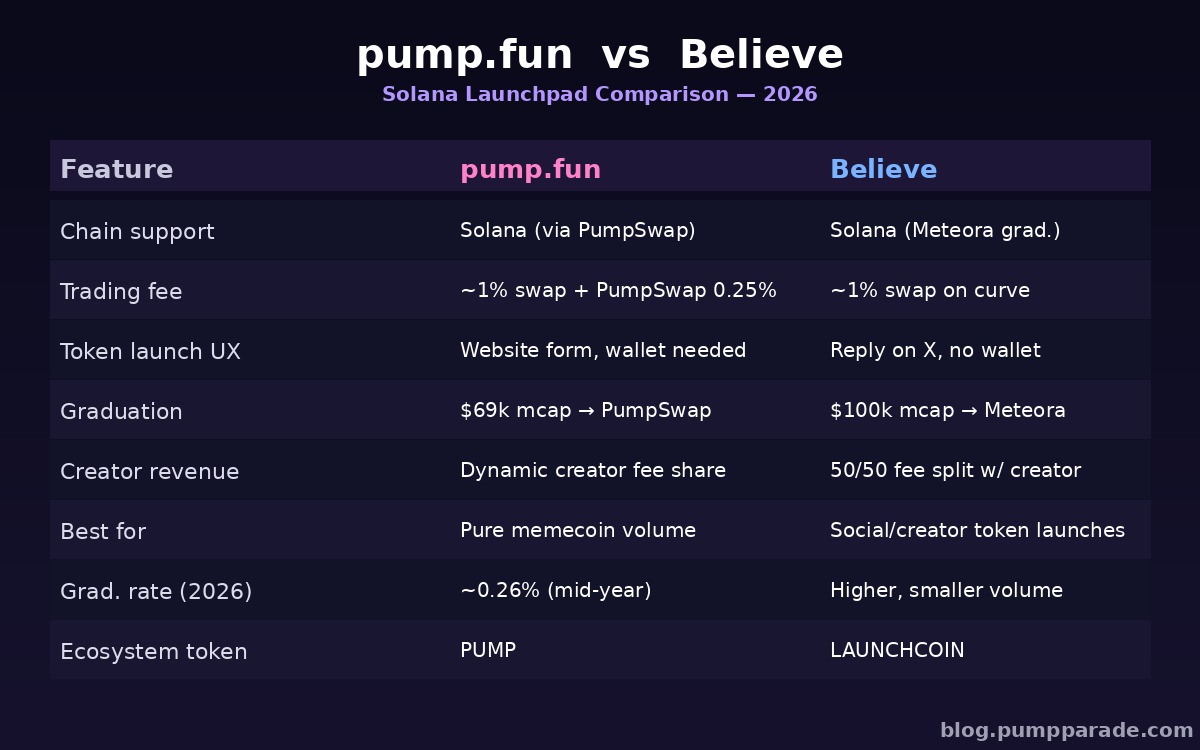
pump.fun is the OG Solana memecoin launchpad. Anyone can deploy a token in a few clicks. Trading happens on a bonding curve first, and once the token hits a target market cap it “graduates” to a real AMM pool. In March 2025 the team launched their own DEX, PumpSwap, so graduated tokens now migrate there by default instead of Raydium. That vertical integration means pump.fun captures fees across the entire lifecycle: bonding curve, migration, and post-grad trading.
Believe (formerly launchcoin.io, founded by Ben Pasternak) is a Solana launchpad that lives inside X (Twitter). To create a token, you reply to a specific @launchcoin post with a ticker. The backend deploys the token on Solana automatically. No wallet, no gas, no bonding curve interface. Once a Believe token crosses ~$100,000 in market cap, it graduates off the bonding curve and migrates into Meteora, a Solana liquidity protocol. The ecosystem token, LAUNCHCOIN, sits at the center of the platform’s fee model.
Same category, wildly different funnels. pump.fun optimizes for volume of launches and speed of speculation. Believe optimizes for social distribution and creator alignment.

Feature Deep Dive
Token creation experience
On pump.fun, you fill out a form: name, ticker, image, optional links. Sign with a wallet, pay ~0.02 SOL, and the token is live on a bonding curve. Total time from idea to tradable token: under a minute, but you need a Solana wallet and some SOL.
On Believe, you tweet a reply to @launchcoin with your desired ticker. The bot replies with a live token link within seconds. Total time: about ten seconds, and you do not need a wallet at any point. That is a meaningfully lower barrier for non-crypto-native creators.
Trading mechanics
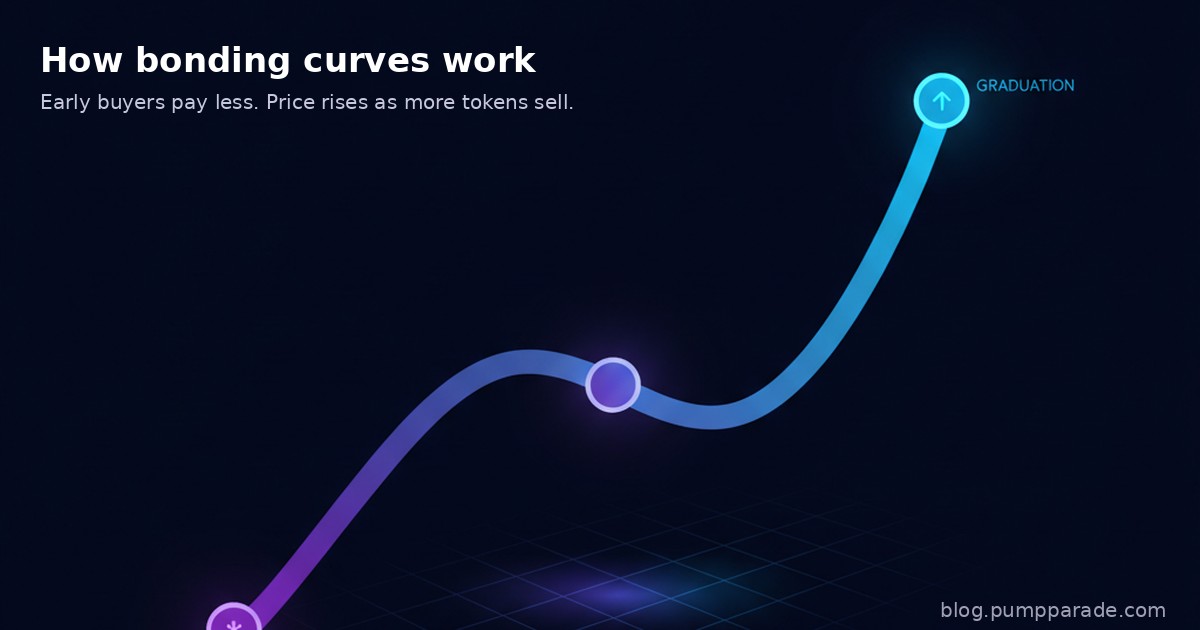
Both use a dynamic bonding curve for the pre-graduation phase. Early buyers get lower prices, and the price rises as more tokens are bought. On pump.fun, a token graduates when its curve fills at roughly $69k market cap (about 86 SOL of purchases). On Believe, the graduation threshold is higher at roughly $100k market cap, and the migration destination is Meteora rather than an in-house DEX.
Under 2% of tokens ever created on pump.fun have graduated across its lifetime, and in mid-2026 the graduation rate collapsed to roughly 0.26% (per DEXTools reporting). Believe’s graduation rate is proportionally higher, but on a much smaller absolute base of tokens.
Post-graduation destination
This is where the strategic split shows up most clearly. pump.fun keeps graduated tokens in-house on PumpSwap, which launched with 0.25% swap fees (0.20% to LPs, 0.05% to protocol) and later added creator revenue sharing. Believe pushes graduates to Meteora’s dynamic AMM pools, which have deeper liquidity for larger trades and rebate mechanics that favor active LPs.
If you like a walled-garden lifecycle, pump.fun is cleaner. If you prefer graduated tokens landing in the broader Solana DeFi stack, Believe fits better.
Creator economics
pump.fun runs a Dynamic Fee Model introduced in January 2026 that lets creators earn a slice of trading fees, and the exact percentage moves with token performance. The system is optimized for a small number of very high-volume winners.
Believe splits trading fees 50/50 with the token creator. Every trade on your token pays you daily, as long as you have linked your X account. That is the most creator-favorable split in the launchpad category, and it explains why Believe attracts founders and creators who see the token as a product rather than a lottery ticket.
Social distribution
pump.fun tokens travel through the Solana degen ecosystem: Telegram channels, sniper bots, chart-watch communities. Believe tokens travel through X itself, since every launch is by definition a tweet. That means Believe tokens can go viral inside the same feed where they were created. It is a genuinely different growth loop.
Fees & Pricing
Both platforms take a cut on every trade, and both have layered fees beyond the headline number. Here is the practical breakdown.
- pump.fun bonding curve swap fee: ~1% per trade (with a portion routable to creators under the Dynamic Fee Model).
- PumpSwap post-graduation fee: 0.25% (0.20% LP, 0.05% protocol), plus optional creator revenue share.
- pump.fun token creation cost: ~0.02 SOL upfront.
- Believe bonding curve swap fee: ~1% per trade, with 50% flowing to the token creator daily.
- Believe token creation cost: Effectively free from the user’s perspective (no wallet interaction required to launch).
- Meteora post-graduation fees: Variable, set by dynamic fee LP pools that adjust to volatility.
Priority fees, Jito tips, and Solana network fees apply on both platforms during high-congestion periods, so the effective all-in cost of a trade can be materially higher than the 1% swap fee alone.
Side-by-Side Comparison
Pros & Cons
pump.fun
Pros:
- Largest launchpad on Solana by cumulative volume and cumulative fees.
- Vertically integrated with PumpSwap, so graduated tokens keep the fee cycle in-house.
- Massive audience of degens, snipers, and copy traders means real liquidity from day one on the curve.
- PUMP token gives the platform a formal on-chain expression that market participants can trade around.
- Dynamic Fee Model rewards creators of tokens that actually attract volume.
Cons:
- Requires a Solana wallet with SOL to launch or trade, which is friction for non-crypto creators.
- Graduation rate collapsed to ~0.26% in mid-2026, so most tokens never make it off the curve.
- Revenue and fees are down sharply from the 2025 peak, reflecting broader memecoin fatigue.
- The signal-to-noise ratio for new listings is brutally low.
Believe
Pros:
- Zero-wallet, tweet-to-launch UX. Truly novel and truly frictionless for non-crypto users.
- 50/50 creator revenue share is the most creator-aligned economics in the category.
- Graduated tokens land in Meteora, which gives them deeper post-graduation liquidity than a walled-garden DEX.
- Attracts a different, higher-signal user base: indie founders, internet-brand builders, X-native creators.
- v2 beta’s Human Sentiment Market adds a real product surface beyond raw memecoin trading.
Cons:
- Volume and audience are a fraction of pump.fun’s, so early liquidity on Believe curves is thinner.
- Depending on X for the launch surface concentrates platform risk (rate limits, policy changes, bot suspensions).
- Fewer tooling and analytics integrations compared to the pump.fun ecosystem.
- The bonding curve threshold to graduate ($100k mcap) is higher than pump.fun’s ($69k mcap), so it takes more buying to migrate.
Security & Trust
Both platforms are non-custodial for traders: trades happen on Solana against the bonding curve smart contract or the post-graduation AMM. Neither holds user funds. Both use Solana’s standard finality and confirmation guarantees.
Token security is a different story. Because both platforms allow anyone to launch a token in seconds, the ratio of rug-adjacent or joke tokens to serious projects is very high. On pump.fun, mint authority, freeze authority, and LP burn status are visible in third-party tools like Birdeye and DexScreener, and experienced traders check these before every buy. On Believe, the launch flow strips out some technical customization, which reduces certain rug vectors but also makes tokens more homogeneous.
The infrastructure risk is different too. pump.fun runs its own website, in-house DEX, and token architecture. Believe leans on Meteora for post-graduation liquidity and on X for launch surface. If X changes API rules or suspends the launch bot, Believe’s launch pipeline is materially exposed. If PumpSwap fails, pump.fun’s graduated tokens have a fallback route to Raydium and other Solana DEXs, but the default flow is disrupted.
User Experience
pump.fun’s website is dense and information-heavy. Live tokens scroll past in real time, charts update instantly, and every listing shows curve progress, holders, and top traders. If you already speak degen, it feels like home. If you do not, it feels like Bloomberg for memecoins.
Believe’s UX is deliberately minimal. The primary interface is X itself: you see a token launch as a tweet in your feed, and clicking through takes you to the Believe page with a chart and a buy button. That is a very different mental model. It rewards social discovery over screen-watching.
Mobile is where Believe’s design choice pays off. Because launches happen in tweets, and buying is a light in-app or web action, the entire loop works comfortably on a phone. pump.fun is usable on mobile but really wants a desktop with multiple tabs open.
Verdict
Rating:
- pump.fun: 4.0 / 5 for memecoin launchpad category leadership, docked for declining metrics and low signal.
- Believe: 4.2 / 5 for genuine product innovation, creator alignment, and a differentiated growth loop, docked for smaller audience and X-dependency risk.
If you are a trader looking for the most volume and the deepest sniper meta, use pump.fun. If you are a builder, founder, or creator who wants to launch a token as an actual product with real economics, use Believe. The best answer for most people is not to pick one, it is to know when to use each.
For a broader look at how the launchpad category is evolving, check our Moonshot review and our PUMP token price analysis.
FAQ
Is Believe safer than pump.fun?
Neither platform is inherently safer. Both are non-custodial and both let anyone launch any token. Believe reduces some rug-adjacent options by simplifying the launch flow. pump.fun exposes more of the underlying token setup, which is fine for informed traders and dangerous for beginners.
Do I need a wallet to use Believe?
Not to launch a token. You can create a token by replying to @launchcoin on X. To trade a token, you do need a Solana wallet with SOL.
What happens when a token graduates?
On pump.fun, graduated tokens migrate to PumpSwap, the in-house DEX. On Believe, graduated tokens migrate to Meteora, which offers dynamic AMM pools with deeper liquidity for larger trades.
Which platform pays creators more?
Believe pays creators more directly. It splits trading fees 50/50 with the token creator, distributed daily. pump.fun’s Dynamic Fee Model shares fees with creators but the exact percentage varies based on token narrative and volume.
Can I use Believe outside of X?
The primary launch flow is via X replies. Trading and viewing tokens happens on the Believe web app. If you want to launch without X, you cannot use Believe today.
This article is for informational purposes only and is not financial advice. Memecoin trading is high-risk and most tokens on both platforms will go to zero. Do your own research before buying or launching any token.